Home » Consumer News » Recent Articles:

Frontier Announces Stunning $30 Monthly Rate Hike for Basic Fiber TV Service in Oregon, Washington

Phillip Dampier January 5, 2011 Competition, Consumer News, Frontier, Verizon 5 Comments

"Too rich for my blood."

Former Verizon FiOS customers now served by Frontier Communications in Oregon and Washington are receiving word of astonishing rate increases of as much as 46 percent from the phone company.  The massive rate increase is being blamed on “increasing programming costs” charged by the cable networks carried on a cable system that competes with Comcast, which charges far less for the same channels.

Frontier’s rate hikes are so dramatic — $30 a month for the popular standard 200-channel package, some customers are wondering whether the company is trying to sabotage their own fiber-to-the-home service.

“They sent us a rate increase letter stating our former standard package, priced at $65 a month, is now going up to a ridiculous $95 a month for basic cable,” says Tom, a regular Stop the Cap! reader. “That’s a rate increase only my health insurance company could love.”

New customers face the new rates immediately, but existing customers have until Feb. 18 before the new high price kicks in.  Many are preparing to move back to Comcast, which raised rates this year as well — but is now a relative bargain at $63 a month for a similar package.

“As much as I love FiOS, Frontier has managed to screw it up as badly as the rest of their services and now I am going back to Comcast,” Tom says. “You have to wonder if they are purposely incompetent or if it’s part of a larger plan to sabotage the Verizon FiOS network they inherited.  Either way, they’ve priced their service out of the market.”

When Tom called Frontier to complain, the company offered to rip out the advanced fiber network Verizon installed and stick a DirecTV satellite dish on his roof instead.

“Frontier is a real ‘Back to the Future’ kind of company — they just don’t get it,” Tom said.  “The operator actually told me she couldn’t understand why I would want to cancel service.”

Customers receiving new customer promotional discounts will get a real case of sticker shock when Verizon’s original promotional rates reset to Frontier’s new regular price.

“Washington County better beef up their hospitals because there are going to be a lot of heart attacks when that bill arrives,” Tom says.

The Oregonian newspaper reports customers are not the only ones to be shocked by Frontier’s enormous rate increase.  Regulators promised more competition and cheaper prices as part of Frontier’s purchase of Verizon landlines feel had as well.

“[Frontier’s rate hike] is essentially a white flag surrender and an exit from the head-to-head video competition,” lamented David Olson, director of the Mt. Hood Cable Regulatory Commission.

That’s a far cry from what Frontier Communications CEO Maggie Wilderotter told the newspaper in September when asked if the company would raise FiOS rates.

“That is not our plan. If I look across the board at our basic service pricing, I don’t think we’ve raised prices anywhere in the last four or five years,” she said.

The Oregonian quotes a Frontier representative who says the company’s relatively small customer base disqualifies them from volume discounts Verizon used to receive.

“Part of the challenge we have, compared to other providers, is that our footprint is so small,” said Frontier spokeswoman Stephanie Beasly. “They’re able to spread it out over a much larger customer footprint.”

That can’t be the whole story, said Fred Christ, policy and regulatory affairs manager for the Metropolitan Area Communications Commission, which regulates cable TV in Washington County.

“There’s more to it than programming costs. Anybody in the industry can pretty much figure that out. What more there is, we don’t know yet,” he said. “Unless programmers are trying to run Frontier out of business, why would they jack their rates that much?”

Smaller companies like Frontier generally do not try and buy programming on their own, but join group-purchasing plans like those offered by the National Cable Television Cooperative.  Municipal providers routinely purchase programming at substantial discounts.  It is not known if Frontier is a member, but they could be.

Frontier’s New Rates for FiOS in Washington/Oregon (courtesy: The Oregonian)
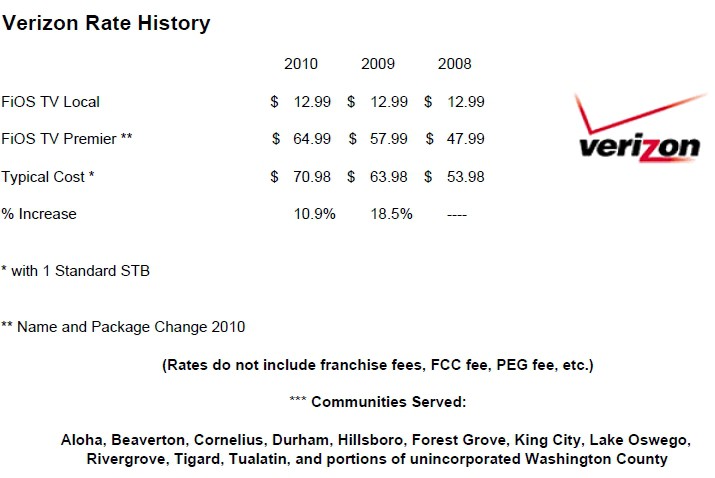
  • Basic local service package, with local broadcast stations: Rises from $12.99 to $24.99
  • FiOS TV Prime HD (220 channels, including the most popular sports and entertainment networks): Rises from $64.99 to $94.99
  • FiOS TV Extreme HD: Rises from $74.99 to $104.99
  • FiOS TV Ultimate HD: Rises from $89.99 to $119.99.

No rate increases are planned for broadband or telephone service.

Verizon FiOS pricing increased at less than half the rate Frontier will demand from subscribers in 2011. (Source: Metropolitan Area Communications Commission, Tualatin Valley, Ore.)

911 Director: Time Warner Cable’s Digital Phone Service “Puts Public Safety In Jeopardy”

Phillip Dampier January 5, 2011 Consumer News, Video 3 Comments

Seconds count. If your house was on fire, would you wait a minute or more for Time Warner to handle your 911 call?

Time Warner Cable’s digital phone service may be risking lives of the customers who use it to call 911 for emergency services.

That statement from Madison County, N.Y. 911 Director Paul Hartnett comes after the cable company bungled the handling of an emergency call reporting a house fire in the town of Clayton, Jefferson County, causing delays for emergency responders.

Even worse, the problems could be wider in scope, potentially putting many Time Warner Cable phone customers at risk of a delayed 911 response when seconds count.

At issue is an ongoing upgrade of the cable company’s E-911 database, begun after Time Warner dropped Sprint as their 911 vendor in favor of Intrado.  As the slow upgrade continues, customers dialing 911 could end up having their calls routed to a national 911 call center Intrado runs in Colorado.  The process often takes several minutes from the time the caller dials 911, someone in Colorado answers, and the call is eventually transferred back to the originating county, at which point the caller has to repeat information to a local 911 operator they could not reach directly.

Jefferson County’s 911 Director John Pumber told WSYR-TV news they first noticed the problems about a week ago. “I can see this thing escalating extremely fast, in talking to other cohorts around the state, some of the other centers, it’s becoming more and more of a problem,” he said.

Monday, a 911 call reporting a house fire in the Jefferson County town of Clayton was re-routed to the call center in Colorado. The call was eventually forwarded back to Jefferson County’s 911 center, 44 seconds later. By the time the nature of the emergency was given to the local operator, the house was fully involved in fire.

“If your house is on fire, and especially this individual was calling from his house, so we are leaving him in harms way to get the information and get him help [for] whatever the amount of time it took to get through the call center in Colorado and then through our procedures here,” said Plumber.

“Whether it’s medical, fire, law enforcement related – seconds do make a difference,” said Hartnett. “They’re putting public safety in jeopardy because they’re delaying calls. We’ve had medical calls, and other calls. We’ve dodged a bullet so far.”

This call, recorded by Madison County 911 last week, illustrates the problem:

911: Police communication?

Intrado: I’m calling from Intrado, a call center for Time Warner Cable, I have a subscriber on the line that dialed 911. They’re trying to get through to you, they have a medical emergency.

911: Okay, what’s the address madam?

Intrado: They need an ambulance at 4289 Canal Street.

911: Could I speak with them, or?

Intrado: You sure can, it’s going to be a female with difficulty breathing. Do you want their call back or mine?

911: If I’m going to talk to her, I’ll get it from her.

Intrado: You’re going to talk to her husband, his name is John. John your dispatcher is on the line.

911: Hi Sir, how are you?

Caller: Not good, you need to get a f***ing ambulance here right now!

Time Warner Cable Regional Communications Manager Stephanie Salanger released a statement last week addressing the issue:

“TWC has deployed a state-of-the-art E-911 system that offers several key advantages over more traditional systems, including real-time address validation. Our solution complies fully with FCC rules and industry standards, and it also is based on the same technology the federal government is considering mandating for “Next Generation 911″ services, so we will be well-positioned to comply with any new rules as soon as new standards are implemented.

In the very rare cases where errors in routing 911 calls or when errors in the 911 address database occur-which happens from time to time under any 911 system-calls are routed to the Emergency Call Relay Center managed by TWC’s E911 partner in Colorado, rather than to the default or incorrect 911 answering location. This call center allows TWC to determine the customer’s location and route the call to the appropriate emergency answering center. This has happened only in a extremely small number of cases since TWC began transitioning to its new 911 system. TWC has been continually working with local 911 authorities to ensure they understand the details of TWC’s 911 system and will continue to do so.

TWC has always been and remains committed to providing the highest quality E-911 services for its customers. We will continue to work with local E-911 officials and agencies to ensure they are aware of, understand and are satisfied with TWC’s E-911 system and all of its functionalities.”

[flv width=”480″ height=”380″]http://www.phillipdampier.com/video/WSYR Syracuse TWC phone glitch delays emergency responses 1-4-11.flv[/flv]

WSYR-TV in Syracuse ran two reports over two nights documenting more than 40 recent incidents where Time Warner Cable dropped the ball in properly managing 911 calls from their customers.  Warning: Loud Audio! (8 minutes)

Comcast Makes Customers Wait 90+ Days for Refunds of Final Bills

Phillip Dampier January 5, 2011 Comcast/Xfinity, Consumer News Comments Off on Comcast Makes Customers Wait 90+ Days for Refunds of Final Bills

If you were late paying your Comcast bill by three months, the nation’s largest cable operator would shut your service off.  But if you decide to cancel service yourself, the company makes you wait up to 90 days for a refund of your credit balance.

ZDNet’s Dan Kusnetzky learned this first hand when he decided to give Verizon FiOS a try.

“I tried to pay the final Comcast bill at the time that I returned the company’s cable modem and set top box, but was told that I’d have to wait for the final bill to be calculated,” Kusnetzky wrote. “I was told, however, that I’d receive a credit for the unused service rather than having to pay Comcast anything.”

Despite that assertion, Comcast billed him for another month of service anyway, and he never heard about the promised credit when he called the cable company to inquire about the extra unexpected bill.

“When I called Comcast and was finally able to hack my way through the jungle of their voice response system (it took three calls before I was finally able to speak with a human being named “Jaun”), I was told that the credit would be refunded in the form of a check in late March,” according to the columnist. “That means Comcast plans to hold onto the money owed me for three months!”

Comcast’s voice response system leaves a lot to be desired according to Kusnetzky, and he openly wonders why Comcast thinks it’s fine and dandy to demand immediate payment (often in advance) for ongoing service while leaving customers waiting three months or more for their refund to finally show up.  That’s time Comcast gets to play with customers’ money, and the ZDNet author believes that is unacceptable.

Verizon Wireless Eliminating “New Every Two” Program; Other Upgrade Discounts Being Phased Out

Phillip Dampier January 5, 2011 Consumer News, Verizon, Wireless Broadband 6 Comments

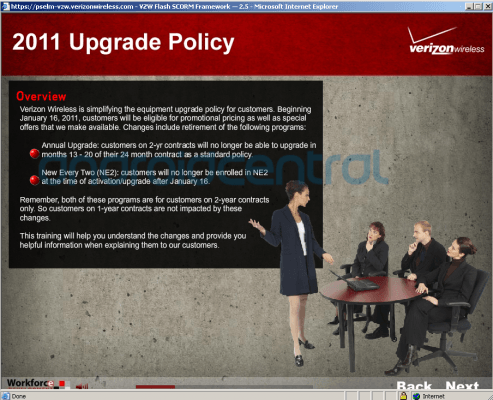
Verizon's new upgrade policy, courtesy of Android Central.

Verizon Wireless is making changes to their handset upgrade programs, all to the benefit of their bottom line and not to yours.

In training materials obtained by Android Central, Verizon is discontinuing its “New Every Two” handset discount program for customers who sign new contracts after Jan. 16 and will stop allowing customers to obtain early upgrade discounts on new phones before their contract nears expiration.

The “New Every Two” promotion has been a familiar part of Verizon Wireless service for years.  Customers finishing their two year contracts receive a $50 discount on their next new phone with the carrier, as long as they sign a new two year contract.

Early upgrades, which used to qualify customers for discounts during months 13-20 of their 24 month contract, are coming to an end as well.

There is some speculation the early upgrade plan is being curtailed to try and stop a rush on the rumored Verizon iPhone due early this year.

Since many customers upgrade to more expensive smartphones, the “New Every Two” program only delivers a discount, not the new free phone it provided in an earlier era.

Still, the loss of discounts will effectively give the biggest benefits to Verizon Wireless’ bottom line, allowing the company to reduce subsidies it pays on behalf of customers demanding the latest and greatest new phones.

Exclusive: Frontier’s California Confuse-o-rama: Residents Victimized by Frontier’s Changing Stories

Elk Grove, Calif. residents receiving letters from Frontier Communications claiming they are using the company’s Internet service too much are getting confusing responses from the phone company when calling to register complaints about the Internet Overcharging scheme.  Even worse, one company official told a subscriber they have to keep the new usage limits secret “for legal reasons in case we have to change it again.”  But no worries, Frontier explained to one customer: if you exceed the secret cap again, you’ll be notified future overages will be conveniently billed on a future Frontier bill.

Stop the Cap! has been receiving dozens of e-mailed complaints from customers upset that the company’s bait-and-switch broadband also comes with uninformed customer service representatives who can’t deliver straightforward answers to customers trying to understand how they can avoid up to $250 a month for 3Mbps DSL broadband service.

“When I signed up for Frontier DSL, nobody said a thing about usage limits,” writes our reader Trina who lives near Camden Park.  “My small business has DSL from Frontier as well and we were horrified when we received a letter telling us we were over-using their service.”

Trina and her husband have four teenage boys living at home, all sharing their Frontier DSL account.  When she called the company in response to the letter she received, the confusion began.
“The first representative didn’t understand what I was talking about and denied there were any limits and said the letter must have been a mistake,” Trina says. “But my husband noticed others in our area were talking about the letter on area message boards so when he called, he got a representative that confirmed the limits were real.”

Trina was told her home would need to upgrade to Frontier’s $249 monthly DSL service plan, the same one Frontier held over the heads of some customers in Mound, Minn. last year.

“I told them they must be smoking crack — are they serious?  There is no way I am going to pay $250 a month for DSL that gives us 1.5Mbps service — not in this world,” Trina says.  “My husband laughed when I told him, saying Frontier is going to drive themselves out of business from this stupidity.”

Elk Grove reader Stephen also called Frontier after he received a letter stating he used over 100GB in a month.

“Yeah, I used 104GB according to my router’s logs and Frontier deemed me a bandwidth abuser,” Stephen writes.  “Of course the company tried to sell me a plan priced at $100 a month for their lousy DSL service we got suckered into on one of their term contracts.”

Stephen said he’d manage to find a way to shave 5GB off his monthly usage and forego Frontier’s $99 offer until he signs up with a competitor and tells Frontier to take a hike.

“It’s one thing to be abused by a lackluster phone company like Frontier who never did a thing for Elk Grove — it’s another to pay them more for their abuse,” he writes.

Stop the Cap! reader Pete, also in Elk Grove, says he can’t get a straight answer over exactly what the monthly limit is.
“When I called, I was told 5GB by one representative, 100GB by another, but get this — when I logged into the ‘Flexnet’ Usage Meter the company tells you to review, it showed I had a 20GB limit,” Pete says.  “I called Frontier on the phone and told them I was so through with them — I can’t stand their nonsense.”

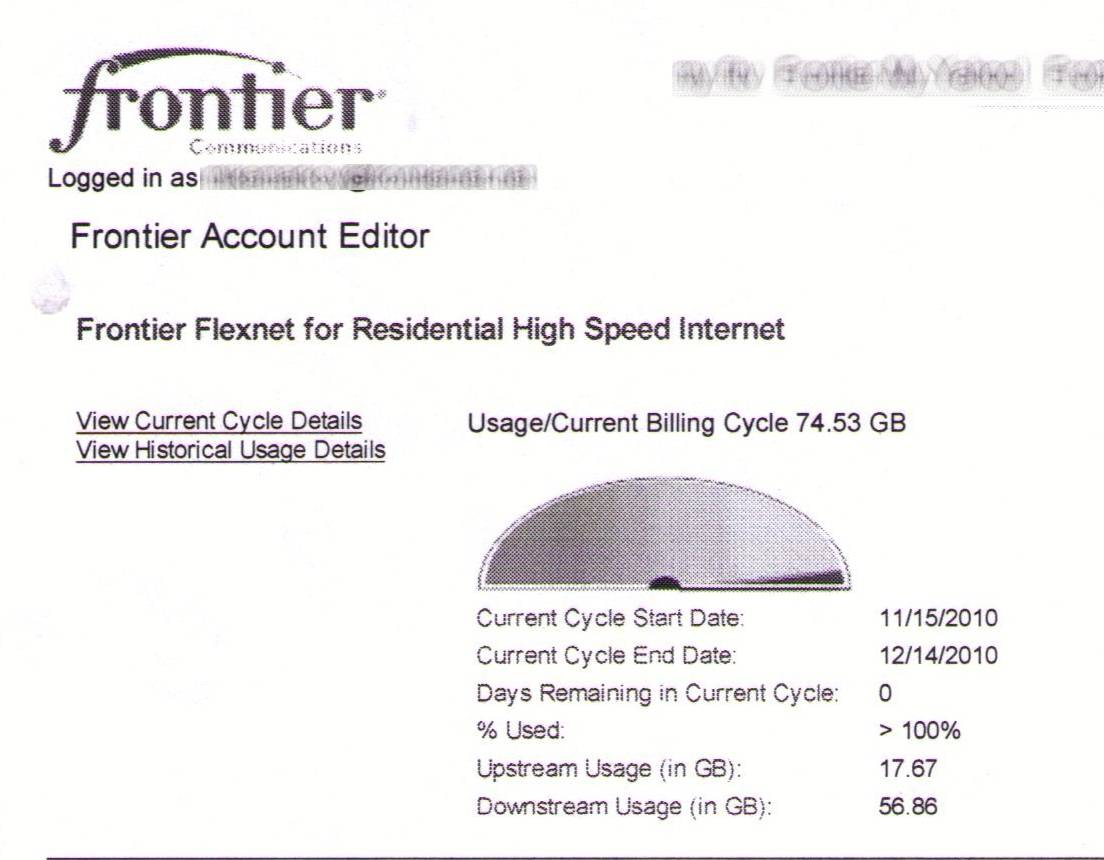
Pete wasn’t alone.  Our regular reader Mike figures his cap was actually 20GB a month if the company’s usage meter was to be believed, and he sent pictures.

“I got their nastygram last month over my usage and now my Flexnet meter shows me over the limit,” Pete says.  “I have been vocal on a local Elk Grove message board so I’m feeling like this is retaliation.”

In fact, Mike’s usage meter depicts him as well over the arbitrary 100GB limit Frontier suggests in their letter, despite not coming close to 100GB of usage.  Ditto for our reader Michelle who lives in Palo Cedro, a community Frontier can largely hold captive thanks to limited competition.

Benjamin, also in Palo Cedro, says Frontier’s move will hurt small businesses in the northern California Shasta County community of 1,200.

“I need high speed Internet to help start my business, which will largely involve uploading and downloading multimedia, (which is hard enough to do on a 1.5 connection) but to increase the cost is absolute insanity,” he says.
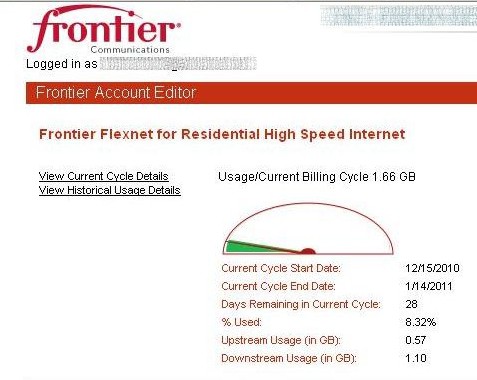
Our reader Mike discovered Frontier's usage meter suggests he has far less than a 100GB monthly usage allowance.

Benjamin’s alternatives barely qualify.

“I can either try Clearwire, which works terribly locally and is known for its speed throttles when congested, or HughesNet satellite-delivered Internet, which is overpriced,” Ben adds.

As our readers already know, satellite fraudband is no replacement for real broadband service, because it comes with a “fair access” policy that isn’t fair and doesn’t deliver much access.

“I will fight this any way I have to,” Benjamin says.

John in Elk Grove writes in to say the entire affair is a Frontier shell game.

“It’s pure bait and switch to sell us broadband without limits and then suddenly impose them while we are supposed to be on ‘price protection agreements’ that the company says will keep our prices stable,” John says. “Now we learn it’s all a shell game — they can say we used too much and that doesn’t count with their price protection scam.”

John adds Frontier can change the limits at will, and customers who choose to depart could still face enormous cancellation penalties.

“The Frontier representative I talked to when I called to cancel service told me I owed $300 for ending my contract early,” he said. “I told them to go to hell and that if they tried to collect, I’d personally make it my life’s work to cost them far more than that in lost business.”

Customer anger only increases after speaking with Frontier’s own representatives.
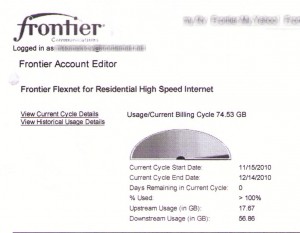
Uh oh. Frontier suggests Mike has already blown through his monthly usage allowance, despite his carefully reduced use of the service.

“Mr. Brown” shares his experience:

I am an Elk Grove resident and a Frontier DSL internet customer. I received the same letter from Frontier about exceeding the 100gb of bandwidth within a 30 day period. It said that I must reduce the amount of use or bump my account up to the next tier of service, a $99/mo business account.

I called the number on the letter to talk to a customer service representative so that they would not disconnect me for not responding within 20 days. I asked him if there is a maximum bandwidth cap. He told me that there is no cap, but that their terms of service says that they can disconnect you if you are exceeding reasonable usage and that Frontier will determine what is reasonable usage. The representative could not help me any further so he connected me with his supervisor.

The supervisor said that Frontier sent this letter out to about 1,000 customers in Elk Grove and that most of the customers who have called after receiving the letter have not questioned them and said they they will reduce their usage.

He also said that there is no longer any $99/mo plan, the only option is to reduce usage. He said they sent the letters out to the costumers who are using more than a reasonable about of bandwidth telling them to use less Internet. Then if they did not, Frontier will send another letter saying that if they use more than a reasonable amount that they will charge the customer for anything over.

He went on to say that Frontier had to remove the statement about the previous 5GB bandwidth cap in their terms and conditions and that for legal reasons they are not going to tell us what the new limit is, in case they have to change it again in the future.

I tried to get him to admit that there is a cap and to tell me what that limit was, but he would not.  He would only say that I would be okay if I did not go over 100gb/mo and that if I do, to expect to receive another letter with the new terms that would allow them to charge my account for excess bandwidth.

The one thing is common with readers we’ve heard from is their urgent search for a new provider.

Trina canceled all of her Frontier services at home and at her business and switched to SureWest, a fiber to the home provider.  Joining her includes Mike, Stephen, Pete and John.  Together, their combined disconnects will cost Frontier more than $500 a month in lost revenue, all because of broadband traffic that costs Frontier far less than 5 percent of that amount.  If each customer shares their horror story with friends, family, and neighbors, the loss in revenue could cost far more.

For customers like Mike, he can’t wait to get his SureWest service installed.  The company offers to buy out current contracts with companies like Frontier valued at up to $200, and their fiber-delivered broadband service leaves Frontier’s speeds in the dust.  Mike says if Frontier gives departing customers a hard time about early cancellation fees, file a complaint with the California Public Utilities Commission Consumer Affairs Branch.

SureWest offers 3/3Mbps service for $36.99 per month, 25/25Mbps service for $51.99 a month, and 50/50Mbps service for $181.99 a month.  A $3.99 High Speed Internet features and services charge applies.  There are no limits on SureWest’s Internet service.

SureWest delivers several fiber to the home broadband service plans that best Frontier's DSL speeds by a mile.

Frontier offers 3Mbps service with a slower upload speed for $32.99 per month or 10Mbps service for $44.99, both with a required price protection plan and $6.99 monthly modem rental fee.

“Why in the world would you pay Frontier more for less service,” asks Pete.  “Once they pile on the administrative fees, surcharges and taxes, it’s well north of $40 a month, and you don’t even get the speed they advertise, much less the usage limits they don’t.”


Search This Site:

Contributions:

Recent Comments:

Your Account:

Stop the Cap!