Home » Consumer News » Recent Articles:

Sprint Drops Data Service Add-On for Tulsa Customer, Then Charges Him Early Termination Fee

Phillip Dampier January 25, 2011 Consumer News, Sprint, Video, Wireless Broadband Comments Off on Sprint Drops Data Service Add-On for Tulsa Customer, Then Charges Him Early Termination Fee

A Sprint customer in Tulsa, Okla., was recently sold a Blackberry plan that included a data add-on service that allowed him to tether his Sprint wireless connection to his laptop, perfect for wireless broadband on the go.

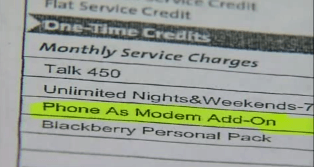
John signed a two-year contract with the company, which included a copy of his plan choice and the charges associated with his account. There it was, right on his bill — Sprint’s “Phone as Modem” add-on, priced at $15 per month.

A few weeks later, the service stopped working, and after multiple phone calls with Sprint, John was told he should have never been sold that data plan add-on; it was only available to corporate customers, not individuals.

John pointed to his contract with Sprint, which clearly showed he was paying to receive the service, but Sprint didn’t care.  Nor would it permit him to exchange his phone for wireless broadband equipment that would provide him with the broadband service he needed.  Why?  Because he was already into his two year contract.

John was left fuming, wondering why Sprint’s contracts allow them to renege on a deal made fair and square while trapping him with equipment he can no longer use to obtain the service he needs.
“To me, they voided the contract when they took away the service without my knowledge,” John told KJRH-TV’s Problem Solver Pete Knutson. “This is principle, this is sole principle.”

John canceled his contract, but Sprint promptly billed him a $125 early termination fee and sent his account to collections, threatening his credit rating.

John was not alone in his predicament.

Sprint quietly canceled its individual “phone as modem” tethering option for Blackberry owners last April, literally stripping the feature off of any plan set up with a personal Social Security number.  Business accounts configured with a Taxpayer ID Number associated with the business name on the account kept the option.

Sprint was supposed to notify affected customers through bill inserts, but since most Sprint customers are now billed electronically, few customers got the message.

Several customers reported they were “notified” when the service simply stopped working one day last spring.  One Shenandoah Valley customer found out the hard way.

“My wife used her 8330 for internet access, and we purchased the MBR900 to tether the phone so she could have it in the best place for reception,” the customer notes.  “Sprint decided to disable the use of the phone as a modem, I thought the router went kaput until she called Sprint.”

It took five rounds of calls with Sprint customer service before finding a support representative with the real answer.

An even bigger question is why a Sprint salesperson pitched John a plan with an option that has not been sold to individuals for nine months.

As has so often been the case, phone companies seeking to avoid bad publicity nearly always waive fees and credit a customer’s account when the media comes calling.  John’s account balance was brought back from collections and promptly credited to reflect a zero balance.

Sprint refused to provide a specific explanation for how this happened. Channel 2’s Knutson advises customers to always check their cell phone contracts to make sure they are actually getting the services they are paying to receive.

[flv width=”480″ height=”380″]http://www.phillipdampier.com/video/KJRH Tulsa Cell company drops service still charges cancellation fee 1-13-11.flv[/flv]

KJRH-TV in Tulsa shares the story of John, a former Sprint customer who didn’t get the service his contract promised.  (2 minutes)

The State Time Warner Cable Forgot: South Carolina’s Yesterday Broadband

Phillip Dampier January 24, 2011 Broadband Speed, Consumer News 6 Comments

While Time Warner Cable trumpets upgraded broadband services in many of the states it provides service, South Carolina and some other southeastern areas are the exception.

Stop the Cap! reader Brett writes Time Warner’s broadband experience in South Carolina is so four years ago.

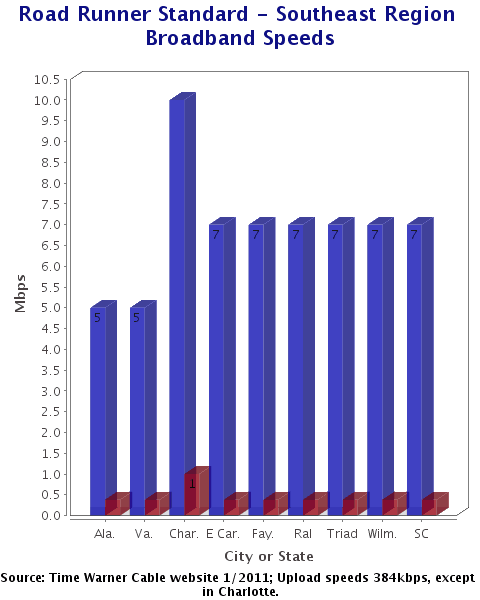
“Check out the paltry speeds that Time Warner Cable offers in Columbia. As far as I can tell we are the slowest region around.  The very best package they offer, with PowerBoost, is 10Mbps for downloads, 512kbps for uploads,” Brett writes.  “How sad.”

Most Columbia customers get less than that.  The standard Road Runner package has been stuck at 7Mbps down and 384kbps for some time.

While broadband speeds have not changed, the rates have.  Time Warner Cable announced rate increases throughout the Carolinas in December, boosting prices for many services.

Time Warner Cable spokeswoman Rose Dangerfield said needed upgrades were part of the reason for the rate increase.

“The company spent $380 million in the past year to upgrade equipment in South Carolina and North Carolina,” she said.

A review of Time Warner Cable’s speeds in the Carolinas and the states of Virginia and Alabama makes one wonder where the money went, because Brett shares company with other customers across most of the region.

Shaw Sneakiness: Company Lowers Usage Limits, Hopes Nobody Noticed

Shaw sets the bar lower.

Shaw Cable, western Canada’s largest cable company, has quietly lowered usage caps on virtually all of their broadband plans, while “forgetting” to change the date on their Terms of Service:

  • Lite was 13GB, now increased to 15GB ($2/GB overages)
  • High Speed was 75GB, now decreased to 60GB ($2/GB overages)
  • Xtreme was 125GB, now decreased to 100GB ($1/GB overages)
  • Warp was 250GB, now decreased to 175GB ($1/GB overages)
  • Nitro was 500GB, now decreased to 350GB ($1/GB overages)

Shaw’s terms of service page documents changes implemented by the cable company and includes the revision date, changed whenever the terms change.  Not this time.  Blogger “Thewunderbar” documented Shaw left the revision date on the document unchanged, suggesting the cable company hadn’t made any adjustments to their service since July, 2010.  After publishing his piece, Shaw quietly updated their website to reflect the correct date.

Cable and phone companies in Canada have established a unique, unchecked duopoly.  They are systematically increasing prices while decreasing the amount of service provided to Canadian consumers.  Shaw’s decrease in usage limits comes with no corresponding price cut for Internet service.

At a time when Netflix streaming is attempting to make inroads into Canadian homes, broadband providers who also have interests in pay television (cable, phone or satellite) are working overtime to make sure no consumer believes they can safely cancel their cable-TV service and watch everything online.

Over the past four years, Canadian ISPs have embarked on a wide range of Internet Overcharging schemes:

  • The elimination of flat rate, unlimited broadband service;
  • The introduction of low usage allowances designed to trip up an increasing number of consumers leading to,
  • The introduction of stinging overlimit fees for customers exceeding usage limits, at prices marked up from 500-5000 percent above wholesale;
  • The introduction of speed throttles which artificially slow your broadband experience to speeds sometimes just above dial-up;
  • The ongoing limbo dance of usage caps that decrease in size over time, exposing more consumers to overlimit fees, making them think twice about everything they do online.

Nobody has successfully monetized the broadband experience like Canadian ISPs have.  Even as their costs to deliver the service continue to rocket downwards, companies keep on increasing prices, exposing Canadian consumers to unwarranted bill shock from unjustified overlimit fees.  What does it cost Shaw per gigabyte?  An estimated 1-3 cents.  What do they charge you?  Up to $2.

It’s nothing short of a rip-off, and Stop the Cap! urges Canadian consumers to contact their member of Parliament and demand immediate action to ban these innovation-killing, job-retarding, unjustified overcharging schemes.

Knology Retains Internet Overcharging Ripoff for Lawrence, Kansas Customers

"If you have to ask how much, you can't afford it."

Knology, which bought out Sunflower Broadband last year, has elected to carry forward the old owner’s Internet Overcharging schemes, charging broadband customers penalty rates for exceeding their usage allowances.

The company’s explanation for their overpriced bandwidth comes with a tall tale about their competitors they simply made up out of thin air:

Data transfer allotments allow Knology to offer higher speed service with lower prices. Unlimited, open usage plans offered by other providers typically employ network controls to slow down the high usage customers.

That’s news to us, and to their nearest competitor AT&T.  They deny speed throttling any of their U-verse or DSL customers.

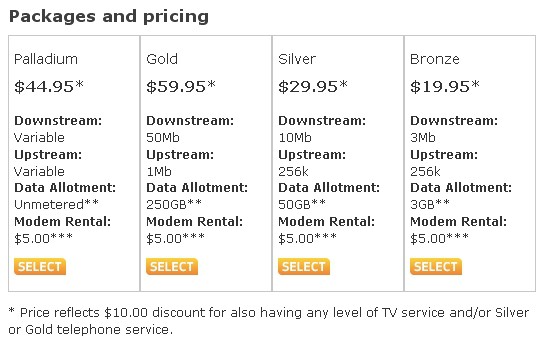
While the company’s download speeds are impressive — up to 50Mbps — their upload speeds are not, topping out at a paltry 1Mbps.

Knology's pricing is nearly identical to its predecessor Sunflower Broadband, except for the $5 rate hike for its most popular Silver plan.

Knology claims they expand usage allowances based not on network capacity, but by the percentage of customers they gouge with overlimit fees:

Data transfer allotments: Each level of internet above includes the amount of data transfer indicated measured in Gigabytes (GB). The data transfer allotments are increased regularly, based on usage patterns, to ensure the number of customers who go over their allotments remains under 10%. Additional GB of data transferred beyond the allotment is billed at $1.00 per GB if not purchased at a discount before the end of the billing period. The percentage of Knology customers charged for extra data transfer beyond their allotment was 6.1% in April 2009.

Paul Bunyon, Knology's new director of marketing

Bemusingly, customers with time machines who can travel into the future and determine they will exceed their allowance for the month can pre-purchase an increase in their usage allowance at a discount.

No time machine?  Then you either pay the standard overlimit rate, watch your usage like a hawk, or potentially over-buy excess usage that expires at the end of the month.

Customers tell Stop the Cap! the company’s single, unlimited use package is “the same piece of garbage it always was,” writes Larry who lives in Lawrence.  He had high hopes Knology would do the right thing and abandon Sunflower’s overcharging schemes.

“Apparently not, and after a month with their unlimited service, I have scheduled my U-verse installation with AT&T,” Larry writes. “Even on Knology’s limited packages, they don’t provide the speeds they promise.”

Larry also says the higher speed tiers Knology offers deliver diminishing returns.

“If their uplink is congested, or the web sites you visit are busy, it won’t matter if you have 10Mbps or 50Mbps — the speed is effectively the same,” he says. “Besides, upload speed is more important these days and 1Mbps is just plain lousy in 2011.”

“Bye, bye SunKnology.”

Sunflower's Old Broadband Plans & Pricing (February 2010)

Lee, Mass. Resident Wins Battle With Time Warner – Gets $12,000 Install Fee Slashed to $35

Phillip Dampier January 20, 2011 Consumer News, Public Policy & Gov't, Rural Broadband 2 Comments

Last year, Stop the Cap! told you the story of Mark Williams, the Lee, Massachusetts resident that was quoted an installation fee of $12,000 from Time Warner Cable.

The town intervened, claiming the cable company was violating its franchise agreement by not providing standard cable installation for any customer who also received electric and phone service.  Time Warner agreed to reduce the fee to $4,000 — still unacceptable to Williams.  Months later, and after a threat of sanctions from the Board of Selectmen, Williams got his cable-TV, broadband, and phone service installed for $35 — the same rate other Berkshire customers pay.

Williams did have to spend around $1,500 to bury an underground cable that runs some 600 feet from the nearest utility pole to his home.  Williams wasn’t interested in overhead wiring and didn’t mind paying the additional fee to have the cable buried where he wanted it.

Lee, Massachusetts is located in broadband sparse western Massachusetts

Cable companies routinely deny cable television services to customers who live in sparsely populated areas, where the company is not expected to earn back its wiring investment within a short period of time.  In such cases, either the customer (and other interested neighbors) split the wiring costs or they go without service.  But Lee’s franchise agreement insisted the cable company wire any customers in its franchise area who also have access to other utilities, which includes nearly everyone.

Other communities trying to get their outlying residents cable service could find providers amenable if they insist on similar clauses during franchise renewal negotiations.

Williams tells The Berkshire Eagle he is grateful for the support of his town government, especially patent attorney Malcolm Chisholm of the Lee Cable Advisory Committee for taking on Time Warner on his behalf.

“He’s a real terrier and sinks his teeth into something until it’s done right,” Williams told the newspaper.

Search This Site:

Contributions:

Recent Comments:

Your Account:

Stop the Cap!