Home » Consumer News » Recent Articles:

Dollar-A-Holler Groups for AT&T/T-Mobile Merger

Phillip Dampier April 7, 2011 AT&T, Consumer News, Editorial & Site News, Public Policy & Gov't, T-Mobile, Wireless Broadband Comments Off on Dollar-A-Holler Groups for AT&T/T-Mobile Merger

It's "Return of the Astroturf Groups"

It did not take more than a few hours for the first non-profit and “minority advocacy” groups to hurry out press releases applauding the announced merger intentions of AT&T and T-Mobile.

Winning approval of the merger in Washington will take a full court press by lobbyists and organizations that claim to represent “the public interest,” even if the merger will likely raise prices for the constituents they ostensibly represent.  Too often, these groups also fail to openly disclose they have board members that work for the telecommunications industry or welcome large financial contributions made by one or both companies.  That makes it difficult for the average consumer to discern whether matters of arcane telecommunications policy are truly of interest to these organizations or whether they are simply returning a favor to the companies that write them checks.

The Communications Workers of America, the union representing many AT&T employees, has been applauding the announced merger on their website, “Speed Matters.”  It’s hard to blame the union for supporting the merger — it opens the door to union membership for T-Mobile employees.  The union does a good job representing their workers, and their interests often are shared by consumers.  For instance, the CWA has smartly opposed Verizon landline sell-0ffs to third party companies, which have tended to bring bad results for ratepayers.  But their website does trumpet some sketchy organizations not well known outside of the dollar-a-holler advocacy industry.

Take “The Hispanic Institute” (THI).  This obscure “group” chose a name for itself suspiciously similar to the much larger and more prominent National Hispanic Institute.  That’s where the similarity ends, however.

The Hispanic Institute believes the AT&T and T-Mobile merger will bring harmony and joy to the Latino community clamoring for mobile broadband:

“The proposed merger of AT&T and T-Mobile will move us closer to universal mobile broadband deployment. When we consider how essential mobile technology is to empowering communities, we conclude that this proposal is good for Hispanic America. It provides an opportunity to amplify the growth in mobile broadband adoption by both English and Spanish speaking Americans.”

AT&T regularly contributes substantially to Urban League programs.

In fact, the only thing most Latinos will find after the merger is higher prices for reduced levels of service.  T-Mobile’s aggressive pricing and innovative (and sometimes disruptive) packages are well-known in the industry, and they are a frequent choice of budget-minded consumers, including many members of the Latino community.  It does little good to expand mobile broadband service that many cannot afford.  Reduced competition always leads to higher prices, a fact of life missed by THI.

Perhaps THI’s misguided support for the merger was an aberration.  But then again, maybe not.  The group also promotes a pharmaceutical industry-funded scare site designed to convince Americans that prescription drugs imported from Canada are dangerous and unsafe.  Calgary is apparently the new Calcutta, when you have a vested interest in stopping people from saving a fortune on their medication by buying it north of the border.

Perhaps that was also just “an error in judgment.”  But little doubt remains after you read their spirited defense of the bottom-feeding payday loan industry (even though they claim they are not.)

Friends of Big Pharma, Payday Loan Gougers, and A Bigger AT&T are no friends of mine… or yours.

The Urban League is a regular recipient of AT&T cash.  In return, the group is no stranger to advocating for the phone company’s political agenda.  One of their chapters belongs to the ultimate in Astroturf groups — Broadband for America.  How many organizations cautiously optimistic about a telecom industry merger would rush out a press release about it?  They did:

“The pending merger of AT&T and T-Mobile USA holds potential opportunity for an expanded, diverse workforce … We plan to carefully observe the upcoming regulatory process and look forward to a transition that is guided by AT&T’s commitment to diversity and equal opportunity. We have every reason to be optimistic,” said Marc Morial, president and CEO.

Speed Matters somehow forgot to mention AT&T is a major member of the Alliance they quote in support of the merger.

Of course he does.

Then there is the ultimate in echo chamber advocacy courtesy of the Alliance for Digital Equality:

“The merger of T-Mobile USA and AT&T will enable rapid broadband coverage for most of the nation — including many lower-income and rural communities that have been largely underserved — through an expanded 4G LTE deployment to 95% of the U.S. population within six years. This is a huge step forward in making President Obama’s vision of reaching 98% of Americans a reality.

“What’s more, wireless broadband has shown tremendous promise in bringing our communities of color into the digital age — something that an increasing number of studies and reports have shown we have got to improve upon if we are going to bridge the digital divide that exists in this country. This merger puts the right technologies into the communities that need it, at the right time… and at the right price.” — Julius Hollis, Chief Executive Officer

Missing from these glowing words is an admission that AT&T is a major member of the Alliance.

It’s the coalition of the willing to sell out consumers.

Special Report: Unlimited Internet Access Is the Global Norm, Not the Exception

Their bull got you right in your wallet.

The next time you hear a provider telling you usage-capped broadband is the way the rest of the world does business, understand one thing:

They are lying to you.

Stop the Cap! conducted extensive research on just what kind of broadband plans are sold around the world. We researched every member country of the Organization for Economic Cooperation and Development, and included several developing and non-aligned countries for good measure.

Our findings are conclusive: Unlimited broadband packages are the global norm. Some providers sell a mix of “light use” plans with usage allowances, but almost always side-by-side affordable, unlimited use options for those who want them. The only exceptions we found:

  • Australia: The most common reason for usage caps comes from lack of capacity.  Countries in the South Pacific continue to experience international capacity shortages that are gradually easing with the introduction of new underseas fiber cables.  Several providers have promised to ease or eliminate caps as new capacity comes online.
  • Canada: For reasons of marketplace concentration, lack of competition, and regulatory malpractice, Canadian broadband has lost its former status as a world-leader in broadband and has now become an also-ran, with almost universally usage-capped and throttled broadband from large cable and phone companies delivering expensive, comparatively slow service.
  • Iceland: International capacity problems limit international broadband traffic with usage caps, but some providers offer unlimited service for domestic traffic.
  • New Zealand: Just like Australia, New Zealand suffers from international capacity problems not seen in Europe, North America, or continental Asia.  Both Australia and New Zealand are using public finances to overcome broadband shortages and reduce or eliminate usage caps.

Some providers in the United States are following Canada’s lead attempting to monetize broadband traffic to maximize profits.  Some Canadian providers claim usage-based billing is necessary to finance the construction of broadband networks across the broad expanse of rural Canada.  Yet Russia, a far larger country with fewer financial resources, succeeds in delivering unlimited service where Canada fails.  Their arguments just don’t add up, and combined with the reality we present here proves providers are telling tall tales about the need for their Internet Overcharging schemes.

If Albania can deliver unlimited Internet access, why can’t your provider?

Country Provider
Albania SAN Ltd. — Delivers “always on, always unlimited” DSL service
Austria Telekom Austria — “Unlimited high speed Internet”
Australia AAPT -- Delivers up to 1TB combined peak/off-peak usage; unlimited plans N/A
Belgium Telenet — Offers multiple plans with no set limits.  Reserves right to reduce speeds for highest use customers
Chile VTR -- Unlimited Access
Czech Rep.
O2/Czech Rep. -- Unlimited Access
Denmark Tele Danmark -- Fast, unlimited service up to 20/2Mbps
Estonia Elion -- Hyperfast 100Mbps Internet, no limits
Finland Elisa -- Fixed broadband without fixed limits
France Orange, Free, and Teleconnect all unlimited, all the time.
Germany Deutsche Telekom -- Internet at a flat rate.
Greece OTE — Conn-X, now up to 24Mbps and no limit.
Hungary Magyar Telekom/DT -- Delivers up to 80Mbps unlimited access.
Iceland All providers have usage caps on foreign traffic due to international capacity issues
India India Bharat Sanchar Nigam, Ltd. offers uncapped plans.
Ireland Irish Broadband promises "fast and unlimited access 24/7."
Italy Tiscali: 20Mbps service, “browse the Internet without limits.”
Japan KCN delivers up to 1Gbps service: rocket fast and never a limit.
Korea All major providers deliver unlimited service packages.
Luxembourg Numericable delivers 30Mbps service with "no volume limits."
Malaysia
Persiasys offers a complete selection of unlimited use plans.
Mexico Cablevision delivers up to 20Mbps service without usage caps.
Netherlands Onesnet provides up to 100Mbps service at a monthly fixed rate.
New Zealand
ISPs in NZ deliver unlimited broadband only during off-peak hours due to capacity.
Nigeria Junisat delivers several unlimited satellite broadband packages.
Norway Telenor sells ADSL and VDSL 'super broadband' packages without limits.
Philippines PLDT and Digitel markets unlimited service in the Philippines.
Poland Telekomunikacja Polska offers ADSL service across Poland with no use limitations.
Portugal Portugal Telecom sells unlimited broadband service, often over fiber networks.
Russia Koptevo, CentroSet, and MegaBistro offer all you can eat broadband buffets.
Singapore
SingTel wants your family to enjoy 15Mbps unlimited Internet access.
Slovakia Slovak Telecom/DT delivers optical Internet with unlimited access 24/7.
Slovenia Telekom Slovenije offers unlimited access to their networks up to 100/100Mbps in speed.
Spain Telefonica delivers unlimited broadband service to all its customers who want it.
Sweden Com Hem, Sweden's national cable company, offers unlimited access up to 100Mbps.
Switzerland Swisscom offers unlimited downloads across all but one "lite use" plan.
Turkey SuperOnline delivers more than a half-dozen unlimited access packages in Turkey.
UK
Virgin Media offers unlimited broadband access in the UK.  BT plans to soon.

Upstate New York Broadband Rankings Out: Rochester Ranks Last in Speed and Value

Phillip Dampier April 6, 2011 Broadband Speed, Competition, Consumer News, Frontier, Verizon Comments Off on Upstate New York Broadband Rankings Out: Rochester Ranks Last in Speed and Value

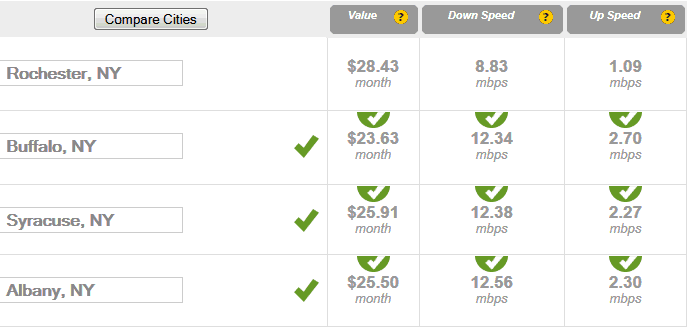
In an upstate New York match-up, the Rochester/Finger Lakes region scored dead last in broadband speed and value, according to data from Broadband.com.

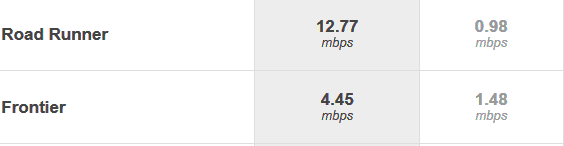
Why are broadband speeds so much lower in the Flower City?  Blame Frontier Communications, which continues to pitch its decade-old DSL product, delivering an average speed of 4.45Mbps, while other upstate cities enjoy access and competition from Verizon’s fiber to the home network FiOS.  Frontier DSL actually often costs more, after taxes and fees, than Time Warner Cable’s much-faster cable broadband product, Road Runner, which rates an average download speed of 12.77Mbps in Rochester.  Frontier does manage to pull one win — higher upload speed DSL providers can often achieve in cities where cable operators keep upstream speeds as low as possible.

Time Warner Cable has dragged its feet upgrading broadband service in the area to its DOCSIS 3 platform other upstate cities have had since last year.  DOCSIS 3 should arrive within the next 4-8 weeks, which should boost broadband speeds, but may not deliver lower broadband prices because of Frontier’s uncompetitiveness in the area.


(Source: Broadband.com)

The top city in upstate New York for download speed is the state capital, Albany.  But Buffalo wins the contest for upload speed thanks to aggressive competition for Time Warner from Verizon in the Queen City.  Buffalo also pays the least for service — nearly $5 less per month than residents in Rochester pay on average.  Syracuse scores in the middle — but closer in terms of speed and value to other Verizon-served cities.

Slow and expensive broadband service can hamper economic development and costs consumers more.  Unfortunately, there are no signs Frontier Communications has plans to do anything differently in its largest service area — a classic driver of the accelerating number of customers calling to pull the plug on their landline service.

Time Warner Cable's Road Runner vs. Frontier Communications' DSL (Speeds are downstream/upstream; Source: Broadband.com)

Time Warner Cable’s Channel Shuffle Loses a Few Along the Way

Phillip Dampier April 6, 2011 Broadband Speed, Consumer News, Video 5 Comments

Some Time Warner customers think there is more up the cable company's sleeve than "subscriber convenience."

Time Warner Cable customers across the country have been coping with some dramatic channel realignments over the past year, in some cases finding as many as a half-dozen channels gone missing from their analog basic cable lineup when it’s all said and done.

Communities in South Carolina, Ohio, and Nebraska are the latest to find dozens of channels assuming new positions on the dial, some now requiring a $7-10 digital set top box rental to keep watching.

The reasons for the changes?  To make room for an increasing number of HD channels, upgrade to DOCSIS 3 technology to support faster broadband, and to simplify finding networks on a lineup with hundreds of choices.

In Lincoln, Neb., Time Warner Cable will be aligning all of their analog and digital standard definition channel numbers with their HD counterparts.  So if CNN occupies channel 120 on the standard definition cable lineup, CNN HD will be found on channel 1120.  Customers simply have to add a “1” in front of the three digit channel number to get the same network, when available, in HD.

Lincoln residents may appreciate the fact some channels will be easier to find, but many analog customers without a cable box are not happy several of those channels will be gone from their lineup altogether.  The “victims” of the analog to digital switcheroo are familiar to those who have already been through channel realignments — C-SPAN 2, ShopNBC, TruTV, Travel Channel, and Oxygen will be available only to those who have a digital cable box or CableCARD.

In the Myrtle Beach, S.C., area, Time Warner Cable also moved the Speed channel to a new digital-only home.  Brett Phillips who lives in Georgetown called that a hidden price increase, telling The Sun News Time Warner was effectively taking away a channel while not reducing his cable bill.

Time-Warner informed me that, effective March 10, I would no longer be able to receive Speed channel, which was part of the cable package for which I had signed up, unless I installed a digital box, which the letter said would be free until Sept. 30. What the company did not state in the letter was that, after Sept. 30, the digital box would cost $9.95 per month. In effect, Time-Warner tried to unilaterally impose an 11.41 percent increase in the monthly cost for the cable service to which I had originally subscribed. The newly required digital box is a standard definition box, which means it will not process high-definition broadcasts.

In Nebraska and Ohio, Time Warner is handing out “free” digital boxes for 12 months, but only to those who do not have one now.  Those with existing digital boxes cannot obtain a second one or get their existing box for free.  Some critics, including our Lincoln reader Marta says that is a ripoff.

“As a good customer who already pays for two digital boxes and spends almost $200 a month on my cable service, why am I paying for my digital boxes when those who want the lowest priced analog service get one for free,” Marta asks.  “Clearly this is a way to get those boxes into peoples’ homes so at the end of the year they will reluctantly pay for the $7 a month to keep renting it.”

Marta was turned down when she asked if she could get a free extra box for her kitchen television.

“No, Time Warner only gives these free boxes to people who never had them before,” she said.  “I understand the company needs to make room for new things, but they have got to get these box prices down — they could turn the whole system digital as far as I care -if- the boxes were free, or at least much cheaper.”

Some other subscribers have their own conspiracy theories about the channel realignments.

One Nebraska resident noted Time Warner Cable was moving Fox News Channel to channel 44 — an ominous turn of events for this individual:

“It seems that the liberal unionized TWC is putting Fox News on channel 44. Obama is the 44th President. [George] Soros is behind this I just know it.”

[flv width=”480″ height=”380″]http://www.phillipdampier.com/video/WEWS KSHB Time Warner Channel Changes 4-6-11.flv[/flv]

WEWS-TV in Cleveland and KSHB-TV in Kansas City tell their respective viewers about the grand shuffle in their channel lineups.  (3 minutes)

ComputerWorld’s Report on Usage Capping is a Big Bucket of Wrong

Phillip Dampier April 5, 2011 Consumer News, Data Caps, Editorial & Site News 2 Comments

Phillip Dampier

I could spend all day refuting sloppy ‘accepted as true with no fact-checking’-reporting done by news organizations on the issue of Internet Overcharging.  Facts not in evidence:

  • Assumptions that what is “fair” in wireless must be fair on wired networks;
  • Everyone is doing it around the world so North America should do the same;
  • People are not paying “their fair share” for the growing amount of usage.

It’s all a big bucket of wrong, and the only thing getting rolled over month after month are consumers.

Yesterday, it was GigaOM telling us “Comcast DSL” (?) had no usage caps at all.  (They do — 250GB per month, and they sell cable broadband, not landline DSL.)

Today, it’s ComputerWorld‘s Matt Hamblen, who blows it right in the first paragraph:

Data caps on nearly all wireless and wired networks in the U.S. seem likely to be in place soon, despite the latest unlimited data offers from Verizon Wireless and Sprint.

Impressive crystal ball gazing there.  Nearly all networks will be capped?  Even though Sprint is banking its near-future on selling unlimited use plans and the economics of wireless are considerably different than wired broadband, Hamblen boldly predicts near-universal usage caps, even as most providers have no formal caps at all.

Hamblen’s journey starts with a survey of capped broadband offerings on the wireless side.  Spectrum issues and the nature of wireless technology makes providing unlimited use plans more challenging, especially when users consider their mobile broadband service a home broadband replacement.  Some have even left peer-to-peer software running in the background 24 hours a day.  It was this, according to Clearwire, that did in that provider’s unlimited service, which is now heavily speed-throttled in many areas.

Stop the Cap! has argued repeatedly current generation wireless broadband will never be a suitable replacement for traditional wired broadband, unless your use is confined to web browsing, e-mail, and occasional multimedia.  The capacity isn’t there and the technology is susceptible to serious speed loss in congested areas.  That is not to say future wireless technology might not change this reality.  The political debate over re-purposing unused UHF television channel frequencies for wireless broadband is just getting underway in Washington.

But trying to draw arguments from the wireless world for usage caps across wired broadband networks is where the line ends.

Hamblen predicts because AT&T wants to gouge its wired broadband customers (many who are now cancelling service and heading back to the cable company, when possible), now everyone will be going to the Internet Overcharging party:

Data caps on both wired and wireless customers are widespread, even if they annoy some smartphone early adopters in the U.S. Ars Technica listed the policies of 11 different wired network data caps for several different countries.

Hamblen’s report isn’t simply false — it’s sloppy.  Wired broadband usage limits are not widespread in the United States, and despite Ars Technica‘s sampler, the trend globally is away from usage-capped wired broadband, not towards it.  Evidently Hamblen didn’t bother to read Matthew Lasar’s piece, which includes references to BT in the United Kingdom moving towards unlimited use service in the near future, Canadian consumers’ victories against usage-based billing preserving unlimited use plans from resellers, and Australia’s own ever-increasing usage allowances.

In fact, even Lasar missed the fact several Australian ISPs now sell unlimited use plans themselves — something unheard of just a few years ago.  As in Britain, some users who consume over 300GB in a month may find their speeds reduced at peak usage times, but only until capacity improvements allow the throttles to be removed.  Even South Africa, one of the most challenging places to deliver 21st century broadband, has providers delivering unlimited use service.

Hamblen then moves on to another inaccurate argument — consumers will simply reserve their high bandwidth downloads on smartphones for the office Wi-Fi network, that will also face usage caps.

Except virtually every usage cap that does pop up in the United States applies to residential accounts only.  Commercial accounts are exempt, as are the Wi-Fi networks powered by them, especially for cable broadband-based service that is increasingly popular with small and medium sized companies.

Although Wall Street wants usage caps and regularly says they are inevitable, that does not make them reality.  Consumers certainly do not want them and will cancel service with a provider if an uncapped alternative exists.  While certain providers, their backers on Wall Street, and some dollar-a-holler groups defending them all have a financial interest in pushing memes about Internet Overcharging, members of the media should not.

Search This Site:

Contributions:

Recent Comments:

Your Account:

Stop the Cap!