Home » Consumer News » Recent Articles:

Rudy & Rupert: How Fox News Was Forced Onto Time Warner Cable and Your Cable Bill

Phillip Dampier July 25, 2011 Consumer News, Public Policy & Gov't Comments Off on Rudy & Rupert: How Fox News Was Forced Onto Time Warner Cable and Your Cable Bill

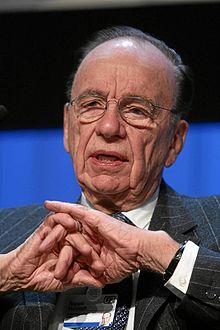
Murdoch

As Fox’s parent company News Corp. continues to reel in a wide-ranging criminal investigation involving phone hacking murder and terror victims in the United Kingdom, the scandal is now spreading into the United States with new revelations this week that CEO Rupert Murdoch, working with New York’s then-mayor Rudy Giuliani, used politically-motivated threats to force Time Warner Cable to add a newly-launched Fox News Channel to the cable dials of New Yorkers, raising their cable bills in the process.

The Daily Beast reports efforts by Murdoch to pay a substantial bounty to get the news/commentary channel on in Manhattan were not effective, so Murdoch turned to a political alliance with Giuliani, who received significant support from Murdoch’s NY Post in his earlier election bid, to force the issue with threats against the cable operator:

Let’s start in 1996, three years after Murdoch’s New York Post helped make Giuliani mayor with the narrowest win in modern city history. That year, Rupert and Ailes, who’d actually managed Rudy’s unsuccessful mayoral run in 1989, were launching Fox Cable News and they had one rather daunting problem: Time Warner controlled the prime NYC cable franchise, with 1.2 million viewers, including virtually all of Manhattan, where every advertiser who might buy a spot lived or worked. And Time Warner refused to give Fox a channel for its new venture. In those days, Time Warner only had space for 77 channels on the dial, and 30 applicants had lined up before Fox. Richard Aurelio, who ran the NYC cable system for Time Warner, recalls now that he assured Ailes that in a year or so, they would “get more capacity and put you on.” But, says Aurelio, now long retired at age 83, “Murdoch was furious.” A former deputy mayor under John Lindsay, Aurelio says he’d “never seen such a display of raw political power,” branding it “ferocious.”

Records revealed that after Murdoch and Giuliani talked directly about the matter on Oct. 1, their aides had 25 conversations and two meetings in the space of a few weeks. A deputy mayor instantly warned Time Warner about the possibility that their franchise, granted by the city every 15 years, might not be renewed and volunteered to fly anywhere in the country to meet with a Time Warner executive above Aurelio. When Time Warner wouldn’t budge, Giuliani came up with an extraordinary remedy. The city controlled five public-access channels, written into law as alternatives to commercial television, and the mayor decided to give one of them to Fox. In fact, presumably to make it look like this wasn’t something he would just do for Murdoch, he offered another to Mike Bloomberg’s then-fledgling TV network. The Bloomberg News channel actually had its debut one night before a federal judge could stop the deal, but soon the courts blocked this transparently extralegal adventure.
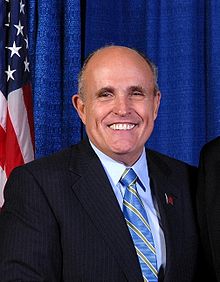
Giuliani

While Murdoch was initially willing to pay cable systems up to $11 per subscriber to launch Fox News on cable systems in the fall of 1996, most cable systems were effectively out of channel capacity at the time.  Fewer than ten million households had access to the new new network when it launched, despite the record launch bonus Murdoch was willing to pay.  Time Warner Cable had promised the network it would likely have channel space within two years as the company completed the rollout of its then-new “digital cable” service, which opened up hundreds of new slots for additional channels, but Murdoch was not willing to wait.

The Giuliani Administration owed a lot to Murdoch’s newspaper operations in the city, trumpeting his political campaigns.  One year before Fox News launched, Giuliani’s then-wife Donna Hanover was hired by WNYW-TV, Fox’s owned and operated local station in New York, despite the fact it was over a decade since her last job in television.  Fox tripled her salary just after Giuliani began threatening Time Warner Cable’s franchise to provide cable service in New York, unless and until the cable system made room for Fox News.

By 1997, Time Warner Cable added the network not only to its Manhattan cable system, but agreed to roll the channel out to most of its cable systems nationwide by 2001.

Murdoch’s early willingness to pay a bounty to get cable carriage has proved a worthwhile investment, considering Fox News has now become one of the most expensive networks in the cable package.  In December, Chase Carey, COO of News Corp., compared Fox News’ value with ESPN — America’s most expensive cable channel.  Carey has sought wide-ranging rate increases for Fox News in 2011, even after the network won earlier increases which made them by far the most expensive channel in the news and commentary category, running about a dollar per month per subscriber.  Those rate increases are passed down to every cable subscriber in the form of a higher monthly bill, whether one watches the channel or not.

In 2007, additional pressure was brought against cable operators to add Fox Business Channel, a perennially-low rated channel that was started to counter “the anti-business bias” of CNBC.  Despite now being available in nearly half of all American households, the spring Nielsen ratings show only about 57,000 people over the age of 2 watch the channel on any given day, even though every cable subscriber with the network on their lineup pays for it.

New ‘5-Strikes And Your Offline’-Copyright Agreement Scares Wi-Fi Providers

[flv width=”360″ height=”290″]http://www.phillipdampier.com/video/KJCT Grand Junction Wi-Fi Hot Spots 7-18-11.mp4[/flv]

The voluntary agreement between many of the nation’s largest Internet Service Providers and copyright holders is striking fear into the hearts of small retail businesses who provide free Wi-Fi to their customers.  If those customers download illegal content, who is ultimately going to be held to account?  KJCT-TV in Grand Junction, Colorado investigates whether some local coffee shops may be forced to shut their Wi-Fi off, or make customers sign agreements before they can log in.  (2 minutes)

NAACP: ‘Having One Company (AT&T) Looking at the Whole Landscape Will Get Service to Those Who Need It’

Phillip "Not Paid by AT&T" Dampier

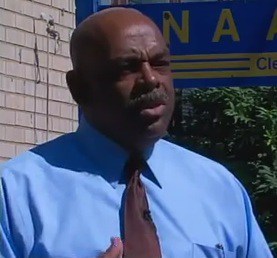
When asked if the merger of AT&T and T-Mobile will limit customer choice, NAACP’s local executive director Stanley Miller told a Cleveland, Ohio television station, “I don’t think that’s an issue in today’s environment; I think the companies are smarter today and they will make people understand and give them the beneficial services that they’ll need.”

The civil rights group had nothing to say about how much AT&T will charge for these “beneficial services.”

At least WEWS-TV in Cleveland is bothering to ask the question.  Most of America’s television news has either ignored the enormous merger on offer from AT&T and T-Mobile, or didn’t wade much further beyond AT&T’s press release about the “benefits” the merger will bring.  Unfortunately, the television station never bothered to alert viewers to the fact the civil rights group receives substantial financial support from AT&T.

Miller’s performance trying to tout his parent organization’s unqualified support for the merger sent a very clear message to anyone watching NewsChannel 5 — he doesn’t really understand what he is talking about.

On the issue of expanding wireless service into rural Ohio, Miller was left tongue-twisting his way into advocating a monopoly because they’ll be best equipped to get service to those who need it.  That’s a fascinating prospect — a monopoly spending money expanding service where it is unprofitable to provide.  That’s the reason companies like AT&T have ignored rural America, and will continue to do so — merger or not.

Miller (WEWS-TV)

In fact, AT&T’s claim that it needs the network of T-Mobile to stop the persistent problems of dropped calls and slow data service doesn’t make much sense either.  Verizon, AT&T’s closest competitor, doesn’t seem to be suffering those problems, perhaps because it has made investments in upgrades AT&T has avoided.

In California, consumer advocate Jon Fox was taking an equally skeptical look at AT&T’s claims on behalf of CalPIRG, the California Public Interest Research Group.  Fox noted AT&T’s promotion of the merger in his state came at invitation-only cheerleading sessions run by company officials:

Earlier this month, AT&T California President Ken McNeely explained to an invitation-only audience that the proposed merger with T-Mobile will create new jobs, help communities and improve wireless phone service. AT&T preferred not to take questions from the general public on how that vision fits with AT&T’s history of consolidation, layoffs and aggressive market behavior.

Nearly 30 years after regulators broke up AT&T’s unprecedented control over the U.S. wired phone market, consumers are asked to believe that this time things will be different. This notion defies both experience and common sense. Unless significant market regulation is put into place that encourages a competitive wireless arena to flourish, this proposed merger will be bad for consumers, innovation and economic growth.

Fox notes the wireless marketplace in the United States is hardly a paragon of competitiveness today.  If the merger were approved, 76 percent of Americans would receive wireless service from two providers — AT&T and Verizon.  Fox observed America’s next-most-hated conglomerate — the oil and gas industry — wishes it could have that sort of market power.  The top two oil companies in the U.S. have a combined market share of only 24 percent.  America, he notes, wouldn’t tolerate that kind of consolidation in the gasoline market, so why should we tolerate it in the mobile market?

The California Public Interest Research Group

Fox advocates more competition, not less.  He suggests the government force AT&T and Verizon to open their cellular networks to independent third party competitors at fair prices, and let everyone compete.  That could germinate competition that would end the chorus of rate increases from the largest players and allow for innovative pricing plans that don’t force customers into the nearly identical service plans AT&T and Verizon want to force you to accept.  T-Mobile already provides the most innovative pricing in the wireless marketplace, and AT&T is about to swallow that innovation whole.

What ultimately happens to a well-dwarfed Sprint remains an open question, but one many on Wall Street have already answered, suspecting America’s third largest carrier simply won’t be in a position to compete.  Fox thinks the situation is dire when two companies will have a virtual lock on wireless data services Americans increasingly depend on.

That’s not the view of the NAACP, of course.  But then the NAACP is hardly an independent observer, being the recipient of a considerable amount of money and executive talent from AT&T.  That counts for a whole lot more than the rank and file members of the organization, who will be paying the increased prices AT&T has in store for everyone.

[flv width=”360″ height=”290″]http://www.phillipdampier.com/video/WEWS Cleveland ATT T-Mobile Merger 7-14-11.mp4[/flv]

WEWS-TV in Cleveland investigates the ramifications of a merger between AT&T and T-Mobile.  More than 94% of all Ohioans filing comments with FCC oppose the merger, but groups like the NAACP support it.  NewsCenter 5 wanted to find out why.  (3 minutes)

Run Around and Sue: Movie Studios Want Zediva Remote DVD Rental Service Shut Down

Phillip Dampier July 21, 2011 Cablevision (see Altice USA), Consumer News, Online Video, Video Comments Off on Run Around and Sue: Movie Studios Want Zediva Remote DVD Rental Service Shut Down

A California company with a novel approach for renting DVDs faces the prospect of a preliminary injunction against the service if a judge agrees the service is skirting copyright law.

Zediva promotes itself as a remote DVD rental service that avoids lengthy delays often imposed on online streaming and pay-per-view services.  The company allows customers to “rent” DVD titles the same they are released, remotely streaming the contents over a broadband connection.  Zediva says it literally has a bank of DVD players which customers can access and remotely control.  When a customer “rents” a DVD, a Zediva employee inserts the disc into a DVD player and gives each customer up to two weeks to watch the movie.  Because Zediva says only one customer can rent the physical DVD at a time, it is not skirting copyright or streaming laws. The service will even mail the DVD to a customer if they don’t want to watch it over their Internet connection.

Zediva argues it is using the Internet as a way to connect the DVD player to a renter’s television.  The company says it should not matter where the player is physically located, and because a customer can exclusively control the actual player during the rental period, it is not violating any laws.

Hollywood disagrees, and the Motion Picture Association of America promptly filed suit in April, claiming Zediva’s business model undermines its licensing agreements with online movie services.  The lawsuit claims Zediva is not paying movie streaming rights like other online movie services, and is not comparable to a traditional movie rental store because the company makes individual titles available for viewing by other parties as soon as four hours after a customer stops watching, even though they can return and watch the movie again for no additional charge for up to two weeks.

This week, the MPAA touted a potential new friend of the lawsuit — Cablevision, which filed its own amicus brief in the case drawing distinctions between its Remote DVR service and Zediva.  Cablevision is in trouble with some rights holders over its new Remote DVR, which records shows on equipment at the cable company’s offices and then streams the programming on-demand to subscribers’ TV sets.  Some contend Cablevision owes “per performance” license payments for every show watched over the service.  Cablevision has consistently argued to the contrary, suggesting the actual location of the storage system should not matter, so long as the recordings are made and watched by only a single customer.

But Cablevision’s brief shows the company has no interest in being connected to Zediva, arguing its Remote DVR service is not comparable to the pay-per-view business Zediva is running.

A judge is expected to hear the case early next week.

[flv]http://www.phillipdampier.com/video/CNBC Zediva Video Streaming Service 3-17-11.flv[/flv]

CNBC and the New York Times’ David Pogue tried out Zediva back when it was introduced in March of this year.  (3 minutes)


Cable and Telco’s New Money-Maker: Security & Home Automation — Coming Soon to Your City

Phillip Dampier July 20, 2011 Comcast/Xfinity, Consumer News, Verizon, Video 2 Comments

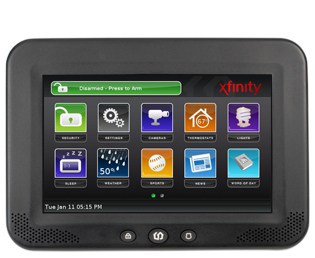
Comcast’s touch control panel delivers alarm functions, home automation, and even weather updates.

Verizon Communications, Bright House Networks, Comcast/Xfinity, and Time Warner Cable are all on the verge of making a major new push to get customers to consider signing up for home security through their respective bundled offerings.  It’s just the latest new way telecommunications companies are responding to Wall Street’s insatiable quest for growth in the average revenue earned from each customer.  But how good are these services, and how much are they going to cost?

Time Warner Cable has offered security monitoring in a number of legacy markets inherited from their former owners.  But now the company is beta testing an entirely new suite of home security applications in cities like Rochester, N.Y., with the hope of introducing the service later this year in additional markets.

Time Warner Cable and Bright House seem to be jointly testing a similar system, designed to compete with 24/7 home alarm monitoring providers like ADT or GE Home Security.  Although price points have not yet been announced, Stop the Cap! has learned the cable company intends to test a basic package of home monitoring including a limited number of monitored doors and windows for between $25-30 a month, not including upfront costs and installation.

Like other alarm providers, additional services such as managed IT services and protected points of entry will cost extra.  The next generation of home security from Time Warner Cable will be controllable from apps for iPad and smartphones, in addition to a touchscreen control panel supplied with the system.  By integrating the system with your home broadband connection, you can stream video from security webcams and configure alerts for any number of events.

Bright House’s proposed system, for example, would let you set a text message alert when the kids got home from school.  Want to know if someone sneaked out of the house in the middle of the night?  The security system can alert you to that as well.

Comcast/Xfinity has been rolling out a similar system in some of their markets. XFINITY® Home Security also delivers monitoring services, and provides remote access over the Internet.  It will also let you remotely control home appliances, lighting, and any installed web cameras.  Away from home and want to see if your spouse is up to no good?  Now you can quietly spy on anyone in your home while you are away.

[flv width=”640″ height=”380″]http://www.phillipdampier.com/video/Comcast Home Security.flv[/flv]

XFINITY Home Security System from Comcast is explained in this promotional video from Comcast.  (3 minutes)

Comcast’s basic monitoring package doesn’t include many of the coolest add-ons like video monitoring and access to a modern touch-based control panel that also serves up weather forecasts and even sports scores.  Many customers end up with the “Preferred Package” because it delivers a much wider range of protective services.  The service tested successfully in Houston and is now also available in Philadelphia, Portland, Jacksonville, Sarasota/Naples, Chattanooga and Nashville.

Comcast didn’t reinvent the wheel with their security system.  They rebranded iControl Networks’ Open Home automation and security platform.  Pricing?  $199 for the “basic package” that didn’t impress us, or $299 for the “preferred” package which comes with the bells and whistles.  Installation is sometimes included in those prices, but a $50 “activation fee” also applies.  Expect to pay $30 for basic monitoring, $40 for “preferred” monitoring each month for a minimum of three years — an early termination fee applies if you cancel early.  Also expect to pay more for any optional extras you add.

Verizon’s alarm system was promoted at this year’s Consumers Electronics Show.

Verizon Communications’ new ominously-named “Home Monitoring and Control” system is powered by its fiber to the home FiOS service.  Introduced at this year’s Consumer Electronics Show, Verizon has teamed up with lock-maker Schlage, who manufactures the “smart door locks,” and Motorola, which throws in 4Home, their home automation platform.  Trane even includes a smart-thermostat, remotely controllable.

Unlike systems sold by cable competitors, Verizon’s is budget-minded, priced at just $9.99 per month.  But the system package at that price is not remotely monitored and was designed to be sold to the do-it-yourself type. For ten bucks, you get to control everything through your television set top box, smartphone, or tablet computer.  If you want more, you pay more.  An upgraded package includes remote door locking/unlocking and remote controllable webcams that you can pan and zoom.

The deluxe package throws in the remote monitoring service and a smart-home energy use suite that let’s you monitor and control energy consumption of your home appliances.

“The more services they can get someone to sign up for, the stickier that customer is to them,” said Bill Ablondi, director of home systems research for the Parks Associates market research firm.

Most systems will come with a term contract of 12-36 months, and many could fetch discounts for heavily-bundled customers.  Most insurance companies also provide up to a 15 percent discount on homeowner policies for remotely monitored burglar and fire detection systems.

For the cable and phone companies, home security could easily bring another $40 a month in revenue and put many cable bills north of $200 a month in combined services.  Since virtually all of the systems were developed by third parties, development costs are low, and since existing broadband service in most homes provides ready connectivity to an alarm monitoring center, the costs to provide the service are minimal.

For existing security companies, the pending threat of big cable and phone companies eating their business for breakfast isn’t one they are taking lying down.

ADT is developing its own suite of home automation and security monitoring, and didn’t waste anytime taking a swipe at the cable companies.

“We’ve been in this business for 135 years,” said ADT spokesman Bob Tucker, starting with telegraphs and personal security. As for Bright House and Verizon, he said, “Would you really want to trust the security of your home and family to the same people that install HBO?”

[flv width=”640″ height=”380″]http://www.phillipdampier.com/video/Verizon Makes a Connected Home a Reality.flv[/flv]

Verizon’s forthcoming home security and automation system is promoted in this company-supplied video.  (1 minute)

Search This Site:

Contributions:

Recent Comments:

Your Account:

Stop the Cap!