Home » Consumer News » Recent Articles:

Size Queens: Verizon Puts FiOS Boxes on 20-Foot Poles in Brooklyn; Neighbors Don’t Like Them

Verizon's 20' Monolith (Courtesy: Macro/micro Brooklyn)

Verizon Communications has found a way to outdo AT&T’s enormous and unsightly “lawn refrigerators.”  They have installed 20 foot fiberglass poles in the middle of historic neighborhoods in Flatbush, Brooklyn on top of which the phone company plans to mount boxes containing equipment to support its FiOS fiber to the home service.

The enormous polygonal poles went up suddenly without advance warning, and neighbors left their homes to gaze up at the mysterious new addition to the Victorian-era community.

“The neighbors started gathering around it like it was the monolith in ‘2001,’ ” Rev. Jeanne Person, told the New York Times.

Nobody seemed to know who installed the poles, or more importantly why.

It turns out they are Verizon’s answer to AT&T’s enormous and unsightly 4-6 foot tall metal cabinets that the latter has been installing on street corners and in front of homes throughout U-verse service areas.

John J. Bonomo, Verizon’s director of media relations, told the Times the poles provide an interface between underground cables and above-ground wires that thread through backyards.  Bonomo recognized the way AT&T does it attracts vandals and graffiti.  Verizon’s solution tries to hide the unsightly boxes in the canopy of neighborhood trees, to varying degrees of success.  It also prevents anyone other than Spiderman from stealing equipment inside.

Besides, Bonomo says, the company got all of the necessary permits from the Department of Transportation.  Well, almost all of the necessary permits.

They forgot the Landmarks Preservation Commission, which regulates the look and feel of protected, historic neighborhoods — like Flatbush.  Install 20-foot plastic poles without a permit at your peril.

A spokesperson for the Commission says they hope to reach a resolution with Verizon soon.

It’s not that neighbors are ungrateful that Verizon is extending FiOS into Brooklyn, where it will provide real competition to Cablevision.  Many applaud the fiber service and look forward to signing up.  They just don’t believe randomly placed 20′ poles are the way to do it.

“First we wanted to know what it was,” Rev. Person said. “Then when we figured out what it was, we wanted to get rid of it. What does landmarking mean if it doesn’t protect us?”

[flv width=”640″ height=”380″]http://www.phillipdampier.com/video/WCBS NY Verizon 20 Pole 6-7-11.mp4[/flv]

Brooklyn residents complained to WCBS-TV about the 20 foot unwelcome additions to their neighborhoods.  (2 minutes)

Sprint Customers’ Treatment of 4G WiMAX: So Unimpressive They Shut It Off to Save Battery Life

Sprint’s 4G experience has been nothing to write home about for a number of their customers, who are increasingly disabling the service to save on battery life.

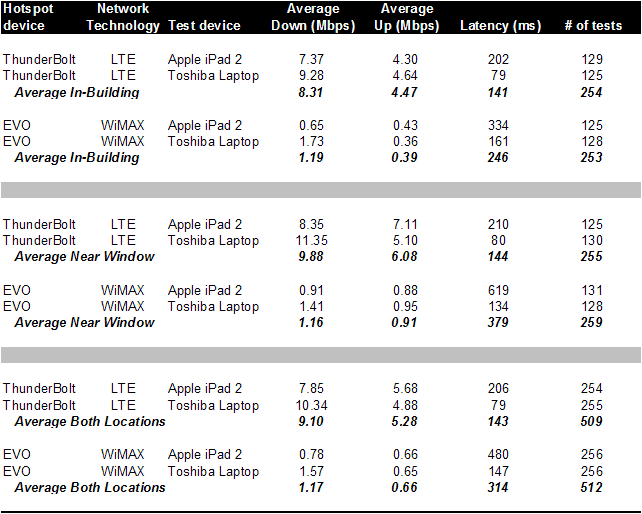
Speed tests of Sprint’s 4G WiMAX experience show increasingly unimpressive results, as the network grows exponentially more crowded with customers trying to capitalize on the higher speeds 4G is supposed to deliver.  The result?  BTIG Research in April found, after exhaustive testing, the average Sprint 4G customer was now getting around 1/1Mbps service from a network that promised to deliver speeds many times that.

This isn't even a contest. (Source: BTIG Research)

Now an increasing number of customers are simply switching the 4G service off completely to extend battery life.

Doug Mahoney, a contributing editor for TechZone360, says he has about given up on WiMAX:

WiMAX tends to stay turned off so I run 3G and there’s no big differences in the convenience of reading email or using simple apps like Twitter and Foursquare.  With more public places starting to offer free WiFi, the case for WiMAX — or LTE — on a smart phone starts to grow weaker between the extra cost and the battery life issue.

Mahoney complains Sprint’s 4G network is simply not robust enough to support consistent speeds and access.  In suburban Washington, he compares Sprint’s 4G coverage to an open air tree, with spotty service scattered across the region.  As a result, his 4G phone spends a lot of time desperately-seeking-signal — a process that accelerates battery depletion.

Given Sprint’s WiMAX “tax” of an additional $10 a month for the service, Mahoney isn’t so certain he’d pay it again on a future Sprint phone.

Are the same speed reductions in store on Verizon’s currently-lightning-fast LTE 4G network few customers use right now?  Perhaps, but Verizon’s brand may force the company to make sure coverage is much stronger than what Sprint customers currently tolerate:

LTE has the same power consumption issues as WiMAX. I suspect Verizon will have better, more ubiquitous LTE coverage just due to the characteristics of the 700 MHz spectrum and physics involved, so I should have faster broadband available in more places rather than the abstract green tree coverage map.

Time Warner CEO Wins Contract Extension – $17 Million Compensation Package

Phillip Dampier August 3, 2011 Consumer News 4 Comments

Glenn Britt

Time Warner Cable has notified the Securities and Exchange Commission that the cable company has extended the contract of current CEO Glenn Britt through at least the end of 2013, an extension of one year.

As part of the contract deal, the cable company added provisions for “long-term incentive compensation,” a combination of salary, bonuses, and other financial incentives designed to keep a CEO from looking for greener pastures elsewhere.  Britt’s package is anticipated to be worth at least $17 million over the period 2012-2013, which includes a base salary of at least $1.25 million, and much of the rest coming from bonuses.

Britt is likely being rewarded for the company’s strong financial results and stock price, which has been high recently.  But the cable company continues to lose cable-TV video customers, and is finding increasing resistance to rate increases from cash-strapped consumers being priced out of the company’s packages.

Cogeco Customers Pay for Company’s European Mess: Rate Hikes Sooth Portuguese Write-Off

Phillip Dampier August 3, 2011 Canada, Cogeco, Competition, Consumer News, Data Caps 5 Comments

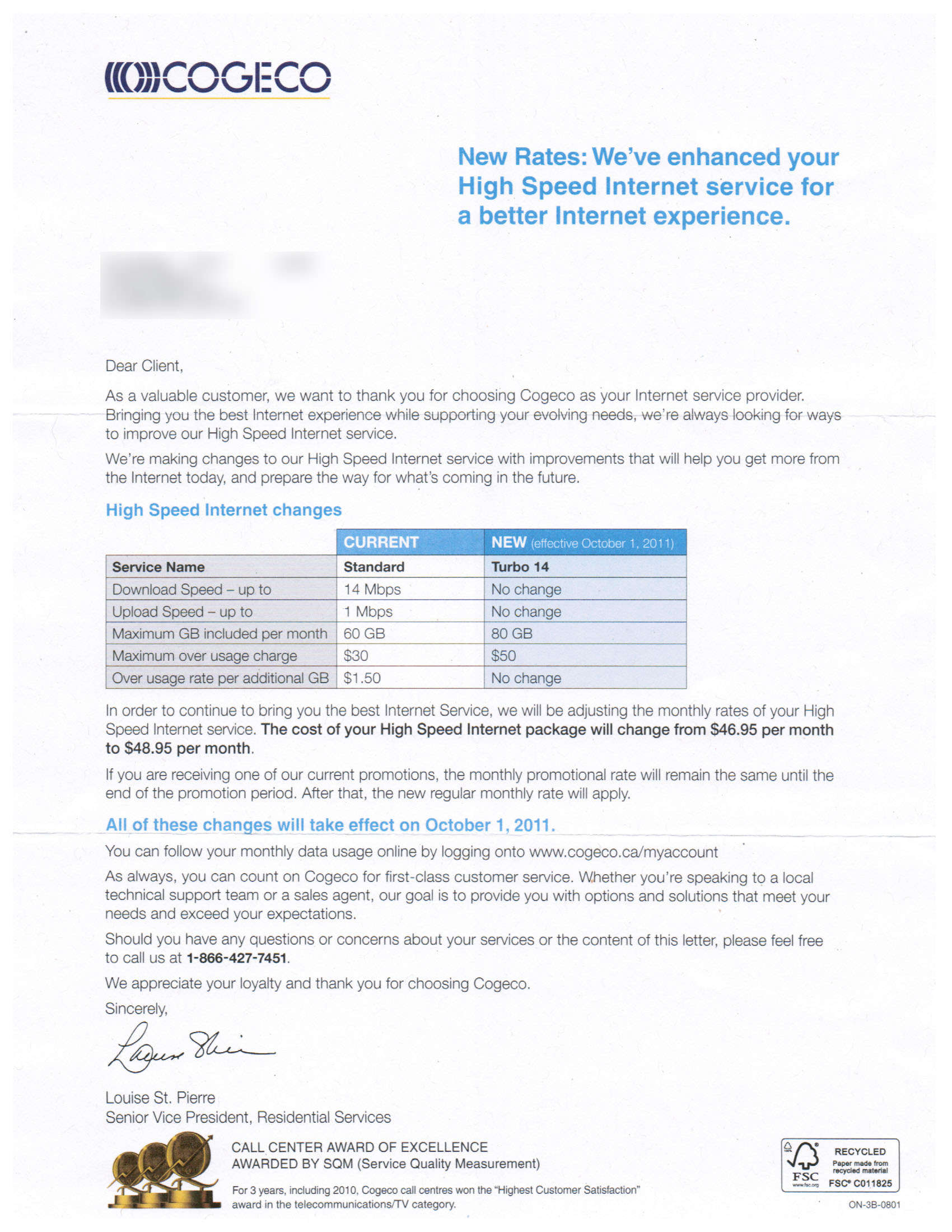
Cogeco Cable customers are about to pay for the company’s tragic financial results from its Portuguese operations in the form of broad-based price increases the company is selling as service “improvements.”

July’s financial results for Cogeco, which owns cable systems in Ontario, Quebec, and Portugal, are not good.  With mass subscriber defections and downgrades from Cogeco’s Portuguese cable system Cabovisao, company officials have decided to write off their European investment, resulting in a $56.7 million loss in the third quarter.

Tempering the damage is the company’s decision to raise broadband prices for Canadian customers by $2 a month for their Standard broadband package, soon to be priced at $48.95.

(Courtesy: 'Gone' from Fort Erie, Ontario)

“To add insult to injury, they are calling these changes ‘improvements,'” writes Stop the Cap! reader Claudette, who is a Cogeco customer in Ontario.  “In fact, the only thing Cogeco is improving is their skill at overcharging us.”

Cogeco's financial mess in Portugal.

Cogeco has sent letters to subscribers notifying them about the “improvements,” mostly in the form of a name change for the company’s ‘Standard’ plan, soon to be renamed ‘Turbo 14.’  They have also launched a new section on their website to break down the changes.

The only benefit Cogeco is introducing for customers with their Standard plan is a slight bump in usage allowances, from 60 to 80GB.  But that change comes with a major catch.  Cogeco charges customers a $1.50/GB overlimit fee with a monthly maximum overcharge of $30.  When ‘Turbo 14’ premieres Oct. 1, the maximum overlimit fee will jump to $50 a month.

“That is a total ripoff, because the next plan up with bigger allowances — just over 100GB a month — costs nearly $77 a month, for a whopping 16Mbps,” she adds.  “They just raised our rates last July and now they want more.”

Cogeco is punishing their premium customers even more by taking the maximum overlimit fee cap completely off their DOCSIS 3-based Ultimate 30Mbps and 50Mbps plans.  Available in some Cogeco service areas at prices of $60 and $100 a month respectively, the plans come with usage limits of 175-250GB.  The sky is the limit for overlimit fees, racked up at $1 per gigabyte.

Cogeco customers are outraged, and have begun shopping for alternatives, just like their counterparts in Portugal who have put their cable service on the chopping block.

The ongoing Portuguese financial crisis has been met with tax increases and benefit reductions by the government, and Portuguese consumers have responded with wholesale cord-cutting, cancelling Cabovisao cable-TV service in droves.

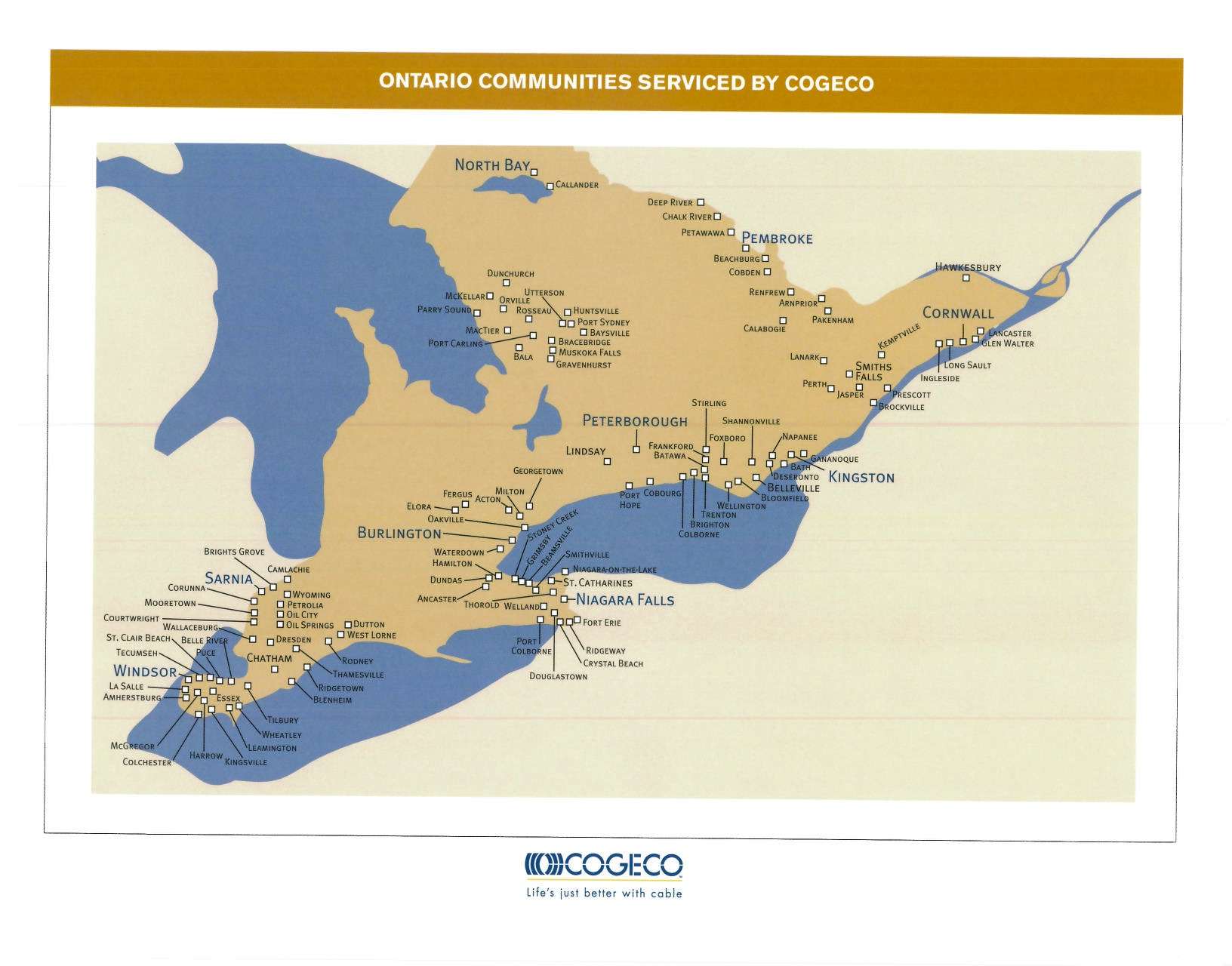
Cogeco's systems in Ontario (click to enlarge)

“You now have customers squarely opting out of [cable TV],” said Louis Audet, Cogeco’s president and chief executive officer. “These are economic circumstances that we have not, nor has anyone here, witnessed in North America. These are very unique to the circumstances in Portugal.”

At least Audet hopes they are.

With fewer competitive choices in the rural and suburban Ontario and Quebec markets Cogeco favors, consumers have a tougher time finding alternative providers, but not an impossible one.  Many are dropping Cogeco’s phone and broadband packages, moving to Voice Over IP or cell phone service for the former, and independent broadband providers like TekSavvy for the latter.  TekSavvy still retains unlimited use plans and has been traditionally more generous with allowances for the usage-based plans the company also sells.

Investors have been placated with a boost in Cogeco’s dividend payout… for now.  But many have adopted a “told you so” attitude about the company’s controversial decision to invest in overseas cable to begin with.

Scotia Capital analyst Jeff Fan said he had a negative view about Cogeco’s Portuguese venture.

“We hope this paves the way for a sale,” he wrote in a note to investors, “as Portugal is still cash-flow negative and dilutes the strong Canadian results.”

In fact, many investor groups dream of an even bigger sale — of Cogeco itself.

Joseph MacKay of Mackie Research said Canada’s fourth-largest cable company is ripe for a takeover by a larger cable operator, presumably Rogers or Shaw Communications.  Rogers already blankets Ontario with cable services, so Cogeco’s operations in eastern provinces would be a ‘natural fit’ for the company.  Shaw’s interest in expanding eastward could also get a boost from the buyout of Cogeco.

But one significant roadblock remains — the controlling interests of the Audet family, which have no intention of selling and control enough voting shares to stymie a hostile takeover.  In fact, despite the poor showing of the company’s Portuguese operations, the Audet family claims to be interested in acquiring other providers and expanding Cogeco’s size.

With the benefit of a two-dollar rate increase and the proceeds of Internet Overcharging, they’ll be in a position to put more dollars toward that goal.

White Space Wi-Fi: 802.22 Benefits Rural Providers, Not Home Wi-Fi Users

Phillip Dampier August 2, 2011 Broadband Speed, Consumer News, Editorial & Site News, Public Policy & Gov't, Rural Broadband, Wireless Broadband Comments Off on White Space Wi-Fi: 802.22 Benefits Rural Providers, Not Home Wi-Fi Users

An example of an 801.22 Wireless Regional Area Network

The mainstream media and technology blogs have been running away with coverage about the IEEE’s recent approval of the so-called “white space” 802.22 wireless standard with stories of up to 100 kilometers of wireless coverage for home Wi-Fi over unused UHF television channels.  The thought of installing a router that can deliver reception of your personal broadband connection for up to 62 square miles sounds very exciting, but don’t get as carried away as some media outlets have.

The truth is, 802.22 benefits wireless providers, not consumers (unless you happen to receive your Internet service from a commercial provider over this technology.)

The new standard was designed to benefit Wireless Regional Area Networks (WRANs).  In general terms, this means Wireless Internet Service Provider (WISPs), who are most likely to adopt the new technology to enhance wireless service over long distances in rural areas not covered by DSL, cable broadband, or other wired networks.  To achieve the maximum amount of coverage noted in the popular press, providers will need to utilize specialized transmitters using antennas considerably higher than what one would find in a home environment.

Unlike today’s Wi-Fi networks, 802.22 uses much lower frequencies which tend to propagate over longer distances.  Using frequencies in the Megahertz range instead of the Gigahertz range makes it much more likely ground-based wireless signals will penetrate buildings and reach across the rural landscape.

To accommodate “white space” wireless, the Federal Communications Commission last year approved the use of unused broadcast channels for these data transmissions.  But providers will not simply be able to fire up their white space Wi-Fi network just anywhere.  The standard includes a provision that will automatically register the exact location of each transmission site with a central coordinating body.  Providers must agree to vacate channels if harmful interference to licensed broadcasters is “sensed” by the technology, and even though multiple operators may be able to operate concurrently in an area at the same time, there are important limitations on how many available “white space” channels will exist in different television markets.

Realistically, the most sensible implementation of 802.22 will come in very rural areas with few, if any, local broadcast signals to contend with.  If the FCC has its way, a considerable amount of the so-called “white space” will be sold off to America’s largest cell phone companies, leaving even fewer channels open for this kind of wireless broadband.  In large urban markets, it’s doubtful many channels will be available for 802.22 use, if any at all.  Currently, the FCC dictates these networks cannot operate on an occupied broadcast channel, or the adjacent channels on either side.  That means if your city has a station on channel 31, these networks cannot use channels 30, 31, or 32.

Another problem is the available bandwidth for individual users.  Each “channel” has 6MHz of bandwidth, which can realistically provide 12Mbps service to a single user.  The IEEE specifies a maximum speed of 22Mbps, but that is more theoretical than actual when taking into account the longer distances average customers will be from the transmitter.  Providers will almost certainly pack each channel with multiple users.  A dozen customers concurrently using the service would probably get around 1.5Mbps on average (384kbps upstream), assuming nobody saturates the channel at maximum speeds. That is equivalent to some rural DSL providers.  Should providers “oversubscribe” the network, and dozens of customers try and use the service at the same time, speeds could drop precipitously.  The further users are from the transmitter, the lower the speeds they will receive regardless of how many users are on the network at that time.

To handle demand, one solution is to run multiple transmitters to handle the traffic, but how many transmitters can operate will depend on how much “white space” is available.  That is why this technology is best suited for rural areas where UHF television signals, and customers, are few and far between.

Home Wi-Fi users will need to wait for the development of a different standard — 802.11af — to take any advantage of “white-space” Wi-Fi, sometimes called White-Fi or “Super Wi-Fi.”

Since the much used 2.4 GHz band for Wi-Fi is congested in urban areas, IEEE 802.11af can provide additional open frequencies for home users.  But most 802.11af home equipment will operate at considerably lower power and range, and will suffer some of the same bandwidth limitations created by narrow channel spacing.  An even bigger problem will be available channel space.  The same urban areas experiencing over-congested Wi-Fi will also likely have the largest number of operating television signals, limiting the use of this technology.

Some theorize White-Fi wireless will not be of much use to home broadband users at all, instead opening up connectivity for devices we might not normally associate with wireless connectivity.  A home security system could plausibly work well with limited bandwidth.  So could home electronic devices that want to communicate their status.  A washer and dryer could use the technology to communicate with each other to synchronize completion time and signal the homeowner that their laundry is ready.  Home weather stations could deliver data over longer distances, refrigerators could signal owners they need to be restocked, and so on.

If you are waiting for wireless broadband nirvana, unfortunately there is not much to see here with these developments.  Increasing usage demands continue to make wireless among the least suitable technologies to deliver the substantial-sized data pipeline broadband consumers increasingly require.

Search This Site:

Contributions:

Recent Comments:

Your Account:

Stop the Cap!