Home » Consumer News » Recent Articles:

Public Service Commissioner Accuses Louisiana Governor of Sabotaging Broadband Grant

Phillip Dampier November 17, 2011 AT&T, Community Networks, Competition, Consumer News, Public Policy & Gov't, Rural Broadband, Video Comments Off on Public Service Commissioner Accuses Louisiana Governor of Sabotaging Broadband Grant

Campbell

A commissioner on the Louisiana Public Service Commission accused Gov. Bobby Jindal of sabotaging a now-rescinded $80 million dollar broadband improvement grant for the benefit of the state’s largest telecommunications companies.

Public Service Commissioner Foster Campbell publicly berated the Republican governor for intentionally interfering with the project until time ran out and the government withdrew its funding.

The cancellation of the project has proved embarrassing because it is the first and only time a state has lost federal broadband grant money.

“We want to know what the heck happened; we’re the only ones in the country that dropped the ball,” Campbell said. “I meet with people in every parish, and the number one priority by far is high-speed Internet, and how do you lose $80 million coming from the federal government to do that. How do you drop the ball, and if they did drop the ball was it because someone whispered in their ears, ‘it’s going interfere with big companies?'”

Campbell suspects the state’s largest phone and cable companies lobbied the governor’s office for changes in what was originally proposed as a public broadband network reaching large sections of rural Louisiana that do not have broadband access.

The state’s Division of Administration eventually scrapped plans for the public broadband network and replaced it with a proposal to use grant dollars to purchase long term institutional broadband contracts from private providers.  AT&T is the dominant local phone company in Louisiana — the same company that has steadfastly refused to provide DSL service across rural Louisiana. The new proposal would have not delivered any broadband access to individual Louisiana homes, only to institutions like schools, libraries, and local government agencies.
In Campbell’s eyes, the grant represented a competitive threat and seeing it dead and buried was the governor’s special favor to Big Telecom.

“I think they threw a little dirt on this one or a lot of dirt on it,” Campbell told the Tulane Hullabaloo.

Jindal himself admits his administration did get directly involved in changing the project’s course.

The governor called the revised private provider-focused project “a reasonable approach that would have expanded broadband access and not hurt private providers.” Jindal attacked the public broadband network originally planned by the Louisiana Broadband Alliance as “a heavy-handed approach from the federal government that would have undermined and taken over private businesses.”

With the $80 million dollars back in the hands of the federal treasury, Jindal is now blaming the Obama Administration for taking the money back.

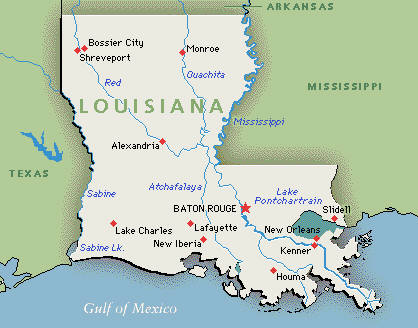
The Louisiana Broadband Alliance, a collaboration among six state agencies, would have deployed more than 900 miles of fiber-optic network to expand broadband Internet service in some of the most economically distressed regions of Louisiana. The new network intends to provide direct connections for more than 80 community anchor institutions including universities, K-12 schools, libraries, and healthcare facilities. The 3,488-square-mile service area includes 12 impoverished parishes targeted by the state’s Louisiana Delta Initiative and a separate five-parish area that is home to four federally-recognized American Indian Tribes.

AT&T Ripped Off Hamilton County (Tenn.) 911 By “Intentionally Undercollecting” Fees, New Suit Alleges

Phillip Dampier November 17, 2011 AT&T, Consumer News, Public Policy & Gov't, Video Comments Off on AT&T Ripped Off Hamilton County (Tenn.) 911 By “Intentionally Undercollecting” Fees, New Suit Alleges
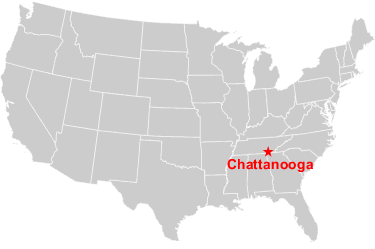
The Hamilton County’s Emergency Communications District is suing AT&T of Tennessee for what it says was an intentional decision to under-report and under-charge customers the monthly $1-3 911 fee levied on residential and commercial phone lines.  Hamilton County, which includes the city of Chattanooga, Tenn., ironically discovered the “intentional under-collection” of the mandatory 911 fees when it received a proposal from the phone company to provide telephone service to the county at a lower rate than competitors could offer, in part because AT&T offered to discount or eliminate the 911 surcharges.The county 911 agency, through its lawsuit, suggests most of the under-reporting is taking place with business customers who are using AT&T’s multiplexed Centrex phone service.  AT&T provides up to 23 voice phone lines over a single circuit, but only charges 911 fees on a single line, the lawsuit alleges.

“They were able to do what they call bundling,” ECD Executive Director John Stuermer told WRCB-TV. “Technology allows multiple phone lines over a single pair of wires, [but] we’re not getting the funding for the lines as we should have.”

Hamilton County ECD wants a U.S. District Court to fine AT&T $10,000 for each falsified financial report it has filed since 2001. Collectively, that could amount to a fine up to $1.33 million.

The lawsuit demands that AT&T open access to its billing files for a county investigation.

AT&T won’t comment on the lawsuit, but it isn’t the first time the phone company has faced scrutiny for similar under-collection of 911 fees. In 2006, the 911 district for Madison County, Ala., sued AT&T’s predecessor BellSouth for the same thing. The company settled that lawsuit privately in 2009.

[flv width=”480″ height=”380″]http://www.phillipdampier.com/video/WRCB Chattanooga Hamilton County sues ATT for 911 fees 11-15-11.mp4[/flv]

WRCB in Chattanooga reports Hamilton County 911 may not be getting the funding it needs because AT&T isn’t passing along what it owes in 911 surcharges.  (3 minutes)

Rural Americans Losing Reliable Phone Service; FCC Investigates Growing Landline Failures

Phillip Dampier November 17, 2011 Consumer News, Public Policy & Gov't, Rural Broadband, Windstream Comments Off on Rural Americans Losing Reliable Phone Service; FCC Investigates Growing Landline Failures

The Great Plans Communications Company has taken to notifying their customers about the growing problem of rural phone calls that never go through.

Rural Americans in 37 states are experiencing unprecedented problems making and receiving telephone calls on their landline phones.  The problem has grown so much, the Federal Communications Commission has announced it will investigate the 2,000 percent increase in complaints from customers who are fed up with bad phone service.

In a Stop the Cap! special report published this week, we shared details about the deteriorating landline networks owned by AT&T and Verizon.  But the problem extends beyond those phone companies, and is causing more than a little inconvenience for affected customers.

Hospitals report they are increasingly unable to reach rural patients and 911 emergency call centers say a growing number of emergency calls are not getting through.  Callers assume the problem isn’t with their landline telephone company, but with the hospital or 911 call center.

In response, the FCC has created the Rural Call Completion Task Force to investigate delayed, uncompleted, or poor quality calls.

“It’s not only an economic issue, it’s a public safety issue,” said Jill Canfield, the director of legal and industry at the National Telecommunications Cooperative Association.

In parts of Minnesota, problems are not limited to local dial tone service, but also extends to long distance calling.

Members of the Minnesota Telecom Alliance, which represents rural phone companies in Minnesota, discovered growing problems completing calls nearly a year ago.  Customers would dial numbers and be met with silence or uncompleted call intercept recordings.  Other customers, especially in area codes 320 and 218 couldn’t hear or be heard by the other calling party.  Other calls sounded like they were made underwater.

Phone companies also dealing with frustrating long distance problems have taken to their blogs to alert customers.  Great Plains Communications is one example:

For a while now, we’ve been aware of a particularly frustrating situation affecting rural telephone customers around the country.

Across the country, residents of rural communities are unable to receive long distance phone calls or are receiving calls of poor quality due to incomplete or blocked long distance calls. The issue affects landline, toll-free and wireless long distance calls.

So what’s the reason for this? Well, in the U.S., phone calls are carried on a network of phone lines that may be owned by a wide range of companies who charge a fee to carry long distance calls. To cut costs, some long distance companies attempt to use the lowest cost route available even if that route includes providers who aren’t capable of providing good call quality or even completing the call.

The result is thousands of dropped calls or calls with almost no sound quality occurring across the nation. Additional problems that customers have experienced are:

• The caller hears ringing but the receiving party hears nothing.
• The caller’s phone rings, but then hears only “dead air” when the call is answered.
• The call takes an unusually long time to place.
• Garbled, one-way, or otherwise poor call quality on completed calls.
• Callers receive odd or irrelevant recorded messages.

Investigators examining the problem confirm that company’s suspicions that fierce cost-cutting has a lot to do with the problem, especially as phone companies try and save money using cheaper Voice Over IP technology.  While most of the problems seem to afflict long distance calls (and the carriers that handle them), local phone companies like Windstream are also being targeted in the review.

A decade ago, consumers chose their long distance provider.  But today’s bundled service packages often include unlimited long distance, using the phone company’s preferred provider.  Some long distance calls are routed over the least expensive route, even if call quality suffers.

What particularly provokes customers are quality reductions coming at the same time companies like Windstream are raising prices in states like Minnesota.

Windstream defends its network and says it isn’t to blame for the problems.

“The fault is not in our network and not in our system,” Windstream spokesman Scott Morris told the SCTimes. “We do feel like we’re providing high-quality service … in what we can control and fix.”

Cox Disconnects Its “Unbelievably Fair” Cell Service; Existing Customers Will Migrate to Sprint

Phillip Dampier November 16, 2011 Competition, Consumer News, Cox, Wireless Broadband Comments Off on Cox Disconnects Its “Unbelievably Fair” Cell Service; Existing Customers Will Migrate to Sprint

Don't bother.

Cox’s ambitious plans to get into the cell phone business were already tempered by the cable company’s decision last spring to simply resell Sprint service under the Cox name.  Now it’s “game over” as the company today quietly stopped signing up new customers and will pull the plug on existing ones March 30, 2012.

Those customers already signed up for Cox’s “unbelievably fair” cell service will officially become Sprint customers next April.

In a confidential memo obtained by Engadget, Cox executives ultimately decided it didn’t make sense for the company to invest in a limited range 3G cellular network.

Cox’s plans to utilize the 700MHz wireless spectrum it acquired in 2008 for 3G-powered wireless service began to go wrong almost from inception.  The wireless business is increasingly in the hands of two super-sized companies, thanks to ongoing mergers and acquisitions.  That leaves smaller, regional companies at a competitive disadvantage unless they heavily discount service.  While Cox was contemplating its first 3G network, AT&T, Verizon, and Sprint were well on the way to launching next generation 4G service that would have left Cox behind.

Cox itself is a regularly-rumored takeover target, likely by Time Warner Cable.  No cable industry buyer has much interest in a cell phone service.  Shedding it could make the company more attractive for would-be suitors.

Engadget reader Sal Petrarca observed:

I always thought it ironic when I [heard Cox’s radio ad asking customers] ‘You wouldn’t order cable from the phone company, would you?’ I guess no one is going to be ordering [cell] phones from the cable company now, eh?”

Inside Time Warner Cable’s 10-Minute Service Call Windows

Phillip Dampier November 15, 2011 Competition, Consumer News, Video Comments Off on Inside Time Warner Cable’s 10-Minute Service Call Windows

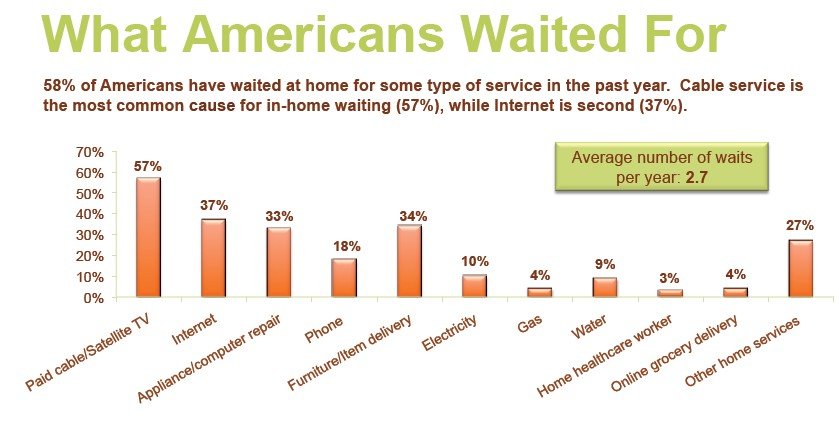
Cable and satellite companies are the worst offenders when it comes to forcing customers to wait around for scheduled service calls, wasting time and money.

Who hasn’t taken time off from work for the cable installer or a repair crew, who inevitably arrive just minutes before the end of the six hour “window” the company provided.

Making people sit at home for service calls wastes money — a lot of it.  A new study from TOA Technologies found Americans hang out at home an average of 4.3 hours waiting for the cable guy to arrive, much longer than most people think they should have to wait.  TOA added up the cost of lost wages and reduced productivity that results when employees are absent — $37.7 billion annually.  That works out to an average of two eight-hour working days off a year per person, costing $250 a year.

More infuriating: you find yourself indisposed when the cable crew finally shows up and you can’t reach the door in time before they leave, or the promised visit never materializes.  That results in the dreaded “sorry we missed you” sticker attached to your front door and a rescheduled service call, often a week later.

When your cable company is also your Internet Service Provider, it can be double trouble.  ISP service calls were the second worst, phone companies fourth.

The cable industry’s lousy reputation among consumers is not lost on them. More than a decade ago, the industry voluntarily offered $20 service credits for late or missed service calls to improve their image. But TOA found the longer companies keep customers waiting, the more likely it is they will consider taking their business elsewhere.

With the advent of telephone company competition, customers infuriated by Comcast or Time Warner Cable may decide to switch to Verizon FiOS or AT&T U-verse, or vice-versa.  Now the cable industry is back with new ways to placate customers and save everyone time and money.  Shortened service call windows and self-install kits are increasingly common ways customers can avoid a day home from work.

Time Warner Cable is one of the cable industry’s most-improved players, reducing waiting windows, calling customers to give them a heads-up when they are on the way, and offering weekend and evening service calls. In upstate New York, Time Warner customers can, in certain circumstances, be given an estimated time of arrival accurate to within 10 minutes.

The 10-minute “Tech on the 10s” program only works on the first scheduled service call of the day.  If the cable repairman starts his shift at 9am, the only guaranteed time slot will be from 9-9:10am.  Because different technicians start their shifts throughout the day, the company promises that several hundred slots are available each week.  If the technician blows it and still arrives late, the customer gets $20 for their troubles.

The company hopes shortening wait windows will give customers fewer reasons to use that time to shop around for a different service provider.

[flv width=”480″ height=”290″]http://www.phillipdampier.com/video/WSYR Syracuse How much does it cost you to wait 11-13-11.mp4[/flv]

WSYR in Syracuse takes a look at the impact of waiting for the cable repair man to show up and what Time Warner Cable is doing about it.  (2 minutes)

Search This Site:

Contributions:

Recent Comments:

Your Account:

Stop the Cap!