Home » Consumer News » Recent Articles:

Corporate Welfare: Why is Rogers Getting a Taxpayer Handout for Its Magazines?

Phillip Dampier January 13, 2012 Canada, Consumer News, Editorial & Site News, Public Policy & Gov't, Rogers Comments Off on Corporate Welfare: Why is Rogers Getting a Taxpayer Handout for Its Magazines?

Canadian taxpayers gift Rogers-owned Macleans magazine $1 million annually, just because.

The Tories running the Canadian federal government are on a mission to slash government spending.  In addition to budget cuts, Ottawa is about to start pink-slipping public service workers.  But executives at Rogers Communications, Canada’s gi-normous media conglomerate can rest easy knowing their corporate welfare payments are still safe from the government axe.

At a time when North Americans are abandoning print media in droves, it’s more than a little odd that Rogers is getting a government handout for a whole mess of magazines the company still prints and sells to an increasingly disinterested public.

It turns out the Canada Periodical Fund exists to throw nearly $71 million a year in subsidies to magazines ranging from the endangered to the ubiquitous.  Among the titles getting taxpayer handouts include those even Americans recognize.  Rogers is getting $1.5 million a year in free money just for printing Maclean’s.  They get the same for Chatelaine, Canada’s version of Reader’s Digest, and Canadian Living.

In fact, more than a dozen well-known magazine titles get a cool million plus from the federal government, just for… existing.

Ironically, Canadian Heritage defends the subsidy program as an effort to ensure “Canadians have diverse Canadian print magazines, non-daily newspapers, and digital periodicals.”  Canadian publishing, much like its telecommunications marketplace, is increasingly about as non-diverse as you can get, as a handful of giant corporations consolidate their ownership of most major print publications.  Transcontinental and Rogers together account for half of the top 50 magazines in Canada.  Smaller titles are fading through a combination of increasing postal rates and decreasing interest on the part of an online-0bsessed culture.

The Ottawa Citizen thinks it has all gotten out of hand:

The central problem with this government program is that big magazines don’t need government help and the little ones aren’t worth it. A really generous observer could see public value in Atlantic Horse & Pony, Modern Dog or Hardware Merchandising, but this is Canadian culture writ extremely small.

The magazine program clearly helps prevent a Darwinian reduction in the astounding number of Canadian magazines. Thus we have Big Buck Magazine ($40,521) a quarterly periodical devoted to deer hunting. Subscribers who enjoy pictures of dead animals might also like Western Canadian Game Warden ($18,626), Ontario Monster Whitetails ($8,488) or The Canadian Trapper ($5,303).

Farm publications are soundly supported, including Canadian Ayrshire Review ($12,319), Canadian Cattlemen ($158,952) and Cowsmopolitan Dairy Magazine ($16,504). It includes no sex tips, by the way. The biggest beneficiary is The Western Producer, a weekly farm newspaper that takes in nearly $1.6 million.

Religious publications also do well, including Canadian Mennonite ($152,957), Mennonite Brethren Herald ($85,590), The United Church Observer ($191,592) and Presbyterian Record ($156,373).

Even the satirical magazine Frank collected $57,517 from the taxpayers, surely one of its best pranks.

[…] The taxpayers might not get much value from the Canada Periodical Fund, but the Conservative government is making the most of it. In the Canadian way, the magazine and weekly newspaper grants have been turned into pork. Local MPs announce these silly little grants, using standard language about how the giveaway contributes to the economy and the diversity of Canadian content.

A few thousand dollars could do wonders for most digital versions of small print publications, all without killing trees and wasting energy delivering them to a dwindling number of readers.  But giant-sized conglomerates like Rogers don’t need the handouts.  Not when the company enjoys a revenue largesse from its current holdings.  You cannot promote diversity handing out checks to companies that would like nothing better than to use the money to merge and acquire their way to an increasingly concentrated media marketplace.  Nobody has proved that better than Rogers Communications.

Time Warner Cable Lines Pass Over Driveways of Customers They Refuse to Serve

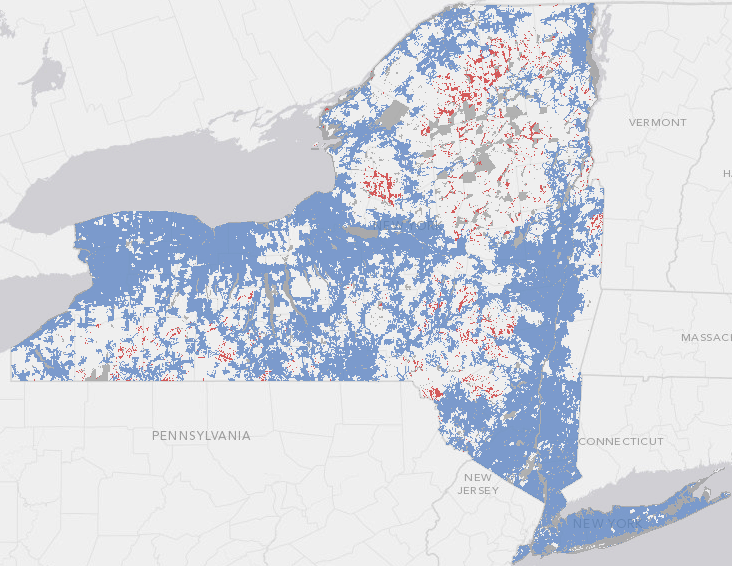
Would-be customers of Time Warner Cable’s broadband service in Vienna, a small town in Oneida County, N.Y. are confused about why the cable company will not provide them with broadband service, even though cable company lines pass right over their respective driveways.

Pete Rauscher sees neighbors within a mile away happily using Time Warner’s Internet service, even though he cannot buy it for himself.

“I’d like to get the service…so do [my neighbors],” Rauscher told WSYR-TV in Syracuse. “It isn’t right that somebody within a mile of us has the same cable service, but we don’t.”

Broadband Map for New York. Blue=Cable Broadband -- Red=No Broadband At All

Rauscher and his neighbors are victims of a de-facto cable industry standard that says wiring fewer than 35 homes within a mile is not financially viable.  Rauscher might understand this, if a Time Warner-owned cable line didn’t pass straight over his driveway.

The cable company says it would cost at least $17,000 to provide Rauscher with broadband service, an installation fee way out of his budget.

Parts of Oneida County are still without any broadband service, except for those lucky (and wealthy enough) to receive and pay for a wireless 3/4G broadband connection from Verizon Wireless.  That company charges $80 a month for up to 10GB of usage, much more expensive than what Time Warner would charge.  DSL is not provided in that section of Vienna.

Time Warner says it regularly re-evaluates expansion into currently unserved sections of its service area.  Two sections of nearby Camden now receive cable service from the company, partly thanks to new housing developments in the rural region.  But for now, the cable company remains resolute in not serving customers who do not meet its population density test.

[flv width=”480″ height=”290″]http://www.phillipdampier.com/video/WSYR Syracuse Fight for High Speed Internet 1-12-12.mp4[/flv]

WSYR-TV tells the story of rural Oneida County residents who cannot get Time Warner Cable broadband service, even though the cable company lines cross their driveways.  (2 minutes)

Breaking News: Comcast’s Nationwide E-Mail Outage

Phillip Dampier January 13, 2012 Comcast/Xfinity, Consumer News Comments Off on Breaking News: Comcast’s Nationwide E-Mail Outage

Comcast’s e-mail service failed for customers across the country this morning, creating a storm of complaints on Comcast’s customer support forum.

The outage appeared to begin at around 10:00 ET this morning and blocked access to customers relying on Comcast for their electronic mail.

Stop the Cap! reader Bob dropped us a line to let us know about the problem, and its impact appears to be near-universal for Comcast/Xfinity customers.

One reader who managed to get through on Comcast’s overwhelmed customer support phone line sent along this news:

“I contacted Comcast and got a recording that their email servers are having technical issues and their techs are aware of the problem and are working to resolve the issue. They did not give a time frame when the servers would be back on line.”

A Comcast employee reported:

“This is a top priority issue we are working on right now and have all the required engineers working hard to fix this.  As a workaround, can you try accessing your email using the online mobile site:

http://m.xfinity.com/m/ “

As of 12:45pm ET, e-mail services were starting to return to normal, but with a new problem — a flood of backlogged e-mail is now trying to work its way to customers, delaying the sending and receiving of new e-mail messages.

Users of other web-based e-mail services like Gmail are unaffected.

Comcast Spanked for Sneaky Truck Roll Fees; Certain Maryland Residents Getting Refunds

Phillip Dampier January 13, 2012 Comcast/Xfinity, Consumer News Comments Off on Comcast Spanked for Sneaky Truck Roll Fees; Certain Maryland Residents Getting Refunds

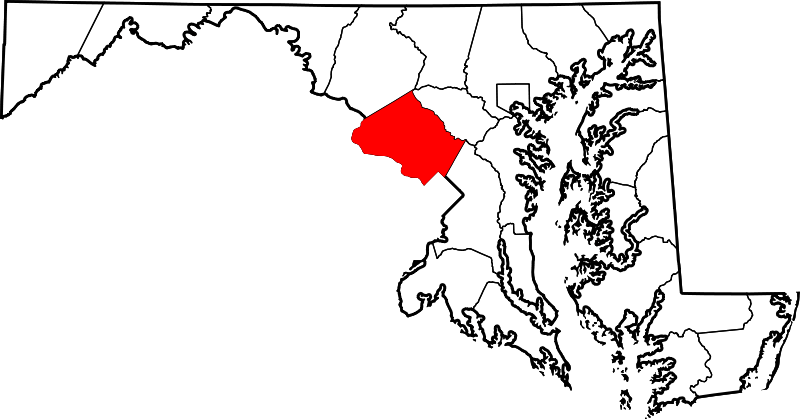
Some Comcast Cable customers in Montgomery County, Maryland are due refunds ranging between $19.95-39.95 for “truck trip fees” that came as a complete surprise.

Since 2007, Comcast has been quietly charging customers for service repair calls that the cable company determines are the result of inside wiring defects, customer-instigated equipment failure, or “no-cause” visits that find no problems with the customer’s service.  But after 85 Comcast customers in the county complained about service call fees that were never disclosed to them, Comcast is agreeing to return the money to affected customers.

Montgomery County, Maryland

In an agreement with the Montgomery County Office of Consumer Protection, Comcast must disclose that service call fees may be applicable under certain circumstances.  Customers must be given the option of canceling the service call with no penalty.

Service call fees are not charged when the company finds trouble in its own equipment or wiring.  In many cases, service call fees come at the discretion of the service crew dispatched to customer homes.  Customer attitude towards the cable company employees can make a big difference in getting them to waive fees, even if the problem turns out to be the customer’s responsibility.

Comcast is not alone charging fees for customer-created problems.  Verizon charges up to $110 in Maryland; RCN — a competing cable company — charges up to $49.95.

Under the terms of the settlement, Comcast does not have to admit any wrongdoing.

Judge Dismisses Hidden Cable Modem Fee Lawsuit Against Comcast

Phillip Dampier January 13, 2012 Comcast/Xfinity, Consumer News, Public Policy & Gov't 2 Comments

Motorola cable modem

A California federal judge has thrown out most of a class action lawsuit that charged Comcast with marketing broadband service plans without disclosing extra fees for cable modem equipment.

The head plaintiff, Athanassios Diacakis, claimed Comcast sold Triple Play promotions over the phone and in the media without mentioning customers would also have to pay additional fees to lease a cable modem.  Diacakis accused the cable operator of violating California’s tough false-advertising laws by not fully disclosing all fees and surcharges while explaining the promotion.

U.S. District Judge Saundra Brown Armstrong disagreed, however, dismissing most of the plaintiffs claims.  The judge didn’t declare Diacakis’ claims untrue, but ruled they were insufficiently documented to proceed to trial.

“The [amended complaint] fails to specify when or where Comcast advertisements were viewed, the content of those advertisements, or which of them in particular Plaintiff relied upon,” Armstrong wrote.

Diacakis is free to submit an amended complaint if he wishes to proceed with his class action case.

Comcast charges customers $7 a month to lease cable modem equipment, but invites customers to purchase their own cable modems to avoid rental fees.  Many customers do just that, choosing from several dozen approved models Comcast will provision for broadband customers.  The cost to purchase cable modem equipment ranges from $50-125 on average, depending on the cable modem selected.  It takes less than two years for purchased cable modems to effectively pay for themselves at Comcast’s current rental rate.

Search This Site:

Contributions:

Recent Comments:

Your Account:

Stop the Cap!