Home » Consumer News » Recent Articles:

Bright House Fires Up 2,000 Wi-Fi Hotspots For Customers Across Central Florida

Phillip Dampier January 18, 2012 Consumer News, Video, Wireless Broadband Comments Off on Bright House Fires Up 2,000 Wi-Fi Hotspots For Customers Across Central Florida

Bright House Networks Thursday switched on a huge network of free Wi-Fi hotspots for its broadband customers across central Florida.  Concentrated on coastal beach communities in eastern Florida and in the cities of Orlando, Tampa, and St. Petersburg, the new Wi-Fi service can be found on beaches and parks, inside malls and shopping destinations, downtown business districts, and medical facilities across their Florida service area.

Bright House Networks Wi-Fi Coverage Map

Existing Bright House broadband customers can log in and use the service for free:

  • Most wireless devices will display available networks. If the device doesn’t show networks, open the network options and select My BrightHouse or Bright House Networks.
  • Open the Internet browser of your choice.
  • When the WiFi HotZones page opens, click ‘log in’ under Bright House Road Runner Customer.
  • Log in using Road Runner email and password or My Services credentials.
  • Agree to the terms of use and connect to the WiFi network.

Non-customers can purchase access with a credit card in increments of as little as three hours.  Stop the Cap! readers in central Florida report speed test results of around 5/1Mbps from many of the Wi-Fi locations, which is much better than many other publicly available Wi-Fi networks.

Bright House says it has launched the Wi-Fi service to help customers hang on to their usage-limited mobile broadband allowances.

“We’re trying to save our customers money, time and energy,” Bright House spokesman Donald Forbes said.  “Plus, Wi-Fi is so much faster and such a better connection.”

Cable provider-delivered Wi-Fi is often used by the industry as a customer retention tool and goodwill gesture.  It typically uses the company’s pre-existing broadband infrastructure, which keeps costs low.

Bright House is soliciting customer feedback about possible new locations for future Wi-Fi hotspots.  The company plans to add at least 2,000 additional hotspots by the end of this year.

[flv width=”640″ height=”500″]http://www.phillipdampier.com/video/Bright House launches major Wi-Fi initiative 1-12-12.flv[/flv]

Bright House produced this informational video introducing its Wi-Fi service.  (2 minutes)

AT&T Gouges Californians With 25% Telephone Rate Increase

Phillip Dampier January 17, 2012 AT&T, Consumer News, Public Policy & Gov't 3 Comments

Years ago, phone companies could not simply raise rates willy-nilly.  They had to justify rate increases before an oversight body, usually on the state level.  But after spending millions to lobby state lawmakers to deregulate the phone business, AT&T is set to recoup their investment with a dramatic 25 percent rate increase for landline phone service in the state of California.

Some residential customers have kept basic landline service as a last resort, switching to “measured service,” where customers pay a small charge for every call they make or receive a calling allowance that covers several calls a day.  Measured service can deliver substantial savings over traditional flat rate service.  But now AT&T is targeting these “budget customers” for some stunning rate hikes.

Starting March 1st, AT&T is raising rates by nearly 25% for measured service — from $12.37 to $15.37 a month — a $3 increase.  After your calling allowance is exhausted, each additional local call will cost three cents per minute.

Customers with flat rate service will also pay AT&T $1.05 more — $21 a month (before taxes, fees, and surcharges) for basic flat rate, unlimited local calling.

Best of all (for AT&T), the company does not have to explain or justify the rate increase.  That attitude was evident when reading the Los Angeles Timesaccount of the rate hike, complete with an arrogant, shoulder-shrugging AT&T spokesman:

Lane Kasselman, an AT&T spokesman, said fees for measured and flat-rate calling plans are going up because, well, because.

“Goods and services go up,” he told me. “That’s how our economy works.”

The increase is expected to hit seniors and low income consumers the hardest — they are the biggest constituency of the 10 percent of AT&T customers who choose measured-rate, budget service.  They are also the least likely to have cut the cord on their traditional landline service in favor of a cell phone or competing Voice Over IP provider.

AT&T hints that the rate increase is partly to push customers into multi-service bundles that include phone, Internet, and television service.  By hiking the price of individual services, the bundled price suddenly seems to deliver the best “savings” for customers.

Critics call that price pumping — artificially raising the price of a-la-carte services to create phantom savings for the company’s higher-revenue bundled service packages.

A San Francisco advocacy group calls it something else.

“It’s extortion, pure and simple,” said Regina Costa, telecom research director for the Utility Reform Network, or TURN, a consumer group. “There’s no proof that these price increases are justified.”

Thanks to California’s deregulation of the landline phone business, no proof is required.

Editorial: Stop the Cap!’s View About the “Stop Online Piracy Act”

Phillip Dampier January 17, 2012 Consumer News, Editorial & Site News, Public Policy & Gov't, Video Comments Off on Editorial: Stop the Cap!’s View About the “Stop Online Piracy Act”

We have received several inquiries about where Stop the Cap! stands on the “Stop Online Piracy Act” — legislation currently in Congress designed to combat online piracy.  We’ve remained silent on this legislation for only one reason: we just haven’t have the time to cover it.  But I wanted to take a moment to answer the ongoing inquiries from readers about where we stand on this legislation.

In short, we oppose it.

As with virtually all legislation bought and paid for by large corporate interests, this attempt to thwart online piracy is yet another example of special interest overreach with a bountiful basket of unintentional consequences corporate lobbyists are not paid to consider when pushing the agenda of giant media and entertainment conglomerates.

As of yesterday, the Obama Administration seems to have recognized the growing opposition to the legislation from just about everyone apart from the corporate interests spending millions to promote and lobby it.  Some media reports seem to indicate SOPA is on the verge of being shelved, at least temporarily.  But you can be certain that like all monied legislation, it will be back.

Instead of a lengthy explanation about SOPA, we’d prefer to point you to some excellent pieces explaining why the proposed bill is a really, really bad idea.  Free Press has an organized campaign to stop the legislation in its current form, one that you should consider supporting, even if the bill is now languishing in Washington.  Also check out the Electronic Freedom Foundation’s web form to contact your legislators to oppose SOPA.

Stop the Cap! will participate in the Stop SOPA censorship campaign scheduled for tomorrow.  Visitors will first land on an information page explaining why this site “has been blocked.”  But that page includes a link to continue your journey back here, where regular coverage will continue.

Be sure to watch these two videos:

[flv width=”596″ height=”356″]http://www.phillipdampier.com/video/MSNBC Chris Hayes SOPA and Antipiracy Debated 1-15-12.flv[/flv]

Chris Hayes’ courageous in-depth debate about SOPA appeared on MSNBC, a network owned by Comcast-NBC, which ardently supports the legislation to the point of distributing pro-SOPA coffee mugs to employees. (18 minutes)

[flv width=”512″ height=”308″]http://www.phillipdampier.com/video/SOPA Marvin Ammori.flv[/flv]

Marvin Ammori’s assessment of the legislation appeared on Al-Jazeera English, one of the few news networks willing to discuss the proposed legislation on-air.  (4 minutes)

West Virginia Contractor Says Frontier Owes $1.6 Million, Forced to Lay Off 50+ Workers

Phillip Dampier January 16, 2012 Consumer News, Frontier 4 Comments

An Oak Hill, W.V. contractor has said Frontier Communications’ unwillingness to pay a $1.6 million dollar balance is behind a layoff of more than 50 employees who handled cable work and phone installations on behalf of West Virginia’s largest phone company.

S&N Communications laid off the workers indefinitely Jan. 9, telling them the phone company had not paid the contractor.

Frontier Communications issued a statement indicating the “contractual relationship between Frontier Communications and S&N Communications has ended.  Both parties consider such contractual arrangements to be confidential.”  It had no comment about S&N’s claim Frontier had an outstanding balance.

Frontier has experienced several challenges providing phone and broadband service in West Virginia.  A plague of copper thefts, poor service, and a broadband service interruption last Thursday affecting 9,000 residents have all presented problems for Frontier’s customers. On Sunday, a squirrel chewed through a fiber line that disrupted service for hundreds of customers in Brooke and Ohio counties, also knocking out service for Brooke County’s 911 center and sheriff’s office.

[flv width=”480″ height=”380″]http://www.phillipdampier.com/video/WVNS Ghent Telecommunications Company in Fayette County Lays Off Workers 1-11-12.mp4[/flv]

WVNS in Ghent, W.V. reports on the layoffs at S&N Communications.  (1 minute)

North America Losing Broadband Speed Race: Former Eastern Bloc Scores Major Gains With Fiber

Phillip Dampier January 16, 2012 Broadband Speed, Community Networks, Competition, Consumer News, Editorial & Site News, Public Policy & Gov't Comments Off on North America Losing Broadband Speed Race: Former Eastern Bloc Scores Major Gains With Fiber

North America’s broadband rankings continue to take a beating at the expense of countries deploying fiber optic broadband.  While the United States and Canada cope with aging landline technology and an uncompetitive marketplace that tells consumers they don’t need fiber-fast broadband speed, countries like Bulgaria, Lithuania and Estonia are lighting up 50-100Mbps networks that often charge lower prices than North Americans pay for 1-3Mbps DSL.

Ookla, a global leader in broadband testing and web-based network diagnostic applications, reports that the best performing broadband networks for speed, value, and performance are increasingly in Europe and Asia.  While both the United States and Canada used to be among the world leaders in broadband infrastructure, that is no longer true.

Some examples:

  • The United States now scores 31st in average download speed, Canada is 33rd;
  • In upload speed, America now ranks 37th, Canada a woeful 69th;
  • Ookla’s Household Quality Index, which ranks packet loss and general reliability of home connections found Canada scoring 27th place, the United States 38th;
  • At a cost per megabit, neither the US or Canada offers very good value.  The USA ranked 29th ($4.95 per megabit), Canada 33rd ($5.85 per megabit);
  • Neither country does a great job delivering the speeds and service promised either.  The USA ranked 25th, Canada 32nd.

Ookla found that while speeds are rising in North America, they are not increasing nearly as fast as in other, higher-ranked countries.  Most of the speed gains in North America come from cable or limited fiber-broadband deployments like Verizon FiOS or community-owned fiber to the home networks.  Wireline ADSL service, which represented a larger proportion of home Internet connections in 2008, continues to lose ground to faster options from cable companies, community-owned broadband, and phone company fiber upgrades.  In eastern Europe, the Baltics, Russia and Ukraine, many of the dramatic boosts in broadband speed and quality come as a result of national fiber network upgrade projects.
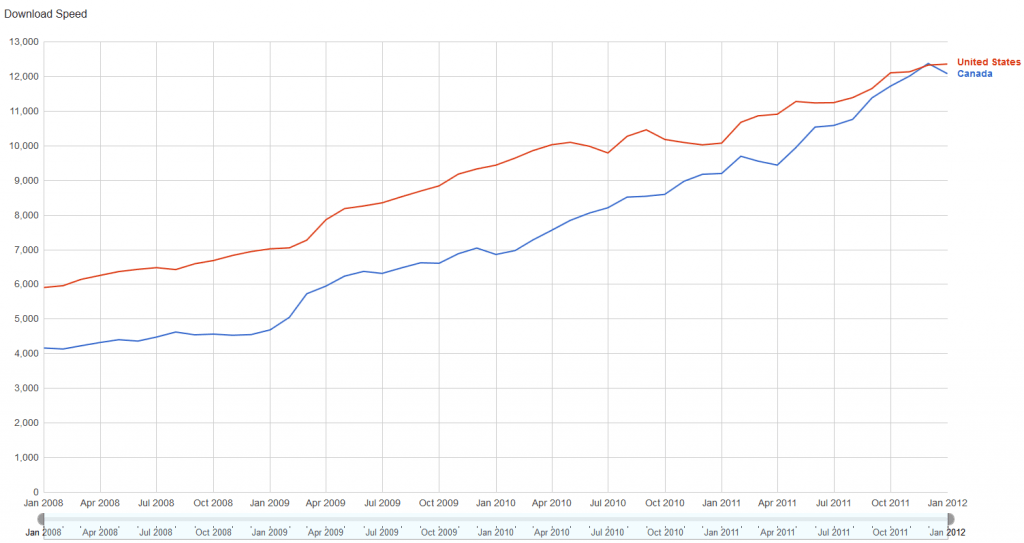
While speeds in North America are gradually increasing, both the U.S. and Canada are being outpaced by many countries in Europe and Asia.

While providers in the United States and Canada often dismiss fiber as too costly, Ookla found fiber-based networks delivering some of the world’s best values in broadband.

For example, on a cost-per-megabit basis, Bulgaria’s new fiber networks deliver the world’s cheapest Internet service, at an average of just $0.64 per megabit.  The average broadband speeds in the country are now higher than 21/11Mbps.
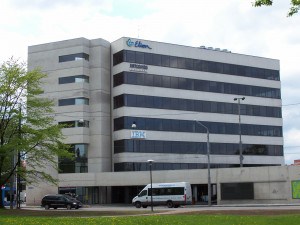
Elion headquarters in Tallinn. Elion delivers fiber broadband to homes across Estonia.

Contrast that with average speeds in the United States (12.41/2.97Mbps) and Canada (11.95/1.70Mbps).  Other top scoring countries for cost-per-megabit include:

  • Romania $0.97 USD
  • Lithuania $1.11 USD
  • Ukraine $1.17 USD
  • Republic of Moldova $1.41 USD
  • Latvia $1.80 USD
  • Hungary $2.00 USD
  • Slovakia $2.04 USD
  • Hong Kong $2.26 USD
  • Russia $2.51 USD

In terms of download speed, Estonia’s investment in a national fiber network is now paying dividends, with a dramatic increase in national average broadband speeds to 50/28Mbps.  As new cities join Estonia’s fiber network, speeds take a dramatic upswing.  Contrast average speeds in Saue (101.03Mbps), Viimsi (98.98Mbps), Tallinn (69.80Mbps), and Võru (65.58Mbps) with ADSL-rich Pärnu (12.55Mbps), Paide (12.40Mbps), Rapla (8.93Mbps), and Valga (7.71Mbps).

It is much the same story in other fiber-rich countries, where broadband speeds far exceed the averages in the United States and Canada:

Look what happens to Estonia's broadband speed rankings when it switched on its national fiber broadband network.

  • Lithuania 31.65 Mbps
  • South Korea 31.44 Mbps
  • Latvia 25.42 Mbps
  • Sweden 24.62 Mbps
  • Romania 24.47 Mbps
  • Netherlands 24.36 Mbps
  • Singapore 22.94 Mbps
  • Bulgaria 21.12 Mbps
  • Iceland 20.53 Mbps

Despite all of the bad news, the cable industry’s trade publication Multichannel News tried to find victory in the jaws of defeat, noting things could be worse… if they ran traditional phone companies.

Cable operators delivered the fastest average broadband download speeds in 2011 — with major MSOs easily blasting by rival telco and satellite Internet services — according to data from independent testing firm Ookla.

For the full year, the six fastest residential Internet service providers in the U.S. based on average download speed were Comcast, Charter Communications, Cablevision Systems, Time Warner Cable and Insight Communications.

[…] Comcast and Charter delivered average download speeds of 17.19 Megabits per second, followed by Cablevision at 16.40 Mbps, Cox at 15.76 Mbps, TWC at 14.41 Mbps and Insight at 14.22 Mbps.

Verizon Communications fared better than its telco peers with an average download speed of 12.94 Mbps, thanks to FiOS Internet, its fiber-to-the-home service that provides up to 150 Mbps downstream. And overall, Verizon had the highest upstream speeds with an average of 7.41 Mbps. Still, the company’s legacy DSL services dragged down overall speeds.

Behind DSL were woefully slower speeds from the nation’s wireless ISPs (which include 3G broadband from large companies like Verizon Wireless and AT&T), and perennially last place satellite Internet.

Moffett

Despite repeated claims by providers that consumers don’t need fiber-fast broadband speeds, industry analyst Craig Moffett at Sanford Bernstein tells a different story:

“Technology adoption is creating a feedback loop that increasingly favors cable’s physical infrastructure,” Moffett wrote in a research note last month. “As more people are served by higher-speed connections, more and more applications are evolving to take advantage of them. Customers with lower-speed connections are increasingly being forced to upgrade to higher speed connections… or be left behind.”

The conclusion reached by Multichannel News columnist Todd Spangler:

“The relative broadband speeds of cable vs. telco isn’t merely an academic curiosity: Major providers are increasingly touting Internet performance in their marketing as they fight for consumers’ dollars.”

Unfortunately for the cable industry, although DOCSIS 3 upgrades have afforded dramatic increases in broadband download speeds, upload speeds lag behind.  Fiber to the home networks are best positioned to achieve victory in the global broadband race.  That is important not only because it delivers consumer dollars to the best provider in town, but fuels the further development of the digital, knowledge-based economy North America increasingly seeks to lead.


Search This Site:

Contributions:

Recent Comments:

Your Account:

Stop the Cap!