Home » Consumer News » Recent Articles:

Breaking News: Time Warner Cable Relaunching Usage Based Billing

Phillip Dampier February 27, 2012 Consumer News, Data Caps 8 Comments

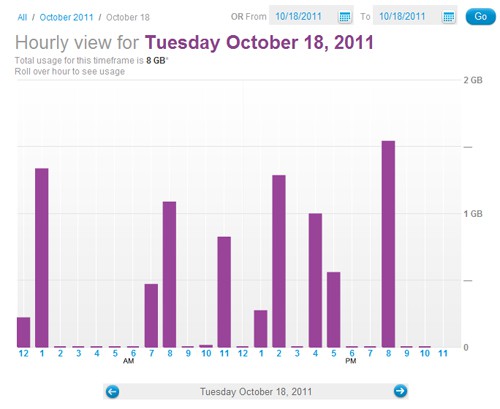
Time Warner Cable's usage meter.

Time Warner Cable today relaunched usage-based billing, offering customers a $5 monthly discount off Internet access when they confine their usage to a maximum of 5GB per month.

Stop the Cap! was at the forefront of protesting Time Warner’s last Internet Overcharging experiment in 2009, which would have allowed unlimited access for $150 a month — a major rate increase to be sure.  Other customers had usage allowances that originally would have ranged from 40-60GB per month, with overlimit fees of $1/GB or more.

Time Warner Cable’s Jeff Simmermon, director of digital communications, admitted the 2009 experiment attempted in Beaumont, San Antonio, and Austin, Texas, Greensboro/Triad, N.C., and Rochester, N.Y. was unsuccessful.

“Yes, we did try this before, a few years ago,” Simmermon said. “And yes, pretty much everyone agrees that it didn’t go so well. So we listened to customer complaints. A lot.”

The cable company is trying again in southern Texas, including the cities of San Antonio, Laredo, Corpus Christi, the Rio Grande Valley and the Border Corridor.

This time Simmermon says the usage-based pricing program for Time Warner Cable customers will be optional. He also promised Time Warner Cable customers will always have access to unlimited broadband at a flat monthly rate.

This is a major change for the cable company, because earlier statements from both CEO Glenn Britt and the chief financial officer Irene Esteves called usage based billing inevitable.

Simmermon admitted Time Warner Cable is making plenty of money selling unlimited access to customers today.

Simmermon

“We profit from unlimited consumption, and a free, open Internet is the sort of Internet that has gotten us this far,” Simmermon wrote on the company’s blog.

“All participation in the Essentials plan is opt-in, with the opportunity to save a few dollars each month,” Simmermon said. “It’s not going to be for everybody, and that’s fine — all Time Warner Cable customers will still have the option of selection an unlimited broadband plan.”

The details:

1) Up to 5GB/month of data transmission for a $5/month discount from one’s current monthly bill. All Standard, Basic and Lite broadband customers will be eligible. Turbo, Extreme and Wideband customers will continue as always, with access to unlimited broadband and no optional tiered plan or discounts.

2) The ability to opt-in and opt-out of a tiered package at any time.

3) A “meter” that tracks usage on a daily, monthly, weekly or even hourly basis, enabling customers to accurately gauge usage.

3) A 60 day/2 billing-cycle grace period to allow customers to adjust usage patterns. During this time the company will notify customers of overages but won’t charge for them.

4) Overages will cost $1 per GB, not to exceed a maximum of $25/month.

This presents the opportunity to save $5/month from a monthly broadband bill.

Time Warner already has the TV Essentials plan for $39.99/month that offers low-income households to have access to cable, in a stripped down package. Simmermon says this is meant to be the broadband equivalent.

[Stop the Cap! will publish our own views on this development in a separate editorial.]

Sprint Attempts, Pulls Back from Buyout of MetroPCS; Wall Street Questions Management

Phillip Dampier February 27, 2012 Competition, Consumer News, MetroPCS, Sprint, Video, Wireless Broadband Comments Off on Sprint Attempts, Pulls Back from Buyout of MetroPCS; Wall Street Questions Management

An aborted takeover attempt of MetroPCS by America’s third largest cell phone company — Sprint Nextel has some on Wall Street calling for the hide of Sprint CEO Dan Hesse.

The proposed multibillion dollar takeover of prepaid provider MetroPCS, which offers mostly urban service in select cities, was vetoed late last week by Sprint’s own board of directors.

The deal would have delivered a 30 percent premium to MetroPCS shareholders, and further consolidate America’s wireless marketplace. It would have also further complicated Sprint’s financial position — already heavily indebted as it commits to a major 4G wireless service upgrade and deals with an even more expensive commitment to Apple to pitch the iPhone on Sprint’s network.

Reuters reports some investors considered the deal a mistake and are glad it was aborted.

A 30 percent premium seemed “irrational” and would have hurt Sprint shareholders, Roe Equity Research Kevin Roe told the news service.

“He’s on a short leash,” Roe said. “The board did the right thing, thank God. It’s remarkable this deal got this far.”

MetroPCS competes with Sprint’s prepaid services in several regions including metropolitan New York City, northeastern Texas, southern California, southern Michigan and central/southern Florida.  MetroPCS operates its own 4G LTE network.

Now that MetroPCS is considered “in play,” it is likely other suitors may consider buying the company out.  Among the most likely — Leap Wireless, which owns Cricket and operates a comparable service.

Craig Moffett of Bernstein Research has told investors the wireless industry continues to be “crying out for consolidation.”  The most important players in that consolidation story are T-Mobile and Sprint, which remain potential partners if the two companies can overcome their technology differences.  T-Mobile operates a GSM network incompatible with Sprint-Nextel.

[flv]http://www.phillipdampier.com/video/CNBC Sprint Walks Away from MetroPCS Deal 2-24-12.flv[/flv]

CNBC reports Sprint walked away from a takeover attempt of MetroPCS on Friday.  (3 minutes)

In Denial: Nielsen and Cable Industry Still Don’t Believe in Cord-Cutting

ABC’s Daisy Whitney (New Media Minute) went in search for evidence that Americans really are fed up with their cable TV bill and are cutting the cord.  She collided head-on with an industry still in denial that consumers are fed up with high cable bills and relying on their home broadband connection for video entertainment.

Nielsen reports there are 5.1 million homes in the U.S. that have broadband-only service from their provider, and presumably rely on over-the-air TV for live televised events.  That’s up a huge 23 percent over last year.  But some analysts dismiss that as growth that comes from homes that never had broadband in the first place, a conclusion that needs more evidence to back it up.

Providers admit most of their new customers are coming from other broadband providers, especially as Americans dump slow DSL in favor of faster cable or fiber-delivered service.  In most areas, those who want broadband service already have it.  The primary exception: rural residents just accessing newly-available broadband for the first time.

For 20 years, the cable industry has enjoyed a growth in video subscribers.  That is no longer the case.  While the numbers are not staggering, hundreds of thousands of big cable customers are dropping their cable TV subscriptions every quarter, and they don’t seem to be taking their business to the competition.  Granted, many cancellations are income-related, especially among video-only customers, but it is clear a ceiling has been reached on what Americans will tolerate from the cable company.

With programming rate increases continuing unabated, that bill is only going up.

[flv width=”640″ height=”380″]http://www.phillipdampier.com/video/ABC Quitting Cable TV Truth or Lie 2-22-12.m4v[/flv]

Daisy Whitney’s New Media Minute explores cord cutting.  (2 minutes)


Customers Launch Petition Drive With Change.org to Stop Data Capping

Noted online petitioner Change.org will be promoting a petition to stop bandwidth capping this week.

Perhaps best known for hosting an appeal which influenced Bank of America to drop their proposed $5 monthly ATM card fee, Change.org will be presenting the ‘no data capping’ petition on various social media sites in an attempt to gain signatures.

The petition’s letter, directed to AT&T, Comcast, the Federal Communications Commission, and all Internet Service Providers (ISPs) who practice data capping, demands that they return to a billing model of unlimited access for a reasonable monthly fee.  Telecommunication providers have a responsibility to improve service, not lower it, the authors argue, particularly in light of the fact that taxpayer-funded broadband pipelines already exist, which the providers are not using.

Petition author David K. Smith argues that data caps contradict the Internet’s inherent purpose.  In the petition page’s linked article, “Why Data Caps Are Censorship,” he states that as the Internet is exponentially growing, one can always access more information than any data cap could allow, resulting in censorship from “the Big Picture.” The article maintains that exclusion from the total amount of information available results in “leashed” users having an incomplete perspective due to restricted access, and that incomplete, fragmentary information is useless.

“Now is a great time to be signing and sharing this petition,” said Smith.  “We have Change.org’s attention, and more and more articles are appearing to protest bandwidth injustices.  I feel this is a critical fight for our freedom to information.”

Change.org online help assets suggest that one of the most effective ways to gain signatures is for advocates to place a link to the petition under appropriate news and technical articles, along with a paragraph describing its relevance to the subject discussed.

[Stop the Cap! encourages readers to sign this (and other) petitions which declare the practice of Internet Overcharging unacceptable.  Whether it’s data caps or throttled speeds, customers deserve an unlimited, unthrottled Internet experience they pay good money to receive.  As financial reports show, today’s unlimited pricing formula delivers enormous profits to broadband providers, even as their costs to provide the service continue to decline.]

Rogers: Bill Shock Warnings Cost Us Money; Subscribers Fearing Fees Stop Using Data

Phillip Dampier February 23, 2012 Broadband Speed, Canada, Consumer News, Data Caps, Online Video, Rogers 1 Comment

Ever wonder why cell phone companies are upset about new regulations that would warn customers when they are about to face mobile usage overlimit or roaming fees?  Rogers Communications explains why in their latest quarterly results:

Nadir Mohamed, CEO:

There was, however, a sequential slowing in the wireless data revenue growth rate, and that’s primarily attributable to new outbound data roaming plans that we put in place. With these new plans, we put in place automated customer notification mechanisms that had a net effect of slowing usage versus stimulating it to the degree that we expected it to. We’re in the process of modifying how these plans and notifications work, which I expect will have a more stimulative effect and help restore the trajectory we had for wireless data growth.

In simpler terms, Rogers began notifying their customers through text messaging when they were about to start data roaming — the most expensive data usage around, incurred when you leave Rogers’ service area and roam on another provider’s network.  With Canadians visiting the United States and elsewhere, using a cell phone while traveling can get expensive fast.  Rogers created new roaming data plans for customers likely to need the service while abroad.  But their roaming data plans come at steep prices:

Unintended consequences: When subscribers know they are about to pay more, they stop using.

U.S. Data Passes

Day Pass: $5 for 2MB
Day Pass: $10 for 10MB
Day Pass: $20 for 40MB
Week Pass: $25 for 15MB
Week Pass: $50 for 60MB
Week Pass: $100 for 250MB

The warnings that customers were about to incur even higher a-la-carte roaming fees or start to consume their day or weekly data pass had the unintended, but highly predictable effect of getting people to think carefully about using data while roaming.

Bruce

While good for consumers, that is bad for Rogers’ bottom line, so the company’s formerly frank warnings to customers are “being modified” to help the company “stimulate” revenue and restore the predicted revenue growth from the high-priced roaming plans.

“We tried to create real transparency about when people and how people could get on data packages as they went overseas,” admits Robert Bruce, president of Rogers Communications Division. “We put in a fair number of reminders to let people know that they were on à la carte pricing, and we think that these dissuaded significantly customers from using it and possibly created some confusion along the way.”

Rogers Cable customers are also finding some of the company’s newest innovations a challenge to their monthly broadband usage allowances, among the lowest in Canada:

  • Rogers Remote TV Manager: Enables cable subscribers to search programming and manage PVR recordings anytime on any device;
  • Rogers Live TV. This service lets cable customers stream live TV channels on their tablets and watch shows anywhere they are in the home;
  • Rogers On Demand TV app on Microsoft’s Xbox 360 LIVE platform, bringing Rogers On Demand TV to the gaming console;
  • A refresh of the digital cable user interface, improving ease of use for the Whole Home PVR and a better program guide and search function.

In the long term, Rogers is moving towards an IP-based delivery system for its video programming, allowing the company to deliver video across different platforms more efficiently.  As Rogers converts the rest of its cable systems to digital cable, it is opening up new broadband capacity — a critical part of the company’s revenues.

Rogers admits it uses data caps to drive revenue.  By moving customers into higher usage, more expensive tiers, Rogers is able to drive revenue upwards as well.

“As customers continue every quarter, in and out, to consume more and more and spend more and more time on the Internet, we think it’s both a great opportunity for us and a welcome addition to the product offering from a customer perspective,” Bruce said.

Search This Site:

Contributions:

Recent Comments:

Your Account:

Stop the Cap!