Home » Competition » Recent Articles:

Spectrum Auction: T-Mobile Runaway Winner, But Dish Buy Puzzles Investors

Phillip Dampier April 17, 2017 Broadband "Shortage", Comcast/Xfinity, Competition, Consumer News, Dish Network, Public Policy & Gov't, T-Mobile, Wireless Broadband Comments Off on Spectrum Auction: T-Mobile Runaway Winner, But Dish Buy Puzzles Investors

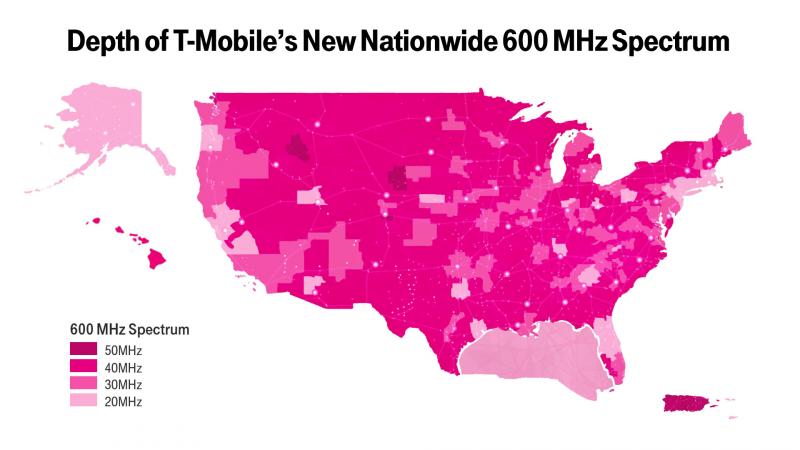
T-Mobile’s 600MHz coverage map — assuming it builds out its full spectrum purchase.

One of the most consequential and visible spectrum auctions ever is over, and it will have a significant impact on broadcasters, wireless carriers, and the future competitive landscape of the wireless industry.

The world’s first “incentive auction” paid television stations to voluntarily vacate or move their assigned channels to make room for the wireless industry’s desire for more spectrum to power wireless data services. Up for bid was 70MHz of spectrum currently used by UHF television stations. A total of 50 winning wireless bidders collectively agreed to pay $19.8 billion to acquire that space. The biggest winner was T-Mobile USA, which is paying almost half the amount of total proceeds to acquire 45% of the spectrum available in the current auction. T-Mobile managed to acquire enough spectrum to cover 100% of the United States and Puerto Rico with an average of 31MHz of available spectrum nationwide, quadrupling its current inventory of important “low-band” spectrum, which is excellent for covering rural areas and inside buildings.

Consumers are likely to benefit as early as later this year when T-Mobile begins lighting up cellular service utilizing the newly available spectrum. Unfortunately, customers will have to buy new devices compatible with the new bands of frequencies.

Having the spectrum alone is not enough to beef up T-Mobile’s network. The company will have to invest in a large number of new cell sites, particularly in outlying areas, to eventually rival the coverage of AT&T and Verizon Wireless. But with an ample supply of 600MHz spectrum, T-Mobile could soon challenge AT&T and Verizon Wireless’ perceived network and coverage superiority. After this auction, AT&T continues to hold the largest portfolio of <1GHz spectrum — 70.5MHz. Verizon is second with 46.2MHz and T-Mobile has moved up in its third place position with 41.1MHz.
Although the FCC claims the current auction was among the highest grossing ever conducted by the FCC, industry observers claim companies got the new frequencies at a bargain price. A 2015 spectrum auction attracted $44.9 billion in bids, more than double the amount bid this year. The average price wireless companies paid per megahertz per person this year was just shy of 90¢, compared with $2.72 in 2015.

Where bargains are to be had, Charles Ergen and his Dish Network satellite company are sure to follow.

Few companies have as much unused wireless spectrum in their portfolio as Dish. Ergen loves to bid in auctions and has also picked up excess spectrum available on the cheap from other satellite companies that have since gone dark or bankrupt. Dish spent $6.2 billion on spectrum during the latest auction, puzzling investors who drove Dish’s share price down wondering what the company intends to do with the frequencies.

Investors were hoping Dish would eventually sell its spectrum portfolio at a profit, something that could still happen if other wireless carriers see a deal to be made. But some Wall Street analysts fear Dish might actually build a large wireless network of its own to offer wireless broadband service. Wall Street dislikes big spending projects and the competition it could bring to the marketplace, potentially driving down prices.

The other possibility is that Dish is making itself look more attractive to a possible buyer like Verizon, which could acquire the satellite company to win cheaper cable programming prices for its FiOS TV and an attractive amount of wireless spectrum for Verizon Wireless. The nation’s biggest wireless carrier notably did not participate in this spectrum auction.

Another unusual bidder was Comcast. Craig Moffett from Wall Street firm MoffettNathanson called Comcast’s $1.7 billion bid “half-hearted” and said it was unlikely to be enough spectrum for the company to begin offering its own wireless service. Comcast plans to rely on Verizon Wireless to power its wireless service, at least initially.

Comcast targeted its bids only in cities where it already provides cable service, which also nixes the theory Comcast and Charter might have been working together to form a cellular joint venture. Moffett expected Comcast would seek at least 20MHz of spectrum across most of the country. It ended up with 10MHz and only in select cities. Moffett thinks that may signal Comcast’s interest in buying an existing wireless carrier is still on the table.
Drahi’s Acquisition Quest ’17 – Altice Could Seek Up to 30% Of U.S. Telecom Market

Phillip Dampier April 12, 2017 Altice USA, Competition, Consumer News, Public Policy & Gov't Comments Off on Drahi’s Acquisition Quest ’17 – Altice Could Seek Up to 30% Of U.S. Telecom Market

Patrick Drahi

“If he can succeed with a corporate-friendly Trump Administration and his lackey Republican legislators and regulators, Patrick Drahi’s Altice could seek to own or control up to 30% of the American telecoms market,” said A.W. Dewalle, a researcher studying Altice’s unprecedented acquisition-frenzy across the world’s telecommunications marketplace. “His IPO in the land of Uncle Sam is just the first shot and it will make a lot of executives very rich and consolidate America’s cable industry.”

Wall Street banks are clamoring for a piece of Altice’s initial public offering, announced this week. The big winners, who will split substantial fees paid to advise Altice USA, are Goldman Sachs, JP Morgan, Morgan Stanley and Citi. The IPO will allow the Drahi-controlled Altice USA to raise money for further acquisitions in the United States and to potentially restructure its existing debt, run up acquiring Cablevision and Suddenlink.

Reuters reported that Drahi’s biggest U.S. shareholders — BC Partners and the Canadian Pension Plan Investment Board will use the IPO as an opportunity to sell some of their combined 30% stake in Altice USA, giving Drahi further assurance he will stay firmly in control of the American operation as he takes on new investors.

Les Echos reports Drahi’s pattern is a familiar one for a man in a hurry to take a much bigger stake in the American telecom market, where profits are high and competition is relatively low. By raising additional funds, Altice USA can show financial strength as it appeals to bankers to loan it the billions in will need to acquire existing cable (and potentially phone) companies. If Altice uses some of the money to repay its existing $20 billion U.S. debt, that could also win the company favorable interest rates on its future loan portfolio.

Drahi is an acquisition specialist, having bought more than 30 companies to add to his Altice portfolio since its start in 2002. Low interest rates, favorable banking terms and corporate deregulation have fueled the shopping spree. With the election of Donald Trump in the U.S., Altice is convinced the sky is the limit when it comes to mergers and acquisitions.

“Everything about his government and the people he has put in place at regulatory agencies says deregulation, ‘laissez-faire,’ and consumers beware,” said Dewalle, a point echoed in part by the Financial Times.

The election of Donald Trump has lifted expectations among chief executives that it will be easier to consolidate companies in the telecoms, media and technology (TMT) sector, as the Republican president has a more laissez-faire approach towards competition. Many media and telecom players are under pressure to boost margins and find new growth avenues, while facing declining sales, according to a senior banker in the industry. “M&A might be the only option for many companies in this sector and Altice will certainly try to play a big role in this,” said [one] banker.

Altice is already laying the public relations groundwork to convince skeptical legislators and regulators that an Altice buyout is not bad news for customers. Altice is spending millions to scrap Cablevision’s existing hybrid coax-fiber network for a 100% fiber to the home replacement. Other upgrades are also ongoing across Suddenlink’s footprint.

Because the American telecom marketplace is not nearly as competitive as the one Altice faces in Europe, Americans are accustomed to paying for broadband and television services at prices that would be scandalous in France. The excess profits earned in America can help Altice finance fiber upgrades in its more competitive European markets. Altice confirmed this week it planned to invest more in 4G wireless upgrades for its SFR division in France and will cover 22 million French homes with fiber to the home service by 2022 and 5.3 million homes in Portugal by 2020.

How big will Mr. Drahi seek to get in the United States? He testified before the Economic Affairs Committee of the French Senate last June, telling legislators he owns or controls about one-third of the French telecom market. In the United States, he controls just 2%, leaving plenty of room to grow.

French business experts predict Drahi will initially seek to sweep up the remaining independent cable operators in the States into the Altice empire before turning attention to a big player like Comcast or Charter Communications, the largest and second-largest American cable operator respectively. Publicly traded companies like Cable ONE would be the first prime targets for an Altice buyout. But Drahi could also repeat his Cablevision acquisition by offering a premium price for privately held operators like Cox Communications, which has a presence in larger cities, and Mediacom — which provides service in 23 states and has a big presence in the midwest.

Most of the rest of America’s independent cable operators are small, regional operations serving smaller communities. Drahi has his choice of these kinds of operators that include Adams Cable, Armstrong, Atlantic Broadband (owned by Canada’s Cogeco), Blue Ridge Communications, Buckeye Broadband, Hargray, Midco, Northland, Service Electric, TruVista, Wave Broadband (exploring a sale), and WOW, among others.

Thus far, Drahi has not shown much interest in acquiring telephone companies, so analysts expect him to confine his acquisitions to the cable business. Even if Drahi acquires a substantial cable portfolio in the United States, he will argue he still faces competition from telephone companies in those same service areas. What Drahi won’t do is compete from the ground up by building a competitive cable system to face off against a firmly entrenched American duopoly.

“That would be bad for business,” said Dewalle.

FCC Considering Making It Easier for Telcos to Kill Landline/DSL Service

The FCC has circulated a draft rulemaking that proposes to make it easier for phone companies to end landline and DSL service in areas they are no longer interested in maintaining existing infrastructure.

“We propose eliminating some or all of the changes to the copper retirement process adopted by the Commission in the 2015 Technology Transitions Order,” according to the draft, which would allow phone companies to end service “where alternative voice services are available to consumers in the affected service area.”

The proposed new policy would depart significantly from the one put in place during the Obama Administration because it would end assurances that competing providers would have reasonable and affordable access to wholesale broadband and voice services after phone companies mothball their copper wire networks in favor of wireless or fiber alternatives. If the FCC proposal passes, incumbent phone companies like Verizon and AT&T could end rural landline and DSL service and not make provisions for competitors to have access to the technology alternatives the phone companies would offer affected customers.

Verizon immediately praised the FCC proposal, saying it was “encouraged the FCC has set as a priority creating a regulatory environment that encourages investment in next-generation networks and clears away outdated and unnecessary regulations,” wrote Will Johnson, senior vice-president of federal regulatory and legal affairs at Verizon. “This action is forward-looking, productive and will lead to tangible consumer benefits.”

Previous attempts by Verizon to discontinue landline and DSL service did not lead to “tangible consumer benefits” as Verizon might have hoped. Instead, it led to a consumer backlash, particularly in areas affected by Superstorm Sandy in 2012. Verizon elected not to rebuild its copper wire infrastructure in affected coastal communities in New York and New Jersey. Instead, it introduced a wireless landline replacement called Voice Link that proved unpopular and caused a revolt among residents on Fire Island. The wireless replacement did not support data, health monitoring, credit card transaction processing, faxing, and was criticized for being unreliable. Verizon eventually relented and opted to expand its FiOS fiber to the home network on the island instead.

Verizon also attempted to market Voice Link to New York residents in certain urban and rural service areas affected by extended service outages in lieu of repairing its existing infrastructure. Under the proposed changes, the FCC would ease the rules governing the transition away from copper-based services, which include traditional landline service and DSL, in favor of wireless technology replacements and fiber optics.

Because telephone companies like AT&T and Verizon have made mothballing rural wireline infrastructure a priority, the FCC strengthened its rules in 2015 by doubling the notification window from 90 to 180 days, giving more time for affected customers to make other service arrangements or complain to regulators that there were no suitable alternatives. The FCC wants to roll back that provision to its earlier 90-day notification window in response to telephone company complaints that maintaining copper wire infrastructure is expensive and diverted investment away from next-generation networks.

AT&T has been lobbying for several years to win permission from state legislatures to abandon copper wireline infrastructure, mostly in rural areas, where the company has chosen not to upgrade to fiber optic networks. AT&T claims only about 10% of their original landline customer base still have that service.

Both Verizon and AT&T have shown an interest in moving rural consumers to more proprietary wireless networks, preferably their own, where consumers would get voice and data services. But consumer advocates complain customers could lose access to competitive alternatives, may not have a guarantee of reliable service because of variable wireless coverage, could pay substantially more for wireless alternatives, and may be forced to use technology that either does not support or works less reliably with home security systems, medical monitoring, faxing, and data-related transactions like credit card processing.

Other consumer groups like AARP and Public Knowledge have complained that shortening the window for a transition away from basic landline and DSL service to alternative technology could disproportionately affect the customers most likely to still depend on traditional wireline service — the elderly, poor, and those in rural areas.

Comcast’s NBC Preparing Launch of Subscription “All Access”-Style Streaming Service

Comcast’s NBCUniversal is laying plans to introduce a premium online video service highlighting NBC Network content and possibly various programming from the various cable channels owned by Comcast.

After watching rival CBS amass more than 1.5 million subscribers for its “All Access Pass” ($5.99, $9.99/mo for commercial-free option), Comcast’s NBC entertainment division isn’t willing to leave money on the table any longer.

The yet unnamed service is expected to compete with services like Hulu and Netflix, but will most likely be comparable to CBS’ premium subscription offering. In addition to featuring a deep library of NBC content, the service could include a significant catalog of past and present shows from cable networks like Bravo, SyFy and USA. Also to be determined is whether NBC will follow CBS’ lead and offer viewers live streaming of their local NBC station as part of the package.

The new service may not launch in the immediate future because Comcast is still observing restrictions imposed by regulators as a condition of its 2011 acquisition of NBCUniversal. The rules make it difficult for Comcast to develop services comprised entirely of content it owns or controls. Federal regulators added the restriction out of concern Comcast could interfere with Hulu’s access to NBC content. Hulu is popular with cord-cutters, and is seen as a viable alternative to cable television. The last of these restrictions expire in September 2018, about the time Bloomberg News reports Comcast is likely to launch the service.

If all the major American networks decide to develop their own premium streaming services, it could have significant implications for Hulu, which combines content from its partners NBC, ABC, and FOX. If NBC pulls out of the partnership, it will be free to keep all the revenue earned from its own streaming platform, and could inspire ABC and FOX to follow.

Observers suspect this represents more evidence that broadcast networks increasingly expect viewers to pay for access to their programming, at least online.

Here’s What You Need to Know About Comcast’s Xfinity Mobile

Phillip Dampier April 10, 2017 Comcast/Xfinity, Competition, Consumer News, Wireless Broadband Comments Off on Here’s What You Need to Know About Comcast’s Xfinity Mobile

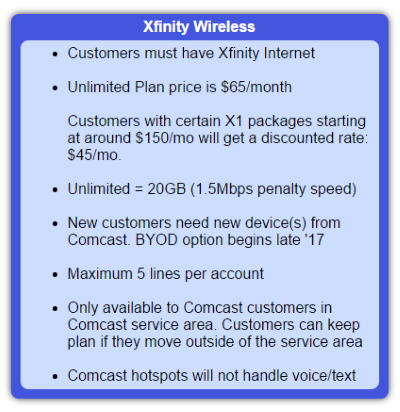
Comcast, the nation’s largest cable television operator, will compete for wireless customers with a new no-contract wireless plan that combines Verizon Wireless’ mobile network with Comcast’s installed base of 16 million hotspots installed in customer homes and businesses.

Xfinity Mobile will offer two plans — a pay as you go option for $12/GB and an unlimited calling, texting, and data plan that ranges from $45-65 a month. Customers spending about $150 or more on a Comcast X1 bundle of services will pay the lesser amount, while those with a more basic package will pay more. Customers must at least subscribe to Xfinity Internet service to qualify for the new wireless plan and live in a Comcast service area.

Comcast is powering its cell phone service with its MVNO agreement with Verizon Wireless, which grants the cable company the right to resell Verizon’s wireless network under the Xfinity brand. But Comcast hopes customers will use their devices the most while connected to an Xfinity Wi-Fi hotspot, available in most Comcast customer homes and an extensive network of businesses. To make sure that happens, devices acquired from Comcast will come pre-configured to automatically connect to Comcast’s Wi-Fi, where available.

Comcast’s “unlimited” $65 plan — likely to be the most popular option, is between $15-25 less than what Verizon and AT&T charge their customers for a comparable plan, at least for accounts with just a single device attached. Like other “unlimited” plans, Comcast has a fine print data cap: 20GB of wireless data usage per month, after which it will throttle the customer’s connection until the next billing cycle begins. Comcast intends to always impose the speed throttle once 20GB is reached, not just in areas with congested cell towers. But throttled speeds will be a less maddening 1.5Mbps instead of the usual 128kbps most carriers use to punish their data-heavy users.

Overall, the plan may deliver some savings to current Comcast customers unfazed by signing up for a “quad play” bundle of wireless, phone, TV, and internet access, especially for those bringing a single wireless line to Comcast. Customers with multiple wireless devices on a family plan may want to do the math before signing up with Comcast. Unlike other wireless carriers, Comcast does not offer a discount for additional lines. For most, the price will be $65 a month for each line. For an account with four lines, that would amount to $260 a month — $75 more than what AT&T charges for a similar four-line plan.

Comcast may also attract some interest from light users or those with devices like tablets. Comcast’s $12/GB data plan has no limits or minimum charges. If a customer doesn’t use the plan, there are no charges. If a customer on this plan approaches 4GB of usage in a billing cycle, they can upgrade to Xfinity’s unlimited wireless plan ($45-65) mid-month and then use up to 20GB of data with no extra charges or speed throttles. Customers can put some devices on an unlimited plan and others on a pay-as-you-go plan on the same account.

Early adopters ready to sign up when the service launches this May or June will need to buy new devices from Comcast. The company will sell current generation Apple iPhones, Samsung Galaxy smartphones, and a budget option from LG Electronics. Customers can pay for devices upfront or receive interest-free financing.

Comcast’s interest in entering the wireless business represents the latest effort to keep customers locked into Comcast’s suite of products and services. The more services a customer bundles with Comcast, the more disruptive it will be to switch to another provider.

“The economics really work,” Comcast CEO Brian Roberts said in January. “The goal of the business is to have better bundling with some of our customers who want to save on some of their bill and get a world-class product.”

Because Comcast will rely entirely on Verizon Wireless to provide cellular connectivity, the cost of getting into the mobile business is relatively low. Comcast struck a deal with Verizon several years ago giving the cable company “perpetual” access to Verizon Wireless, as well as any upgrades Verizon makes to its network in the future. However, Verizon still has the right to raise prices on Comcast, potentially slowing or stopping Xfinity Wireless from ever growing large enough to threaten Verizon’s profits.

Charter Communications is planning to introduce a similar wireless product in 2018.

Search This Site:

Contributions:

Recent Comments:

Your Account:

Stop the Cap!