Home » Competition » Recent Articles:

Comcast: Cable Costs About As Much as a Cup of Coffee (Starbucks Coffee, Maybe)

Phillip Dampier September 19, 2012 Comcast/Xfinity, Competition, Consumer News, Editorial & Site News Comments Off on Comcast: Cable Costs About As Much as a Cup of Coffee (Starbucks Coffee, Maybe)

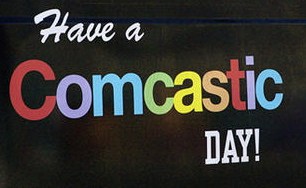
The last time Comcast charged less per day than the cost of a cup of coffee, they used this logo.

Comcast is raising rates on its Atlanta-area customers effective Oct. 1.

“Despite working hard to keep down our prices, we are continuing to experience increased costs, including rising programming expenses, while also investing in next-generation technologies that deliver new innovations,” said Brian Farley, a spokesperson from Comcast. ” This year alone, we’ve added 15 new channels in in metro Atlanta – including Disney Junior, ShopNBC and ESPN Goal Line – and made our programming available on additional screens.”

It is uncertain how many Atlanta area customers were clamoring for Comcast to add ShopNBC — a network Comcast now owns with the purchase of NBC-Universal, much less pay extra for it.

Comcast expects most customers will see increases averaging $3 a month on their October bills. But the cable operator also took time to remind customers of the incredible value cable television still offers Atlanta:

Comcast: $2.28 a day. A cup of coffee at the Atlanta Diner? $1.65

“At just a few dollars a day, cable is about the price of a cup of coffee and significantly less expensive than taking a family to the movies or a sporting event,” Farley said.

Perhaps, but not always.

Comcast charges just under $70 for its popular Xfinity Digital TV Starter package — around $2.28 a day. Atlanta-area Regal Theaters charge around $11 a ticket — $44 for a family of four. The Atlanta Diner charges $1.65 for a cup of coffee (with free refills). Assuming you visited them for 30 days, your coffee tab would run $49.50, still much less than what Comcast charges every month.

More than a decade ago, cable operators used to claim their service was still less than a cup of coffee. It actually still might be, assuming your cup of coffee comes from Starbucks.


Despite Provider Propaganda, Broadband Competition and Value for Money Lacking

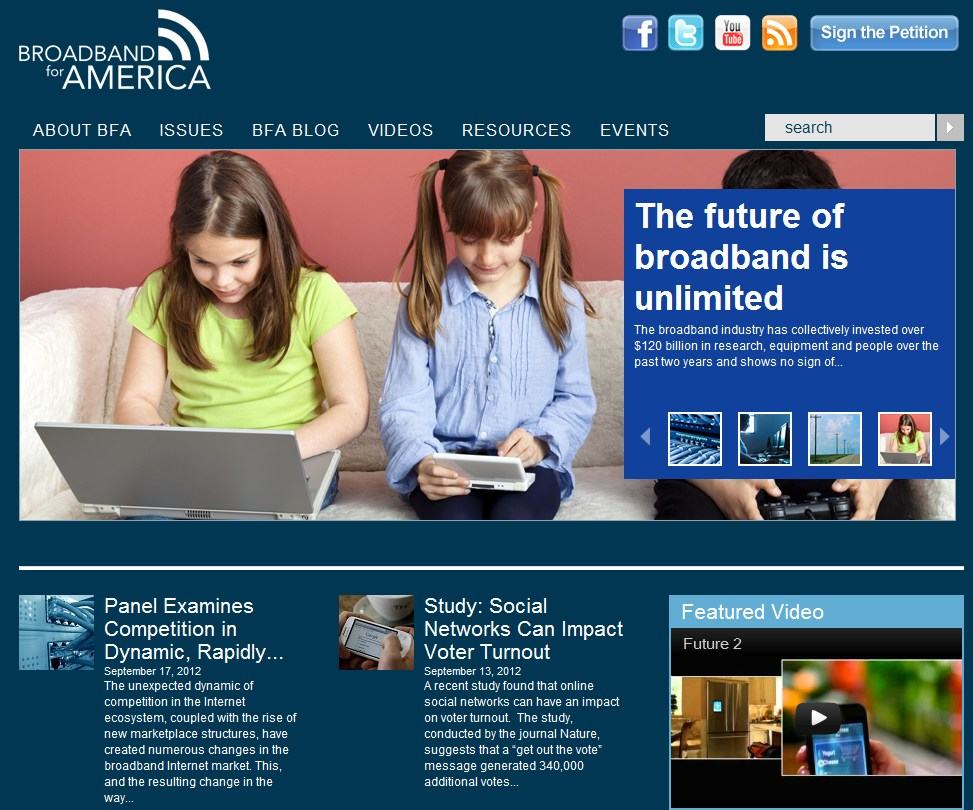
Despite industry propaganda touting an “unlimited broadband future” (possibilities, that is, not an end to usage caps) and good sounding headlines about robust competition in the broadband market, the reality on the ground isn’t as rosy.

Americans looking for a better deal for broadband are largely stuck negotiating with the local cable company or putting up with less speed from the phone company to get a cheaper rate.

That is hardly the “success story” being pushed by the Mother of All Broadband Astroturf Front Groups, Broadband for America. BfA, backed by money from some of America’s largest telecom companies calls today’s marketplace “dynamic” and “rapidly changing.” For them, competition is not the problem, the way we define competition is.

Tell that to San Jose Mercury News columnist Troy Wolverton, whose dynamic and rapidly changing Comcast cable bill has now reached $144 a month, and threatens to go higher still when his two-year contract expires.

Wolverton is a case study of what an average American consumer goes through shopping around for broadband service. Despite assertions of a vibrant, competitive Internet access paradise from groups like Broadband for America, Wolverton found very little real competition on the menu, despite being in the high tech heart of Silicon Valley.

Valley residents can typically choose between AT&T and Comcast, if they have any choice at all. Neither company offers a great deal for consumers.

Comcast offers faster speeds at considerably higher prices that can be reduced somewhat by signing up for a costly triple-play service. AT&T’s prices are lower, but its service is slower and is based on a technology that in my experience is less reliable.

So it goes for millions of Americans who face the same dilemma: take a higher-priced package from the cable company or settle for less from the phone company. With the exception of Verizon FiOS, most large telephone companies still rely on basic DSL service to deliver broadband. AT&T’s U-verse and CenturyLink’s Prism are both fiber to the neighborhood services that deliver somewhat faster speeds than traditional DSL, but also have to share bandwidth with television and traditional phone service, leaving them topped out at around 25Mbps.

Wolverton could not believe his only choices were Comcast and AT&T, so he visited the California Broadband Availability Map, one of the state projects earnestly trying to identify the available choices consumers have for broadband access. Despite California’s vast size, it quickly became apparent that even companies like AT&T and Comcast largely don’t deliver broadband outside of cities and suburbs. Several smaller, lesser-known providers emerged from the map that were open to Wolverton, which he explored with less-than-satisfying results:

In addition to Comcast and AT&T, it listed Etheric Networks, which offers a wireless Internet service directed at home users that’s based on Wi-Fi technology, and MegaPath, which offers Internet access through a variety of wired technologies, including DSL.

After further research I found that neither of those companies was a legitimate option. MegaPath can’t deliver residential service to my house that’s faster than 1.5 megabits per second. Etheric, which focuses on business customers, offers a service level with speeds of up to 22 megabits per second, but it costs a cool $400 a month.

Other non-options for Wolverton included the highly-rated Sonic.net, which in his neighborhood is entirely dependent on AT&T’s landlines for its DSL service. That was a no-go, after Wolverton discovered he would be stuck with 3-6Mbps service. Clearwire also offers service in greater San Jose, but not at his home in Willow Glen.

That left him back with AT&T and Comcast.

But that is not really a problem in the eyes of industry defenders like Jeffrey Eisenach, managing director and principal at Navigant Economics and an adjunct professor at George Mason University Law School. Navigant is a “research group” that counts AT&T as one of its most important clients. The firm provides economic and financial analysis of legal and business issues cover for clients trying to sell their agenda. Navigant’s “experts have provided testimony in proceedings before District Courts, the Department of Justice, the Federal Trade Commission, the Federal Communications Commission, the Federal Energy Regulatory Commission, and numerous state Public Utilities Commissions.”

Eisenach goes all out for the broadband industry in his paper, “Theories of Broadband Competition,” which throws in everything but the kitchen sink to defend the status quo:

  • The cost of broadband service is declining;
  • The duopoly of cable and phone companies are still competing for customers and introducing new services;
  • Competition can take the form of provider innovation (ie. providers compete by offering a better services, not lower prices);
  • Wireless competition is accelerating, citing LightSquared and Clearwire as two conclusive examples of competition at work;
  • The cost of service on a per-megabit basis has declined.
  • Competition in today’s broadband market delivers ancillary benefits not immediately evident when only considering the customer’s point of view;
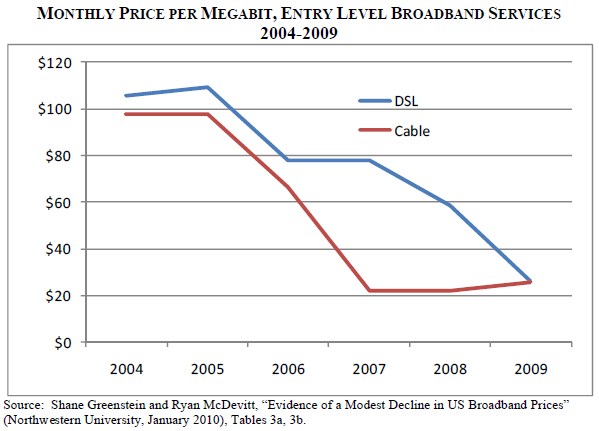
Eisenach’s pricing proof stopped in 2009, just as cable providers like Time Warner Cable began raising broadband prices. TWC’s Landel Hobbs to investors: “We have the ability to increase pricing around high-speed data.” (February, 2010)

Eisenach has appeared at various industry-sponsored evidence touting his views of broadband economics and competition that later turns up as headline news on Broadband for America’s website. But just as Wolverton’s initial optimism finding other choices for broadband faded with reality, so do Eisenach’s conclusions:

  1. Eisenach’s evidence of broadband price declines stops in 2009, coincidentally just prior to the recent phenomena of cable broadband rate increases, which have accelerated in the past three years;
  2. Competition still exists in urban and suburban markets, as long as phone companies attempt to stem the tide of landline losses, but it’s largely absent in rural markets and in decline in others where companies “reset” prices to match their cable competition. AT&T’s U-verse and Verizon’s FiOS both effectively ended their expansion, leaving large swaths of the country with “good enough for you” service. Cable operators have even teamed up with Verizon Wireless to cross-market their products — hardly evidence of a robustly competitive marketplace;
  3. Innovation can take the form of services customers don’t actually want but are compelled to take because of bundled pricing or, worse, the decline in a-la-carte add-ons in favor of “one price for everything” models. Verizon Wireless set the stage for providers of all kinds to consider mandatory bundling for any product or service that can no longer deliver a suitable return on its own. For customers already taking every possible service or fastest speed, this pricing  may deliver lower prices at the outset, but for budget-focused consumers, compulsory packages or high prices on a-la-carte services assures them of a higher bill;
  4. Eisenach’s examples of competition are a real mess. LightSquared is bankrupt and Clearwire has shown it cannot deliver an equivalent broadband experience for customers and throttles the speeds of those perceived to be using the service too much. Other wireless providers typically limit customer usage or cannot deliver speeds comparable to wired broadband;
  5. While the cost per megabit may have declined in the past, cable providers are still raising prices, and as Google and community-owned providers have illustrated, delivering fast speeds should not cost customers nearly as much as providers continue to charge, with no incentive to cut prices in the absence of equally fast, competitive networks;
  6. While broadband may open the door for additional economic benefits not immediately apparent, competitive broadband would further drive innovation and reduce pricing, delivering an even bigger bang for the buck.

Wolverton recognized taking a promotional offer from AT&T will temporarily deliver savings over what Comcast charges, but he would have to set his expectations lower if he switched:

I’m reluctant to switch to AT&T. [U-verse] Max Plus is the fastest level of service it offers at our house, but with a top speed of 18 megabits a second, it’s significantly slower than Comcast’s Blast. Speed matters to us, because my wife and I often share our Internet connection, and we frequently use it to transfer large files such as apps, videos, photos or songs to or from the Net.

[…] What’s more, as the FCC outlined in another recent report, Comcast does a better job of delivering the speeds it advertises than does AT&T.

What’s worse in my book is that AT&T’s U-verse’s Internet service is a version of DSL. It’s faster than regular DSL, because the copper wires in your house and neighborhood are connected to nearby high-speed fiber-optic cables. Even with that speed boost, though, I’m hesitant to go back to any kind of DSL service, because my wife and I suffered through years of unreliable DSL service from AT&T predecessor PacBell and then EarthLink, which piggybacked on AT&T’s lines.

Wolverton also objected to Comcast’s bundled pricing scheme, which delivers the best value to customers who sign up for broadband, television and phone service. Wolverton does not need a landline from AT&T or Comcast, and would like to drop the service. He’s not especially impressed with Comcast’s TV lineup (or pricing) either. But he noted if he switched to broadband-only service, Comcast would effectively penalize him with a broadband-only rate of $72 a month, exactly half the current cost of Comcast’s triple-play package.

In a later blog post, Wolverton confessed he liked Comcast’s broadband service and speeds, and with the carefully-crafted pricing the cable and phone companies have developed, he expected to remain a Comcast customer given his choices and pricing options, which are simply not enough.


Chattanooga’s Can-Do Broadband: Faster Speeds, Lower Prices While Others Hike Rates

Phillip Dampier September 18, 2012 AT&T, Broadband Speed, Comcast/Xfinity, Competition, Consumer News, Editorial & Site News, EPB Fiber, Public Policy & Gov't Comments Off on Chattanooga’s Can-Do Broadband: Faster Speeds, Lower Prices While Others Hike Rates

While cable and phone companies make excuses justifying rate increases and usage caps, Chattanooga’s publicly-owned EPB Fiber network has been blowing the windows out with hurricane-fast gigabit broadband, and now they are cutting prices for some while boosting speeds for others.

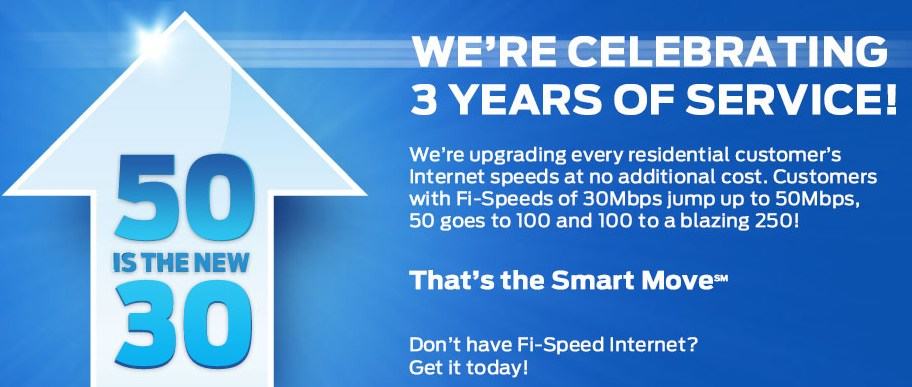
At the recent Hackanooga event, EPB customers learned the fiber to the home provider was set to celebrate three years of service by delivering value for speed that Comcast and AT&T can’t touch:

  • 30/30Mbps customers will now receive 50/50Mbps service for $57.99 a month;
  • 50/50Mbps customers are now getting 100/100Mbps speeds for $69.99;
  • 100/100Mbps customers are now seeing 250/250Mbps service for $139.99;
  • 1000/1000Mbps service is getting a significant price cut: $299.99 a month, down $50.

In comparison, Comcast customers pay $115 a month for hardly-comparable 105/20Mbps service and they will nail you with a modem rental fee. Don’t call AT&T for 100Mbps speeds, they’ll call you. The U-verse platform can’t even achieve 30Mbps in its current configuration.

“This is the second time EPB has upgraded service to customers for free,” says Lisa Gonzalez from Community Broadband Networks. “In 2010, EPB upgraded 15Mbps service to 30Mbps.”

Gonzalez notes that if customers review their bills from Comcast, Time Warner Cable, AT&T, and others, they will find rate increases outnumber speed boosts. EPB Fiber has not increased broadband prices for three years.

Skeptics of community-owned broadband network might also take note: EPB Fiber CEO Harold DePriest reports the company has now passed 40,000 customers in the Chattanooga area and has made $4 million, despite original projections of a loss of $8 million in the third year of operation.

What makes the difference? Competitive broadband, phone, and television packages and customer support that easily surpasses what Comcast and AT&T offer in Tennessee. EPB is also Chattanooga’s municipal electric utility, so it understands the importance of keeping service up and running for customers. EPB is also heavily involved in the local community, and its revenue stays in southeastern Tennessee instead of being shipped back to Philadelphia (Comcast) or Dallas (AT&T). Comcast made it to #4 on the American Customer Satisfaction Index’s 15 most disliked companies roster. AT&T scored #3 on 24/7 Wall St.’s Most Hated Companies list.

House Republicans Order Hearing on FCC’s Actions Regarding Bankrupt LightSquared

Phillip Dampier September 18, 2012 Competition, LightSquared, Public Policy & Gov't, Wireless Broadband Comments Off on House Republicans Order Hearing on FCC’s Actions Regarding Bankrupt LightSquared

House Energy & Commerce Committee

The House Energy and Commerce Committee plans to hold a hearing Friday to review the Federal Communications Commission’s actions regarding the now-bankrupt wireless firm LightSquared, which proposed a nationwide 4G network later found to create major interference problems for GPS users.

At issue are the circumstances surrounding the conditional waiver the company received from the FCC to move forward with its network in 2011. Some Republicans are questioning whether the FCC rushed the approval process without independently assessing whether LightSquared would interfere with GPS services located on nearby frequencies.

The hearing, requested by the Republican majority, will explore whether the FCC skipped its own procedures and ignored policy to hurry approval.

Sen. Charles Grassley (R-Iowa) has raised questions about the FCC and LightSquared owner Philip Falcone, who has donated nearly $100,000 to the Democratic Party.

“Without transparency, and with media coverage of political connections in this case, there’s no way to know whether the agency is trying to help friends in need or really looking out for the public’s interest,” Grassley said last September after unsuccessfully trying to get the FCC to pass along documents regarding the venture.

The Center for Public Integrity found numerous political connections between LightSquared and the Democratic Party:

  • Several major Democratic campaign contributors and longtime Obama supporters have held investments in the company and its affiliates during its tangled decade of existence. They include Obama’s good friend and political donor Donald Gips, his former White House personnel chief, who now serves as U.S. ambassador to South Africa. Records show that Gips maintained an interest, worth as much as $500,000, as the FCC was weighing LightSquared’s request.
  • Obama himself was an early investor and came to the presidency a firm believer in expanding broadband. He remains close to other early investors, like Gips and investment manager George W. Haywood, inviting some to luxe social events at the White House and more intimate gatherings like a night of poker and beer.
  • Obama installed one of his biggest fundraisers, Julius Genachowski, a campaign “bundler” and broadband cheerleader, as chairman of the FCC, whose staff granted LightSquared a special waiver to operate.
  • LightSquared’s current majority owner, hedge fund manager Philip Falcone, made large donations to the Democratic Party while his broadband request was pending before the FCC. He and LightSquared executives met with White House officials. Neither Falcone nor the White House would comment on what was discussed.
  • LightSquared employs lobbying firms that wield formidable Democratic firepower: Ed Rendell, former governor of Pennsylvania and onetime chair of the Democratic National Committee, as well as the firm of former House Majority Leader Richard Gephardt.
  • Jeffrey J. Carlisle, the company’s vice president for regulatory affairs, served with Genachowski and Gips on Obama’s transition team.

With nearly $3 billion sunk into the venture by hedge fund owner Falcone and his backers at Harbinger Capital, fierce lobbying pressure was applied to win the conditional FCC waiver, granted by the FCC before it reviewed comprehensive reports affirming interference problems.

When independent tests showed LightSquared’s service would overwhelm sensitive GPS receivers and render the location-tracking service nearly useless, last February the agency withdrew its permission for LightSquared to operate, beginning a death spiral for the 4G venture, which filed for bankruptcy in May.

Upside Down World: FCC Says CableCos Buying PhoneCos “Increases Competition”

Phillip Dampier September 17, 2012 Competition, Consumer News, Public Policy & Gov't 1 Comment

The Federal Communications Commission today approved a request from the National Cable and Telecommunications Association (NCTA), the chief cable industry lobbying group, that will allow cable operators to acquire competing phone companies under certain circumstances, which the Commission says will increase competition.

“Acquisitions of competitive [phone companies] by cable operators often will strengthen facilities-based competition for telecommunications services, which will in turn provide customers with better service and functionality and lower prices,” the Commission ruled.

The FCC theorizes that when a community is served by two (or more) telephone companies, there will be no degradation in competition if the local cable operator acquires one of them. The Commission suspects most cable operators seek out competing phone companies that target business customers for commercial telephone service. The FCC believes that such acquisitions will enhance the cable company’s competing phone service. That, in turn, will theoretically force the dominant phone company to lower its prices to compete with a strengthened cable competitor.

But officials from Montgomery County, Maryland thought some of the FCC’s logic was short-sighted, noting cable companies have been substantially boosting investments in commercial services on their own, without buying the competition. Montgomery County officials worry the unintended consequence of fewer players in the market could be higher prices for residential customers:

“With this level of growth in commercial services revenues by cable companies, any new cable-[telco] merger might reduce competition by merging two competitors rather than “injecting” competition in a local marketplace as the [NCTA] claims,” the county’s legal team wrote. “And the impact on the local residential marketplace of any cable-[telco] merger can only serve to lessen competition for residential customers as the cable companies already are dominant wireline providers in their local residential markets. Thus, a declaratory order will not necessarily promote competitive market conditions at all, and could in fact facilitate a substantial decrease in competition.”


Search This Site:

Contributions:

Recent Comments:

Your Account:

Stop the Cap!