Home » Competition » Recent Articles:

Time Warner Cable Will Increase Standard Broadband Speed to 15/1Mbps Nationwide

Phillip Dampier November 5, 2012 Broadband Speed, Competition, Consumer News 8 Comments

Time Warner Cable will increase the broadband speed for its most popular Standard service to 15/1Mbps across the country over the next 60 days.

With increased competition from Verizon’s FiOS fiber to the home network and AT&T U-verse, Time Warner is boosting Internet speeds to stay competitive with aggressive promotions on offer from phone companies throughout its service area.

Rob Marcus, chief operating officer for Time Warner, today told investors U-verse was available in about a quarter of the company’s footprint, with Verizon FiOS offering service in 12% of the areas where the cable company provides service.

“Last quarter, U-verse featured fairly aggressive double play promotions, especially in Texas and the midwest, while FiOS continued to aggressively enter new buildings in New York City,” Marcus said.

Marcus

Time Warner Cable failed to meet investor expectations for broadband growth during the third quarter, and some are questioning the company’s wisdom narrowly-targeting promotions to specific segments of its customer base. Bloomerg Industries analyst Paul Sweeney suggested the company was struggling to market the correct bundles of services to its customers.

Marcus reported Time Warner has seen the largest growth in DOCSIS 3.0 enhanced broadband so far, with 73,000 new customers signing up for the company’s 30/5Mbps Extreme tier or 50/5Mbps Ultimate tier during the last quarter. Combined with Turbo customers, this represents over 22% of all Time Warner’s residential broadband customers.

But while the company celebrated its new revenue from cable modem rental fees, the new charge has alienated a number of customers, some now shopping around for a better deal from competitors.

“In essence, this is a rate increase on [broadband] service, but the key is our customers have a choice,” Marcus said. “If customers prefer to buy their own modem from a qualified list of options, we’re all for it. After all, if the modem is on the customer’s balance sheet, that is less capital expense for us and fewer truck rolls.”

Marcus’ statement conflicts with one made earlier by Joli Plucknette-Farmen, communications manager for Time Warner Cable in western New York. She told WGRZ-TV last month the new fee was not  a “rate hike dressed up as a fee”, as some critics have suggested.

The company made no announcements about increasing the speeds of its higher-speed tiers to maintain their value in light of the forthcoming speed increase for Standard service.

Frontier Communications Is Getting Into the Green Energy Business

Your electric company is Frontier Communications?

That scenario could come true for customers in New York, Ohio and Indiana. Frontier last week unveiled FTR Energy Services, an energy reseller planning to supply 100% green electricity in selected markets in New York and Ohio and natural gas in Indiana.

FTR Energy Services is a wholly-owned subsidiary of Crius Energy, launching service Nov. 19 with a business plan that claims there is convergence in the broadband and energy sector.

Frontier is likely to combine its marketing efforts with Crius Energy’s products — selling electric and telecommunications services together. Some expect Frontier will even extend bundling discounts to customers who sign up for both.

Third party energy suppliers were supposed to spur lower prices for consumers and businesses by encouraging innovation in the power generation industry. But significant savings, especially for residential customers, have proved elusive. Complicated pricing and contract terms have led to confusion and high customer turnover. Many customers eventually gave up shopping around and returned to the original utilities that have supplied power for generations. For today’s energy competitors, finding a marketing edge can be the key to growth when customers are skeptical and resistant to change.

Crius is hoping its green energy angle will attract environmentally-sensitive customers and Frontier hopes the bundled marketing offers it can blanket across its service area might deliver higher average revenue from customers — a key demand from Wall Street.

Most third party resellers enjoy modest wholesale pricing discounts, so any profits earned from reselling energy to customers are expected to be modest as well. But Frontier hopes the more services it can bundle for customers, the more “sticky” their products become. With bundled discounts and term contracts, it can become an expensive and complicated process to sign up with another provider. So many customers simply don’t.

Initial Impressions of FreedomPop’s $99 iPod Sleeve – 500MB Clearwire 4G for Free Each Month

Phillip Dampier November 1, 2012 Competition, Consumer News, Data Caps, Editorial & Site News, Wireless Broadband Comments Off on Initial Impressions of FreedomPop’s $99 iPod Sleeve – 500MB Clearwire 4G for Free Each Month

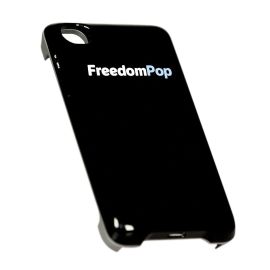
We’ve received FreedomPop’s “Freedom Sleeve Rocket for iPod Touch” here at Stop the Cap! HQ and are giving it a run.

Originally slated for release in the late summer, the $99 sleeve finally arrived yesterday afternoon. FreedomPop’s attraction is 500MB a month of free Clearwire WiMAX usage indefinitely. After the upfront cost of the sleeve ($99), customers can snap the case-like sleeve on the back of their 4th Generation iPod and be on their way streaming content, making Skype calls, checking web pages/email, or sharing the connection with up to eight devices (or friends).

It could be a fine alternative for usage-capped wireless customers who want an extra 500MB edge every month, and if you’ve ever lost a cell phone while exercising (I have), this is a little less risky (and you will definitely notice because the iPod you are listening to will go missing with it).

Still, FreedomPop is a start-up and “free” wireless data sounds a little too good to be true (or at least long-lasting should the business model go awry).

Customers can earn additional usage allotments “connecting” with “Freedom Friends” or signing up for third party offers. If you like the service and want more, FreedomPop’s real business model kicks in — selling you additional data allowances that range from $7.25-$20/GB above and beyond your initial 500MB each month.

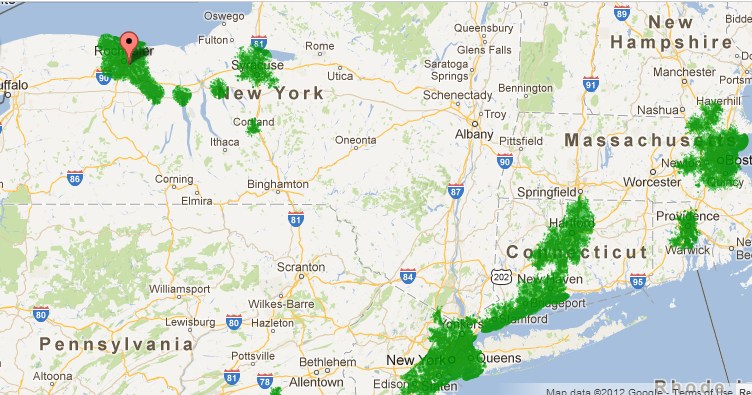
Clearwire’s hit or miss coverage in upstate New York.

So how does the device work? We’re testing it out this week and will report our results in greater detail sometime next week. But up front, some interesting observations:

  1. The device seems durable enough. It can recharge from a USB port or from the included power adapter. Charging time initially took several hours, but we’re unsure how long it will run just yet;
  2. A web-based control panel offers easy customization of the device, which appears as a Wi-Fi hotspot when the 4G service is enabled. You can reset your password and even manage the power level. The “low” setting proved more than adequate for anyone within 10 feet to connect, and since this was designed to attach to the back of your iPod, signal strength of its Wi-Fi service is no problem;
  3. You better have a 4th generation iPod or else it simply won’t fit. I actually discovered I had a third generation unit, which means no luck snapping the iPod to the back of the sleeve. Apple’s newest iPod Touch won’t fit either. But then I discovered it really didn’t matter. I can slip the sleeve all by itself in a pocket and it will still work fine with my iPod, attached or not. FreedomPop also sells a small portable hotspot device that could work equally well if you don’t need a “snap-on” solution;
  4. Clearwire, which has a dreadful reputation for reception and speed issues here in western New York, actually worked impressively well in early tests. Indoors we managed a medium strength signal from a cell tower located about two miles away. Clearwire’s very high frequency means outdoor reception free of obstacles like walls and doors will perform even better, and it did. We managed at least 1-3Mbps service at all times, which is better than a lot of cell carrier 3G networks locally;
  5. Making and receiving VoIP calls using an earlier generation iPod Touch is a nuisance. We noticed audio dropouts and call dropping, and you need to supply a headset with a microphone to be able to speak to a caller. But who calls anyone anymore? Text messages and Google Talk’s instant message system worked much easier;
  6. You can eat usage just browsing web pages. I was astonished to discover I consumed more than 42MB after less than 30 minutes of reading e-mail and web browsing a half-dozen news site web pages. At that rate, I’d be close to my limit after just 10 days. This surprised me because my Verizon Wireless data plan shows my spouse and I manage around 700MB of combined usage every month, and that includes streaming radio every morning on the ride to work. FreedomPop’s usage meter will need some closer inspection because there are indications it counts 1MB of usage for each hour the device is powered on, regardless of whether you are actively using it or not;
  7. The second thing we did after unboxing was visit FreedomPop’s website and turn off “automatic top up” under Billing Settings. Otherwise after you reach 400MB (not a typo) of usage, FreedomPop will “conveniently” automatically add 1GB of additional usage for $20, billed to your credit card. Set in the off position, your account will simply stop working for the rest of the month once you hit 500MB.

I had low expectations from FreedomPop’s alliance with Clearwire, the WiMAX network Sprint customers love to hate (and then turn off on their phones to conserve battery life). But so far I am cautiously optimistic.

Readers should be careful before jumping in and check FreedomPop’s coverage map first because Clearwire’s network is notoriously limited. For example, here in upstate New York Rochester, Syracuse, Geneva, and Cortland are covered. Buffalo, Albany, and Binghamton are not. In the Big Apple, New York City has coverage, Long Island east of Valley Stream is out of luck.

We’ll post a more detailed review next week.

Time Warner Cable Raising Prices for Set Top Boxes to $10/Month in Wisconsin

Phillip Dampier October 31, 2012 Competition, Consumer News, Data Caps 6 Comments

This will cost you $10/month in Milwaukee

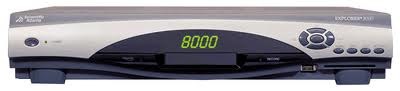
Stop the Cap! has learned Time Warner Cable is back with another equipment rate increase, this time for television set top boxes that will now cost $10 a month each, beginning in Wisconsin.

Time Warner Cable customers in the Milwaukee area are first getting the notice of the $1.05 rate increase on their latest bill. The new rate takes effect in November.

“Many businesses, including ours, are facing rising costs and have to adjust prices in order to maintain their operations,” explains Time Warner Cable Wisconsin spokeswoman Stacy Zaja. “We also understand that some of our customers are struggling in this economy, and are doing the best to hold the line on our prices.”

The rate increase comes at the same time Time Warner is introducing a $3.95 monthly modem rental fee for its broadband service. Unlike cable modems, however, Time Warner will not allow customers to purchase their own set top boxes, so it represents a rate increase customers can only avoid by canceling service or negotiating a lower rate.

At this time, Time Warner will not increase its prices for cable television service, just the equipment needed to view it.

The Business Journal notes Time Warner may be taking a chance on its latest rate increase, because AT&T’s U-verse service is increasingly available as an alternative choice for Milwaukee residents. Time Warner last raised the set top box rental fee by $1 in 2011, along with a $5 monthly rate hike for its cable television service.


Stupid Opposition to Community-Owned Fiber Broadband: It Will Raise Your Electric Bill, Blind Your Kids

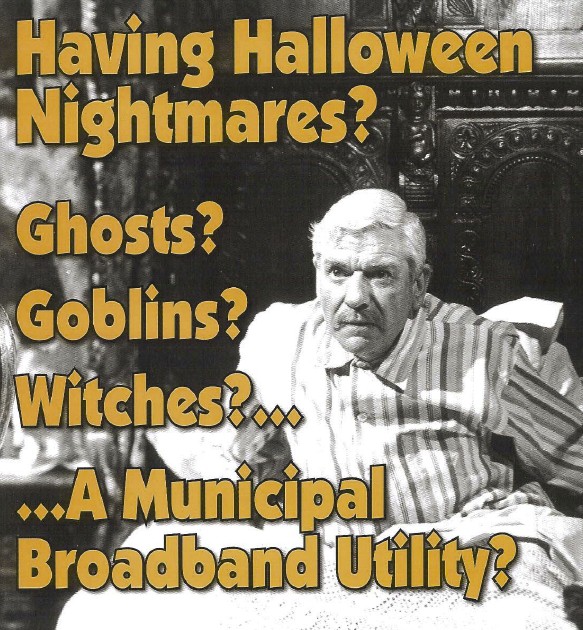
Halloween scare stories are back!

It is amazing the length some incumbent broadband providers will go to stop publicly-owned networks from getting off the ground and competing with the “good enough for you” service on offer from the local phone or cable company.

This morning, Stop the Cap! received word from a Minnesota reader who reports their dinner hour was interrupted by an unsolicited phone call from a group called “Americans for Sensible Broadband,” which as far as we can tell does not exist as a formal group. The caller used ridiculous scare tactics worthy of a bad Halloween movie:

  • Did you know that fiber broadband networks are expensive to run and will increase your electric bill to pay for the high powered lasers needed to send the signal to your home?

Fiber broadband projects now expanding in Minnesota have no relation to your electric bill because most are run by independent community-owned co-ops, not electric utilities. Even if they were run by an electric provider, the cost to power a fiber network is far smaller than the network of signal amplifiers and other transmission equipment needed by traditional cable and phone companies. The only electrical expense to the homeowner is powering any set top boxes or other related equipment to make use of the service. These costs are comparable to what one would pay with cable or phone services.

  • Most fiber networks are not actually fiber at all. The largest companies in America actually let you keep your current wiring, but that is not fiber, so why spend tax money on a risky fiber network?

While AT&T U-verse has chosen the route of “fiber to the neighborhood,” which still relies on existing copper wiring from nearby poles to your home, many fiber to the home projects take fiber… straight to the home. Some community networks do make use of very short lengths of pre-existing copper wiring inside your home, but this has more to do with your convenience. You don’t need a fiber connection to your landline phone, for instance. Compare the broadband speeds and services on offer from the community provider vs. incumbent cable and phone companies. Choose the one that delivers the best services for the price.

  • America’s cable and phone companies are working hard for pro-growth, pro-expansion policies in Washington that will allow your community to get the benefit of billions of private investment, at no risk to you.

An in-home threat to your children or incumbent provider profits?

Incumbent phone and cable companies already enjoy a higher level of deregulation than ever before. If they have not spent money to improve broadband in your area before, there is nothing that will open their wallets to provide the service now, unless someone else subsidizes part of the cost. Guess who “someone” is? That’s right. You the taxpayer or ratepayer. Whether in the form of broadband subsidies paid for by taxpayer dollars or ratepayer subsidies from the Universal Service Fund, only subsidies or competition prod incumbents to deliver better broadband to rural Minnesota (or anywhere else). If you fail a “Return On Investment” test, you will not get broadband no matter how much deregulation gets approved in Washington.

The question for rural consumers is whether AT&T, Frontier, CenturyLink, Comcast, or Charter Cable has your best interests at heart or whether a community co-op you partly own will.

  • In socialistic countries, the government runs the broadband service and can monitor your web browsing. Do you want your local community checking up on your online activities?

“Socialistic” is in the eye of the beholder. Most broadband networks are run by private telecommunications companies, some with state subsidies, others entirely on their own. The federal government’s security agencies already have access to monitor Internet traffic under warrantless wiretapping laws, and that extends to every provider in the country, private or public. That said, there is no evidence local government officials would monitor your web browsing habits, much less have the budget or technical expertise to do so.

  • Fiber cables create more hazards on utility poles designed for phone, cable and electric service. Is it worth risking those services for an unnecessary and expensive fiber network?

Electric and phone companies used the same scare stories to try and keep cable television lines off utility poles more than 30 years ago. Cable operators fought for and won the right to use utility poles to no ill effect, and at fair prices. It is ironic some cable companies want to use the same argument against municipal fiber that phone and electric companies used against them.

  • In these difficult economic times, do you realize your local taxes could triple to pay for unnecessary fiber Internet?

Most public broadband projects are financed by municipal bonds obtained in the private free market. Investors can decide for themselves if they represent a safe investment, and many do. If the networks fail, private investors typically take the hit.

But the most ridiculous claim of all was that “recent news reports warn that lasers could blind your children if they happen to play with the fiber cables in your home.”

The only “news report” we could find on this subject was an Engadget news story from 2011 about an S3 Krypton laser that could blind astronauts without proper safety equipment. But those lasers are not powering broadband networks.

In reality, fiber to the home networks are safer than traditional copper phone wiring, which can send a significant electric shock to anyone playing with the wiring when a telephone rings. Many fiber networks rely on Class 1, low power lasers — the lowest risk level. Even if a customer stared at the lit end of an optical fiber connector, the visible light would be diffused into a cone pattern that would be completely harmless by the time it reached the retina. Many networks also include a secondary safety mechanism that quickly shuts down the laser light once the connection has been broken. Certain higher-powered laser communications networks can have some safety risks, but almost entirely for workers working on primary cables that deliver service to dozens of homes. Those workers are well-trained to avoid those risks.

Minnesota seems to be one of the latest hotbeds of incumbent wrath over expanding community-owned broadband networks. Despite efforts to label them insidious creeping socialism, they are actually no more threatening than a traditional co-op, except perhaps to incumbent cable and phone companies that have been running to the bank cashing checks from customers enduring low broadband speeds at high prices.


Search This Site:

Contributions:

Recent Comments:

Your Account:

Stop the Cap!