Home » Competition » Recent Articles:

NY Times’ Reality Check: Feds Should Block the Godzilla-Sized Time Warner Cable-Comcast Merger

Phillip Dampier May 27, 2014 Broadband Speed, Comcast/Xfinity, Competition, Consumer News, Public Policy & Gov't Comments Off on NY Times’ Reality Check: Feds Should Block the Godzilla-Sized Time Warner Cable-Comcast Merger

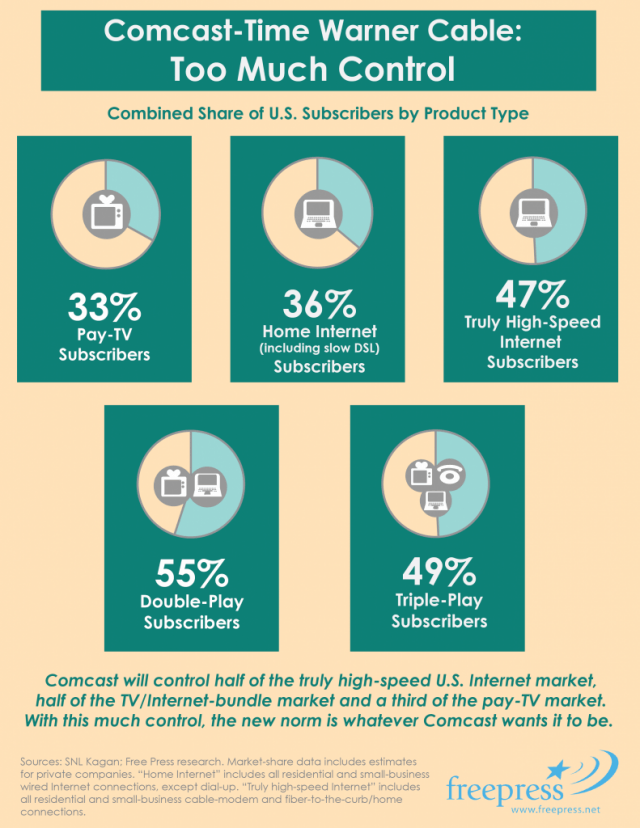
free_press_comcast_twc_market_shares-791x1024The New York Times recommends the Justice Department and Federal Communications Commission reject Comcast’s $45 billion purchase of Time Warner Cable, if only because the combined company will have an unregulated choke-hold on telecommunications services not seen since the days of the regulated AT&T/Bell monopoly.

In an editorial published Sunday, the newspaper called out many of the “merger benefit”-talking points claimed by the two cable giants as specious at best, hinting some even bordered on misleading:

By buying Time Warner Cable, Comcast would become a gatekeeper over what consumers watch, read and listen to. The company would have more power to compel Internet content companies like Netflix and Google, which owns YouTube, to pay Comcast for better access to its broadband network. Netflix, a dominant player in video streaming, has already signed such an agreement with the company. This could put start-ups and smaller companies without deep pockets at a competitive disadvantage.

There are also worries that a bigger Comcast would have more power to refuse to carry channels that compete with programming owned by NBC Universal, which it owns. Comcast executives say that they would not favor content the company controls at the expense of other media businesses.

The company argues that this deal would not reduce choice because the company does not directly compete with Time Warner Cable anywhere. Comcast would face plenty of competition in high-speed Internet service, they say, from telephone and wireless companies.

The reality is far different. At the end of 2012, according to the FCC, 64 percent of American homes had only one or at most two choices for Internet service that most people would consider broadband. Wireless services can handle streaming video, but many customers of Verizon or AT&T would blow through their monthly wireless data plan by streaming just one two-hour high-definition movie, at which point they would have to fork over extra fees.

Comcast executives argue that companies like Sprint are planning to provide very fast Internet service that will compete with wired broadband. But wireless companies have been working on such services for more than a decade with little success.

Those wireless services that do exist uniformly impose low usage caps and cost considerably more than traditional wired broadband plans, especially when considering the cost compared to the actual speed delivered to consumers.

The Times doesn’t believe imposing a litany of conditions in return for approving the deal, similar to those involving Comcast’s purchase of NBCUniversal, would be sufficient to protect consumers from monopoly abuse.

“This merger would fundamentally change the structure of this important industry and give one company too much control over what information, shows, movies and sports Americans can access on TVs and the Internet,” concluded the newspaper. “Federal regulators should challenge this deal.”

Time Warner Cable Unsurprisingly Chooses Austin as Its Next 300Mbps Upgrade City

Greater Austin, a city served by up to four different broadband providers — three either offering or promising fiber to the home service — is getting a speed upgrade from the one company that is sticking with its fiber-coax network — Time Warner Cable.

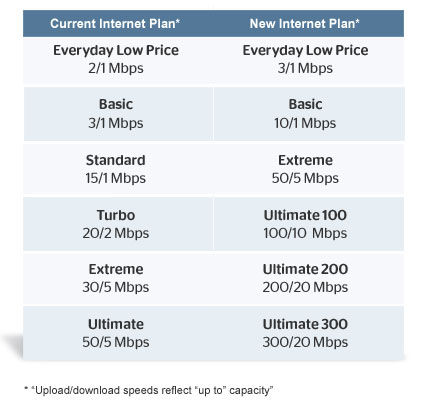
Starting June 3, Time Warner Cable customers who receive letters regarding the upgrade will see major broadband speed boosts at no additional charge:

speed-plan-chart-2014


Austin: Keeping the good broadband all to themselves. (Image courtesy: Kong)

Austin: Keeping the good broadband all to themselves. (Image courtesy: Kong)

The upgraded speeds will be offered to approximately 40 percent of customers in Austin and surrounding communities in June, with the remaining customers in the area getting upgraded through early fall. Here is the upgrade schedule:

June Speed Upgrade: Downtown Austin, West Campus, Hyde Park, Clarksville, Old Enfield, North Loop, Terrytown, Highland Park West, Central East Austin, Windsor Hills, Copperfield, Springdale Heights, Harris Branch, Edinburgh Gardens, Rollingwood, West Lake Hills, Lost Creek, Barton Creek, Jollyville, Anderson Mill, Brushy Creek, Bull Creek Park, Steiner Ranch, River Place, Canyon Creek, and the Reserve at Twin Peaks, as well as these communities: Manor, Cedar Park, Jonestown, Bee Cave, Kyle, Mountain City, and Uhland.

Fall Speed Upgrade: Round Rock, Leander, San Marcos, Elgin, Marble Falls, Lockhart, Bastrop, Fredericksburg, Taylor, Smithville, Wimberley, Liberty Hill, Lago Vista, Buda, Kyle, Elroy, and Lakeway.

“These significant speed increases will allow all our Internet customers in the greater Austin area to enjoy TWC Internet better,” said Kathy Brabson, area vice president of operations for Time Warner Cable in Central Texas.

Time Warner says it is spending about $60 million to upgrade its Austin-area network. That investment may help the cable company withstand competition from providers like Grande Communications, AT&T, and Google. For most in Austin, Time Warner Cable will be the first provider to dramatically boost Internet speeds. Google Fiber has postponed its launch until this fall, AT&T’s U-verse fiber to the home service is more press release than reality, and Grande Communications, although offering 1,000Mbps service for $65, only has that service available in parts of the greater Austin area.

Some customers will need to upgrade and/or exchange their current cable modem to receive the full speed upgrade. Customers leasing a modem can get information about whether an upgrade is needed from Time Warner’s Speed Increase website. We still strongly recommend customers consider purchasing their own modem — it will pay for itself in no time. Communication to the first group of customers about the new speeds and details about equipment is being delivered to homes this week.

Separately, Time Warner also announced it is expanding its local Wi-Fi hotspot network, but did not share any specific details.

Stop the Cap! will not be surprised to see Kansas City the next upgrade choice for Time Warner Cable — Google Fiber is up, running, and competing there. The rest of us will have to wait up to two years for faster speeds to arrive.

Comcast Hires Everyone for D.C. Lobbying Blitzkrieg for Merger Deal With Time Warner Cable

Phillip Dampier May 22, 2014 Astroturf, Comcast/Xfinity, Competition, Public Policy & Gov't Comments Off on Comcast Hires Everyone for D.C. Lobbying Blitzkrieg for Merger Deal With Time Warner Cable
Comcast has at least 40 lobbying firms working on its merger deal with Time Warner Cable.

Comcast has at least 40 lobbying firms working on its merger deal with Time Warner Cable.

It’s shock and awe time in D.C. as Comcast pulls out all the stops to ram its $45 billion deal with Time Warner Cable down Washington’s throat.

The Hill reports Comcast is assembling one of the biggest lobbying teams ever seen inside the beltway, hiring at least seven additional lobbying firms on top of the 33 it already retains. Their mission: to pressure legislators and overwhelm regulators to accept the merger deal and ignore the critics.

The lobbying firms are loaded to the rafters with D.C.’s frequent revolving-door travelers — former legislators, staffers, regulators and their aides that worked in the Clinton and Bush Administrations who now work on behalf of the companies many used to oversee.

On Comcast’s generous payroll: former aides for the House Energy and Commerce Committee and the House and Senate Judiciary committees, in addition to the Justice Department and the Federal Communications Commission — precisely the agencies that will review the merger for anti-trust concerns.

“If you’ve worked on the committees, or if you’ve worked in an agency overseeing a transaction like this, you’ve got knowledge about how the process works and credibility with the staff — it’s that simple,” one lobbyist told the newspaper.

A quick review of some of the players from The Hill:

Joseph Gibson of The Gibson Group, which started lobbying for Comcast in April, has held several prominent roles with the House Judiciary Committee, whose members grilled Comcast executives for four hours earlier this month. Gibson also worked at the Justice Department, including a stint advising the assistant attorney general for the Antitrust Division.

Louis Dupart, a veteran of Capitol Hill, the Defense Department and the CIA who’s now at the Normandy Group. He says on his firm’s website that he “has had multiple successes at the Department of Justice and the Federal Trade Commission on major anti-trust reviews for DuPont, Google, People Soft and other companies.”

The Normandy Group signed Comcast as a client last month. Another lobbyist at the firm, Krista Stark, served as legislative director to Rep. James Sensenbrenner Jr. (R-Wis.) when he was chairman of the House Judiciary Committee.

Marc Lampkin, the managing partner of Brownstein Hyatt Farber & Schreck’s Washington office, has ties to Speaker John Boehner (R-Ohio) and bills himself as “a close confidante to a number of key Republican members of the both the House and Senate.”

Justin Gray of Gray Global Advisors, another Comcast hire, has ties to Democrats as a member of the Congressional Black Caucus Foundation’s Corporate Advisory Council. The biography on his firm’s website credits him with leading “engagement strategies with respect to antitrust and FCC approvals of mergers and other consolidation transactions on behalf of leading satellite radio and cable providers.”

comcast twcLobbyists like Gray used astroturf tactics to mobilize various unaffiliated non-profit groups to write glowing letters in support of consolidating Sirius and XM Radio, usually in return for generous contributions. It is likely to be more of the same with this merger.

In 2011, Comcast spent $19 million on its lobbying effort to win approval of its buyout of NBCUniversal. Last year, it almost spent the most on lobbying of any corporation, coming in second only to defense contractor Northrop Grumman.

Watchdog groups are repulsed by the blatant use of recently-resigned FCC personnel and former legislative aides that left positions working for the public interest to take lucrative jobs with Comcast’s lobbying teams.

“Though Comcast is not alone in its revolving door lobby strategy, what is unprecedented is the gravity of the revolving door abuse now being employed by a small handful of very wealthy communications firms,” said Craig Holman, government affairs lobbyist at Public Citizen.

Holman found 82 percent of Comcast’s lobbying squad in 2014 had worked in the public sector before going to K Street.

Consumers and customers don’t have a well-funded lobbying team fighting for their interests.

Comcast Shakes Its Innovation Money-Maker: Considers Launch of All-New, Deluxe $ Unlimited Internet

"Customer service says you have the right to pay more."

Comcast says you must have the option to pay more for the same broadband service you already get, only now with an allowance

Comcast has announced it is considering testing an innovative new plan in several test markets offering “unlimited Internet access” to customers for a yet-to-be-determined price. Whoever heard of such a thing?

Comcast’s executive vice president David Cohen raised eyebrows last week when he predicted all Comcast customers nationwide would see usage-based billing for their Internet access within five years.

Such statements tend to muck up things like a $45 billion dollar merger with Time Warner Cable that both companies must prove is in the public interest. The buyer wants to limit your Internet usage and the seller got its fingers burned back in 2009 when it tried its own usage cap experiment and now advertises it has no data caps.

Telling Time Warner Cable customers it is in their best interest to lose unmetered Internet plans may be too tough to sell, so Cohen has spent much of this week backtracking and claiming he was “misunderstood:

To be clear, we have no plans to announce a new data usage policy.  In 2012, we suspended our 250 GB data cap in order to conduct a few pilot programs that were more customer friendly than a static cap.  Since then, we’ve had no data caps for any of our customers anywhere in the country.  We have been trialing a few flexible data consumption plans, including a plan that enables customers who wanted to use more data be given the option to pay more to do so, and a plan for those who use less data the option to save some money.  We decided to implement these trials to learn what our customers’ reaction is to what we think are reasonable data consumption plans.  We certainly have no interest in adopting any plans that our customers find unreasonable or disruptive to their Internet experience.

It’s important to note that we remain in trial mode only.   We’re now also looking at adding some unlimited data plans to our trials. We have always said that as the Internet, and our customers’ use of it, continues to evolve, so will Comcast and our policies.

Cohen makes a careful distinction between a strict usage limit and the kind of usage-based billing that will fill the company’s coffers with overlimit fees. But any usage allowance is a limit of how much you can use the Internet before something bad happens — either your access is shut off or your bill explodes.

comcasticStop the Cap! has talked with more than a dozen customers in Comcast’s test markets about their experiences with Comcast’s “data usage policy.” Although the company claims it is seeking customer reactions, it never asks whether those customers want usage limits or not, only what kind.



Giving customers “the option to pay more” is exactly the type of thinking that won Comcast the dubious distinction of being the worst company in America. No usage plan tested by Comcast actually offers savings to customers. It simply places an artificial, arbitrary usage allowance on the overpriced broadband service the company offers now.

At this point, Comcast is not offering any unlimited use trials, but we have learned the value they are likely to place on “unlimited” based on what certain customers have paid all along for that privilege. Ars Technica reports some avoided the 250GB cap by signing up for business class service. The cost? $133.79 a month for 50/10Mbps. If Google Fiber was in town, you’d pay $70 for unlimited 1,000/1,000Mbps service, and the search engine giant would still be making money.

Cohen claims nothing is set in stone, but considering Comcast’s “don’t care” attitude towards its customers, it is a safe bet they will do what is best for shareholders and ignore complaints from customers that often have nowhere else to go for 21st century broadband speeds.

Frontier to Introduce $4.99 Security Landline Service, Gives Up on Expanding Video Services

Frontier is introducing a new $5 a month disaster landline service in June.

Frontier is introducing a new $5 a month disaster landline service in June.

With plenty of talk about the impact of global climate change, Frontier Communications will soon introduce a new inexpensive landline service to help customers plagued by weather disasters.

Frontier Security Phone is a $5 a month landline that can only reach 411 and 911 — perfect for those who lose their Voice over IP phone service in a power failure or find cell service clogged or otherwise unavailable.

“Our [service areas] are very prone to severe weather, lots of hurricanes, tornadoes and the mud slides in Washington State,” said Frontier CEO Maggie Wilderotter. “We have markets that are very plagued by bad weather and having a landline phone that works when your power goes out where we have a density of 34 homes a mile is important.”

Frontier will market the bare bones landline service to customers planning to disconnect service in favor of another provider as well as those that already have. Unlike basic budget service, Frontier Security Phone will not be able to make or receive regular phone calls — it is intended for emergency-use only.

Little known to most Frontier customers (and only mentioned on their website in a thicket of tariff filings) is that different types of landline service are available. By switching away from flat rate service to a measured-rate plan, where each local outgoing call is charged at a prevailing per-call rate (usually under 10 cents), customers can still have the option of making and receiving calls on a budget, especially considering incoming calls are free. In large cities like Rochester, Frontier charges $18.03 a month for flat rate local calling. If one switched to a measured-rate plan, the charge is $12.07 a month. Those interested will have to call Frontier at 1-800-921-8101 and specifically inquire about measured rate local telephone service.

Frontier is also exploring a market trial of a new Voice over IP landline service sold as a bundle with DSL.

Wilderotter told investors attending the JPMorgan Global Technology, Media and Telecom Conference that Frontier believes streaming, on-demand video is the future of Frontier, not traditional linear/live television.

Wilderotter

Wilderotter

Therefore, despite the fact Frontier will continue to support legacy FiOS TV services in adopted Verizon markets in Indiana and the Pacific Northwest, and will likely take ownership of AT&T U-verse in Connecticut, the company has no plans to introduce cable-TV service anywhere else. The biggest reason is the cost of video programming for smaller competitors like Frontier.

“We’re never to going to be big like some of these big guys are, which is why we have a partnership with the Dish Network, because they’re big,” Wilderotter explained. “They go negotiate all the content deals and then we offer those packages to our customers and we get paid a sales commission and a monthly customer service and billing fee from Dish on behalf of that service.”

Although Frontier applauded AT&T for its announced intention to acquire DirecTV, Frontier customers in Connecticut currently subscribed to DirecTV through AT&T will eventually be switched to Dish Network — Frontier’s chosen video partner.

Wilderotter explained that Frontier can leverage its broadband network to support streaming video services without assuming the costs of licensing the content. As Comcast and AT&T grow larger, they can negotiate better volume discounts unheard of among smaller competitors, keeping companies like Frontier at a major cost disadvantage. But if a customer wants Netflix or YouTube, they will need a broadband connection to get it, which is where Frontier comes in.

“If you think about Frontier, we’re in 27 states today, soon to be 28 with the Connecticut acquisition, about 30,000 communities, predominantly rural and suburban. That’s sort of our footprint,” said Wilderotter. “So when we think strategically about the assets that we have as a company, first and foremost is [the] networks in all of those markets, and those networks have been upgraded. So for us, the cost of adding another customer to broadband is really the upfront sales cost, because the network is already in place and the capabilities are already [there].”

Wilderotter adds Frontier’s average payback on its investment to hook up a new broadband customer is about three months.

“We also have industry-leading margins in our company,” Wilderotter said. “Our margins are in the mid-40% range and we’ve typically always had very strong margins in terms of how we run the business from an efficiency and effective perspective.”

Wilderotter also told investors that Frontier plans to add several additional services powered by its broadband network over the course of this year.

“We’re really looking in the categories of home automation, security, lifestyle products and monitoring products,” Wilderotter said. “And with that, there is ongoing monthly recurring revenue in terms of the tech support that we put with that product set when we sell it to a customer.”

When Wilderotter was asked about recent price hikes implemented by Frontier, she admitted the primary reason for the increase was the lack of competitive cable pricing in the market.

“If you look at what cable is offering in our markets, they offer a standalone broadband product somewhere $35 and $65,” she said. “And that doesn’t include the modem. So we felt we could increase the price, still be very competitive in the marketplace and have a product set that made more sense for our customers at a convenient price.”

Search This Site:

Contributions:

Recent Comments:

Your Account:

Stop the Cap!