Home » Competition » Recent Articles:

Thoughts on the NY Public Service Commission’s Information Meeting in Buffalo on Comcast-TWC Merger

Phillip "The new unofficial spokesman of Time Warner Cable?" Dampier

Phillip “The new unofficial spokesperson for Time Warner Cable?” Dampier

I testified last evening at the Buffalo Public Information Meeting held by the New York Public Service Commission on the merger of Comcast and Time Warner Cable.

The regulator invited four witnesses to testify about the merger last evening. The other three:

  • Mark E. Reilly, Comcast’s senior vice president of government affair, northeast division (for);
  • Aaron Bartley, executive director of PUSH Buffalo (against);
  • Christine Carr, executive director of Computers for Children (neutral).

The meeting was sparsely attended with only about two dozen in the audience, a good number of those arriving from Rochester. Also in attendance were groups with direct financial connections to Comcast, some partly disclosed during the evening, others not. Readers will not be surprised they were strongly in favor of the merger. Common Cause was represented and was clearly against the merger, although their representative also had harsh words for Time Warner Cable.

Niagara County Legislator David E. Godfrey (R-Wilson) and Orleans County Legislator Lynne M. Johnson (R-Lyndonville), representing the Niagara Orleans Regional Alliance, spoke on behalf of rural New Yorkers who lack broadband service. Neither went on record opposing the merger but seemed to suggest its approval be tied to a rural broadband solution. The record on successfully pulling that off in earlier deals has been mixed at best. The cable industry treats its Return On Investment formulas like a biblical text. If expanding service isn’t going to make the companies money in the short term, it is very unlikely to happen. We believe New York’s broadband subsidy program is a better deal for consumers if it means keeping Comcast out of New York.

The audience was almost entirely silent during the event and it wrapped up earlier than originally planned. Buffalo seemed less engaged on broadband issues than I would have expected. Had the hearing been held in Rochester, I have no doubt the audience would have been far larger. Broadband matters in Rochester have always drawn crowds and significant news coverage. One Buffalo resident offered that the PSC chose its meeting location poorly — on “an out of the way” college campus in Amherst now in summer session that charges for parking (although we did park for free). Others have told us the meetings were poorly advertised. Thankfully, the PSC is keeping the record open for comments in writing and by phone.

The strongest contrast of views came from testimony from Mr. Reilly and myself, although the meeting was not configured as a debate.
Reilly

Reilly

Mr. Reilly did not seem well-informed about specifics regarding Comcast’s products and pricing. He stumbled through incomplete answers when asked directly (twice) to compare Comcast’s prices against Time Warner Cable. Unfortunately, the question and answer session did not allow for interjection from other witnesses, because if it did, I was more than ready to help Mr. Reilly answer that question because I brought the rate cards for both companies with me. Perhaps he did not want to answer, because as the evidence clearly shows, Comcast costs more.

He also implied Comcast had widely deployed up to 505Mbps broadband service in its service area. Speeds of 300-500Mbps are offered only to a limited number of customers that can, number one afford the high asking price ($300/month plus installation fee) and second are passed by Comcast’s fiber or Metro Ethernet networks.

We also disagreed over usage caps. Reilly claimed the average Comcast customer used just 17GB a month. Comcast’s own website claims median monthly data usage is 20-25GB per month. But according to Digital Trends, the average family with Internet-only service uses 212GB of data each month — more than seven times those who watch traditional television. That is because after cutting cable-TVs cord, they are watching shows over their broadband connection. That number is rising, and fast. Over the four years Comcast had a nationwide cap, it did not adjust it upwards even once to account for broadband growth.

Independent analysis from Sandvine found that Internet users, in general, are accessing increasingly larger amounts of data. The overall mean usage on North American fixed-access networks (as opposed to mobile networks) was 51.4 GB in March, which is up from the 44.5 GB noted in Sandvine’s most recent previous study. Cord-cutters as a whole now dominate network usage, accounting for a 54-percent majority of total monthly network traffic. Cord-cutters are also responsible for some of the cable industry’s biggest revenue challenges with their television packages.

The old industry meme that usage caps affect only a tiny minority of customers was also trotted out. We did not have the opportunity to ask, “if only a tiny percentage of customers exceed their allowance, why bother with usage caps at all?”

Time Warner Cable was not represented at the meeting, and in an ironic twist, that left me as their unofficial spokesbooster. In fact, nobody seemed aware of Time Warner Cable’s Maxx upgrade program which is delivering faster, more affordable Internet access than Comcast offers over its cable broadband network without the threat of looming usage caps.
Jump through hoops for $9.95 Internet

Jump through hoops for $9.95 Internet

Internet affordability emerged as a major topic last evening. Predictably Comcast touted its $9.95 Internet Essentials program without mentioning its highly restrictive pre-qualification requirements:

The program is only available to households that (i) are located where Comcast offers Internet service; (ii) have at least one child who receives free/reduced rate school lunches through the National School Lunch Program (the “NSLP”) and as confirmed annually while enrolled in the program; (iii) do not have an overdue Comcast bill or unreturned equipment; and (iv) have not subscribed to any Comcast Internet service within the last ninety (90) days (sections 1(i)-(iv) collectively are defined as “Eligibility Criteria”). The program will accept new customers for three (3) full school years, unless extended at the sole election of Comcast. Comcast reserves the right to establish enrollment periods at the beginning of each academic year in which it accepts new customers that may limit the period of time each year in which you have to enroll in the program.

2. In order to confirm your eligibility for the program, Comcast will need to verify that your children receive free/reduced rate school lunches through the NSLP in the initial enrollment year and each subsequent year you are enrolled in the program. In order to confirm eligibility, participants in the program will be required to provide copies of official documents establishing that a child in the household is currently receive free/reduced rate school lunches through the NSLP. Each year you will be required to reconfirm your household’s current eligibility by providing Comcast or its authorized agent with up-to-date documentation. If you fail to provide documentation proving your eligibility in the program, you will be deemed no longer eligible to participate in the program.

3. You will no longer be eligible to participate in the program if (i) you no longer have at least one child living in your household who receives free/reduced rate school lunches under the NSLP; (ii) you fail to maintain your Comcast account in good standing; (iii) Comcast ceases to provide the Covered Service to your location; or (iv) your account opened under the program is closed. A change in address may result in your account being closed, even if you continue to receive Comcast services at a different address. Program participation also may be terminated if the Covered Service is upgraded, altered or changed by you for any reason. If you are no longer eligible for the program, but continue to receive the Covered Service from Comcast, regular rates, and any other applicable terms and conditions will apply to the Covered Service.

In brief, you can only qualify if you don’t have Comcast Internet service already. If you do, Comcast demands you stay without Comcast Internet service for at least 90 days before applying (good luck making that work). This is nothing more than a revenue protection mechanism for Comcast so that customers don’t downgrade to discounted Internet. Only poor families with school age children qualify and Comcast intrusively re-verifies eligibility regularly. Had a past due bill in the past or loss/stolen equipment? You are not qualified. Miss a payment? Comcast can kick you off the program. Try to upgrade any part of your Comcast package? You are done with Internet Essentials. Move to a new address? Your Internet discount isn’t going with you.

John Randall from the Roosevelt Institute came to a similar conclusion:

Comcast’s Internet Essentials program does more to benefit Comcast’s customer acquisition, public relations, and lobbying departments than to help people in America who need high-speed Internet access at a reasonable price. The reality is that the program is a cleverly designed customer acquisition program that benefits Comcast’s bottom line.

It was also a cynical way to help Comcast win approval of its merger with NBCUniversal. Comcast held back the program until they could use it as a political chip in their merger lobbying campaign. As we reported back in 2012:

In 2009, Comcast insiders were hard at work on a discount program for the disadvantaged who could not afford Comcast’s regular prices for broadband service. But the program was stalled at the direction of Cohen, who wanted it to be a chip with regulators to win approval of its acquisition of NBC-Universal. The program, sure to be popular among advocates of the digitally disadvantaged, was a key part of approving the $30 billion deal.

“I held back because I knew it may be the type of voluntary commitment that would be attractive to the chairman [of the FCC],” Cohen said in a recent interview.

You would probably take this used car to a mechanic before deciding whether to buy. Why doesn't Comcast know the state of Time Warner's cable systems before they made an offer?

You would probably take this used car to a mechanic before deciding whether to buy. Why doesn’t Comcast know the state of Time Warner’s cable systems before they made a $45 billion offer?

Lastly, Mr. Reilly repeatedly confessed Comcast did not know the state of Time Warner Cable’s system and equipment and could not answer questions about precisely how much Comcast would invest in upgrades. He admitted Comcast’s part-acquisition of Adelphia Cable (its systems were largely divided up between Comcast and Time Warner) resulted in a major under-estimate of repair and upgrade work required.

If I buy a used car, I take it to an expert who can describe its current condition, alert me to likely service required both now and in the near future, and predictions about the vehicle’s anticipated lifetime. Apparently Comcast buys cable systems sight-unseen.

It was widely known in the industry at the time that troubled Adelphia Cable properties were neglected as the company neared bankruptcy. Imagine Adelphia as a metaphor for the state of Sears or K-Mart these days.

Two members of the Rigas family that founded Adelphia were convicted on multiple charges of securities fraud, conspiracy to commit bank fraud and bank fraud. Prosecutors said the Rigases hid the fact the company was dangerously overextended with $2.3 billion in unreported debts. The family used the company’s bank accounts to finance a range of personal follies, including 100 pairs of slippers for Timothy Rigas and more than $3 million to produce a film by John Rigas’ daughter. We don’t know if the film was actually any good.

At the end of the evening in Buffalo, we were still left with the impression Comcast’s promises and commitments were vague and the much-touted benefits were much to be desired as soon as you began reading the fine print.

But frankly, I was disappointed by the low turnout. Consumers who do not want Comcast to be their next Internet provider -must- make their feelings known or that is precisely what is going to happen. We need all New Yorkers within travel distance of Albany or New York City to pack the PSC’s meeting rooms and have the courage to get up and speak. You can talk for 30 seconds or 3-5 minutes. You can also write or call the PSC if you want to extend your remarks in writing. New Yorkers have the power to throw a major wrench into a deal very few of us wants. But only if they make their voices heard:

Wednesday, June 18

SUNY Albany
Performing Arts Center
1400 Washington Avenue
Albany

6:00 pm: Informational Forum
7:30 pm: Public Statement Hearing

Thursday, June 19

NYS DPS Office
90 Church Street
New York

Please bring ID with you.

6:00 pm: Informational Forum
7:30 pm: Public Statement Hearing

Those who cannot attend or prefer not to speak at a public statement hearing may comment electronically to Hon. Kathleen H. Burgess, Secretary, at [email protected] or by mail or delivery to the Secretary at the Public Service Commission, Three Empire State Plaza, Albany, New York 12223-1350. Comments should refer to “Case 14-M-0183, Petition of Comcast Corporation and Time Warner Cable Inc.”

Toll-Free Opinion Line: You may call the Commission’s Opinion Line at 1-800-335-2120. This number is set up to take comments about pending cases from in-state callers, 24 hours a day. Press “1″ to leave comments, mentioning the Comcast/Time Warner merger.

All comments provided through these alternative methods should be submitted, or mailed and postmarked, no later than July 31, 2014. All such statements and comments will become part of the record and be reported to the Commission for its consideration.

All submitted comments may be accessed on the Commission’s Web site at www.dps.ny.gov, by searching Case 14-M-0183.

Academic Sock Puppets for Comcast-Time Warner Cable Merger; Editorials Lack Full Disclosure

Phillip "Time Warner Cable ironically debunked Lyons' advocacy of usage-based billing" Dampier

Phillip “Time Warner Cable ironically debunked Lyons’ advocacy of usage-based billing” Dampier

As part of the broader push to drive support for the merger between Comcast and Time Warner Cable, academics with ties to corporate-funded think tanks and the cable industry are trotting out nearly identical guest editorials appearing in newspapers around the country that attempt to educate the masses about the wonders of cable industry consolidation.

Daniel Lyons, who has written several papers supporting and endorsing the cable industry’s business agenda, is back with his helpful advice:

Consumers have more video options than ever before. Technology has eroded the lines between hardware, content and media companies. Today, Comcast’s biggest competitive threat is not other cable and satellite providers but new entertainment sources not even imaginable a decade ago. Netflix streams video online and is responsible for one-third of all Internet traffic during peak times. Apple is transforming itself from a device manufacturer into an entertainment company that delivers music, video and games instantly through a seamless customer interface. Google has expanded beyond Internet search to video services and even broadband data networks. Verizon, a traditional telephone company, recently bought the rights to stream NFL games to smartphones. Even Walmart has entered the streaming video business.

It is a challenging transaction, one that antitrust regulators should review carefully. But they should avoid rushing to judgment merely because Comcast is consolidating its position over a stagnant cable sector. Some consolidation may be necessary for cable to avoid Blockbuster’s fate and instead compete effectively in this rich, dynamic and increasingly competitive video landscape.

It is especially hard to take Mr. Lyons seriously when he claims with a straight face the cable industry is “stagnant” and on the verge of following Blockbuster into irrelevance. The only product in the cable bundle seeing flat growth is cable television. But that has not presented a difficult financial challenge because cable operators are shifting their priorities towards broadband. Just to make sure they are covered, broadband providers have raised prices and introduced equipment fees that have more than made up the difference. Despite Lyons’ prediction of doom and gloom, industry observers still find the cable business “comically profitable.”

Lyons

Lyons

In fact, the cable industry now dominates the American broadband marketplace and is well positioned to deal with any competitive threat looming on the horizon. All of the competitors Lyons mentions depend on companies like Comcast and Time Warner Cable to reach customers. Cord-cutting looks much less tenable if companies like Comcast return to a regime of usage caps on their broadband accounts. Netflix, Apple, and Google cannot sustain video streaming businesses if customers fear using these services will put them over their monthly usage allowance. Sony’s forthcoming 4K video service for its video player could consume between 40-60GB per movie. Even with Comcast’s “generous” allowance of 300GB per month in its usage-capped test markets, as few as 10 movies a month will put customers over the limit, before they do anything else with their broadband connection.

Despite the threat of Internet stagnation, Lyons is a prolific writer of pro-usage cap and usage-billing studies. In at least one of those papers, he was joined by Michigan State University Professor of Information Studies Steven Wildman, also then an adviser at the Free State Foundation. Wildman was more forthcoming about where the money comes from for these studies – the National Cable and Telecommunications Association (NCTA), the largest cable industry lobbying and trade group in the United States.

Unfortunately for the Free State Foundation and the NCTA, Time Warner Cable inadvertently proved Lyons and Wildman’s theories wrong.

“Pricing experimentation may also help narrow the digital divide,” Lyons wrote. “By recovering more fixed costs from heavier users, firms may have more freedom to extend service at a lower rate to light users who are unable or unwilling to pay the unlimited flat rate. There is evidence that these opportunities are beginning to emerge from companies engaged in usage-based pricing.”

What actually emerged from Time Warner Cable’s tests of discounted usage pricing is a repudiation of Lyons’ theories. Time Warner Cable admitted its usage-based pricing options were so unpopular with customers, only a few thousand out of 11 million broadband customers signed up — hardly a ringing endorsement. Even income-challenged customers preferred unlimited Internet over a usage cap. Time Warner Cable give customers a choice between a cap or no cap. The others, including Comcast, don’t offer an unlimited option and repeatedly claim usage cap tests have met with little resistance from customers, as if they had a choice.

Short Title: Total Deregulation

Short Title: Total Deregulation

Other members of Free State Foundation’s Board of Academic Advisors, including Richard A. Epstein, Justin (Gus) Hurwitz, Daniel Lyons, James B. Speta, and Christopher S. Yoo advance the cable industry agenda in other ways too.

Speta submitted an Amicus Brief: ‘In the Matter of Comcast Corporation v. FCC,’ that basically argued the Federal Communications Commission “does not have jurisdiction to address most Internet regulatory issues, because whatever expansive readings such ancillary jurisdiction has received in the past are no longer tenable.”

In fact, the Free State Foundation unabashedly supports near-total deregulation of the telecommunications industry and an elimination of most FCC powers to oversee it. In comments before the House Energy & Commerce Committee, the foundation’s Board of Academic Advisers recommended:

  • Updating the Communications Act by wiping it out — a clean slate approach is needed to adopt a “replacement” regime – a new Digital Age Communications Act, which is another way of saying near-complete elimination of all current oversight and enforcement powers exercised by the FCC;
  • Lyons, among others, supports eliminating regulation designed around the concept of “in the public interest” with a near-complete deregulation of telecommunications oversight, letting marketplace competition check any bad behavior. The only regulatory activities permitted would require the FCC to show the resulting harm from lack of sufficient competition;
  • The group supports disallowing the FCC from issuing rules to prevent anti-competitive or abusive behavior until such behavior has been proven to have taken place. Any rules that result would automatically expire after a fixed number of years;
  • States would be prohibited from regulating telecommunications services in instances where states feel federal regulation is inadequate.

Ironically, some of the biggest supporters of the group’s ideas to restrict states from writing telecommunications laws seem to have no problem letting states write laws that ban community broadband networks.

And finally, how could we forget to mention Mr. Yoo, who testified in recent hearings in the Senate Judiciary Committee enthusiastically supporting the merger deal, while not bothering to mention his employer, the University of Pennsylvania law school, has close ties to Comcast. In fact David Cohen, the Comcast executive who is the company’s leading voice in Washington and was the first witness at the hearing, is chairman of the trustees of the University of Pennsylvania.

Unfortunately for readers, no newspaper to date has fully disclosed these close industry ties when publishing these guest editorials. As a public service, Stop the Cap! does.

GOP Senators Attack FCC on Sweeping Away Municipal Broadband Bans, Citing “State’s Rights”

Cruz Control

Cruz Control

A group of Republican senators are warning the chairman of the Federal Communications Commission he’d better not touch statewide bans on community broadband networks.

In a letter sent to FCC Chairman Tom Wheeler, Republican Sens. Deb Fisher, Ron Johnson, Ted Cruz, Mike Enzi, John Barrasso, Pat Roberts, Lamar Alexander, John Cornyn, Tom Coburn, Tim Scott and Marco Rubio slammed Wheeler for his willingness to override or ignore state laws co-written by cable and telephone companies that banish municipal broadband from providing any competition.

“The insinuation that the Federal Communications Commission will force taxpayer-funded competition against private broadband providers — against the wishes of the states — is deeply troubling,” said the senators. “Inserting the commission into states’ economic and fiscal affairs in such a cavalier fashion shows a lack of respect for states’ rights,” they said.

Comcast, AT&T, Verizon, Time Warner Cable, and other operators are among the campaign contributors of the nine senators.

Echoing the sentiment of the cable and phone companies, the Republicans called community owned broadband “an unnecessary and risky government liability” and warned Wheeler there would be consequences if he was serious about ignoring the state laws, many enacted with the assistance of the American Legislative Exchange Council (ALEC).

“State political leaders are accountable to the voters who elect them, and the Commission would be well-advised to respect state sovereignty,” said the senators. “We look forward to your timely response, and we hope you will think critically about the Commission’s role and how it can more appropriately interact with our state authorities.”

Community broadband has largely been the only wired competitor facing off against cable and phone companies. Consumers have a much bigger chance of seeing a municipal provider in their community than Google Fiber or another overbuilder.

“Those are nine senators that moonlight for Comcast and AT&T I won’t be voting for,” says Stop the Cap! reader Tom Resden who shared the story. “Municipal broadband balances a playing field that has favored big cable and phone companies for years. These are the same type of senators that 100 years ago would have opposed municipal power and co-ops, willing to leave people in the dark rather than allow a player that answers only to customers get traction. It’s not a state rights issue when the corporations wrote the legislation their well-funded lackeys in statehouses around the country helped hurry into law. What we are really talking about is the corporate right to suppress competition.”

Netflix Rankings Slam FiOS, Speed Alert Messages Prompt Cease & Desist Letter from Verizon

Phillip Dampier June 10, 2014 AT&T, Broadband Speed, Comcast/Xfinity, Competition, Online Video, Verizon, Video Comments Off on Netflix Rankings Slam FiOS, Speed Alert Messages Prompt Cease & Desist Letter from Verizon

[flv]http://www.phillipdampier.com/video/CNN Netflix Slowdown Who is to Blame 6-6-14.flv[/flv]

CNN explores who is responsible for Netflix’s streaming problems on Verizon FiOS and AT&T U-verse. While one industry analyst seems keen to blame Netflix, his other articles on the subject show an increasing bias towards big ISPs like Verizon and AT&T. (2:54)

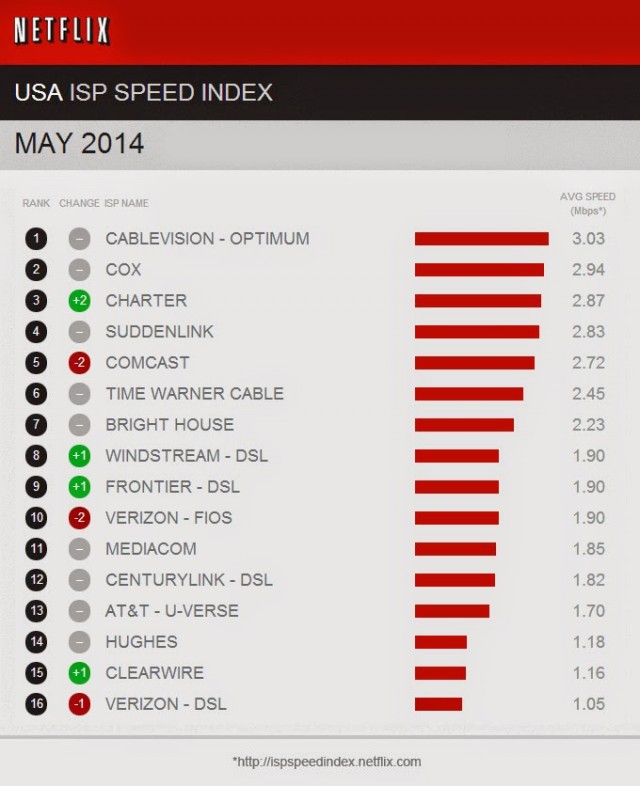
Netflix’s May speed rankings confirm Verizon FiOS customers are likely to find a degraded video streaming experience while using the otherwise speedy fiber to the home service. Netflix performance on Verizon FiOS dropped considerably last month — so much so that Frontier and Windstream DSL customers now get better Netflix performance than any Verizon customer receives. AT&T U-verse customers fared even worse with streaming performance below that offered by Mediacom — America’s bottom-rated cable company and CenturyLink DSL. In fact AT&T U-verse customers receive only marginally better service than Hughes satellite and Clearwire wireless customers. Verizon’s DSL came in dead last.

usa

Coincidentally, both Verizon and AT&T, following Comcast’s lead, have been in negotiations with Netflix to receive payment from the streaming video provider to better handle its traffic. Verizon CEO Lowell McAdam said he’s confident about getting payments from Netflix, and he turned out to be correct — Verizon and Netflix reached an agreement in late April that is still being implemented. AT&T also says it is negotiating with Netflix. Verizon’s streaming video partnership with Redbox has not been affected by the sudden deterioration in online video streaming on Verizon’s network.

verizon att

The problems with Netflix on some ISP’s have gone all the way to the top.

“My wife and I like to lay in bed and watch Netflix,” Tom Wheeler, chairman of the US Federal Communications Commission, said in January. The two companies serving Wheeler’s neighborhood are Comcast and Verizon. When enough customers launch streams on Netflix, saturating the inbound connection to either ISP, the video stops. When it does, Wheeler’s wife joins the parade of irritated customers.

“You’re chairman of the FCC,” she says to him. “Why is this happening?”

Last week, Netflix decided to answer that question with a more informative error message appearing when available bandwidth is insufficient to support a high quality stream.

verizon throttle

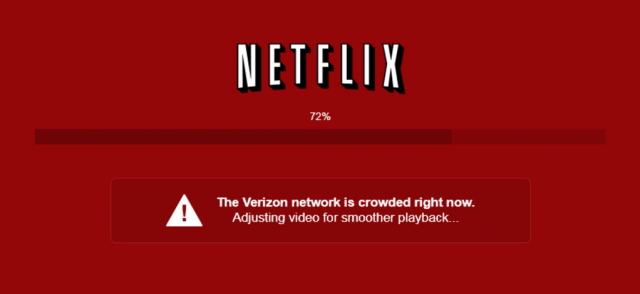
“The Verizon network is crowded right now,” the message says. Netflix then attempts to restore the stream by serving up a degraded, lower quality/bit rate version to the paying customer.

[flv]http://www.phillipdampier.com/video/Bloomberg Netflix-Verizon War of Words 6-6-14.flv[/flv]

Bloomberg interviews Todd O’Boyle from Common Cause. He places the blame for this debacle solely on the shoulders of Verizon and other ISPs. (5:39)

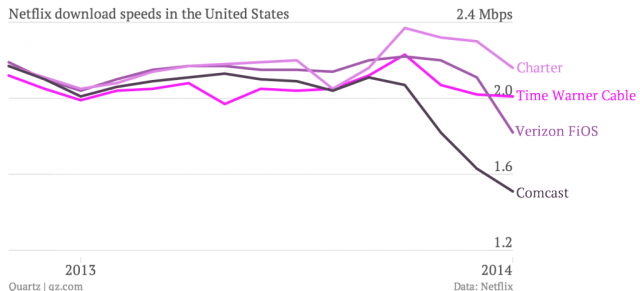
The inability to successfully maintain a stable stream of Netflix content that ranges from 256kbps to 5.8Mbps seems odd on ISPs that offer customers connections far faster than that. The average Netflix stream is 2Mbps, slow enough to be comfortably supported on even a 3Mbps DSL connection. Netflix’s problems with Comcast evaporated after agreeing to pay the cable company to maintain a better connection between its customers and Netflix’s content delivery network. The same cannot be said for perfomance on AT&T’s U-verse platform. Although Verizon signed an agreement with Netflix, it has clearly not been implemented as of yet.

netflix-download-speeds-in-the-united-states-time-warner-cable-verizon-fios-charter-comcast_chartbuilder-2

“We started a small-scale test in early May that lets consumers know, while they’re watching Netflix, that their experience is degraded due to a lack of capacity into their broadband provider’s network,” said Netflix’s Joris Evers. “We are testing this across the U.S. wherever there is significant and persistent network congestion.”

netflix-logoThe companies with the biggest drops in Netflix performance are the same ones strongly advocating special paid “fast lanes” on the Internet for preferred traffic to resolve exactly these kinds of performance problems.

“Some large US ISPs are erecting toll booths, providing sufficient capacity for services requested by their subscribers to flow through only when those services pay the toll,” said Evers. “In this way, ISPs are double-dipping by getting both their subscribers and Internet content providers to pay for access to each other. We believe these ISP tolls are wrong because they raise costs, stifle innovation and harm consumers. ISPs should provide sufficient capacity into their network to provide consumers the broadband experience for which they pay.”

The error message fingering Verizon as the culprit for a poorer Netflix experience brought an angry response from Verizon on its blog:

Reports from this morning have suggested that Netflix is engaging in a PR stunt in an attempt to shift blame to ISPs for the buffering that some of its customers may be experiencing. According to one journalist’s tweet from last night, Netflix is displaying a message on the screen for users who experience buffering which says: “The Verizon network is crowded right now.”

This claim is not only inaccurate, it is deliberately misleading.

The source of the problem is almost certainly NOT congestion in Verizon’s network. Instead, the problem is most likely congestion on the connection that Netflix has chosen to use to reach Verizon’s network. Of course, Netflix is solely responsible for choosing how their traffic is routed into any ISP’s network.

[…] It is sad that Netflix is willing to deliberately mislead its customers so they can be used as pawns in business negotiations and regulatory proceedings.

It would be more accurate for Netflix’s message screen to say: “The path that we have chosen to reach Verizon’s network is crowded right now.”

However, that would highlight their responsibility for the problem.

Milch

Milch

That was quickly followed by a cease and desist letter from Verizon demanding Netflix remove error messages that blame Verizon for the problem. It also demanded a list of Verizon customers that received the Netflix notification.

“Failure to provide this information may lead us to pursue legal remedies,” wrote Verizon general counsel Randal Milch in a letter to Netflix general counsel David Hyman.

“This is about consumers not getting what they paid for from their broadband provider,” Netflix spokesman Jonathan Friedland said. “We are trying to provide more transparency, just like we do with the ISP Speed Index, and Verizon is trying to shut down that discussion.”

“Verizon’s unwillingness to augment its access ports to major Internet backbone providers is squarely Verizon’s fault,” Netflix general counsel David Hyman wrote.

“Netflix does not purposely select congested routes,” added Evers. “We pay some of the world’s largest transit networks to deliver Netflix video right to the front door of an ISP. Where the problem occurs is at that door — the interconnection point — when the broadband provider hasn’t provided enough capacity to accommodate the traffic their customer requested.”

Despite all that, Netflix also admitted it plans to drop the error messages after the “small-scale test” ends on June 16.

[flv]http://www.phillipdampier.com/video/CNBC Buffering Blame Game 6-6-14.flv[/flv]

CNBC explains how Netflix content gets to end viewers over a complicated series of Internet connections between Netflix and your ISP. (1:31)

Independent Cable Companies Unify Against Cable TV Programmer Rate Increases

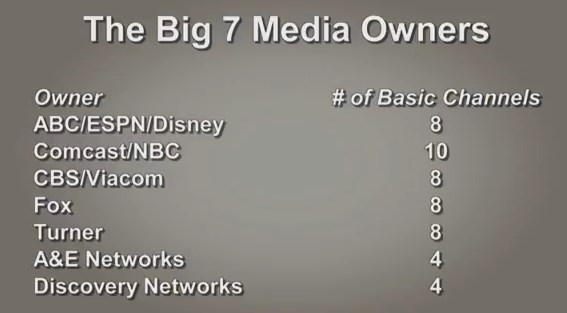
big 7Subscribers of more than 900 independent cable companies may face an unwelcome surprise this summer in the form of a mid-year rate increase.

For years, members of the National Cable Television Cooperative (NCTC) have joined forces to negotiate for the kinds of volume discounts only the largest cable and satellite companies like Comcast, Time Warner Cable, DirecTV, Dish Networks, Charter, and Cablevision have traditionally received. NCTC members range from family owned cable operators, rural co-ops, community-owned providers, independent telephone companies, and small multi-system operators servicing multiple communities. With group-buying power, NCTC-member cable companies used to be able to negotiate volume discounts that could keep their rates competitive with larger providers.

But as consolidation among major network media, cable, satellite, and phone companies marches on, only the largest operators — some directly affiliated with the cable programming networks — are getting the best deals at contract renewal time. All NCTC members combined serve just five million cable TV subscribers. Comcast has 21 million, DirecTV: 20 million, Dish Networks: 14 million, and Time Warner Cable: 11 million.

When NCTC’s contract with Viacom was up for renewal, the owner of networks like MTV and Comedy Central raised the renewal price more than 40 times the rate of inflation. In fact, Viacom’s asking price was so high, operators like Cable ONE pulled the plug on 15 Viacom networks for good and replaced them with other programming. NCTC members eventually compromised on a deal to renew Viacom-owned networks, but customers of companies like Massillon, Ohio-based MCTV are paying the price in the form of a mid-year rate hike Bob Gessner, MCTV’s president, did not want to have to pass on to customers.

MCTV“I don’t like to do this because it puts me in a difficult position of raising prices, which no one likes, or reducing the product, which no one likes, or cutting back on the quality of our customer service, which no one likes,” said Gessner. “Large media companies control all the TV programming and they are raising the price.  The cost of TV programming is rising very rapidly and it is causing this rise in retail prices.”


Some facts about cable TV programming:

  • Nine media companies control 95% of the paid video content consumed in the U.S.;
  • The average household watches only 16 channels, yet networks package their channels to force you to buy those you don’t want to get those that you do want;
  • tvonmysideProgramming network fees account for the bulk of your monthly cable bill;
  • The cost of basic cable has risen 3½ times the rate of inflation over the last 15 years because of demands from networks for higher programming fees;
  • One media company honcho recently stated that, “…content is such a fundamental part of daily life that people will give up food and a roof over their heads before they give up TV.” This shows that they have lost their perspective and the demands for huge increases will continue.
Gessner

Gessner

Gessner has broken ranks with many cable operators that say little more at rate hike time than “increased programming costs.”

Gessner has produced a 20-minute video that carefully explains to his customers what is going on in the cable programming industry and why providers like MCTV are forced to shovel networks onto cable lineups few customers want or watch and how the biggest cable and satellite companies are now negotiating volume-discounted renewal pricing at the expense of smaller providers.

While the largest cable companies in the country secure lower rates through those volume discounts, programmers have found a way to make up the difference: demanding even higher rates for smaller cable companies to cover what they lose from Comcast and other big players.

Gessner, as well as other NCTC member companies, confront huge programmers like Comcast-NBCUniversal, Viacom, Time Warner (Entertainment), Discovery and Disney that first demand 3-7 year renewal contracts with built-in, automatic annual rate increases averaging 5-10 percent, regardless of the ratings of their networks. Most also demand that all of their cable networks be carried on their systems, whether customers are interested in them or not. If these companies dream up new cable networks, like ESPN’s SEC Network and the Longhorn Network, MCTV is committed to carry those channels as well, even though they are of little interest to residents of northeastern Ohio where MCTV operates.

These dream contracts (for cable programmers) are the single biggest reason cable-TV rates are skyrocketing. But Gessner says it gets even worse when those contracts expire. When renewal negotiations begin, programmers these days inevitably demand a “rate reset” which starts rate negotiations at a price 10, 30, even 60 percent higher than under the expiring contract.

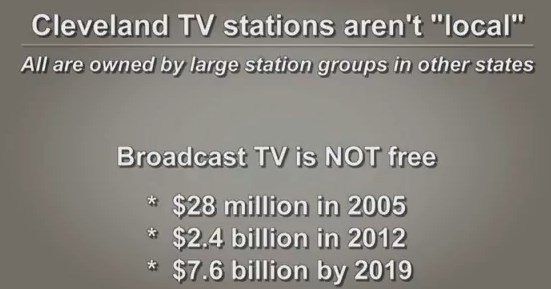
local cleveland tv

Those dollar amounts cover local station retransmission consent agreements nationwide.

Gessner says he doesn’t know how much longer MCTV can afford to carry expensive networks like sports channels. If he drops them, angry subscribers could cancel cable service and switch to a provider willing to pay the asking price. Unless all of his competitors stand together, programmers will maintain the upper hand.

Some cable companies, like Cable ONE, are starting to risk the wrath of their customers by refusing to negotiate for terms they consider unreasonable. When subscribers learned the reasons why Cable ONE dropped more than dozen Viacom channels, many were supportive because the company replaced the networks with other channels and promised to keep rate increases down because they won’t have to pass on Viacom’s higher prices. Viacom retaliated by locking out Cable ONE’s Internet customers from accessing any of Viacom’s free-to-view online programming.

“Viacom lets web surfers from Albania watch Spongebob but Viacom blocks people who live in Alabama, and if you are an advocate of this thing called Net Neutrality, you should be very concerned,” Gessner said. “Viacom is blatantly violating the spirit of Net Neutrality by discriminating against certain Internet users in order to extract higher fees from TV viewers. That’s the sort of vicious bullying behavior many of the content companies use to maintain their stranglehold on the U.S. television industry.”

Gessner and other independent cable operators hope cable operators’ willingness to drop cable networks over their price is the start of something big — a pushback that could eventually force programmers to charge rational rates.

“Hopefully this will serve as a wakeup call to the rest of the industry to stop paying these ridiculous prices for TV rights,” said Gessner. “I have no illusion that sanity will come to the industry overnight — it will take time — but this is a step in the right direction.”

[flv]http://www.phillipdampier.com/video/MCTV Rate Increase 2014.flv[/flv]

MCTV president Bob Gessner hosted this thoughtful presentation to carefully explain why his customers are facing a $1-3 mid-year rate increase for cable television. Gessner breaks with tradition by explaining the cable television business model is effectively broken and needs serious reform, including more choices for customers seeking fewer channels and a lower bill. It’s well worth 20 minutes of your time. (20:11)

Search This Site:

Contributions:

Recent Comments:

Your Account:

Stop the Cap!