Home » Competition » Recent Articles:

Verizon FiOS TV/Broadband Arrives in Suburban Syracuse: Incumbent Time Warner Cable Says “No Price War” Coming

Phillip Dampier October 6, 2009 Competition, Verizon, Video 3 Comments

fiosVerizon FiOS today adds television to its lineup of services in several suburban towns in the Syracuse area, as competition heats up in central New York for cable, telephone, and broadband service.  But the incumbent cable operator, Time Warner Cable, says it’s not worried by Verizon’s arrival, and a company spokesman predicts no price war will result.

Eight communities in the Syracuse area will now be able to choose Verizon FiOS television service in addition to broadband and phone service: Camillus, Clay, Cicero, DeWitt and Salina, and the villages of East Syracuse and North Syracuse in Onondaga County, and the town of Fleming in Cayuga County.

The arrival of television service is important for Verizon, because it lets them compete head-on with incumbent cable operator Time Warner Cable that already offers bundled packages of services, typically known as a “triple play” in the industry — telephone, cable-TV, and broadband.

Chris Creager, Verizon’s president of Northeast operations, claims competition for cable television in central New York will result in better service at lower prices.

“When we enter a market, customers win,” Creager said. “Usually, cable companies are more receptive to looking at prices.”

Time Warner Cable downplayed the competitive threat Verizon could pose to their operations in the region.

In a statement echoing the sentiment Time Warner Cable has expressed in most of the communities where FiOS competes with them, spokesman Jeff Unaitis said Time Warner Cable already has an advanced cable network and has experience delivering cable television service to Syracuse-area residents that Verizon lacks.  Competition is nothing new to Time Warner Cable, he said, noting the company has faced satellite television competition for years.  Unaitis also predicts no significant price cuts as a result of Verizon’s all-fiber FiOS system arriving in town.

Indeed, evidence suggests that Verizon’s FiOS service does not result in dramatic savings for consumers, with one significant exception.

New customer promotions often offer significant price savings, particularly for customers who sign contracts to remain with providers for one or two years, and choose bundled packages of multiple services.  Central New York customers signing up for Verizon FiOS for at least two services can receive a $150 gift card.  Customers choosing their “triple play” will receive $30 off their monthly bill for six months.

Once the promotional offers expire, so do most of the savings, unless a customer threatens to switch providers.  That often brings a renewal of their promotional package price for an extended period, although some providers limit the number of times a customer can take advantage of a promotion.  For consumers trying to optimize savings, that can start a ping-pong relationship with providers, as customers sign up for a promotion and then cancel service when it expires, taking their business to the other player in town.

Competition does often bring improved service, even when savings are elusive.  Broadband service in particular often benefits, as consumers enjoy faster speeds with fewer limitations in communities with FiOS as one of the competitors.

In Syracuse, Time Warner Cable has adjusted speeds upwards for its Road Runner service, in advance of Verizon FiOS’ arrival.  In contrast, speeds in Rochester, a city with no prospect for Verizon FiOS competition, has not seen a speed increase for standard service in several years.  In New York City, a system upgrade to DOCSIS 3 technology has allowed the cable company to offer a premium 50Mbps service tier.  The Syracuse Post-Standard explored the competition angle, and what central New York residents might expect to come from it:

Competition from FiOS, which offers Internet download speeds of up to 50 megabits per second, may push Time Warner Cable to deploy available technology to match those speeds, said Thomas W. Hazlett, a law and economics professor at George Mason University and former chief economist of the Federal Communications Commission. Time Warner Cable recently upgraded its New York City network to offer a 50-megabit option, compared with the maximum 15-megabit speed in Syracuse.

“If it’s like elsewhere, you’re going to see Time Warner respond,” Hazlett said. “They will increase speeds.”

Likewise, Verizon and Time Warner Cable will push each other to offer better channel lineups, better picture quality, on-demand programming and novel services, said Jeffrey Kagan, an independent telecommunications analyst in Atlanta. Prices also will be lower that they would be without competition, but don’t expect a big drop, he said.

The newspaper explored what each company offers customers:

$110 per month: Includes unlimited phone calls in North America; Internet at 15 megabits per second for downloads, 5 megabits for uploads; 255 standard-definition TV channels and seven high-definition channels.

$120 per month: unlimited phone calls in North America; Internet at 25 MBPS for downloads, 15 MBPS for uploads; free Wi-Fi access on nationwide network of hotspots; 275 standard-definition TV channels and 70 high-def channels.

$130 per month: Same package as $120, but with Showtime, 16 more standard-def channels and eight more high-def channels.

Creager said Verizon will lock in the price for two years.

Time Warner Cable’s regular rate for its “All the Best” triple play is $135.50. But new customers can get an introductory rate of $115 for a year, including free use of a digital video recorder for six months, according to the company’s Web site. The service includes unlimited phone calls in North America; Internet downloads at 10 megabits per second, uploads at 1 MBPS; 214 standard-def TV channels and 70 high-def channels.

Time Warner also offers a $100-per-month introductory package that includes fewer TV channels — 154 standard-def and seven high-def.

Several TV news video reports, and a Verizon video press release can be found below the page break.

… Continue Reading

Incremental Progress in Australia on Usage Limits: Pipe Networks’ New Fiber Link Goes Live This Week

Phillip Dampier October 5, 2009 Broadband Speed, Competition, Data Caps, Internode (Australia) Comments Off on Incremental Progress in Australia on Usage Limits: Pipe Networks’ New Fiber Link Goes Live This Week
"PPC-1" - Pipe Network's new fiber link opens this week

"PPC-1" - Pipe Network's new fiber link opens this week

Ongoing connectivity issues and lack of competition continue to leave Australians with expensive, slow, and usage-limited broadband service.

This week, Pipe Networks will make a small dent in improving international connectivity when it activates its new PPC-1 fiber link between Sydney and the U.S. territory of Guam in the Pacific. The project, first envisioned in December 2006, took nearly three years to complete at a cost of more than $175 million U.S. dollars, and has a design capacity of 1.92Tb/s run over two fiber pairs.

Telecommunications analyst Paul Budde said Pipe Networks, along with others “would help to reduce this problem and will therefore provide ISPs with better prices,” which was supposed to result in a lifting of Internet Overcharging schemes like usage caps.

Not so fast.

Broadband providers in Australia have taken notice of Pipe Networks’ new pipeline, but many have not lowered prices or removed usage caps.  The lack of competition has kept a price war from taking place.  Ovum senior telecommunications analyst David Kennedy told Australian IT that without a price incentive, a lot of customers, particularly those served by Optus and Telstra, are unlikely to switch providers.

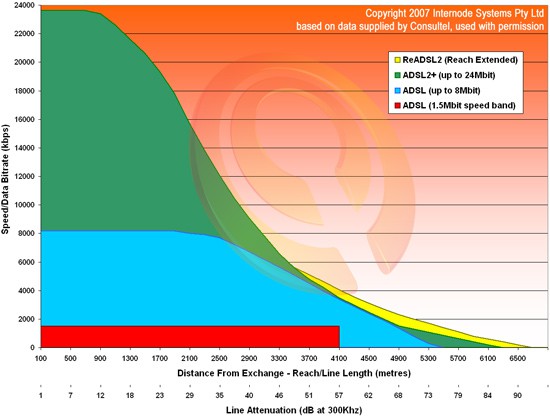
ADSL2+ Speeds drop dramatically the further away you live from the phone company's switching office

ADSL2+ Speeds drop dramatically the further away you live from the phone company's switching office

One DSL provider in Australia, Internode, has made some changes to its service offerings in response to the new fiber link.  The Adelaide-based company has simplified some of its service plans, cut the price of small office/home office pricing by about $9 per month, and increased the paltry usage cap on its Easy Broadband plan from 30GB per month to 50GB per month.  Internode’s Easy Broadband charges $44 a month for DSL service at 1.5Mbps/256kbps,  or in areas upgraded to ADSL2+ service, up to 24Mbps/1Mbps.  Actual speed on the latter service is highly dependent on how far away you live from the telephone company local switching office.

Internode chief executive Pat Tapper doesn’t think PPC-1 will make a huge difference for his company.

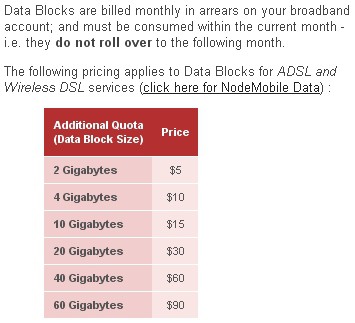
Internode sells "data blocks" for consumers intending to exceed their allowance.

Internode sells "data blocks" for consumers intending to exceed their allowance.

“In the whole scheme of things the PPC-1 circuit doesn’t represent a huge spend in terms of what it costs to run the network. It will change a little bit in terms of our overall cost but only a very small amount,” he said.

“What it does give us is the ability to deliver more capacity to customers in downloads.”

That means a larger usage cap, but not cheaper pricing.

Internode customers that exceed the cap can purchase additional usage blocks, at pricing starting at $2.20 per gigabyte.

CRTC Runs ‘Show Trial’ Hearings Attacking Would-Be Wireless Competitor; Is CRTC Industry Trade Group or Independent Regulator?

Phillip Dampier September 30, 2009 Canada, Competition, Public Policy & Gov't Comments Off on CRTC Runs ‘Show Trial’ Hearings Attacking Would-Be Wireless Competitor; Is CRTC Industry Trade Group or Independent Regulator?
Wind Mobile

Wind Mobile

The Canadian Radio-television Telecommunications Commission (CRTC) is back in this news this week after running a dog and pony hearing at the behest of Bell, Telus, and Rogers (three of Canada’s largest incumbent telecommunications companies) pondering whether would-be wireless competitor Globalive was Canadian enough to do business in the country.

The Telecom Act specifies that all wireless phone companies must be controlled by Canadian citizens.  Toronto-based Globalive Wireless Management Corporation insists it has met the requirements of Canadian law, despite having a major percentage of its financing coming from Egyptian-based Orascom, a wireless mobile provider itself.  Globalive points to approval of its holding company business structure by Industry Canada.

Under the arrangement, Globalive would launch competitive wireless service under the brand Wind Mobile starting later this year.  Then the CRTC got involved.

Canada’s three current wireless phone companies — Bell, Telus, and Rogers, complained to the Commission that Globalive is violating the spirit of the Telecom Act and have essentially joined forces to keep Globalive out of Canada.

The CRTC was quick to respond to the incumbents’ concerns and scheduled hearings which started last Wednesday.  As expected, Globalive got hard questioning from the CRTC and the providers.  Canadian citizens looking for competitive choice weren’t on the agenda.

The Commission previously forced Globalive to publicly release more than 1,000 pages of company documents relating to its business structure, pages that were kept confidential by Industry Canada, but made available to Globalive’s existing competitors for their review.  The result was a gold mine of insight on their potential competitor’s business plan, and they used the information gleaned to argue against the company’s right to provide service.  itWorldCanada covered the response:

“I don’t know how the commission could possibly approve that deal now with that kind of capital structure,” Michael Hennessy, Telus’ senior vice-president of regulatory and government affairs said in an interview. “It would be unprecedented.”

Rogers could have gone along with the Industry Canada ruling, said Ken Engelhart, the company’s vice-president of regulatory affairs, “but when we read the documents we were just amazed. There has never been an approval like this before. The rules have always been [a telecom company] could have a major foreign shareholder, a major foreign debt holder, a major foreign strategic partner. But you could never have the same person being all three. Orascom has 65 per cent of the equity, 100 per cent of the debt and they provide the brand and all the strategic and technical skills.”

“If this is OK there’s no point having any more hearings. They should all get rubber-stamped because if this is Canadian owned and controlled, what isn’t?”

Bell concern trolled their way through written comments, ringing their hands over an ownership structure modified to address their earlier concerns is now even worse.

Anthony Lacavera, chief executive officer for Globalive Wireless Management said Globalive has every right to operate a wireless provider in Canada as he is a Canadian citizen and has control.
TMCNet’s Canadian Angle blog explains:

The biggest problem seems to come down to math.  Globalive states that Lacavera is in control, and he is a Canadian citizen.  The incumbents are complaining about the amount of ownership and possible influence that the Egyptian financial backer, Orascom Telecom, has on the Globalive company.  The way that Lacavera has explained it, the Globalive team is following all the rules while still allowing for some out of this country funding.  Here is the breakdown:

  • Anthony Lacavera owns 35 % of Globalive, and Orascom owns 65%.
  • Orascom funded over $500 Million so Globalive could pay for the wireless spectrum that they bought, and the bridge financing required for the infratructure
  • Both of these parties have agreed to replace the loans with third-party investments – as soon as it is commercially viable.

Telus and Bell suggest that Globalive and Orascom are pulling a fast one – trying to get around the legalities by setting up separate companies but still providing Orascom with a majority stake in the company, and  also with the added benefit of controlling the operations.

It shouldn’t be a big shock that Globalive was financed through another country, and as long as Globalive and Orascom commit to what they say they are going to do, there shouldn’t be any problems.

Well – still one hefty problem – the CRTC is under the influence of the incumbents.  The decisions coming from this regulatory body will provide fuel for many posts to come.

Am I the only one that sees the irony in the CRTC grilling Globalive about being influenced by outside sources?  Isn’t this the pot calling the kettle black?

The reason for all of the debate is simple enough.  Canada’s three wireless phone companies could lose one quarter of their customers to competitors like Globalive and DAVE Wireless, according to Toronto-based Convergence Consulting Group, Ltd., which released a study on the matter last week.  Without Globalive being one of those competitors, incumbent providers will likely retain more customers and more revenue.

“The Verizon FiOS of Hong Kong”: Fiber to the Home 100Mbps Service $35/Month

Phillip Dampier September 27, 2009 Broadband Speed, Competition, Recent Headlines, Video 3 Comments
HK Broadband offers 100% Fiber Optic service to residents of Hong Kong

HK Broadband offers 100% Fiber Optic service to residents of Hong Kong

Hong Kong remains bullish on broadband.  Despite the economic downturn, City Telecom continues to invest millions in constructing one of Hong Kong’s largest fiber optic broadband networks, providing fiber to the home connections to residents. City Telecom’s HK Broadband service relies on an all-fiber optic network, and has been dubbed “the Verizon FiOS of Hong Kong” for its dramatically faster broadband speeds.

Hongkongers have had several choices for broadband service over the years, most offering traditional DSL service throughout the Hong Kong Special Administrative Region (Hong Kong is a territory of the People’s Republic of China). Priced around $32 a month, the most popular service choice offers residents 6Mbps downstream speeds and 0.6Mbps upstream. Some modern residential multi-dwelling units have a more advanced from of DSL service offering up to 18Mbps downstream and 1Mbps upstream.

HK Broadband represents a major competitive threat for traditional DSL service in Hong Kong, because the fiber optic network provides customers with faster speeds ranging from 25Mbps-1000Mbps.  The company also offers a bundle including broadband, a Voice Over IP telephone service, and IPTV (cable television) service with 80+ channels. HK Broadband offers symmetrical speeds on their network, which means your upload speed is as fast as your download speed. The company has pummeled its telephone network-reliant competitors with humorous ads that call out DSL’s slower speeds, particularly for uploads.

<

p style=”text-align: center;”>[flv width=”450″ height=”360″]http://www.phillipdampier.com/video/HKBN Ad – Ants.flv[/flv]
HK Broadband “Ants” Advertisement: Ten Kung-Fu-Fighting-Ants, representing the downstream speed of a traditional DSL broadband connection, are shown ganging up on a single helpless ant, who represents the weaker upstream speed, demonstrating how traditional DSL services typically offer upload bandwidth that is only a 10th of the download speed.

HK Broadband offers 100Mbps service for $35 per month, just a few dollars more than DSL. But there is an interesting catch. HK Broadband, like other providers in Hong Kong, cope with inadequate international broadband connections. Instead of engaging in Internet Overcharging schemes like usage caps, such as those found in Australia and New Zealand, the company has instead capped the speed for websites located abroad at 20Mbps for both uploads and downloads. The 100Mbps speed is reserved for domestic websites. Some subscribers note they couldn’t get speeds much faster than that when accessing overseas sites regardless of the cap, so it has not presented a major problem. As connectivity improves, so should the speeds, according to company officials.

The company also has a unique residential service guarantee — they promise that you will receive at least 80% of the speed you subscribe to, or they refund double your money back. Of course, this applies only to connections made to websites within Hong Kong.

When you’ve got it, flaunt it, and HK Broadband’s fiber speeds are the hallmark of their marketing campaigns.

[flv width=”480″ height=”284″]http://www.phillipdampier.com/video/HKBN 100Mbps Ad.flv[/flv]

HK Broadband “Fat Pipe” Advertisement: Real life characters representing Internet content force themselves into a tiny pipeline, representing DSL, but are later liberated by a wide open fiber optic pipeline they can run through with room to spare.

The investment by City Telecom in their fiber optic broadband network has brought impressive financial results to the company, with customers taking more of their telecommunications business in HK Broadband.  That increases the average revenue per subscriber.  The company has also aggressively increased the level of investment to build out its network, producing an economy of scale that has reduced the costs to wire new subscribers.

Traditional Wall Street investors have often been unimpressed with expensive technology upgrades undertaken by telecommunications companies.  Notably, Verizon Wireless’ FiOS fiber to the home network was pummeled by several investor groups who complained Verizon was spending too much on their fiber network, even though their costs to wire each new customer has dramatically decreased with time.  City Telecom has turned that criticism on its head.  Among many of its competitors, City Telecom is the second most profitable, earning an 11% profit margin.

China Securities has showcased the company, noting it enjoys subscriber growth at levels greater than industry growth, is positioned with technology that assures it of long term stability in revenue and income growth, and despite all of the investments the company has made, retains a strong free cash flow.  Most of all, it has very happy subscribers who enjoy a well regarded broadband service, available at fast speeds and a reasonable price.

The incumbent telephone company’s network of copper wire, supporting lower speed DSL service, is not in the same position.  HK Broadband brought Alexander Graham Bell back to life to chastise the notion that a network more than 100 years old is appropriate for 21st century broadband.

[flv width=”480″ height=”360″]http://www.phillipdampier.com/video/HK Broadband Bell Ad.flv[/flv]

HK Broadband “Alexander Graham Bell” Advertisement: The inventor of the telephone makes a “special-guest” appearance pointing out the fact that the 100 year old telephone network wasn’t designed for today’s broadband connections. This is set in a traditional Chinese Hell-like environment to imply the hellish experience of surfing the Internet with a slow connection.

<

p style=”text-align: left;”>HK Broadband has not escaped the attention of its competitors, of course.  PCCW Limited, Hong Kong’s dominant telephone company, has been aggressively marketing its own fiber, DSL, and wireless broadband products, not allowing HK Broadband to win without a fight. PCCW has had to play catch-up with HK Broadband’s aggressive fiber deployment, which focused on residential and business customers from the outset.  PCCW’s fiber network was primarily intended for business customers, and now the company has been rapidly expanding their fiber network to residential customers.  Today, where PCCW fiber is available, customers can choose from 18Mbps, 30Mbps, 100Mbps, or 1000Mbps service plans.  Many PCCW customers will also be aggressively marketed a wireless mobile Netvigator add-on, one of PCCW’s more successful product lines.

[flv width=”294″ height=”240″]http://www.phillipdampier.com/video/PCCW Fiber Optics Ad.flv[/flv]

PCCW “Fiber Optics” Advertisement: Lampooning HK Broadband’s fiber optic network, PCCW says it had their own extensive fiber optic network laid before HK Broadband came around.  Its tagline, “…the real fiber optics broadband.”

A detailed presentation of HK Broadband and its potential attractiveness to investors was produced by China Securities and features an interview with NiQ Lai, the Chief Financial Officer of City Telecom.

[flv width=”640″ height=”480″]http://www.phillipdampier.com/video/Chinasecurities-City Telecom Presentation September.flv[/flv]

[13 minutes]

Uproar Over Bay Area Comcast Rate Hikes Met With Indifference By Oakland Tribune Business Editor

Phillip Dampier September 24, 2009 Comcast/Xfinity, Competition, Editorial & Site News 2 Comments
Courtesy: vgm8383

Courtesy: vgm8383

Bay area residents are fuming over Comcast’s latest round of rate increases.  The din grew so loud, Drew Voros, the Oakland Tribune Business Editor, noted “the annual outcry over Comcast rates is louder than any rate increase for electricity or water I have come across. A possible exception being California’s energy crisis earlier this decade.”

Voros then casually dismisses consumer outrage by telling his readers “cable TV is not a utility. It is not a vital service with transparency, public input and debate. There is no recourse for poor service through regulatory bodies or the ballot box.”

We know where this is going.

Voros doesn’t suggest that the rate increases are unjustified and unwarranted, nor does he have a bad word to say to Comcast, although he does fixate on one aspect of the regulatory framework (the wrong one) that he believes is at the core of the problem of unchecked rate increases.

His suggestion is to watch free over the air television or try DirecTV, Dish Network or AT&T’s U-verse.

Let’s explore those alternatives.

For some, assuming they get reasonable reception, and many Bay Area residents do not, getting local over the air signals might be good enough, but won’t help with those pesky rate increases on broadband service, or for those channels like C-SPAN or cable news outlets residents access to get coverage of events local broadcasters ignore.

DirecTV and Dish Network are also fine alternatives, assuming you have permission from a landlord to install the reception equipment, and/or your view to the satellite isn’t obstructed by trees or buildings.  AT&T U-verse is an even better potential choice, assuming it’s actually available in your area.

For everyone else, it’s Comzilla or go without.

Voros then goes too far into the weeds and gets lost in what suspiciously looks like “blame the government” rhetoric:

What many TV viewers do not realize is that the franchise agreements are loaded with fees and payments to the cities, funded through annual rate increases. There’s give and take between cable companies and the cities they serve. It’s a business deal with you in the middle.

But consumers are not bound by any franchise agreements, and the options for television services have grown immensely since the first cable TV line was connected in the 1970s. That is why the franchise agreements are out of date. Technology has overtaken that legal document. There’s no monopoly on television content delivery.

Comzilla attacks San Francisco with rate hikes.

Comzilla attacks San Francisco with rate hikes.

Ask any city official if they’d rather enjoy the incremental increase in franchise payments (which amounts to a fixed percentage, usually 3-5% of gross revenue) made possible by the annual rate hike, or the peace and quiet from constituents not upset over an industry that routinely increases rates well in excess of inflation.

Doing away with the franchise system to resolve cable rate hikes would be like using a ShamWow to deal with the after-effects of Hurricane Katrina.

Most cable companies used to include the “franchise fee” as part of the cost of the monthly service, but now routinely break that charge out onto its own line on your bill (and many never lowered the price for the original service, pocketing that as a hidden rate increase as well).  A rate increase may add a few pennies to the franchise fee on a customer’s bill, but then there is the other $3-5 dollars to consider.

Franchise agreements are negotiated for wired providers.  AT&T had to obtain one to provide U-verse.  That’s because local communities demand that a business tearing up their streets provide something in return for the community.  That usually includes: a small percentage of gross revenue, an agreement to provide free service in community centers, government offices, and public schools, and that they set aside several channels for Public, Educational, and Government access, known collectively as “PEG channels.”  It’s a very small price to pay for an industry that earns billions in profits.

Those agreements typically are renegotiated every ten years, so if consumers object to the franchise fee arrangement, they can appeal to local government to reduce or eliminate it.

Voros also suggests consumers try to obtain television programming online.  That is also sometimes possible, but as Stop the Cap! readers know, that also takes a broadband connection, and Comcast just raised the price for many of their customers for that as well.  With the industry’s new TV Everywhere project, dropping your cable subscription, as Voros suggests, will also likely cut you off from many of your favorite cable shows online — TV Everywhere is for paid television subscribers only.

The industry has every angle covered, right down to suing to remove the exclusivity ban on cable networks and programming.  Should the DC Court of Appeals agree, Voros’ contention that there’s no monopoly on television content delivery will also be thrown into doubt.

The solution is not to blame “outdated” franchise agreements.  The cable package business model is the larger problem.  Customers are expected to pay for ever-growing and more costly basic and digital cable packages filled with channels they don’t want.  Of course competition should be encouraged, but allowing consumers to choose and pay for only the channels they wish is a far better solution to runaway cable pricing.

Search This Site:

Contributions:

Recent Comments:

Your Account:

Stop the Cap!