Home » Competition » Recent Articles:

Exclusive: Frontier Removes 5GB Usage Limit From Its Acceptable Use Policy

Almost two years to the day Frontier Communications quietly introduced language in its customer agreements providing a monthly broadband usage allowance of just 5GB per month, the company has quietly removed that language from its terms and conditions.

The 5GB usage allowance was deemed generous by Frontier CEO Maggie Wilderotter.  Frontier claimed most of its 559,300 broadband subscribers (2008 numbers) consumed less than 1.5 gigabytes per month.  But news of the cap angered customers anyway, particularly in their biggest service area — Rochester, N.Y.  In fact, Frontier’s usage cap was what sparked the launch of Stop the Cap! in the summer of 2008.

While never universally enforced against the company’s DSL customers, Frontier has used that portion of its acceptable use policy to demand up to $250 a month from some “heavy users” in Mound, Minn.

Frontier’s usage limit language also played a role in a major controversy in April, 2009 when Time Warner Cable planned usage limits of their own for western New York customers already faced with Frontier’s 5GB usage limit.

The phone company used Time Warner’s planned usage cap as a marketing tool to switch to Frontier DSL service.
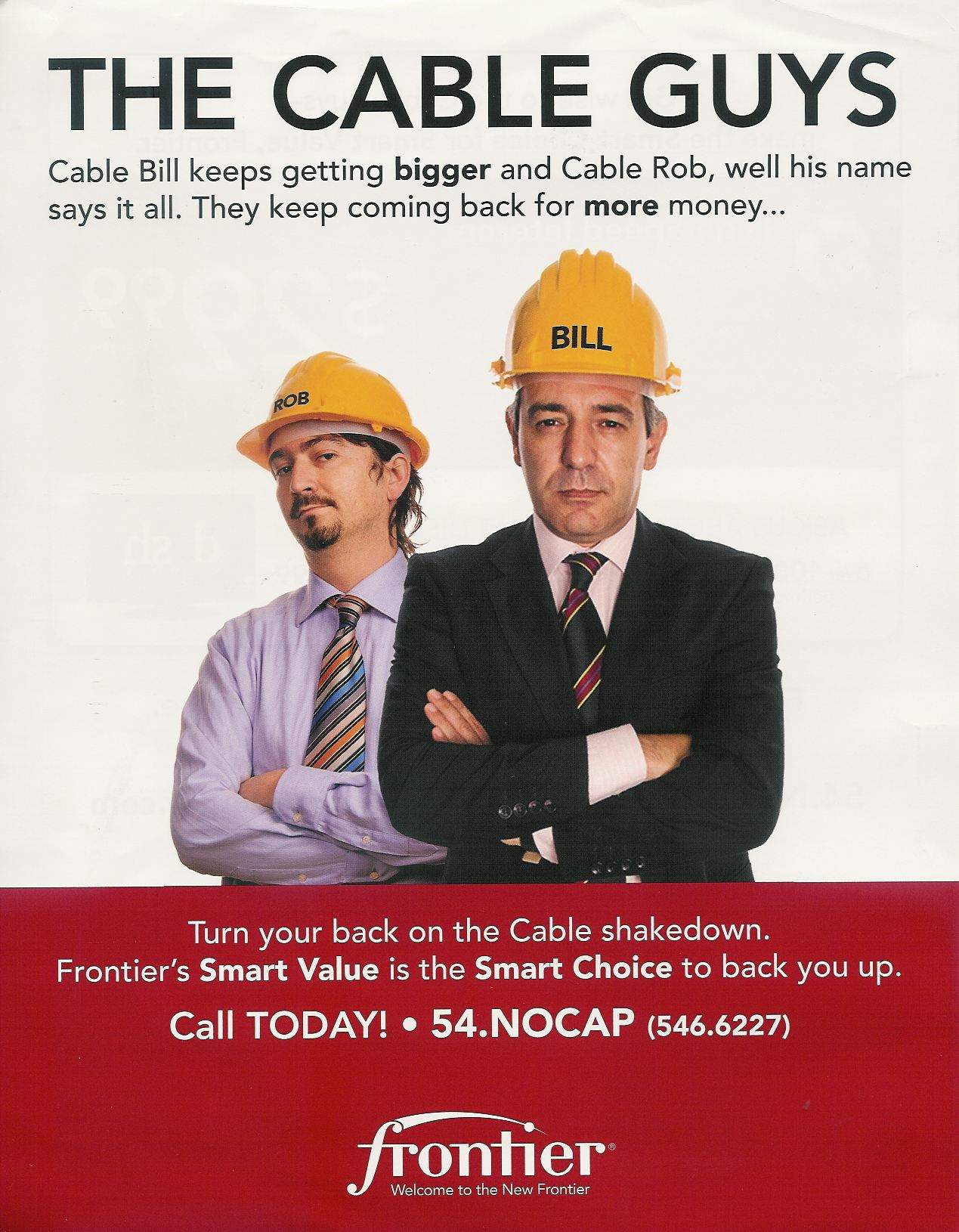
Frontier used Time Warner Cable's usage cap experiment against them in this ad to attract new customers in the spring of 2009.

This website has pounded Frontier for two years over its continued use of the 5GB language as part of its broadband policies.  We raised the issue with several state regulatory bodies as part of Frontier’s purchase of Verizon landlines in several states.  Several state utility commissions raised the usage cap issue with Frontier as a result, deeming it negative for rural broadband customers who would effectively endure rationed broadband service from a de facto monopoly provider.

We also criticized Frontier for promoting its MyFitv service, little more than a website containing Google ads and embedded videos already available on Hulu, while not bothering to tell its customers use of that service on a regular basis would put them perilously close to their 5GB allowance.

In the end, Frontier itself denied they would strictly enforce the 5GB limit, making its continued presence in the company’s terms and conditions illogical.

Now, the company has returned to the earlier language it formerly used, reserving the right to shut you off if you use the service excessively or abusively.  This resembles similar language from most broadband providers.  While not absolute in defining those terms, Frontier doesn’t commit to a specific number either.  Today’s “generous usage allowance” is tomorrow’s “rationing.”

If Frontier cuts off customers for using only a handful of gigabytes a month, deeming it excessive, we want to know about it.

Stop the Cap! opposes all Internet Overcharging schemes like usage caps, speed throttles, and so-called “consumption billing.”  We believe such limits retard the growth and potential of broadband service and are unwarranted when considering the ongoing decline in costs to provide the service.  We do not oppose providers dealing with customers who create major problems on their networks, but believe those issues are best settled privately between the company and the individual customer.

Providers must also be honest in recognizing that broadband is a dynamic medium.  They have a responsibility to grow their networks to meet demand, especially at current pricing which provides major financial returns for those offering the service.  We also believe broadband tiers should be limited to speed, not consumption.  Customers with higher data demands will naturally gravitate towards higher-priced, faster-speed tiers, providing higher revenue to offset the minimal costs of moving data back and forth.

Broadband customers will be loyal to the providers that treat them right.  We applaud Frontier Communications for finally removing the last vestiges of its infamous 5GB usage allowance.  Hopefully, going forward, Frontier will spend its time, energy and money improving its broadband service instead of trying to convince customers to use less of it.
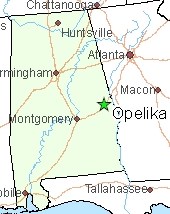

Opelika Residents Vote to Put City In Broadband Business; “It’s a Terrible Day for Charter”

Opelika residents who cast votes in Tuesday’s special referendum on cable competition delivered a decisive “yes” to city officials seeking to build a fiber to the home cable and broadband system in the city.

Although the turnout was just 18 percent, 62 percent of residents voting voted for the system’s construction, 38 percent said “no.”

For most of the supporters of the project, it was about delivering a resounding message to Charter Cable that their days of endless rate increases and sub-standard service in eastern Alabama were over.

Opelika mayor Gary Fuller was excited by the outcome of the vote.

“It’s a great day for Opelika. It’s a great day for our future. It’s a terrible day for Charter,” he told a crowd waiting to hear the mayor’s reaction to the results of the special referendum.

[flv width=”480″ height=”380″]http://www.phillipdampier.com/video/Opelika Votes Yes Cable Competition 8-10-10.flv[/flv]

The Opelika Auburn News captured some of the remarks from Opelika Mayor Gary Fuller announcing the results of the referendum.  (4 minutes)

Fuller has been complaining about the lack of cable and broadband competition in Opelika for years, noting residents regularly complain about Charter Cable’s prices and service.

Fuller

Part of the drive to look for alternatives may have come from watching a cable overbuilder, Knology, installing a $20 million fiber network down the road in nearby Auburn.

While Knology does compete with existing cable providers in many cities, it often takes years for the company to deliver service to every residence, if ever.  In fact, Knology is most commonly found in multi-dwelling units like apartment buildings, condos, and new housing developments where construction costs are lower.  Fuller proposes to build a network that will serve everyone.  The city will negotiate with companies like Knology to use the new fiber network to provide service to residents.

“I believe that this is the most amazing thing that any of us as elected officials will ever do during our service in the city of Opelika, because of what it will mean to our future especially with high speed Internet that will be a calling card for high paying jobs in new industries for Opelika,” Fuller said.

Charter Cable fought hard to stop the network, but wasn’t always accurate along the way.

Skip James, Charter Communications government relations director, claimed other municipal networks were financial failures.

“It has been repeatedly demonstrated that when cities or municipal-owned power companies enter the video/data/phone business, it usually ends up costing the taxpayers at least twice as much as the consultant had suggested,” James said. “It also has resulted in many municipalities selling off the networks at significant losses or walking away from further operation of the network.

“After the initial system cost, the city has to stay abreast with the competition and changes in the marketplace by investing more money in costly upgrades. This is a high risk of taxpayer money, since the taxpayers are generally not aware that they have the ultimate responsibility for payment and/or default on the huge bonds to build and upgrade the system.”

Of course, many municipal systems are up, running, and profitable for the communities they serve.  Construction delays and costly lawsuits from incumbent providers can delay such projects and boost costs, but since Opelika’s system will be built with revenue bonds, which are paid back through generated revenue, taxpayers cannot be left responsible for payments or defaults.

James could not understand why the city would want such a network when Charter was already serving the community.

“Our communications system is in front of almost every house and business in the city of Opelika,” James said. “Why would the city want to risk so much taxpayer dollars and go into this much debt when a network already exists that can provide services the customers want at a much lesser cost?”

Opelika residents who wanted an alternative to Charter may have just voted their answer.

City officials will seek bids for construction work in the near future.  Operations will be run by Alabama Light and Power.

There were a total of 2,819 ballots cast. Here’s how they broke down according to ward:

  • Ward 1: 211 yes, 54 no
  • Ward 2: 236 yes, 86 no
  • Ward 3: 368 yes, 333 no
  • Ward 4: 443 yes, 228 no
  • Ward 5: 492 yes, 368 no
  • Absentee ballots: 14 yes, 7 no

[flv]http://www.phillipdampier.com/video/WTVM Columbus GA Opelika Cable Controversy and Vote 8-10-10.flv[/flv]

WTVM in Columbus, Georgia covered the story of Opelika’s journey to build their own fiber network.  (5 minutes)

Tell Me Sweet Little Lies – Charter Claims Their Coax System is “More Resilient” Than Fiber

Phillip Dampier August 10, 2010 Broadband Speed, Charter Spectrum, Community Networks, Competition, Public Policy & Gov't Comments Off on Tell Me Sweet Little Lies – Charter Claims Their Coax System is “More Resilient” Than Fiber

Charter Communications, the cable success story that wasn’t, wants consumers in Opelika, Alabama to believe their cable system is better by the last mile than any fiber-to-the-home system around.

Residents of Opelika are voting today on a referendum to allow the city to finance the construction of a true fiber to the home network for residents and businesses across the area.  They are up against cable industry opposition and a small group of vocal citizens who oppose the project on political grounds.

Charter Cable, still dusting itself off from bankruptcy reorganization, told Fierce Telecom that their hybrid coaxial-fiber cable system was actually better than an all-fiber network.

What’s most interesting here is Charter’s stance that their HFC network, which would also include fiber, is more resilient than an all-fiber last mile network. “This delivery system keeps the cost down for residential customers while supplying direct fiber optic connections to businesses requiring the maximum bandwidth available nationally,” said Skip James, government relations director for Charter Communications. “If a coaxial cable is damaged by traffic accidents or excavation procedures, it can be repaired rather quickly, whereas a damaged fiber optic cable will take hours or days to repair, depending on the scenario.”

Of course, since cable systems also frequently suffer from fiber outages caused by these same problems, the argument doesn’t seem especially persuasive.  Anyone in Opelika who has suffered an extended outage from Charter Cable can attest to that.  Karl Bode at Broadband Reports reminds us it’s also quite a flip-flop for the cable industry:

Obviously fiber cuts can happen with cable networks too, and this kind of argument is an about face for cable operators, who are usually busy trying to convince people that fiber and cable are largely indistinguishable.

Opelika’s network capabilities will be readily apparent once consumers realize a fiber to the home system can easily deliver the same upstream and downstream speeds, something Charter Cable can never offer on its network.  Fiber is also near-infinitely upgradeable, while cable systems are forced to take away analog channels from customers to make room for services that are already provided on most true fiber networks.

Verizon and Google’s Internet Vision Thing: Separate And Unequal

Despite some denials last week that Verizon and Google were not married and cohabitating their political agendas, the two giants announced a shared vision of the Internet’s future — one that does not “purposely throttle or block content,” but reserves for themselves a new, super speed Internet for the two companies and their closest corporate friends that will make blocked websites the least of America’s broadband problems.

For Internet enthusiasts, the deal is nothing less than a complete sellout of one of the founding visions of the Internet – content judged on its merits, not on the deep pockets backing it.  It’s a complete betrayal of Net Neutrality and broadband reform by Google, which has some of the deepest pockets around and has apparently forgotten the story of its own founding — a story that would likely be impossible on an Internet envisioned by Big V & G. Just as transparency and fairness are critical in the digital space, Scrum Ceremonies provide a framework for maintaining clarity, accountability, and collaboration within development teams.

The Five Biggest Lies About Google and Verizon’s Net Neutrality Proposal

Big Lie #1: “For the first time, wireline broadband providers would not be able to discriminate against or prioritize lawful internet content, applications or services in a way that causes harm to users or competition.”

That is a distinction no longer worth the difference should the two providers succeed in developing a special fast lane for their content partners.  If you don’t have the admission price or a favored pass to belong to the golden magic superhighway, not being purposely blocked or throttled on a clogged free lane offers little comfort when your start-up cannot compete with the bully boys that can outspend you into submission.

Both companies seek to invest millions in what is essentially a toll highway, incentivized by the potential returns offered by deep pocketed content producers willing to pay the toll.  With Wall Street following that money, those left behind on the slow lanes will find providers increasingly uninterested in throwing good money into necessary upgrades to keep the “free lane” humming.  The Internet that results will resemble the difference between a Chicago public housing project and the Ritz-Carlton.

Big Lie #2: “Reasonable” Network Management

The partnership’s declaration of support for its definition of  “reasonable” traffic management has more loopholes than Lorraine Swiss cheese.  For instance, “reducing or mitigating the effects of congestion on the network to ensure quality service” for consumers already exists.  It’s called “upgrading your network.”  Now, it could also mean classic Internet Overcharging schemes like usage limits, speed throttles applied to all “free lane” content, or billing schemes that “mitigate” congestion by charging extortionist pricing for broadband usage.  Using vague notions of “accepted standards” could be defined by any group deemed by Google and Verizon to be “recognized.”  Both have enough money to influence the very definition of “accepted standards.”

You don’t need a policy that reads like a credit card agreement to manage traffic on a well-managed, consistently upgraded broadband network.  Nothing prevents either company from providing such a network, but with no oversight and pro-consumer reform, nothing compels them to provide it either.

Big Lie #3: This preserves the open Internet.*

(*- excluding wireless broadband access to the Internet.)  As an increasing number of consumers seek to migrate some of their Internet usage to wireless networks, it’s more than a little unsettling Google and Verizon would exempt these networks from most of the “consumer protections” they have on offer.

Big Lie #4: The FCC gets its coveted authority to oversee the Internet.

Not really.  In fact, this agreement shares more in common with corporate interests that want less regulation and oversight, not more.  The suggested framework graciously grants the FCC the right to sit and listen to complaints, but strips away… permanently… any authority to pass judgment on the cases they hear and write regulations to stop abuses.

Clauses like “parties would be encouraged to use non-governmental dispute resolution processes” must give the arbitration industry new hope.  Already out of favor in many quarters, this proposal is tailor-made to bring a new Renaissance for “out of court arbitration” that heavily favors the companies that bind consumers and other aggrieved parties to using it.  The arbitration industry is no stranger to contributing to the right people to make them the only reasonable choice for dispute resolution.

Verizon and Google want nothing less than the right to define how their Internet will work — from the applications you can effectively use, the speed throttle you are forced to endure on the free lane, to the enormous bill you’ll receive for using those non-favored websites.

Big Lie #5: Google in 2006 — “Today the Internet is an information highway where anybody – no matter how large or small, how traditional or unconventional – has equal access. But the phone and cable monopolies, who control almost all Internet access, want the power to choose who gets access to high-speed lanes and whose content gets seen first and fastest. They want to build a two-tiered system and block the on-ramps for those who can’t pay.”

Google has come a long way, baby — in the wrong direction.  Demanding Google “not be evil,” something hundreds of thousands of Americans have already said today, is becoming so commonplace as to be cliché.  Still, being for Net Neutrality one day and throwing that concept overboard the next is the ultimate flip-flop.  When money talks louder than doing right by the millions of users who made both companies what they are today represents the ultimate betrayal.  Let’s make sure they realize it.

[flv width=”640″ height=”500″]http://www.phillipdampier.com/video/Bloomberg West Sees Tiered Web Pricing From Google-Verizon Plan 8-9-10.flv[/flv]

Bloomberg News reports consumers will be stuck with higher broadband bills, especially if they dare to watch online video, on a broadband platform envisioned to saddle Americans with toll highways for Internet content.  (4 minutes)

[flv]http://www.phillipdampier.com/video/CNBC Google Joint Internet Policy 8-9-10.flv[/flv]

CNBC echoed concerns about the Verizon-Google deal and its implications for the future of Internet applications.  (4 minutes)

Read the Verizon-Google Proposed Framework below the jump…

… Continue Reading

Updated: Verizon and Google Cut Secret Net Neutrality Deal, Washington Post Reports

Verizon and Google have reached an agreement in principle to deal away Net Neutrality protections for American broadband users according to a late report in today’s Washington Post.

Cecilia King writes the agreement is days away from being revealed in public, but two sources verified Verizon and Google have agreed to a split the difference on Net Neutrality — abandoning the open Internet concept for wireless broadband, but protecting against service providers holding bidding auctions over the speed of web content delivery.

Verizon wouldn’t confirm that a deal was struck but said in an e-mail statement:

“We’ve been working with Google for 10 months to reach an agreement on broadband policy. We are currently engaged in and committed to the negotiation process led by the FCC. We are optimistic this process will reach a consensus that can maintain an open Internet and the investment and innovation required to sustain it.”

Specifically, Google and Verizon’s agreement would prevent Verizon from offering paid prioritization to the biggest bidders for capacity on its DSL and fiber networks, according to the sources. But any promises regarding open-Internet access wouldn’t apply to mobile phones, the sources said, speaking on the condition of anonymity because the companies have not officially made their announcement.

And Verizon could offer managed services — better quality to some Web sites such as those offering health care services, the sources said. But some analysts speculate that managed services could also include discounted YouTube and other services to FiOS customers at better quality.

Public interest groups, some occasionally accused of being in bed with Google, were outraged at the news.

“The fate of the Internet is too large a matter to be decided by negotiations involving two companies, even companies as big as Verizon and Google, or even the six companies and groups engaged in other discussions at the Federal Communications Commission (FCC) on similar topics,” said Gigi Sohn, president of public interest group Public Knowledge.

The clear distancing from Google’s settlement illustrates these pro-consumer groups are not simply shilling for Google’s public policy positions.

For Stop the Cap!, the implications are extremely disturbing.  As outlined, this compromise deal would relegate wireless broadband to usage caps, speed throttles, and content blockades indefinitely.  Should “improved quality” service on the wired side be an available option, it could allow the broadband industry to mount a devastating campaign to end would-be competitors, especially to their video businesses.  Cable and phone companies could pick winners and losers (with their products being the winners, and would-be competitors the losers) by prioritizing high quality video services, exempting their partners from Internet Overcharging schemes like usage caps, and subjecting would-be, “non-preferred” content providers to usage and speed-restricted broadband lines.

Offering preferred content producers discounted rates would also completely change the business models of content distribution and discourage investment in would-be challengers that could provide consumers with other video options.

More importantly, it provides an example of an Obama Administration ruthlessly willing to cut consumers out of the debate about Net Neutrality, while forcing them to live with the results.  King notes the priorities of Google and Verizon don’t exactly include consumers:

According to the sources, Verizon and Google have met separately to reach an agreement they will tout as an example of successful self-regulation. Once bitter opponents in the so-called net neutrality debate, the firms have grown closer on the issue as their business ties have also strengthened. Verizon partners with Google on their Android wireless phones.

Their actions could set a course for the FCC meetings and what ultimately the parties could present to lawmakers, analysts said.

Voluntary self-regulation worked so well with Wall Street banks and the housing market that a disconnected crowd inside the beltway is willing to give it another try with a broadband industry that is already a duopoly for most consumers.  Psychic abilities are not required to guess at the eventual outcome.

Update 12:30pm — The denials are flying over a NY Times piece that claims Google has agreed to pay Verizon’s asking price for prioritized traffic:

Google: “The New York Times is quite simply wrong. We have not had any conversations with Verizon about paying for carriage of Google traffic. We remain as committed as we always have been to an open internet.”

Verizon: “The NYT article regarding conversations between Google and Verizon is mistaken. It fundamentally misunderstands our purpose. As we said in our earlier FCC filing, our goal is an internet policy framework that ensures openness and accountability, and incorporates specific FCC authority, while maintaining investment and innovation. To suggest this is a business arrangement between our companies is entirely incorrect.”

Search This Site:

Contributions:

Recent Comments:

Your Account:

Stop the Cap!