Home » Competition » Recent Articles:

Telecom Analysts Predict Mass Exodus of iPhone Addicts to Verizon Wireless

Phillip Dampier January 12, 2011 AT&T, Competition, Consumer News, Verizon, Video, Wireless Broadband Comments Off on Telecom Analysts Predict Mass Exodus of iPhone Addicts to Verizon Wireless

[flv width=”640″ height=”500″]http://www.phillipdampier.com/video/Bloomberg Doherty Sees Exodus of ATT IPhone Users to Verizon 1-11-11.flv[/flv]

Richard Doherty, research director at Envisioneering Group, Craig Moffett, an analyst at Sanford C. Bernstein, and Bloomberg Businessweek’s Roben Farzad talk about Verizon Wireless’s agreement to start selling Apple Inc.’s iPhone. They talk with Pimm Fox and Julie Hyman on Bloomberg Television’s “Taking Stock.”  (9 minutes)

Surprise: Canadians Getting Bill Shocked by $100+ Overlimit Fees Imposed by Service Providers

Phillip Dampier January 12, 2011 Broadband Speed, Canada, Competition, Consumer News, Data Caps, Editorial & Site News, Public Policy & Gov't, Rural Broadband Comments Off on Surprise: Canadians Getting Bill Shocked by $100+ Overlimit Fees Imposed by Service Providers

The Canadian Radio-television and Telecommunications Commission

Thanks to quick work from the Canadian Radio-television and Telecommunications Commission (CRTC), Canadian broadband providers have wasted no time announcing new usage limits and penalties for those who exceed them.

The principal culprit for the Internet Overcharging: Bell (Canada), the nation’s largest telecommunications company.

Bell’s newly won right to charge wholesale customers usage-based billing rates has caused a collective groan from independent providers from Vancouver to Charlottetown. Primus, the second-largest alternative communications company in Canada, threw up its hands and announced it was going to pass Bell’s costs along to their customers.  Some other providers have already raised rates, shocking customers who received December bills with $100 in overlimit penalties.

“It’s an economic disincentive for Internet use,” said Matt Stein, vice-president of network services for Primus. “It’s not meant to recover costs. In fact these charges that Bell has levied are many, many, many times what it costs to actually deliver it.”

That is a hallmark example of what happens under Internet Overcharging schemes like “usage-based pricing,” usage caps, or other limited use plans.  Customers don’t pay for their actual broadband use — they overpay, especially when stiff penalties are imposed when they exceed their usage allowance.

“Canada’s broadband market is a racket, period,” says our reader Andy, who lives near Petawawa, in northern Ontario.  “If you are in a major city in the south, you can choose Bell or one of their lackeys or the cable company, which almost always means Shaw or Rogers in English-speaking Canada.”

Andy doesn’t have access to cable, so his broadband comes courtesy of DSL from the phone company.  He counts himself lucky he has that, even though it only delivers around 512kbps and is down at least once a week, especially when the weather is bad.  Other communities have no broadband at all, and some areas are so desperate for access, they have provided financial incentives to attract a provider to town.  It rarely succeeds.  Zeropaid reports a handful on unscrupulous would-be providers have taken the incentives and left town with no broadband service to show for it.

“These guys only want the easy customers and they’ve got them in Toronto or Ottawa,” Andy says. “The rest of us can live with dial-up.”

The Canadian government occasionally launches highly publicized demonstration projects to deliver rural broadband in northern Canada, often over wireless, something Andy scoffs at.

“When the TV cameras are shut off and [Prime Minister] Stephen Harper’s political bandwagon goes home, the networks last for about a month until something goes wrong and the whole thing shuts down, sometimes for weeks before someone repairs it,” Andy says.

There oughta be a law.

Katz

In fact Canada, a country with a reputation for keeping a regulatory eye on essential services, has an agency that is supposed to protect consumers and monitor telecommunications services. Unfortunately for Canadians, it was that agency that gave Bell the go-ahead to kill unlimited, flat rate broadband — the service that has kept most independent service providers in business.

Critics charge the Commission has been acting more like a Big Telecom industry trade group than an independent oversight body, and many independent providers openly wonder how long they’ll survive with Bell’s predatory pricing.

Reviewing who serves on the Commission may provide some answers about why they seem to be closely aligned with Canada’s largest telecom companies.  Many of the commissioners used to work for the very companies they are now asked to regulate, and some are likely to return to them after their stint at the CRTC.  The agency’s supposedly independent commissioners know if they want future employment in the telecommunications industry, it’s best not to antagonize your next boss.

Take Commissioner Leonard Katz.  He joined the CRTC in 2005 and was appointed vice chairman of telecommunications in 2007.  For 30 years before joining the Commission, Katz was employed by Canada’s largest telecom firm, moving up through Bell’s management ranks from 1974-1985.  His last big job at Bell was as the assistant director of Bell’s regulatory lobbying department, where he spent his energy and time dealing with federal politicians and the CRTC.  Katz also loves Canada’s wireless industry, dominated by Rogers Communications.  He was founder and chairman of the Cellular Telecommunications Industry Association Clearinghouse for wireless carriers.

Arpin

Or there was Michel Arpin, a consummate former insider at some of Canada’s largest corporately-owned broadcast station groups like Astral Broadcasting, Mutual Broadcasting, and Radiomutuel.  He also had a side relationship with Telus, a western Canadian telecom company that also belongs to the Canadian Association of Broadcasters (CAB).  Arpin served CAB as vice-chair and chair. Arpin, the corporate media man, also served as the vice-chairman of the CRTC’s broadcast division until late last year.

Other examples:

  • Rita Cugini — A regional commissioner for the province of Ontario, her professional background has been working for some of the province’s biggest media interests, including Alliance Atlantis, Telelatino, and CFMT/OMNI.  She also is integrally involved with the Canadian Association of Broadcasters, which bends the ears of regulators regularly on a variety of matters;
  • Tim Denton — About as close to the broadband industry as you can get, Denton’s role as a commissioner began in 2008, but his money was made working for the broadband industry, including the Canadian Association of Internet Providers, which lobbies for big broadband provider interests.
  • Candice Molnar — Serves today as regional commissioner for Manitoba and Saskatchewan, but she knows most of the prairie provinces’ movers and shakers by name, having spent more than 20 years at SaskTel, Saskatchewan’s biggest phone company.  She helped guide SaskTel from provincial to federal regulation when she worked there and her voting record shows her heart is still with her former employer.

Cugini

With a Commission stacked against ordinary Canadian consumers, it’s no wonder Internet Overcharging schemes and stifled broadband competition rule the day in Canada.

“Rural Canada always pays the biggest price,” says Andy.  “If it didn’t happen in Toronto or Ottawa, it didn’t happen at all.”

Andy complains Canadian broadband will never improve with Internet Overcharging schemes in place.

“They complain about your usage and say if they can restrict it, they can improve service to more people; well, where is my better service?” Andy asks.

“At least I don’t have to worry about their usage allowances… yet,” Andy says. “Even if I left my connection running continuously, at these speeds I doubt I could do much damage.”


Verizon Wireless Welcomes iPhone to Its Network Next Month; Stays Silent on Data Pricing

Phillip Dampier January 11, 2011 Competition, Consumer News, Data Caps, Verizon, Video, Wireless Broadband Comments Off on Verizon Wireless Welcomes iPhone to Its Network Next Month; Stays Silent on Data Pricing

It’s official.  Verizon Wireless will welcome Apple’s iPhone to its network next month, but in a glaring omission, company officials refused to discuss data pricing for the all-important data plans that will power the wildly popular smartphone.

The official announcement of the iPhone on Verizon came late this morning in New York at a press event hosted by Verizon’s president Lowell McAdam.  Joining him was Tim Cook, Apple’s chief operating officer. Neither Steve Jobs or Verizon CEO Ivan Seidenberg were on hand for the event.

“Late in 2010 we started offering the Apple iPad and today we are extremely gratified to announce that the iPhone 4 will be available early next month,” MacAdam said. “Our relationship with Apple has developed over the last two years. Back in 2008 we started talking about bringing the iPhone to a CDMA network, and we spent a year testing.”

“All of Apple is very excited to bring the iPhone to Verizon’s customers,” added Cook.

The new phone will be available for pre-orders, exclusively for existing Verizon Wireless customers Feb. 3.  A week later, anyone can reserve the Verizon iPhone at Verizon Wireless or Apple stores, or online.  The new phones will cost $199 for the 16GB model, $299 for the 32GB model with a new two year contract.  The phones will work on Verizon’s 3G network, but not on their new LTE/4G network.

Verizon is so confident its network can handle the traffic, it is bundling, for free, a mobile hotspot with the phone that will allow up to five devices to share the iPhone’s 3G connection over Wi-Fi.  That means you can use a laptop or home computer with a wireless card and connect to Verizon’s 3G wireless broadband service without any additional equipment.

But Verizon’s press event left some questions unanswered, starting with whether the company would sell unlimited data plans to accompany the phone.

“We talked about the device pricing, but we’re not going to talk about the pricing for the network for that connectivity,” Verizon Wireless CEO Dan Mead said. “We’ll have announcements in the future.”

Another downside: the Verizon iPhone will not be able to multitask.  If you make or receive calls on your phone, your data connection is suspended for the length of the call.  This is common on CDMA cellular networks, and it currently affects other smartphones used on Verizon’s network as well.

As far as Apple sees it, that isn’t much of a problem so long as the phone works on Verizon’s network.

“I can tell you that the number one question I’ve gotten is when will the iPhone work on Verizon,” said Cook. “I couldn’t be happier to tell people that. They will make those sorts of trade-offs.”

[flv width=”576″ height=”344″]http://www.phillipdampier.com/video/AP Verizon to Start Selling iPhone Early Feb 1-11-11.flv[/flv]

Lowell McAdam makes the official announcement.  (2 minutes)

Verizon FiOS: No Expansion in 2011; Existing Franchise Areas Will Be Completed, But That’s It

Phillip Dampier January 10, 2011 Broadband Speed, Competition, Consumer News, Verizon, Video 2 Comments

No significant expansion for FiOS in 2011, say company officials.

A Verizon spokesman has confirmed Verizon will not be expanding its FiOS fiber to the home service into new areas in 2011, except in those communities where the company already signed franchise agreements.

It’s the second year of Verizon’s hold on fiber expansion, instituted because of objections by Wall Street, a difficult economy, and a less optimistic view by Verizon’s new management that fiber has the capacity to quickly return on investment.

For upstate New York, the end-effect of Verizon’s decision is an odd patchwork of partially-built FiOS-capable communities, mostly in suburbs amenable to Verizon’s franchise terms. Some suburbs have access to FiOS broadband and phone service, but not television.  Others have access to all three services, while many other areas have nothing but Verizon’s ordinary copper phone lines.

“If you are big on fiber, there are some outlying towns with real estate agents that list whether or not their properties have Verizon FiOS, and whether that includes television service,” says Lysander, N.Y. resident Jeff, who reads Stop the Cap! “Our town was just glad Verizon picked us for upgrades and we didn’t ask too much of the phone company, quickly agreeing to a TV franchise agreement.”

But residents in the city of Syracuse are less happy — they won’t get competitive video from Verizon and are stuck with a Time Warner Cable wired monopoly because the city “dragged its feet” on franchise negotiations.

“When it comes to bigger cities, they see Verizon’s knock on the door as an opportunity to cash in on freebies from the phone company, like upgrading their video studios for government access channels, paying substantial franchise fees, and agreeing to carry channels the city government wants on Verizon’s cable system,” Jeff says.  “When the first cable systems came to town, it was the same story; some communities dragged their feet for years trying to extract more.”

Of course, cities don’t have to wait for Verizon to take care of their growing broadband needs.  They can build their own fiber networks and deliver world class service themselves, or open the new networks up to private competitors to deliver bigger bang for your broadband buck.

[flv width=”480″ height=”380″]http://www.phillipdampier.com/video/WSYR Syracuse FiOS availability not planned for Syracuse during 2011 1-6-11.flv[/flv]

WSYR-TV in Syracuse reports it will be a long wait for many in central New York waiting for fiber to the home television service. (Warning: Loud Volume) (1 minute)

Media Frenzy: The Second Coming… of the iPhone, Headed to Verizon Wireless With Unlimited Data

Phillip Dampier January 10, 2011 AT&T, Broadband Speed, Competition, Consumer News, Data Caps, Verizon, Video, Wireless Broadband Comments Off on Media Frenzy: The Second Coming… of the iPhone, Headed to Verizon Wireless With Unlimited Data

Disgruntled AT&T customers, and those with infinite patience for Apple’s iPhone on Verizon Wireless’ network — your long wait appears to finally be over.

After nearly a year of speculation, Verizon Wireless is expected to announce the imminent arrival of the coveted smartphone on the nation’s largest wireless carrier at a press event tomorrow.

The Verizon version of the iPhone could come at a price premium, with some anticipating the entry level version of the phone could be priced as high as $249 — $50 higher than with AT&T.  The usual two year contract applies.

Analysts predict a muted stampede, at least at first, by unhappy AT&T customers.  As many as two million customers itching to dump AT&T could jump to Verizon in 2011, but they’ll pay dearly to do so.  First, their existing AT&T iPhone won’t work on Verizon’s network, so that means a new phone and a new, two year contract with Verizon to get the best price.  Second, AT&T locked many of its customers into two year contract extensions with the release of the last iPhone in June.  No amount of whining by iPhone users, which has worked to score early upgrades and discounts in the past, will get AT&T to make the price of divorce less expensive.  The company’s price to sever ties: more than $200 for most in-contract customers with the latest version of the popular phone.

[flv]http://www.phillipdampier.com/video/CNBC Verizon iPhone Package 1-10-11.flv[/flv]

CNBC discusses the pros and cons of Verizon’s adoption of Apple’s iPhone in these two reports.  (8 minutes)

Verizon iPhone users will also give up something else: an iPhone that can multitask.  AT&T’s GSM network allowed customers to browse web pages and run applications while you talked on the phone.  Verizon’s CDMA network doesn’t support that.  As long as you talk on your phone, your data applications won’t update.  It’s an either/or proposition, at least for now.

Still, expect the iPhone to be a Verizon hit like none other.  Carl Howe, an analyst for the Yankee Group, expects Verizon to sell 16.5 million iPhones in 2011, with more than half — 9 million — coming from Verizon’s own subscriber base.

The question is — can Verizon’s three bedroom house support the entire extended family showing up on their network doorstep?

AT&T’s network suffered from the onslaught of data-hungry iPhone devotees.  As millions of Americans adopted the phone, an AT&T exclusive, the company’s wireless network groaned under the usage.  With calls dropping, data trickling, and customer service irritating, AT&T scored rock-bottom in consumer ratings.

Some wonder if the same fate could afflict Verizon’s network.  Verizon currently has the lowest percentage of smartphone customers using its network among the four major carriers.  Verizon’s pricing is typically considered the culprit.  Customers insisting on the iPhone ended up with AT&T.  But those seeking Android phones had more choices — Sprint’s unlimited data plans at aggressive price points, T-Mobile’s value-oriented family shareplans, or Verizon’s robust network coverage at Cadillac pricing.

Putting the iPhone, already a premium-priced phone some consumers can’t live without, with Verizon’s reputation for high quality service, is expected to be a winning combination, and 16.5 million customers joining Verizon’s existing 30 million smartphone customers in a single year could have a dramatic impact.

“Unless Verizon has done a lot of network upgrades in advance, it may see many of the same capacity problems that have plagued AT&T,” Howe says.

The news AT&T is about to lose its exclusivity for the phone was taken in stride by some company executives, one who used the occasion to take a swipe at Verizon’s slower speed 3G network.

AT&T public relations head Larry Solomon pointed out Verizon’s 3G network relies on 3.1Mbps EVDO Rev. A technology while AT&T delivers 7.2Mbps on its HSPA 3G network.

The iPhone is built for speed, but that’s not what you get with a CDMA phone,” Solomon told Electronista. “I’m not sure iPhone users are ready for life in the slow lane.”

Verizon Wireless is expected to unveil the new phone Tuesday morning, with its in-store availability expected within a few weeks.  For fans of unlimited usage, there is one more piece of good news: Verizon is expected to continue offering unlimited data usage plans to its new iPhone customers.  AT&T cashiered its own unlimited data plan last spring, forcing customers to keep usage under 2GB per month if they don’t want an even higher bill.  Verizon is reportedly confident its network can sustain the traffic, and will leave its data hungry customers alone… for now.

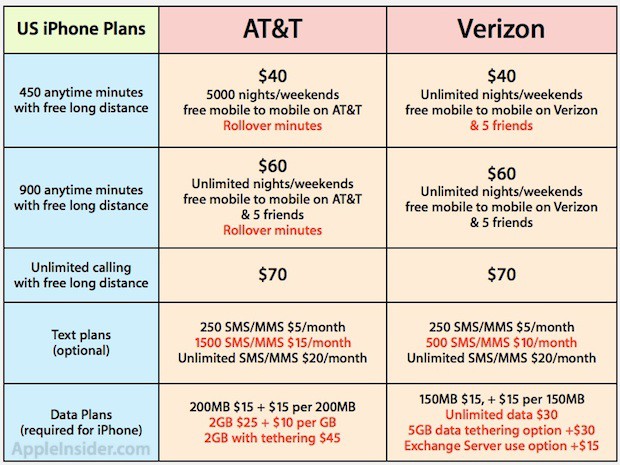
Apple Insider produced this chart comparing Verizon and AT&T's smartphone pricing.

[flv width=”640″ height=”500″]http://www.phillipdampier.com/video/WTTG Bloomberg Verizon iPhone Package 1-10-11.flv[/flv]

WTTG-TV in Washington delivers the news about the imminent arrival of the iPhone on Verizon’s network in a consumer-friendly fashion, while Bloomberg delves deeper into exactly what impact the move will have on existing and future customers of both AT&T and Verizon.  (9 minutes)

Search This Site:

Contributions:

Recent Comments:

Your Account:

Stop the Cap!