Home » Competition » Recent Articles:

AT&T Allows Long-Standing Smartphone Customers to Switch Back to Unlimited Data Plans

Phillip Dampier January 26, 2011 AT&T, Competition, Consumer News, Data Caps, Wireless Broadband 2 Comments

The Associated Press reports, and Stop the Cap! can confirm AT&T is allowing some of their long-standing customers to switch back to unlimited data plans, even if they gave them up after the company introduced cheaper, limited data plan options.

After our regular reader “PreventCAPS” sent word AT&T was relenting on some requests for unlimited data plans, we spent some time late this afternoon with Jim Scott, an AT&T customer from New Rochelle, N.Y. as he navigated his way through AT&T customer service trying to get back to an unlimited data plan.

“When AT&T offered customers new, cheaper data plans, I never knew those replaced the unlimited option and I thought I could save some money downgrading to a cheaper data option,” Scott told us.

But Scott discovered the plan allowances he got didn’t save him money at all, because he exceeded them.

“I am a contractor and I spend all day on my phone moving large image files and even video of work being done on the properties I manage,” Scott says.  “Two gigabytes didn’t cut it.”

Scott tried to switch back to his unlimited plan this summer, but was told he could not, as it was no longer offered.

Enter Verizon Wireless, which is keeping its unlimited service plan at least temporarily as it introduces the Verizon iPhone.  Verizon’s imminent iPhone has become leverage for customers who want to turn the tables on AT&T.

“Thanks to AT&T’s greed, I had already made the decision to dump them for Verizon when my contract ends in February,” Scott says. “AT&T works fine in this part of New York, and the only reason I am leaving is because they don’t have a wireless data plan that met my needs.”

We worked with Scott and suggested he threaten to cancel his AT&T service and walk his future business to Verizon Wireless.  We asked him to make sure to tell AT&T the reason he was planning to cancel his service was because of the end of unlimited data option.

On a three-way call with AT&T customer service, AT&T promptly offered to restore Scott’s access to its discontinued unlimited data plan.

“All I had to say was ‘Verizon’ and ‘iPhone’ and the customer service representative immediately starting clacking away on her keyboard, and I had my unlimited data plan restored in less than five minutes,” Scott said.

The AP reports the key to success is having been a previous subscriber to AT&T’s unlimited data option.  New customers who signed up after June 2010 never had that option, and AT&T has refused to offer unlimited data to these customers.

Because newer customers are under relatively new contracts, actually following through on a threat to drop AT&T is an expensive proposition with early termination fees still well into the hundreds of dollars.  For those closer to a penalty-free exit, AT&T recognizes many of these customers already have one foot out the door.

Jose Argumedo, of Brentwood, N.Y., told the AP he and a friend were switched to an unlimited plan recently after they called AT&T’s customer service. Both have iPhone 4s, and previously had earlier iPhone models.

AT&T spokesman Mark Siegel wouldn’t confirm the option to return to an unlimited plan.

“We handle customers and their situations individually, and we’re not going to discuss specifics,” he said.

Scott says he is comfortable with his iPhone, but getting back an unlimited data plan was more important than the handset.

“If I can use the iPhone as leverage against these guys, why not?” Scott says.  “They’ve had me under their thumb for more than six months now with overlimit fees — now the table is turned.”

Stop the Cap! advises customers who want to follow in Scott’s footsteps get organized before calling:

  1. Be sure to note the number of years you have been an AT&T customer;
  2. Explain you used to have unlimited data and now want that plan back;
  3. Tell them you are prepared to drop AT&T, even at the risk of a cancellation fee, if they don’t restore your access to the unlimited data plan.

If a representative is unable to make the switch, or doesn’t have information about how to switch you back, ask for a supervisor or hang up and call back.
Canadian Consumer Backlash Against Internet Overcharging Gone Wild

The Vancouver Sun‘s Gillian Shaw reports consumers in British Columbia, Alberta, and beyond are about to pay more for their Internet service, and consumers across Canada are not pleased.

Shaw, who isn’t affiliated with Shaw-the-cable-company, notes changes by a federal regulator could mean the end of unlimited broadband service across the country.

Steve Anderson, founder and national coordinator of the Vancouver-based OpenMedia.ca., which also fights for Net Neutrality protections in the country, thinks “usage-based billing,” a core component of Internet Overcharging, has struck a nerve.

“Bell, Rogers, and Shaw have been given the green light to determine how we pay for Internet,” Anderson tells Shaw.  “If this decision goes unchecked, broadband is about to cost much more for Canadians.”

Anderson tells the newspaper more than 40,000 consumers have signed the group’s petition opposing the pricing schemes, and many Canadians are taking the matter to their member of Parliament.

“It is a really interesting grassroots community that has sprung up around this. Basically they said enough is enough. They are drawing a line in the sand and saying ‘we are not going to take this anymore, this is where it stops.’”

Shaw also talked to Stop the Cap! about the pricing schemes:

“We have consumers who pay good money to receive broadband service, now they have to think twice about everything they do online in case they expose themselves to over-limit fees,” said Phillip Dampier.

“How many people measure how much they are using online?” said Dampier. “If you have kids that are teenagers and you are sharing an Internet connection, can you imagine the battles when the bill arrives – ‘Who ran up the bill?’

“If you thought cellphone bill shock was bad, imagine you have two teenagers living at home who are on the Internet all the time.”

Dampier said usage explanations by companies, such as Shaw’s graphic that shows 15 gigabytes of data equals 105,000 emails are useless for the average consumer.

“Shaw says these are generous; that’s all nice, but nobody needs to send out 105,000 emails. But what they do need to do now that Netflix has come to Canada is video streaming and you can blow through these usage limits a lot faster using online video.

“If you have Shaw’s lite service you can get through four movies tops, that’s it — no more emails for you, no web pages, or you can, but watch out, you’ll get a big bill at the end of the month.”

“Holy Crap,” Shaw Customer Exclaims, Their Broadband Service Could Cost You Hundreds a Month

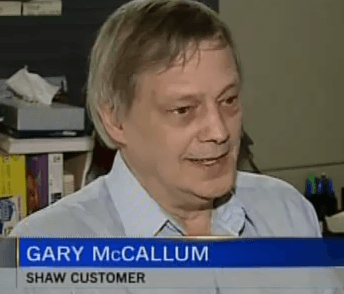
Gary McCallum, a Shaw customer in Edmonton, Alberta, has received word his broadband service is about to get more expensive — a lot more expensive.

“Holy crap, it’s like text messaging [bill shock] all over again when your broadband bill arrives and you are now looking at hundreds of dollars instead of the $40 or $50 you used to pay,” McCallum told CTV News.

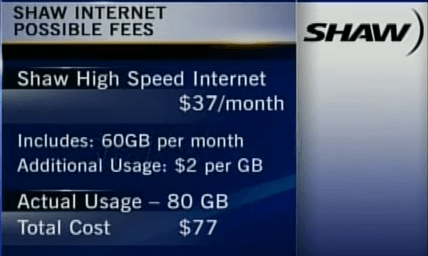
McCallum, and other designated “heavy users,” are receiving letters in the mail from Shaw notifying them they have been exceeding the company’s declining usage limits imposed on its broadband service.  If they exceed the limits again, they may be subject to penalty fees of as much as $2 per gigabyte.

“I’m upset about the backdoor tactics,” McCallum complains.  “They keep it secret and then lambaste you later.”

Most Shaw customers will be forced to confine their usage to 60GB per month, the limit on the company’s most popular broadband plan.  If they don’t, after some warning, they’ll pay a stiff fine.  Just 20GB of overlimit usage will more than double the average customer’s broadband bill, currently around $37 a month.

A house full of teenagers watching Netflix or downloading files could cost far more than that.

Company officials deny the potential revenue bonanza is unjustified.

Customers who use more will pay more, admits Terry Medd, vice-president of operations for Shaw Communications in Calgary.

“It’s video over the Internet that’s driving a lot of this cost,” he said. However, most Shaw Internet customers won’t hit their caps, Medd claims, suggesting it should affect fewer than 10 per cent of customers.

“The average user consumed about one-third of what the cap is. In other words, we’ve set the caps at three times the average usage. For the average user, there’s no concern here,” Medd said.

However, Shaw recently reduced their usage caps on virtually all of their Internet plans, making it more likely customers will be snagged by overlimit fees.

Some customers want to know what they will get if they use far less than their plan allowance.

Don McGregor believes Shaw’s plan to charge Internet users for the data they use is fair and equitable, so long as those who use less than the allowance get a break on their bills.

“Shaw should plan on refunding fees for any use of data below the contracted amount,” the Edmonton resident wrote in a letter to the editor published in the Edmonton Journal.  “Since 90 per cent of Shaw’s subscribers use less than the full GB capacity they pay for, I am sure these subscribers’ refund cheques are in the mail.”

Don, like other Canadians, is about to learn Internet Overcharging is never about fairness or saving customers money.  It’s about charging customers more for the same service they used to receive for less, without any improvements.  ISPs will not provide true “usage pricing” for consumers because it would slash revenue from their broadband service.

But western Canadians need not be victims of Shaw’s overcharging.  Telus, which sells landline-based DSL service in British Columbia and Alberta says it has upgraded its facilities to accommodate usage demands and won’t expose customers to overlimit fee bill shock.

Telus offers a way out of Shaw's Money Party hangover

Although Telus’ website does show usage limits, company officials claim they are rarely enforced, and not at the subscriber’s expense.

Telus could make a significant dent in Shaw’s customer base by dropping them altogether, which will save the phone company from these kinds of  silly legal gymnastics in their FAQ:

Why do you call your service unlimited, when my monthly usage is limited?
We refer to TELUS High Speed as being unlimited because you get unlimited hours of monthly access.

If you do not want to play Shaw’s Internet Overcharging game, perhaps spending time with a new Xbox 360 would be better?  Telus is giving them away to qualified new customers signing up for service.

[flv width=”480″ height=”380″]http://www.phillipdampier.com/video/CTV Edmonton Shaw Internet Overcharging 1-7-11.flv[/flv]

CTV News in Edmonton informs Alberta’s Shaw customers their broadband service could get a lot more expensive.  (2 minutes)

Knology’s Embarrassing Fact Lapses in Lawrence, Kansas

Knology's Shakedown in Lawrence

Pesky facts have a way of getting in the middle of silly marketing campaigns.  Knology of Kansas (actually Georgia) has run into this problem in a big way with its glitzy, carefully-crafted welcome website KnologyKnows.

Some of the company’s facts are uncoordinated.

Lawrence blogger Joe Davis sure noticed:

Knology put up a new website to help build their brand in Lawrence, Kansas. In big capital letters, they write:

Allow us to introduce ourselves. We’re Knology, the new (115-year-old) kid on the block.

Sounds eerily familiar to the beginning of “Sympathy for the Devil” by the Rolling Stones.  Trust me… I have no sympathy for the Devil (in this case, a non-local company), also known as Knology. Their website is called KnologyKnows.com. But considering how many “facts” they’ve put out this past week that have been wrong, they really don’t know.

[flv width=”640″ height=”253″]http://www.phillipdampier.com/video/Sunflower Broadband is Now Knology.flv[/flv]

Knology’s opening welcome video to residents of Lawrence, Kansas has some fact-checking problems. (1 minute)

Davis caught a fact-checking lapse in the company’s introductory video, which claims the world record for handshakes was 13,372.  Oops.  In 2002, while campaigning for office, soon-to-be Gov. Bill Richardson set a world record for the most number of handshakes in an eight-hour period: 13,392.

The only thing Knology has been good at so far in Lawrence is shaking down their customers with Internet Overcharging schemes.  The company has plenty of money to invest in promoting itself, but has so far retained Sunflower Broadband’s costly usage limits and overlimit fees.

Knology hasn’t been around for 115 years either — a company it bought out was.  The Interstate and Valley Telephone Company was one of many independent phone companies created to serve areas AT&T dismissed as rural backwaters not worthy of their service.  Knology itself has only been around since 1994, owned by ITC Holding Company — the people who also brought you Mindspring, a defunct Internet Service Provider sold to Earthlink one month before the dot.com crash.

Did you know Lawrence omits several states?

Davis is also unimpressed with the company’s sell-out of its customer support staff, many of whom will lose their jobs as part of the company’s “rightsizing” initiative.

For Davis, first impressions mean a lot, and Knology is doing themselves no favors.  Some of their other trivia isn’t always accurate, either:

This “fact” is told to anyone who first comes to Lawrence. However, it is wrong. Truth is, 14 states are missing from the Lawrence street grid. The first thing I did when I was told this in 2006 was to find where Connecticut street was located. The funny thing is… Of the 36 state streets in Lawrence, Georgia is not included. Knology is based out of Georgia. Whoops.

Davis says Knology has turned Sunflower’s well-regarded Twitter customer support account into an automated marketing spambot, spewing out continuous tweets telling customers to enter its giveaway and visit its newly branded website.

Stop the Cap! reader Brian, also from Lawrence, agrees with Davis.

“Knology has no concept of the truth in their marketing campaign. This is a scary test of things to come. Fortunately, we just switched to AT&T’s U-verse.”

Perhaps Knology should learn from the ghost of Mindspring, which used to have legendary customer service and a list of:

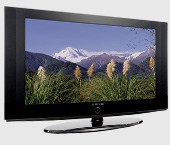
By filling out Knology's survey, you can give the company a piece of your mind over its Internet Overcharging schemes and possibly win this 32" Samsung flat panel TV.

The 14 Deadly Sins of Mindspring (a/k/a “the ways that we can be just like everybody else”)

  1. Give lousy service- busy signals, disconnects, downtime, and ring no answers.
  2. Rely on outside vendors who let us down.
  3. Make internal procedures easy on us, even if it means negatively affecting or inconveniencing the customer.
  4. Joke about how dumb the customers are.
  5. Finger point at how other departments are not doing their job.
  6. Customers can’t get immediate “live” help from sales or support.
  7. Poor coordination across departments.
  8. Show up at a demo, sales call, trade show, or meeting unprepared.
  9. Ignore the competition, they are far inferior to us.
  10. Miss deadlines that we commit to internally and externally.
  11. Make recruiting, hiring, and training a lower priority because we are too busy doing other tasks.
  12. Look for the next job assignment, instead of focusing on the current one.
  13. Office gossip, rumors, and politics.
  14. Rely on dissatisfied customers to be your service monitors.

Readers can share their views about Knology’s unjustified Internet Overcharging schemes and enter to win a 32″ Samsung flat panel TV in the process.  You need not be a customer to participate.  Just complete their survey, and be sure to let them know in the box labeled “other” that you will never do business with an Internet provider that doesn’t provide truly unlimited, full speed, flat rate broadband service.

Shaw Sneakiness: Company Lowers Usage Limits, Hopes Nobody Noticed

Shaw sets the bar lower.

Shaw Cable, western Canada’s largest cable company, has quietly lowered usage caps on virtually all of their broadband plans, while “forgetting” to change the date on their Terms of Service:

  • Lite was 13GB, now increased to 15GB ($2/GB overages)
  • High Speed was 75GB, now decreased to 60GB ($2/GB overages)
  • Xtreme was 125GB, now decreased to 100GB ($1/GB overages)
  • Warp was 250GB, now decreased to 175GB ($1/GB overages)
  • Nitro was 500GB, now decreased to 350GB ($1/GB overages)

Shaw’s terms of service page documents changes implemented by the cable company and includes the revision date, changed whenever the terms change.  Not this time.  Blogger “Thewunderbar” documented Shaw left the revision date on the document unchanged, suggesting the cable company hadn’t made any adjustments to their service since July, 2010.  After publishing his piece, Shaw quietly updated their website to reflect the correct date.

Cable and phone companies in Canada have established a unique, unchecked duopoly.  They are systematically increasing prices while decreasing the amount of service provided to Canadian consumers.  Shaw’s decrease in usage limits comes with no corresponding price cut for Internet service.

At a time when Netflix streaming is attempting to make inroads into Canadian homes, broadband providers who also have interests in pay television (cable, phone or satellite) are working overtime to make sure no consumer believes they can safely cancel their cable-TV service and watch everything online.

Over the past four years, Canadian ISPs have embarked on a wide range of Internet Overcharging schemes:

  • The elimination of flat rate, unlimited broadband service;
  • The introduction of low usage allowances designed to trip up an increasing number of consumers leading to,
  • The introduction of stinging overlimit fees for customers exceeding usage limits, at prices marked up from 500-5000 percent above wholesale;
  • The introduction of speed throttles which artificially slow your broadband experience to speeds sometimes just above dial-up;
  • The ongoing limbo dance of usage caps that decrease in size over time, exposing more consumers to overlimit fees, making them think twice about everything they do online.

Nobody has successfully monetized the broadband experience like Canadian ISPs have.  Even as their costs to deliver the service continue to rocket downwards, companies keep on increasing prices, exposing Canadian consumers to unwarranted bill shock from unjustified overlimit fees.  What does it cost Shaw per gigabyte?  An estimated 1-3 cents.  What do they charge you?  Up to $2.

It’s nothing short of a rip-off, and Stop the Cap! urges Canadian consumers to contact their member of Parliament and demand immediate action to ban these innovation-killing, job-retarding, unjustified overcharging schemes.

Search This Site:

Contributions:

Recent Comments:

Your Account:

Stop the Cap!