Home » Competition » Recent Articles:

AT&T Lobbyist Talks Up Dollar-a-Holler Advocacy: “We Seem to Be Having Success”

Cicconi

Jim Cicconi, AT&T’s chief lobbyist told Politico the company’s practice of encouraging civil rights and charity groups to advocate on its behalf was “entirely natural,” and claimed opponents of the proposed merger of AT&T and T-Mobile were doing the same thing.

“The difference is that we seem to be having success and they are not. We attribute that entirely to the obvious benefits of the merger and the history of what we have stood for as a company,” Cicconi said. “What seems unnecessary is for opponents to attack the motives and credibility of those who have chosen to support our position and not theirs.”

AT&T has made substantial contributions, both financial and through involvement by key AT&T executives on various boards of directors of non-profit groups, as part of its corporate strategy.  Often, many of the non-profit groups involved thank AT&T by submitting letters of support for various business activities AT&T is engaged in, including public policy debates, mergers and acquisitions, and legislation that could impact the company’s bottom line.

On occasion, the connection between AT&T’s large financial contributions and the advocacy letters that often result becomes a point of contention with rank and file members of the organization, as happened in June with a gay rights organization that culminated in the resignation of its president and an AT&T-connected board member.

But more often than not, the corporate money-and-influence-connection goes unnoticed by the constituents of these organizations, many of whom will be disadvantaged, charge critics, by an outcome favorable to AT&T.

Politico explored the links between AT&T executives, lobbyists, money and civic groups and charities and discovered plenty:

Somehow, letters from the National Urban League and...

• Norelie Garcia, associate vice president of federal affairs at AT&T, who is an executive committee chair on the National Puerto Rican Coalition’s board of directors. The group wrote to the FCC May 27.

• Jerry Fuentes, president of AT&T for the Arizona and New Mexico regions, is the vice president for corporate policy on the National Hispanic Caucus of State Legislators’s business board of advisers. The organization wrote to the FCC backing AT&T on May 26.

• Barbara Winn, AT&T’s Sacramento-area director of external affairs, is listed on the letterhead of the Greater Sacramento Urban League as executive committee chairman in the filing the group sent to the FCC supporting the deal June 17.

• Tanya Lombard, assistant vice president of public affairs at AT&T, is a board member of the National Coalition on Black Civic Participation. The group wrote to the FCC May 25, saying “We believe it will help fulfill President Obama’s vision of an America in which everyone has affordable access to high-speed Internet service.”

AT&T is listed as a sponsor of the Cuban American National Council , the National Puerto Rican Coalition, and among the National Coalition on Black Civic Participation’s 35th anniversary partners. Meanwhile, it costs $25,000 annually to be a full member of the National Hispanic Caucus of State Legislators’s business board of advisers, as AT&T’s Fuentes is.

In 2009, the AT&T Foundation gave the local chapters of the Urban League in Chattanooga, Tenn.; Columbia, S.C.; and Knoxville, Tenn., a total of $45,000.

The National Urban League in 2009 received more funding — $100,000 — from the Sprint Foundation. But Sprint, which has been the most vocal corporate opponent of the AT&T/T-Mobile deal, does not have executives on the boards of any of those groups, the company said.


...the National Action Network turned out to be nearly identical.

Politico found many of America’s most influential civic rights groups received private briefings from AT&T executives promoting the deal — meetings which ultimately led to letters of support from those organizations, despite their having little or no input from those opposed to the merger.  AT&T also has dispatched “advocacy kits” to many groups filled with sample letters and talking points the company encourages groups to use as a template for letters of their own.  Not counting on the laziness among many tasked with writing the letters ultimately dispatched to the Federal Communications Commission, there is often a striking resemblance of correspondence favoring the merger.

Politico notes the text in two filings submitted last month to the FCC by the National Urban League and Al Sharpton’s National Action Network regarding the acquisition are nearly identical.

All of this disturbs ColorofChange, a civil rights group not on the payroll of either those supporting the merger or opposed to it.

“There are long-standing relationships AT&T has with these organizations that we think unfortunately have led some of them to take AT&T’s position on an issue that will negatively impact black people,” Rashad Robinson, executive director of ColorofChange told Politico.

AT&T just disclosed its latest lobbying reports, showing the company has increased its lobbying budget by nearly $1,000,000 compared with the same quarter last year — spending $6.84 million during the first quarter of 2011 alone on lobbying the federal government.

Sprint Nextel, seen by many as the primary opponent of the deal, actually reduced its own lobbying expenses during the same period, spending just $583,000 during the first quarter, down 25% from the $774,100 spent a year earlier.
Virginia Releases New Broadband Availability Map: Good, But Not Great Access

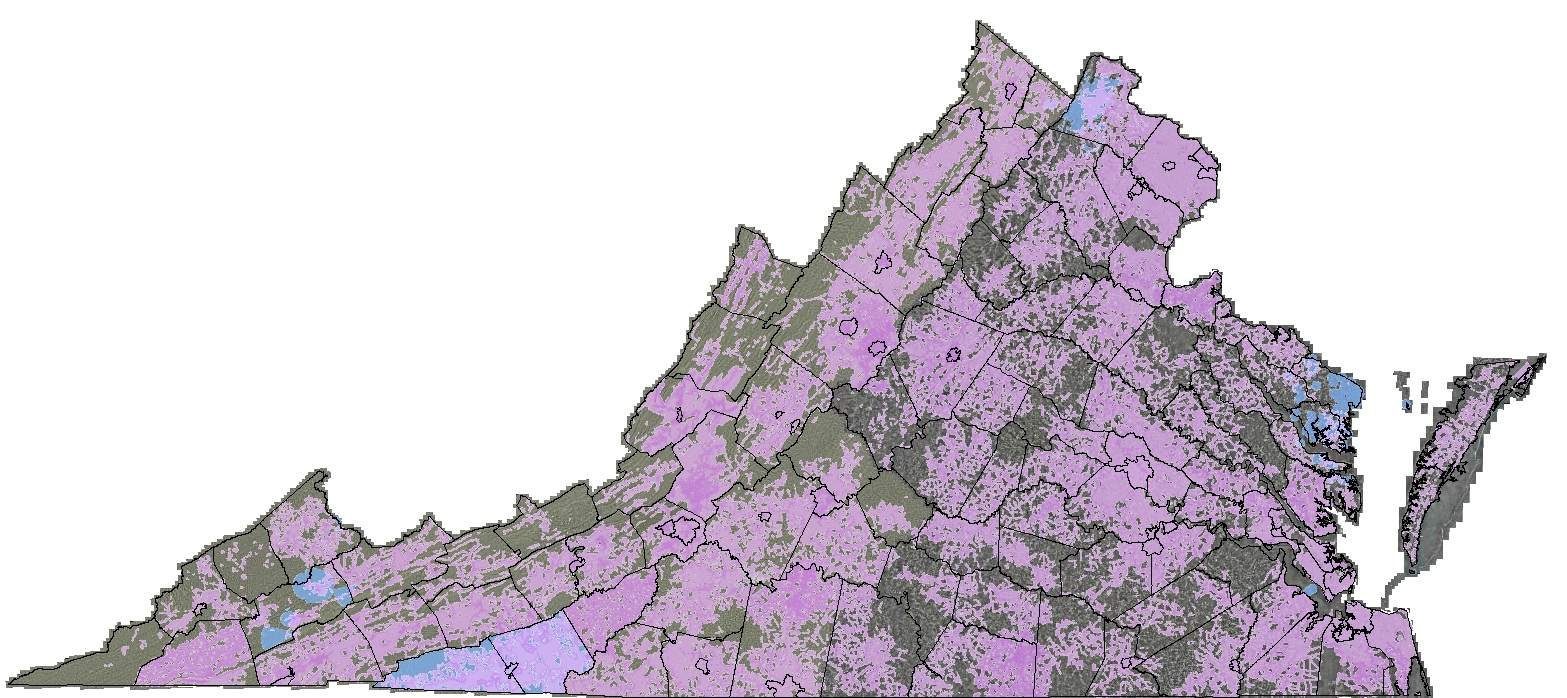
Virginia's 2011 Broadband Availability Map - Purple-Wired Service Providers/Blue-Fixed Wireless ISPs - Does not include wireless mobile coverage (click to enlarge)

The state of Virginia released its latest broadband availability map today, and it shows much of the state’s well-populated areas have access to one or more providers, but also identifies significant gaps in service for rural communities and several smaller towns.

The map is a collaborative effort between the Center for Innovative Technology, Virginia Information Technologies Agency’s Virginia Geographic Information Network, and Virginia Tech’s eCorridors Program.  It hopes to identify areas of significant gaps in coverage with the help of ordinary Virginians crowdsourcing the veracity of the data.

While mobile wireless provides service in some areas where wired providers do not, the stringent usage limits on service don’t make them very useful for home broadband replacements.  Outside of large population centers, telephone company DSL predominates.

“This new map will play a vital role in our efforts to ensure that all Virginians have access to affordable, reliable broadband services. Having the ability to identify and closely analyze unserved areas, gives us the opportunity to strategically align resources and pursue collaborative efforts between public and private organizations to expand broadband coverage across the Commonwealth,” said Secretary of Technology Jim Duffey.

Time Warner Cable Officially Unveils DOCSIS 3 Upgrades in San Antonio; Hill Country Residents Yawn

Phillip Dampier June 30, 2011 Broadband Speed, Competition, Data Caps, GVTC Communications, Rural Broadband Comments Off on Time Warner Cable Officially Unveils DOCSIS 3 Upgrades in San Antonio; Hill Country Residents Yawn

Despite a soft launch weeks earlier, Time Warner Cable officially began selling faster broadband packages in San Antonio Tuesday.

Made possible by DOCSIS 3 upgrades (and not by “Time Warner’s fiber optic network” to quote one San Antonio news outlet), the cable company will now sell 30/5Mbps service for $20 above the current price of Standard Service.  Customers looking for more speed can spend a lot more to get it — $99.95 a month buys you 50/5Mbps service, although the sting seems less if you bundle all of your Time Warner services through their $199 Signature Home package, which includes digital cable, broadband, and phone service.  Signature Home includes 50/5Mbps as part of the package.

About 70 percent of the San Antonio market can get the new speeds immediately.  The rest will be upgraded by September.

The upgrades are seen with some amusement by customers of GVTC, a former telephone cooperative that today provides fiber to the home service in parts of the Texas Hill Country and other rural areas to the north of San Antonio.  They recently received speed upgrades from 40Mbps to 80Mbps downstream and 20Mbps upstream as part of a comparably-priced triple play package.  GVTC’s truly fiber optic system was built to accommodate broadband usage growth.

“Consumers obviously enjoy streaming video and downloading HD movies, but these applications use a lot of bandwidth and can slow down other Internet devices in your household,” CEO Ritchie Sorrells said. “The reality is bandwidth consumption will continue to increase. We’re once again ahead of the curve with our 80 Mbps connection, and this tier will be popular with the growing number of households that realize they have a need for speed.”

One thing GVTC customers don’t need and won’t get is the kind of consumption billing Time Warner Cable is reconsidering for their customers in San Antonio and the rest of the country.

Frontier Fires Back at Comcast In Indiana – Comcast is Telling Stories About FiOS

Phillip Dampier June 30, 2011 Comcast/Xfinity, Competition, Frontier 2 Comments

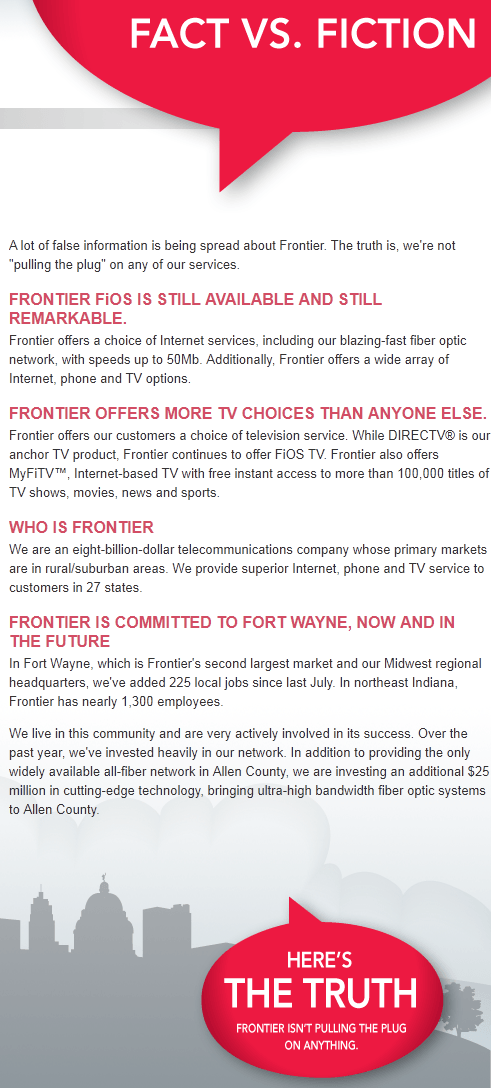
Frontier's Facts - Frontier's new website to counter Comcast's claims about FiOS. (click to enlarge)

Frontier Communications has fired back at Comcast after the Fort Wayne, Indiana cable company erected billboards telling residents Frontier was pulling the plug on its acquired FiOS fiber optic network.

On Wednesday, Frontier purchased a full-page ad in The Journal Gazette headlined, “Comcast Doesn’t Let the Facts Get in the Way of a Good Story! Here’s the Truth: Frontier Isn’t Pulling the Plug on Anything.”  It also launched a new website — Frontier Facts — telling customers it is not “pulling the plug” on any of its services.

Roscoe Spencer, Frontier’s local general manager, tells customers:

Recently, one of our competitors put up billboards, placed inserts in the newspapers and sent mailings to customers indicating we had pulled the plug on FiOS. This statement is simply not true, and we have taken legal action to insist that these false claims be stopped immediately.

Spencer

The spat began when Comcast began trying to recruit disaffected Frontier TV customers who found a massive rate increase notice in bills sent earlier this year.  Frontier blamed the rate increase on the loss of volume discounts former owner Verizon obtained for its FiOS TV service for television programming.  Frontier has sought to negotiate with programmers directly instead of working through a cooperative buying group, so the prices it pays for popular cable networks are much higher than what Comcast pays for a comparable video package.

Frontier watchers suggest the company is well aware its new video pricing is uncompetitive and customers will take their business elsewhere.  Frontier quickly began marketing DirecTV, a satellite provider, as a suitable replacement for those unhappy with the rate increase.  But Comcast also saw an opportunity to pick up new customers at the phone company’s expense, including through the use of billboards Frontier claims are misleading.

Frontier stresses its FiOS platform will continue to provide telephone, television, and broadband service, despite what Comcast’s billboards might suggest.

Despite the involvement of attorneys, Comcast has continued to thumb its nose at Frontier’s legal department.  Frontier spokesman Matt Kelley told the Journal Gazette Comcast was supposed to remove the billboards by Monday of this week, but they remain in place.

The cable company calls it a case of old fashioned competition.

Stop the Cap! reader Kevin calls Frontier’s marketing to get customers to drop FiOS TV for DirecTV a real blast from the past.

“It remains difficult for Frontier to sell people on its advanced fiber network when it is heavily marketing customers to get off of it and switch to DirecTV, a service that looked ultra-modern in the 1990s but today is just a rain-faded, pixellated nuisance,” Kevin says.  “Frontier blew it, Comcast took advantage of their strategic blunders, and now the whining has begun.”

Kevin is a former Verizon FiOS customer who was switched to Frontier when Verizon exited Fort Wayne.

“Verizon knew what they were doing, but eventually decided a few small cities in Indiana were not worth their time or interest, so they sold us off to Frontier, who ended up with a fiber network they’ve shown little interest in running except as an adopted curiosity,” Kevin adds.  “When we got notice of the rate increase, we canceled the TV service and now watch over the air television for free, supplemented with Netflix and Hulu.”

Kevin says Frontier ultimately did him a favor, discovering he was fine without a pay television package.

“Outside of breaking news and sports, you can get most everything else online.  Why pay more?”

The Broadband Revolution is Postponed; Why America’s Duopoly is Holding Us Back

[flv width=”640″ height=”500″]http://www.phillipdampier.com/video/Engadget Broadband in Europe.flv[/flv]

Rick Karr at Engadget delivers a sweeping indictment of America’s broadband duopoly in a special video presentation that explores Europe’s leapfrog advancements in broadband penetration, speed, and pricing.  It’s all made possible by technology policy.  In Europe, open access is guaranteed.  In the United States, telecommunications companies won the right to keep competitors off their networks.  The result is a staggering decline in America’s broadband ranking, now below Portugal and Italy.  So what happened to let Europe spring ahead of the United States?  Government regulation.

The game-changer in the United Kingdom and the Netherlands has been government regulators who have forced more competition in the market for broadband.

The market in the UK used to be much like ours here in the U.S.: British homes had two options for broadband service: the incumbent telephone company British Telecom (BT), or a cable provider. Prices were high, service was slow, and, as I mentioned above, Britain was falling behind its European neighbors in international rankings of broadband service.

The solution, the British government decided, was more competition: If consumers had more options when it came to broadband service, regulators reasoned, prices would fall and speeds would increase. A duopoly of telephone and cable service wasn’t enough. “You need to find the third lever,” says Peter Black, who was the UK government’s top broadband regulator from 2004 to 2008.

Starting around 2000, the government required BT to allow other broadband providers to use its lines to deliver service. That’s known as “local loop unbundling” — other providers could lease the loops of copper that runs from the telephone company office to homes and back and set up their own servers and routers in BT facilities.

Today, the UK’s broadband marketplace resembles America during dial-up Internet days, when customers could choose from a dozen or more providers and get substantial discounts or service tailored towards specific needs.  Today, that choice isn’t available from cable and phone companies.  There’s typically just one of each, and your practical choices usually end there. Thanks to Stop the Cap! reader Corey for sharing the story with us.

The video lasts 16 minutes.

Search This Site:

Contributions:

Recent Comments:

Your Account:

Stop the Cap!