Home » Competition » Recent Articles:

GLAAD Withdraws Support for AT&T/T-Mobile Merger; Reaffirms Support for Net Neutrality

Phillip Dampier July 13, 2011 Astroturf, AT&T, Competition, Net Neutrality, Public Policy & Gov't, T-Mobile Comments Off on GLAAD Withdraws Support for AT&T/T-Mobile Merger; Reaffirms Support for Net Neutrality

In the wake of a scandal that forced the resignation of the president and a board member of one of America’s largest gay civil rights organizations, The Gay and Lesbian Alliance Against Defamation (GLAAD) has withdrawn its prior support for the merger of AT&T and T-Mobile and reaffirmed its support of strong Net Neutrality policies.

In a letter filed with the Federal Communications Commission earlier today, GLAAD did an about-face on its earlier support for the merger, telling the federal agency it now has a “neutral position” with respect to the deal.

Mike Thompson, GLAAD acting president, used the communication to also express the group’s strong support of Net Neutrality, which guarantees a free and open Internet.

“A rigorous review process considered GLAAD’s unique mission and concluded that while AT&T has a strong record of support for the LGBT community, the explanation used to support this particular merger was not sufficiently consistent with GLAAD’s work to advocate for positive and culture-changing LGBT stories and images in the media,” Thompson said in a statement.

Thompson’s belief that AT&T has a strong record of support for gay and lesbian issues remains controversial in many segments of the gay community. John Aravosis of Americablog would take issue with Thompson, accusing AT&T of “screwing” the gay community in the state of Tennessee:

AT&T was one of the companies whose local representatives sits on the board of directors of the Tennessee chamber of commerce.  You remember them, the group that endorsed and actively lobbied for the measure repealing gay and trans rights ordinances in the state, mandating it so that no trans person can ever change their birth certificate gender in the future, and banning any future civil rights ordinances for anyone in the future.  That AT&T.  The AT&T that weighed in early with a statement, when we asked the 13 companies to disavow the legislation and call on the governor to veto, but then whose statement pretty much didn’t say anything.  The AT&T then that emailed me multiple additional statements AFTER the governor signed the hateful bill into law.

Aravosis

GLAAD has taken its first steps to move as far away from dollar-a-holler advocacy as possible as a result of the hostile reception GLAAD’s original position got from rank and file members of the civil rights group.  After AT&T’s financial contributions to the group were exposed, along with the interests of one of their board members with direct ties to the telecommunications company, GLAAD accepted the resignation of group president Jarrett Barrios and board member Troup Coronado.

Remaining board members want the controversy to be over and done with.

“I am confident that Mike made the right decision both in withdrawing GLAAD’s endorsement of the AT&T merger application and in affirming our support of general net neutrality principles,” said GLAAD board member Tony Varona.

Politico obtained a statement in response to these events from AT&T:

“As we’ve previously said, we recognize, and fully respect that these organizations, which do important work, will make up their own minds about whether to support the merger or remain neutral. And, though it should go without saying, the decisions made by these organizations will not in any way impact our desire to work with, partner with or support those organizations in the future.”


 

House Republicans Put Telecom Law Up for Sale to the Highest Bidder: Buy Your Way Around the Law

Phillip Dampier July 13, 2011 Competition, Editorial & Site News, Net Neutrality, Public Policy & Gov't, Wireless Broadband Comments Off on House Republicans Put Telecom Law Up for Sale to the Highest Bidder: Buy Your Way Around the Law

Phillip Dampier: "Where is the actual innovation in The Spectrum Innovation Act?"

Republican members of the Subcommittee on Communications and Technology on spectrum issues have circulated a draft bill — The Spectrum Innovation Act — which is breathtaking when you finish reading it.  For the first time I can recall, the United States Congress is proposing a way for business to bypass telecommunications laws by buying their way out.  The proposed bill would allow big spectrum holders like wireless phone companies, broadcasters, and others warehousing unused spectrum to win a “get out of regulation free”-card just by buying and selling the public airwaves.

A hearing on spectrum issues is scheduled for this Friday, and it promises to be fascinating if only to hear the reasoning behind Congress proposing to throw their own authority to the wind.

The bill’s contents are appalling for a variety of reasons:

  • Public airwaves remain a private commodity that companies can buy, sell, or trade, with the not-so-fringe benefit of winning deregulation or being granted a legal free pass to ignore laws still in effect for others;
  • The purchase of spectrum under this bill could allow wireless carriers to avoid even the pretense of today’s watered-down Net Neutrality policies;
  • Unlicensed white space/spectrum which could be used for innovative new wireless applications could instead become warehoused by private companies for their own use (or more likely to keep others from using it.)

Harold Feld, legal director of Public Knowledge, says the impact of the House measure should not be underestimated.

Feld

“Until now, communications law has never been publicly put up for sale,” Feld said.  “This draft bill would do that by allowing broadcasters to choose which rules they will follow and which rules they won’t if they sell their broadcast spectrum at auction.”

That is distressing enough, but the implications for wireless innovation are in peril if this bill ever becomes law, according to Feld.

“The innovation and experimentation we have seen through the use of unlicensed spectrum would screech to a grinding halt,” Feld believes. “Rather than have the FCC decide how much spectrum would be used for unlicensed uses, the draft bill would require a collective bid for unlicensed spectrum higher than bids for licensed uses.  Given that unlicensed uses like Wi-Fi come from small and new companies, the future of new uses would be very bleak.”

Feld points to several provisions in the bill to prove his points:

  • Pages 18-19, line 19 (regulatory relief). If you are broadcast licensee, instead of taking money from an incentive auction for repacking or moving to a different spectrum band, you can ask FCC for a waiver of any commission rule or any provision of law.
  • Pages 28-29, line 8 (administration of auctions).  If someone buys a license at auction, the spectrum is exempt from even the weak Net Neutrality rules that have been approved to guard against basic anticompetitive activity in wireless service such as barring competitive services.
  • Page 29, line 3.  Prohibits spectrum cap, and also eliminates the ability of  the Commission to favor small business and minority, women-owned businesses in auctions.
  • Page 26, line 10. Unlicensed spectrum is subject to auction.  A block of spectrum would be put up for auction, with bidders specifying whether use would be for licensed or unlicensed use.  Unlicensed has to be higher for bid to be accepted.
  • Page 30 (section begins).  Gives public safety spectrum to the states, without an auction, with a nebulous plan and some unspecified grant money to coordinate the public safety network.

He’s more than proved the point.

While such legislation would no doubt be celebrated by incumbent providers to reinforce the status quo — their status quo — it is a nightmare for everyone else — another piece of irony from some Republican lawmakers who name their bills the diametric opposite of their end effect.  We can’t think of a better way to crush innovation and destroy the potential of competition by granting today’s players deregulation and easy access to unlicensed spectrum.  It’s as oxymoronic as a level playing field in the Rocky Mountains.  That’s why we need some actual innovation in The Spectrum Innovation Act.

Hawaiian Telcom’s Top Secret Cable TV Service: How Much, Where Service is Available Company Won’t Say

If this is a new way to attract customers, it’s sure stumping marketing experts who are questioning Hawaiian Telcom’s launch of its new cable TV service to compete with Time Warner Cable’s Oceanic Cable.  Nobody knows where exactly the service is available for sale, or for how much, and HawTel officials are not saying.

“If you call Hawaiian Telcom and ask them about the service, they essentially say ‘don’t call us, we’ll call you’ and they are the phone company!” says Oahu resident and Stop the Cap! reader Dan Ho, who first discovered HawTel was getting into the cable business from Stop the Cap!  “I realize we’re talking about another form of U-verse here, but that could still be a good thing for Hawaiians who cannot get Oceanic Cable and are stuck with HawTel’s awful DSL service.”

HawTel’s new fiber-copper hybrid network tested successfully for 250 mystery families who participated in a secretive beta-test.  The new service is expected to be sold mostly in a packaged bundle with extra high speed DSL (presumably up to 25Mbps), a central DVR terminal that can record up to four shows off the company’s digital cable TV package concurrently, and unlimited phone service.

Lester Chu, a HawTel spokesman, wouldn’t tell reporters the prices for the new service, instead offering to accept bills from competing providers and allowing HawTel to competitively bid for your business.  The company also wouldn’t say where the service was for sale, “for competitive reasons,” added Chu.

But HawTel has been licensed to provide service on the island of Oahu, and intends to rollout the service in contiguous service areas, so once the first new customers do go public, we’ll be able to ascertain where the service is slated to be delivered next.

HawTel says they will begin targeted advertising to alert residents when the service will be available.  That traditionally means direct mailers, door hanger tags, and door-to-door visits from sales teams hired by HawTel.

“It’s a crazy way to build excitement for the product, by keeping it a secret,” Ho believes. “More important, I suspect their pricing is not going to be very good if they require customers to bring in a current bill from a cable competitor in order to get a quote.”

Ho should know, he’s a marketing professional himself.

“I suspect the company wants face time with a customer to explain away the lack of visible savings by instead talking up the features they will offer that Oceanic Cable does not,” Ho suggests.

Among those features – the four-recordings-at-a-time DVR, the 250-channel all digital lineup, and the presence of NFL Network, a network Time Warner Cable systems have perennially refused to carry on their basic digital tier because of its cost.

[flv width=”480″ height=”290″]http://www.phillipdampier.com/video/KITV Honolulu Hawaiian Telecom Bring Cable Competition To The Islands 7-7-11.mp4[/flv]

KITV-TV in Honolulu opened their newscast with the mysterious launch of Hawaiian Telcom’s new TV service.  (2 minutes)

[flv width=”360″ height=”290″]http://www.phillipdampier.com/video/KHON Honolulu Hawaiian Telcom launches cable TV service in select location 7-7-11.mp4[/flv]

KHON-TV in Honolulu covers HawTel’s introduction of cable competition on the island of Oahu, even though company officials won’t say where it’s available or for how much.  (Loud Volume Warning!) (1 minute)


AT&T Objects: Academics Giving ‘Biased Opinions’ Interferes With Its Own ‘Biased Opinions’ on Merger

The state of California is in receipt of a letter from AT&T objecting to a state workshop on the AT&T/T-Mobile merger that included 70 minutes for a panel of academic experts to share their views of one of the state’s largest wireless mergers in years.

J. David Tate, AT&T’s general attorney and associate general counsel, sent the letter in response to news California regulators would open the workshop to a presentation from academics about the impact the merger would have on California consumers, ranging from competition to roaming access to spectrum issues.

Tate called that inappropriate and asked the California Public Utilities Commission to ban their testimony:

“AT&T is raising objections to the panel because having a panel of ‘academic experts’ present at this workshop will pose significant risk of tainting the record with potentially uninformed and biased opinions. These opinions do not constitute the facts upon which the transaction should be reviewed.

“[…] Allowing academicians with unknown expertise in the wireless telecom industry the opportunity to place on the record their personal opinions regarding AT&T’s planned purchase of T-Mobile USA is procedurally improper, unfairly prejudicial to the parties, and contrary to due process principles.”

Instead of allowing those outside of the industry to present their views on the merger, AT&T suggested the best solution would be to allot the 70 minutes originally given to the academics to AT&T (and the three remaining panels AT&T does not object to) instead.

AT&T Downgraded: Customers Rush to Lock In Unlimited Data… on Verizon Wireless

Phillip Dampier July 11, 2011 AT&T, Competition, Data Caps, T-Mobile, Verizon, Wireless Broadband Comments Off on AT&T Downgraded: Customers Rush to Lock In Unlimited Data… on Verizon Wireless

The impact of the last minute stampede by Verizon Wireless customers (new or otherwise) to lock in the company’s unlimited data plans before they were retired last week has reached Wall Street, but the ripples extend far beyond Verizon Wireless itself.

Macquarie USA analyst Kevin Smithen this morning downgraded AT&T stock to “neutral,” expressing concern about AT&T’s slowed growth in wireless revenues.

“We see increased headwinds to wireless revenue growth, limited improvement in enterprise and a lack of clarity on the status of the [pending acquisition of T-Mobile],” he writes. “We view projected organic revenue growth of 0.5% in 2012 as uninspiring. At current levels, we believe absolute and relative risk-reward to roughly balanced given these issues.”

Customers concerned about Internet Overcharging schemes being implemented by Verizon Wireless began fleeing other providers to “lock in” unlimited data service with Verizon before it was nigh.  One big victim of that was AT&T.

“We were waiting for the next iPhone to finally jump to Verizon, even if it meant paying a termination fee to AT&T, just to escape the dreadful service,” says Shai Lee, who was among several dozen readers contacting Stop the Cap! for assistance securing unlimited data plans with Big Red.  “When Verizon announced $30 for 2GB, there was no way we were going to be locked into paying that, so we jumped early.”

Many followed.

Smithen believes customers are also fleeing other carriers, especially T-Mobile, which he believes will lose two million customers before AT&T closes the deal or faces ultimate rejection for its merger by Washington regulators.

Some analysts believe T-Mobile customers are leaving over a combination of the company’s inherent weakness as a provider-now-in-limbo while others dread the reality of being ultimately stuck with AT&T.

“It’s like fleeing a country before the invading army reaches your town,” shares Samuel, a T-Mobile customer leaving for Verizon. “I won’t live under AT&T’s regime.”

Smithen sees even greater challenges for AT&T with the arrival of iPhone 5, which will either cost the company to subsidize or start another wave of AT&T emigration.

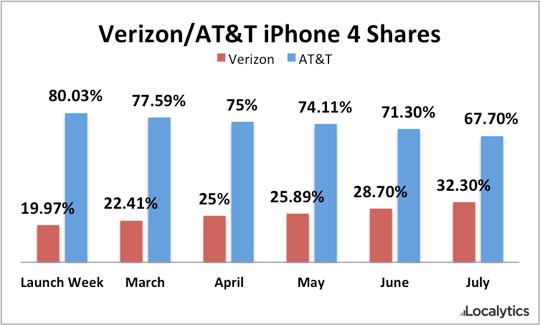
Verizon has already managed to secure 32 percent of the U.S. iPhone 4 market, according to a study by the mobile analytics company Localytics.  Since rumors about Verizon imminently ending unlimited data plans began in May of this year, Localytics has tracked a spike in Verizon iPhone purchases, one explained by existing customers upgrading to smartphones, and new customers arriving from other carriers.

For AT&T, customers on contract with smartphones are not adding additional services and those with data plans are trying to stay within plan limits, robbing AT&T of extra revenue.

Smithen says with this track record, average revenue per customer is “stalling.”

Search This Site:

Contributions:

Recent Comments:

Your Account:

Stop the Cap!