Home » Competition » Recent Articles:

Sprint Moves To Launch Its Own LTE 4G Network; WiMax? Not So Much Anymore

Phillip Dampier September 27, 2011 Broadband Speed, Competition, Data Caps, Sprint, Video, Wireless Broadband Comments Off on Sprint Moves To Launch Its Own LTE 4G Network; WiMax? Not So Much Anymore

Sprint is preparing to launch its own 4G LTE network early next year in an undetermined number of markets to increase 4G speeds and compete with AT&T and Verizon.

Sprint’s existing 4G service, based on older WiMax technology that powers the Clearwire network, has not kept up with subscriber demands, and many of Sprint’s “4G”-capable markets have speeds more in common with 3G than Verizon’s LTE or AT&T HSPA+ 4G networks.  As Clearwire continues to struggle through serious financial problems (the service has not expanded into a new market since 2010), lawsuits, and disgruntled customers, Sprint isn’t waiting around for Clearwire’s own planned upgrade to TD-LTE, which would require at least $600 million in financing to undertake.

Instead, Sprint is deploying the same technology used by Verizon for its LTE network.

CNET reports Sprint will initially use its G-block spectrum (1900MHz) for its LTE network, but the most robust coverage will come in 2013 when Sprint retires the Nextel iDEN network which currently resides in the 800MHz band, more suitable for longer range reception.

Sprint says the 4G LTE upgrade is all part of its Network Vision plan, which upgrades virtually the entire Sprint network at a cost of $4-5 billion.  But shareholders aren’t reacting over Sprint’s LTE spending, because it is included in the earlier budget already disclosed to Wall Street.

For consumers, the upgrade will mean the company that first embraced 4G will once again deliver speeds worthy of that label.  Sprint customers across the country have reported network speeds have suffered as more customers have piled on Sprint’s and Clearwire’s network.  Clearwire will remain a Sprint partner, but that wireless provider will increasingly depend on Sprint’s network, a reversal of Sprint’s current dependence on Clearwire WiMax for their existing 4G service.  Clearwire may ultimately be unable to finance its own upgrades.

Sprint also announced it will keep its unlimited smartphone data plans, because they attract customers from AT&T and Verizon who do not want limited-use plans.  But preserving unlimited data comes at a cost.  Sprint has been cutting perks all month:

  1. Sprint nearly doubled its early termination fee from $200 to $350 effective Sept. 9.
  2. Sprint slashed its satisfaction guarantee program for new customers from 30 to 14 days on Sept. 16.  Sprint’s guarantee allows new customers the opportunity to test Sprint’s network before committing to a two-year contract.  The company also now expects to be paid for whatever airtime charges were incurred during the trial.
  3. Sprint has announced it is ending its Premier Program Dec. 31.  Premier gave customers who spend more than $89 a month on an individual cell plan the opportunity to upgrade their phones annually, penalty-free.  Members also received free minutes, discounts on accessories, early buying opportunities for the newest phones, and regular plan reviews.  Instead, customers will be dropped into the same New for YouSM Upgrade Program lower spenders receive.  But Sprint will be changing that program too:

Unlimited data... for now.

On October 2, the following changes to our New for YouSM Upgrade Program will take effect:

  • New lines of service and existing customers who upgrade on or after October 2, 2011 will receive future upgrades after 20 months;
  • $75 and $25 upgrade discounts will no longer be available for customers signing up for a 1-year agreement or 2-year agreement after 12 months or signing a 1-year agreement after 22 months.

Additional information for existing customers. As of October 2:

  • If you’ve already qualified for a full upgrade, nothing changes. When you sign up for a new 2-year agreement and take your device offer, future upgrades will be available after 20 months;
  • If you haven’t qualified for your full upgrade yet, to receive a discount you’ll wait until you qualify for your full upgrade at 22 months.
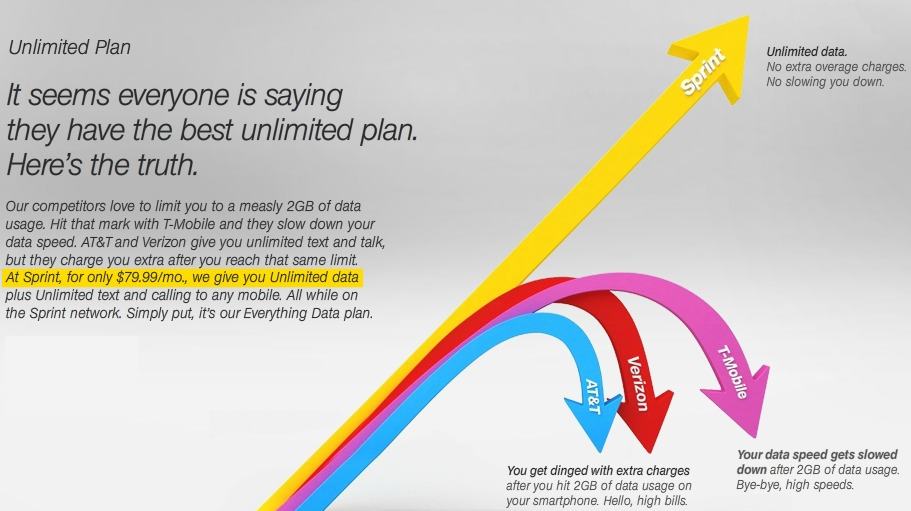
On Oct. 5, Sprint is expected to introduce the Apple iPhone on its network for the first time.  Some analysts predict iPhone will be the catalyst to drive Sprint’s unlimited data plan into the ground, because the phone has a reputation for being a favorite for heavy data users.  iPhone 5 will remain dependent on 3G networks for connectivity outside of Wi-Fi, which could drive data usage higher than any other Sprint phone.  Should that overwhelm Sprint’s 3G network before its 4G service enjoys a widespread rollout (and Apple introduces a phone that works on 4G), Sprint may find itself limiting data usage as well, as least on its 3G network.

[flv width=”640″ height=”380″]http://www.phillipdampier.com/video/Welcome to 4G from Sprint.flv[/flv]

Sprint’s promotional video promoting its current 4G WiMax network, powered by Clearwire.  (3 minutes)

Internet Overcharged: Verizon Reseller Sells California Man Wireless Data Plan That No Longer Exists

Phillip Dampier September 26, 2011 Competition, Consumer News, Data Caps, Editorial & Site News, Verizon, Video, Wireless Broadband Comments Off on Internet Overcharged: Verizon Reseller Sells California Man Wireless Data Plan That No Longer Exists

Company-owned store or third party reseller?

Customers who see the logo of their favorite wireless phone company on a storefront might do better to look a little closer to determine if they are doing business with a company-owned store, or a third-party reseller.  A Bakersfield, Calif., man quickly learned the difference when he bought a mobile broadband service plan from Go Wireless that Verizon says no longer exists.

Allan Fox found out the hard way when his first bill arrived with a steep overlimit fee attached, and without the broadband plan he signed up for.

Fox purchased the discontinued plan from Go Wireless, a third party reseller of Verizon Wireless services.  Fox thought he was purchasing a 3GB plan for $35, with a two-year service contract.  Verizon thought otherwise, and so began weeks of a runaround between Fox, Go Wireless, and Verizon.

It turned out that Verizon no longer offered the plan Fox bought from what he thought was Verizon Wireless itself.  Go Wireless is one of several independent third party companies that resell Verizon Wireless service, often with their own terms and conditions that include early termination fees owed not just to Verizon, but also to Go Wireless.

Go Wireless’ retail stores prominently feature Verizon Wireless’ logo, with their own logo appearing in reduced size, next to a message indicating they were a “premium retailer.”  That presumably sounds better than “third party reseller.”

After several attempts to straighten out the mess, Fox wanted to cancel his contract and just move on.  But then he discovered Go Wireless would charge him a $175 early cancellation fee, even though Fox’s predicament was their fault.  That’s when Fox called a local television newscast for help.

Wirefly is a major online reseller of Verizon Wireless

KBAK-TV news waded into the middle of the dispute that had gone on for nearly six weeks.  Verizon Wireless told the station it was willing to cancel Fox’s service penalty-free, but since Fox purchased the phone from a third-party reseller, and not from a company-owned store, Go Wireless would have to credit their own cancel fee.  Go Wireless, experiencing some turnover in local management, finally agreed to waive the fee, but only after the TV station got involved.

Customers must be careful when purchasing phones or signing contracts with third party sellers — both online and in traditional stores.  Most company-owned stores display their respective carrier logos and nothing else.  Words that usually provide a clue you are dealing with a reseller include: “authorized retailer,” “authorized dealer,” “Service provided by: (name of third party company),” “authorized agent,” and a dead giveaway is a signed contract with anyone other than the cell phone company you are using for service.

Third party resellers make their money on generous commissions earned when a customer signs a new contract or renews an existing one.  That commission can be forfeit if a customer returns the phone or cancels service early, which is why third party dealers protect themselves with their own contracts that include early termination or cancellation penalties owed to them, not the wireless provider.  Some customers can find themselves exposed to $500 or more in total cancellation penalty fees owed between the wireless phone company and the reseller.

So why do people purchase phones from these resellers?  Convenience and savings.

In smaller communities, company-owned stores may be few in number (or non-existent), and in-person help can be a godsend for customers who need to figure out their phone or obtain a warranty replacement.  Online, resellers like Amazon.com, Newegg, Wirefly, and others often charge substantially less than wireless carriers charge themselves for phones.  That savings can often be more than $100.  But these resellers are not for those who are unsure about the phone they want (or the provider).  Returning a phone or canceling service means dealing with two parties — the carrier and the reseller, to end service.  The cost of doing so can be very steep, so always read the terms and conditions before buying.

[flv]http://www.phillipdampier.com/video/KBAK Bakersfield Man has Internet billing trouble 9-26-11.mp4[/flv]

KBAK-TV’s Investigation Bakersfield unit helped a local man untangle a major billing mess that began when he was sold a mobile broadband plan that no longer existed.  (3 minutes)

Rogers Launches Astroturf Campaign to Recruit Customers to Lobby For Spectrum… for Rogers

Canadians looking for more competitive wireless prices and faster service may think they’re going to get them if they sign on to a new campaign sponsored by Rogers Communications that calls on the Canadian government to eliminate spectrum “set-asides” for the country’s smaller wireless competitors.  Rogers wants those frequencies for itself, critics charge, and they have the resources to outbid any new player in the country’s wireless market.

From Rogers’ “I Want My LTE” Website:

[…] There are some who are supporting a Federal Government regulation that would limit who can have access to the spectrum. Such regulation would exclude select companies from the upcoming auction to license the 700 MHz spectrum band. The outcome of this auction will have a major impact on deploying LTE across Canada. If a decision is made that prevents certain companies, including Rogers, from participating in the spectrum auction, it would be a recipe for leaving Canada behind the rest of the world, stalling Canadian innovation and limiting who can access LTE.

The website offers a pre-written plea to policymakers in government to allow for an open bidding process for the forthcoming 700MHz frequencies many wireless companies crave for their robust performance.

The problem is, according to industry observers, if a wide-open, no-limits auction takes place, it’s a virtual certainty Canada’s largest wireless companies — Bell, Telus, and Rogers, would walk away with most, if not all of the auctioned spectrum.  Even worse, it will stall competition that will lead to lower prices.

“The future of affordable wireless rates is at risk, not the future of long-term evolution (LTE) networks,” said Chief Operating Officer Stewart Lyons. “Mobilicity has helped bring down the cost of wireless in Canada significantly and we need to augment our limited amount of spectrum to ensure affordable pricing continues.”

“[The] big 3 wireless carriers have more spectrum than they need and will stop at nothing to dress up and misrepresent their hidden agenda of eliminating competition so they can raise their rates back up again,” he added.

The government is not planning to ban Rogers and the others from the spectrum sale.  They just want to set aside some frequencies for bidding among the smaller, newer competitors.  But even that is too much for Rogers, who has bad memories from the last spectrum auction that allowed those competitors to become established in the first place.

Today, new cell service providers like Wind Mobile, Mobilicity and Quebecor’s Videotron are forcing larger carriers to reduce prices or lose business.

Fido is actually Rogers under a different name.

For some Canadians, wireless bills have dropped a lot since the competition arrived.  Some are leaving Rogers in favor of better prices elsewhere.

Andy Lehrer from Toronto had a cellular plan with Fido, an ostensibly independent cell phone company that is, in fact, owned outright by Rogers Communications.  Lehrer was paying Fido $150 a month for his Blackberry voice and data plan.  Today, with one of the new competitors, he pays $44 a month for a plan that offers more data and talk time.

Although new competitors still have just under 5 percent of the Canadian market, the price differences have become too enormous to ignore in many cases, especially if a customer is willing to give a new carrier a break as it works through growing pains.

Lehrer told the Globe & Mail his cellular reception is poorer, but not bad enough to make him switch back to Rogers’ Fido.

Convergence Consulting Group Ltd. notes the price disparities mean savings as much as 58 percent with new competitors’ combined voice and data plans.  For data services alone, new providers charge as much as 83 percent less.

If Rogers and the two others head home from spectrum auctions with everything up for bid, it will assuredly stall competition and help protect today’s high wireless prices.  Rogers, Bell, and Telus have never seen fit to undercut each other, adopting a rising prices raise all balance sheets-approach at doing business.  But scrappy new entrants like Wind and Mobilicity are willing to slash prices to attract customers.  But nobody will buy service if those companies cannot obtain necessary spectrum to actually compete.

Regardless of the outcome, North America in general has a long way to go to find the lower wireless prices commonplace abroad.

Close Sezmi: Cable Alternative Ends Service Today

Phillip Dampier September 26, 2011 Competition, Consumer News, Online Video 2 Comments

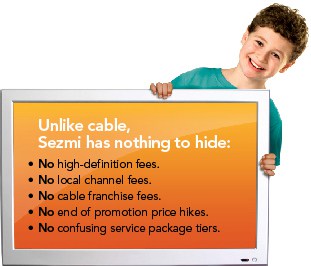
Just over one year ago, Stop the Cap! introduced readers to Sezmi, a cable-TV alternative that delivered a package of selected cable networks, on-demand movies, video podcasts, YouTube content and local broadcast stations with a 1TB DVR set top box for $19.99 a month. Subscribers that decided to forgo the cable networks paid even less — $4.99 a month for service.

But no more.

As of this morning, Sezmi has discontinued its service, leaving customers with a nearly-worthless set top DVR box they spent $149.99 to acquire, and a number of questions about the company’s sudden change of direction.

The company issued a statement telling customers it has ceased monthly billing and giving customers until later this year to use some of the features Sezmi operates in-house:

We regret to inform you that Sezmi is discontinuing its consumer service. As of Monday, September 26, 2011, you will no longer be able to view or record broadcast TV programming through your Sezmi System. However, you will still be able to view movies and shows you have already saved to your Sezmi media recorder. To help ease the transition, you may also rent movies and shows if available at no charge from Sezmi’s On Demand catalog through November 1, 2011.

Why do you have to discontinue your consumer service?
Sezmi has changed its business focus to providing our product and technology platform to service providers, internationally and in the U.S., who are interested in providing broadband video services to their customers. As a result, we are no longer supporting our direct-to-consumer service.

What does this mean for me?
You will no longer be billed for Sezmi service. As of September 26th, you will no longer be able to utilize the programming guide and your digital media recorder will no longer operate as a recorder. You will be able to view movies and shows you have already saved to your recorder and YouTube access will not be affected. Between now and November 1st, you may rent any movies or shows at no charge to you. After November 1, Sezmi’s On Demand catalog will no longer be available but you will be able to use your Sezmi system to view all programming you have saved to the media recorder.

No Service After Sept. 26, 2011 didn't make the list.

What it also means is customers are stuck with a proprietary DVR box that won’t work with other services.

Sezmi’s business model was most operational in the Los Angeles market, where it leased unused spectrum from several LA-area television stations to carry its lightweight cable package.  In other markets, Sezmi simply wedded over the air digital free television stations with its online lineup of on-demand programming and charged $4.99 a month to watch.  It was never a compelling offer outside of Los Angeles, and even in that city, trouble brewed when Sezmi discontinued the cable package in December.

Among the difficulties Sezmi encountered:

  1. Finding cooperative local broadcasters willing to lease unused digital spectrum to Sezmi proved to be a difficult proposition.  Broadcasters are zealously guarding the frequencies they control now and do not want to get into long-term contracts with third parties.  Network owned stations in major cities may have already committed significant spectrum to their own sub-channels and other projects, or want to hold them in reserve for future use.  Besides, why lease spectrum to a company for a cable package large networks could theoretically build themselves.
  2. Sezmi lacked access to many popular cable channels, notably ESPN and HBO.  It’s difficult to get consumers to drop a cable or telco-TV subscription in favor of one that is limited to two dozen cable channels, some of which were hardly deal-sealers.  Efforts to move cable channel programming to online distribution were met with difficulty because content owners increasingly want a piece of the action.  Deep pockets are required to sustain video streaming businesses.
  3. Consumers never really understood the product and were not convinced to choose it over better known alternatives that included satellite TV.

Sezmi’s new focus on working with larger players could meet with some success, but Sezmi’s best chances of all could be developing the technology for ethnic audiences or other narrowcast opportunities where the lack of a hundred plus channel cable package would not be a factor.

Cellular South Becomes C Spire Wireless: Offers Unlimited Data Plans, Sort Of…

Cellular South, a regional wireless provider serving Mississippi, western Tennessee, and parts of Florida and Alabama, relaunched operations this morning as C Spire Wireless.

Company officials claim C Spire will be the first carrier to offer “personalized wireless services” that will adapt to customers based on how they use their phones and other  devices.

“We have entered a new era in wireless – an era centered on broadband networks, mobile computing devices and now personalized services. Completing calls is only a small part of what we deliver our customers,” said Hu Meena, president and CEO of C Spire. “Since 1988, our main focus has been on providing exceptional service for our customers and their wireless needs. Those needs have changed dramatically and will do so at an even more rapid pace in the future.”

Among the changes underway across the mobile industry is an effort to end unlimited wireless data plans for smartphone customers, but that won’t be the case at C Spire, which is retaining unlimited smartphone data usage for many of its service plans, sort of.

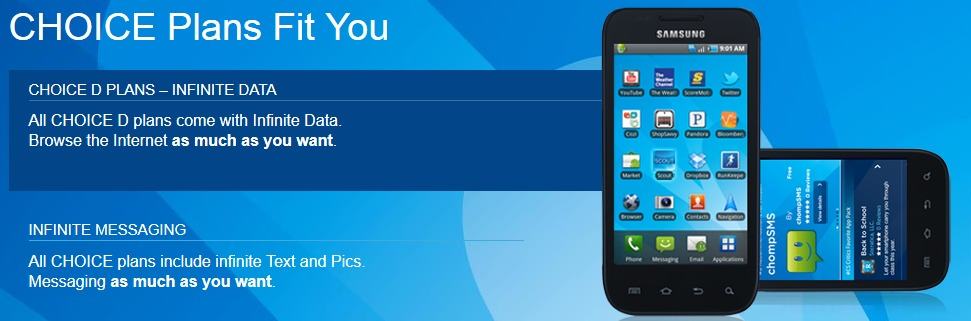
“C Spire understands that when customers have to measure and limit their data, they aren’t getting the optimal experience with their wireless provider. That’s why the company is introducing Individual and Family Choice Plans that offer customers the ultimate in choice and flexibility, and access to infinite data,” the company said in a statement.

But there is a major catch — that “infinite” data usage does not include streaming multimedia content.  That comes extra: priced free through October 29. Then 2 hours for $5, 5 hours for $10, or unlimited usage for $30.

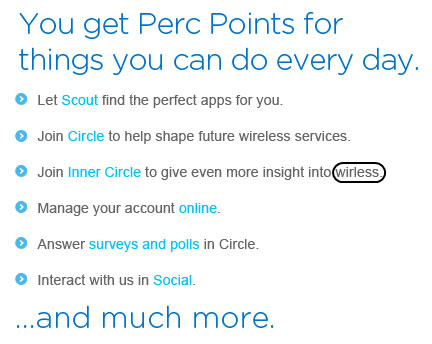
How many "percs" can I win picking out the sloppy spelling errors on C Spire's website?

C Spire does away with counting megabytes or gigabytes and asks customers to guess how many hours they expect to use streaming media applications on their phones. That means customers will pay $50 a month for C Spire’s Choice D 500 plan, which includes unlimited web browsing and e-mail, plus 500 talk minutes per month.  But if you want to listen to unlimited online radio or stream video, that price increases to $80 a month.  But that $80 does buy an unlimited experience at that point.

C Spire’s pricing reflects the failure of strong Net Neutrality protection, allowing carriers to charge extra for different types of content on its network.

Wireless mobile broadband customers still face a cap on C Spire’s data-only plans: 1GB for $19.99, 3GB for $29.99 or 5GB for $49.99.

Users must spend at least 50 percent of their usage during the month within a C Spire service area.  Excessive roaming can get your service suspended.  As a regional carrier, that means “home usage” is limited to a handful of southern states.

But company officials are spending little time discussing their pricing and plans, instead focusing on how C Spire will “personalize” the wireless experience.

No other wireless provider understands its customers and adapts to their wireless needs like C Spire. Customers will see this unique personalization in apps and content that fit who they are, services that anticipate their needs, and rewards they’ll get just for using their phone in new ways. C Spire’s industry-leading personalization capabilities are powered by Pulse, a proprietary system that enables the company to understand and develop a closer relationship with its customers. In turn, C Spire recommends and provides the right selection of technology experiences tailored for each customer – giving them unmatched wireless personalization.

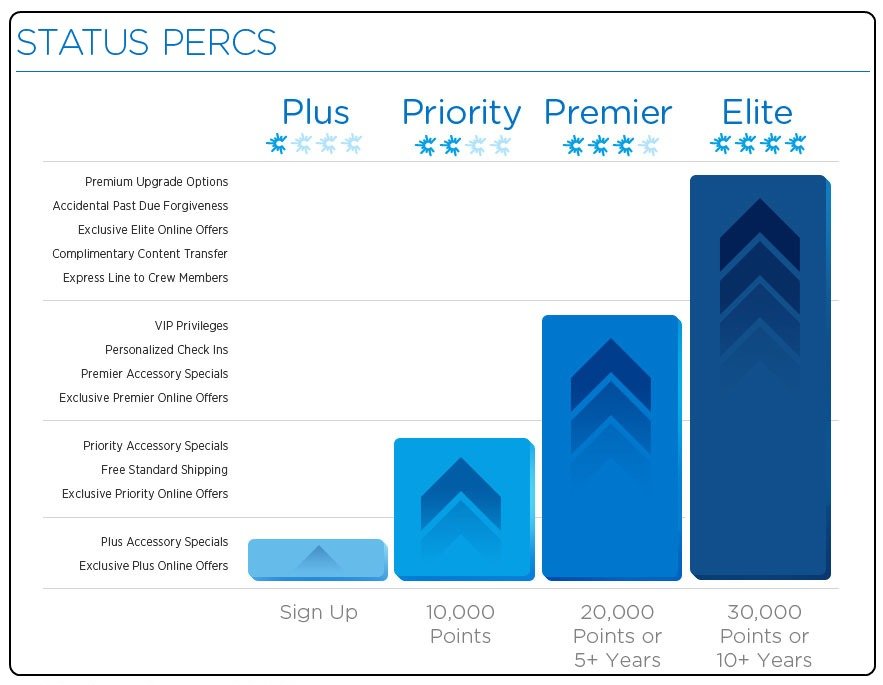
C Spire offers what they are calling “percs” — points that customers can collect based on interacting with the company’s website and social media platforms, the number of years they remain loyal to C Spire, and opting into company research programs including their Scout Program, which track apps usage.

The rewards on offer at the moment are not impressive — waiving late bill payment fees, priority access to customer service, feature upgrades, and discounts on accessories and shipping.

The company’s website has been unresponsive at times this morning and customers on C Spire’s Facebook page are complaining they are confused about pricing and plan changes, particularly those related to streaming data usage.

C Spire's Rewards Program

[flv width=”480″ height=”290″]http://www.phillipdampier.com/video/C Spire Ads 9-26-11.flv[/flv]

Magic Sparklies: The wireless company’s new advertising campaign introduces Cellular South’s new brand: C Spire Wireless (1 minute)

Search This Site:

Contributions:

Recent Comments:

Your Account:

Stop the Cap!