Home » Competition » Recent Articles:

America’s Best Broadband Value: The U.S. Postal Service?

Phillip Dampier October 3, 2011 AT&T, Comcast/Xfinity, Competition, Consumer News, Cox, Data Caps, Editorial & Site News, Public Policy & Gov't, Suddenlink (see Altice USA) Comments Off on America’s Best Broadband Value: The U.S. Postal Service?

Allen Wan from Chicago dropped Stop the Cap! a postcard by good old snail mail about today’s broadband cap ‘n tier regime in place at some of America’s largest Internet Service Providers to make an important point: with Internet Overcharging schemes like usage caps and usage-based billing, America’s best broadband value may actually come from the United States Postal Service.

Allen breaks it down for us:

AT&T Comcast U.S. Post Office
Regular Unit/Monthly Price $25 for 768kbps DSL
$45 for 6Mbps DSL
$60 Internet-only service $0.44 First Class Mail
$0.11 Blank CD-R
$0.12 Blank DVD+R
$0.48 Blank DL-DVD+R
$0.10 Label/Envelope
Cap/Capacity 150GB per month 250GB per month 700MB for CD
4.7GB for DVD
8.5GB for DL-DVD
Price per Gigabyte $0.17 for 768kbps DSL
$0.30 for 6Mbps DSL
$0.24 $0.93 for CD
$0.14 for DVD
$0.12 for DL-DVD

Allen’s chart points out that for large file transfers like movies, TV shows, and major software updates, consumers actually get more value on a per-GB basis burning those shows and software to a traditional or dual-layer (DL) DVD, and dropping them in the mailbox.

While prices for service may vary, so do Internet Overcharging schemes.  If a customer reaches their monthly limit one time too many, they will be relying on the post office to move files back and forth because companies like Comcast and Cox will terminate their service.  Other providers, like AT&T and Suddenlink, are content to simply send the customer a bill with overlimit charges on it.

With a marketplace duopoly, ineffective government oversight, and ever-increasing prices, the U.S. Post Office may still be in the running after all, thanks to Back to the Future-pricing from your ISP.

Alcatel-Lucent Announces VDSL2 Vectoring: 100Mbps on Copper Phone Lines

Phillip Dampier October 3, 2011 Broadband Speed, Competition, Consumer News, Public Policy & Gov't, Rural Broadband, Video Comments Off on Alcatel-Lucent Announces VDSL2 Vectoring: 100Mbps on Copper Phone Lines

While most rural telephone companies are selling customers 1-3Mbps copper-delivered DSL service, Alcatel Lucent has announced the commercial availability of VDSL 2 Vectoring, a new way of delivering up to 100Mbps over the copper wire telephone network most rural North Americans still depend on for telecommunications service.

VDSL2 combines a fiber-copper hybrid network similar to Bell’s Fibe or AT&T’s U-verse, with interference-cancelling technology called “vectoring” to deliver speeds much closer to the 100Mbps theoretical limit of current DSL technology.

“Alcatel-Lucent’s plan to make VDSL2 vectoring commercially available is very timely,” said Rob Gallagher, Principal Analyst, Head of Broadband & TV Research, Informa.  “VDSL2 Vectoring promises to bring speeds of 100Mbps and beyond to advanced copper/fiber hybrid networks and make super fast broadband speeds available to many more people, much faster than many in the industry had thought possible.”

A new way to boost copper speeds even faster.

Different flavors of DSL are currently in use around North America and beyond.  The most basic form, ADSL, also happens to be the most commonplace among phone companies offering basic broadband service.  For customers up to 12,000 feet away from a phone company central office, DSL delivers speeds usually at 1Mbps or faster.  Customers enjoying the fastest speeds must live much closer to the phone company facilities.  The further away you live, the slower your broadband speed.  In rural areas, consumers can live further away than the maximum distance of the central office, which means no DSL service for those subscribers.

A combination of signal loss and interference, called “crosstalk,” from adjacent copper wire pairs are both the enemies of DSL broadband, because they can drastically reduce speeds.

Telephone companies can address this problem by building new satellite central offices located halfway between customers and their primary facilities.  These offices, usually connected by fiber, can successfully reduce the amount of copper wire between the customer and the company, boosting speeds.  Many phone companies also deploy DSL extensions called D-SLAMs, which can be attached to a phone pole or enclosed in a metal box by the roadside.  A fiber cable connects the D-SLAM back to the phone company, while existing copper phone wires go back to individual subscribers.

More modern forms of DSL: ADSL2, ADSL2+, and VDSL, share some of those concepts.  The key is cutting as much copper wire out of the network as possible, replacing it with fiber optic cable which does not suffer signal loss or interference in the same way.

Many European and Pacific broadband networks rely on ADSL2/2+, which can usually deliver reliable speeds in the 20Mbps range.  VDSL networks offer even more bandwidth, and are the basis of U-verse and Fibe, which split up broadband, phone service, and television on the same cable.  When customers demand even faster speeds, phone companies can “bond” several individual DSL connections together to deliver faster speeds.  Some traditional ADSL providers do that today for their customers, especially in areas where low speeds prevail.

An argument the phone company will love.

Alcatel Lucent says VDSL2 with Vectoring is the next best thing to fiber to the home, because it is cheaper to deploy with fewer headaches from local authorities when streets and yards are dug up for fiber cable replacements.  It also meets the growing speed needs of average consumers.  Alcatel Lucent predicts the minimum speed North Americans will need to support the next generation of online video is 50Mbps, more than 10 times the speed phone companies like Verizon, AT&T, Frontier, and CenturyLink provide over their traditional DSL networks, especially in rural and suburban areas.

Vectoring can deliver results for phone companies with aging copper wire infrastructure, more prone to crosstalk and other signal anomalies.  Alcatel Lucent compares vectoring with noise-cancellation headphones.  By sampling the current noise conditions on copper cable networks, vectoring can suppress the impact of the interference, boosting speeds and delivering more reliable results.

With technologies like VDSL2 with Vectoring promising speeds far faster than what rural North Americans currently enjoy, the Federal Communications Commission may want to re-evaluate its national minimum speed standard for broadband — 3-4Mbps — found in its National Broadband Plan.  Alcatel Lucent promises they can do much better.

[flv width=”640″ height=”324″]http://www.phillipdampier.com/video/Alcatel Lucent VDSL2.flv[/flv]

Alcatel Lucent produced this video to promote its new VDSL2 with Vectoring technology.  The video targets cost-conscious phone companies who are being pressured to deliver faster service, but don’t want to spend the money on a fiber to the home network.  (6 minutes)

Update: Suddenlink Usage Cap Numbers Arrive, Company Declines to Comment

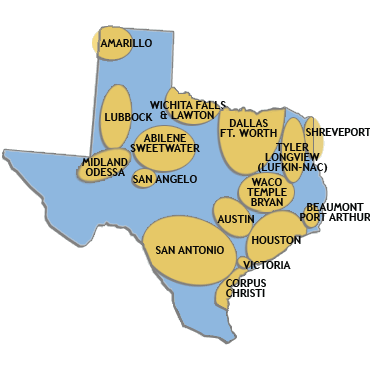
Suddenlink serves portions of these Texas communities

Stop the Cap! has learned Suddenlink will establish usage allowances nearly identical to AT&T for their broadband customers, with a $10 overlimit fee for each 50GB customers manage to exceed their limits.

Suddenlink officials have declined to comment on Stop the Cap!’s report published yesterday.

The usage caps, which will first be implemented on customers in Amarillo, Tex., are as follows:

  • 150GB per month for customers subscribing to “lite” tiers of less than 10Mbps, similar to what AT&T limits its DSL customers;
  • 250GB per month for 10, 15, or 20Mbps customers, similar to AT&T U-verse;
  • 350GB per month for premium-priced 50 or 107Mbps service packages.

Suddenlink says they expect less than 1% of their customers to exceed the monthly limits.  If they do, they will receive warnings three times before the overlimit fee is imposed.

“It could have been worse, but there doesn’t seem to be any justification for these limits other than the fact their biggest competitor in Texas — AT&T — has them,” says Amarillo resident and Stop the Cap! reader Angel.

“It’s another example of what happens when you live in a country that allows broadband duopolies,” Angel says. “Just like with cell phones, as soon as AT&T does something, their competitors follow suit and the customers are stuck paying more and more for less and less service.”

Angel says the first time he is billed an overlimit fee of any kind, he’ll downgrade his broadband service.

“Why pay for premium priced speed tiers when usage caps make them not worth the extra money?”

Verizon Wireless Fraudulently Pumped Up Prepaid Numbers, New Lawsuit Claims

Phillip Dampier September 29, 2011 Competition, Consumer News, Verizon, Wireless Broadband Comments Off on Verizon Wireless Fraudulently Pumped Up Prepaid Numbers, New Lawsuit Claims

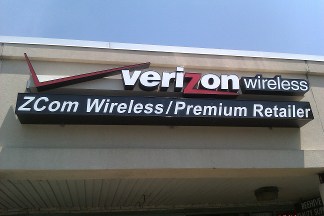
A ZCom owned Verizon Wireless store in New Jersey

Verizon Wireless executives forced independent authorized resellers of the company’s prepaid wireless service to buy cheap phones and activate them with their own money, fraudulently boosting the number of so-called “new activations” Verizon reports to its stockholders.

That is the chief allegation in a new lawsuit filed not against Verizon Wireless itself, but its largest franchisee, ZCom.

The NY Post reports Verizon Wireless executives who managed independent New York Verizon retailers masterminded the alleged scam by suggesting Verizon Wireless’ biggest franchisee, ZCom, “fraudulently increase the number of Verizon Wireless new account activations through the fabrication of fraudulent prepaid accounts,” the suit charges.

ZCom, which sub-leases authorized retail locations for Verizon products, was the defendant in the suit because ZCom can make or break independent store owners who sub-lease, staff, and manage the retail stores.

Plaintiff Shelly Bhumitra, who sub-leased several Suffolk County stores from ZCom, told The Post he was pressured to fraudulently activate pre-paid phones when a Verizon Wireless executive came to his store with ZCom’s owner, Iminder “Vikas” Dhall.

“They suggested that with our own money we should buy inexpensive phones [not smartphones],” and then load them with $30 of prepaid minutes, he said in an interview.

Bhumitra said he was then told to “give them away as bonus phones” to customers so that when used they would count as new activations.

The store owner said he was also instructed to load prepaid minutes onto phones that customers were throwing away and activate them with fictitious names. He was told to keep them in a drawer and make calls on them once or twice a month, echoing charges in the suit.

A store owner would ultimately earn $55 from each activation — enough to more than make up for the $30 outlay.

The three Verizon Wireless executives outed for allegedly taking part in the scheme have all recently resigned, according to the lawsuit.

Verizon itself is taking several measures to distance itself from the case.  Not being named as a defendant has allowed the company to avoid commenting, claiming it would be “inappropriate.”  The company also canceled its contract with ZCom, which generates $150 million in revenue for Big Red every year and holds the “master lease” to 130 Verizon Wireless stores, which are all over downstate New York.  For now, those store locations will remain open.

ZCom’s lawyer denied the allegations in the lawsuit.

Quarterly financial reports can make all the difference for shareholders who can make or break a stock based on financial results.  Verizon Wireless has had an increasingly challenging time managing to grow its prepaid division, which industry observers say used to charge more than its competitors for no-contract plans.  By inflating the number of new activations in company results, shareholder value is artificially protected.  Store owners can be convinced to play along because of lucrative new customer signing commissions, and to meet required sales targets.  Poorly performing store manager/owners can find their leases terminated and, in a worst-case scenario, the store location itself can be closed.

Bhumitra claims he was intimidated into going along with the alleged scam.

Verizon Wireless has tried to compete more aggressively in the prepaid category in 2011, with some success.  After creating new monthly packages bundling voice minutes with data and texting at lower pricing, the company added 879,000 new prepaid customers in the first quarter, and 1.3 million in the second, the Post reports.


Wall Street Wants Two Wireless Carriers for Americans: AT&T and Verizon

Phillip Dampier September 28, 2011 AT&T, Competition, Public Policy & Gov't, Sprint, Verizon, Wireless Broadband Comments Off on Wall Street Wants Two Wireless Carriers for Americans: AT&T and Verizon

Wall Street is pushing back against Justice Department efforts to unwind a merger proposal between AT&T and T-Mobile that will leave America with three national carriers.  Some investment firms even believe three carriers are still “too many” and want mergers and acquisitions to accelerate to allow two dominant national carriers to emerge.

“It’s pretty clear what the end game is in wireless,” said Julie Richardson, managing director at Providence Equity Partners Inc. “LTE, 4G — you have to have those services to compete. One of the most interesting things to watch in telecom will be these players coming together.”

Richardson shares the view among many on Wall Street that carriers forced to build costly 4G services like LTE need less competition and more cash-on-hand to pay for upgrades and to obtain needed spectrum.

Only AT&T and Verizon Communications have the resources to support a national 4G Long Term Evolution network, Richardson said. Sprint, the third-biggest U.S. wireless operator, is struggling to compete against larger rivals and has lost money for 15 consecutive quarters, Bloomberg News reports.

Among smaller players, Richardson believes the future is clear: mergers, acquisitions, and partnerships.  Sprint is moving increasingly closer to the nation’s cable companies, which have sought a cost-efficient way to deliver the ultimate “quad-play” service package that includes wireless, landline, cable-TV, and Internet service, all from the cable company.  But talk of constructing competing cell networks has gone largely nowhere, and cable companies that do offer some type of wireless service typically resell an existing service under their own brand.  Road Runner Mobile, from Time Warner Cable, for example, is really Clearwire under a different name.  Same for Comcast’s wireless Internet service.  Cox is pitching “unbelievably fair” wireless phone service that actually comes from Sprint.

But cable operators currently don’t seem to be interested in outright acquisitions of cell companies like Sprint, preferring to partner with them instead.

Clearwire, which needs financing and better wireless spectrum, may eventually find a friend in Dish Networks, the satellite TV company.  Dish controls wireless frequency spectrum it currently does not use, and has expressed an interest in expanding beyond a traditional satellite television provider.  An acquisition of Sprint or Clearwire could help them accomplish that.

Search This Site:

Contributions:

Recent Comments:

Your Account:

Stop the Cap!