Home » Competition » Recent Articles:

No Matter the Technology, Fiber to the Home is Better… Period

Phillip Dampier October 18, 2011 Broadband Speed, Community Networks, Competition, Data Caps, Editorial & Site News, Public Policy & Gov't, Rural Broadband, Video Comments Off on No Matter the Technology, Fiber to the Home is Better… Period

Phillip "Wants a High Fiber Diet" Dampier

Believe it or not, there are still some people out there who believe wireless broadband, as it exists today, is the future of high bandwidth communications in North America.  Forget DSL, forget cable, forget fiber optics, they say.  Technology like 4G and WiMax are “far superior” and cheaper.

To be fair, most of the people advocating the technology Sprint is in the process of abandoning have a vested interest in stopping fiber broadband projects.  That is because while Verizon continues to sit on its hands expanding its excellent FiOS fiber-to-the-home service, some of the most aggressive fiber projects in the country are being built by your local town, city, or village government.  It’s community-owned broadband, by and for the people in your own area.  Large telecom interests that have always refused to deliver fiber service (or pretend to by using the word ‘fiber’ while not bringing a single strand to your home) have it in for potential competitors that are willing to provide the advanced fiber technology they won’t.

So why aren’t big phone and cable companies providing this level of service?  In a word, money.  Their shareholders don’t like the initial cost of deploying fiber to the home service, even though the technology is superior to what reaches your home today, is infinitely expandable without stringing new cables across town, and can support money-making applications developers and providers have not even dreamed of yet.  With a pervasive lack of competition, there is nothing to overcome Wall Street’s conclusion that fiber doesn’t deliver fast enough profits to justify the initial expense.

When you take Wall Street out of the equation, especially in the telecom sector, the math works very differently.  While the phone and cable company is probably telling you “no,” companies like Google are saying yes in Kansas City.  So are municipally-owned rural co-operative phone and cable companies.  Communities deciding broadband is too important to leave to the phone companies that deliver half their residents 1-3Mbps DSL and call it a day are saying yes to fiber optics as well.

Overseas, fiber networks are being built in countries in Eastern Europe where the economics would never make sense by Wall Street standards, yet residents (and perhaps more importantly new digital economy businesses) are now getting Internet speeds of 100Mbps or better.  The next countries that could import good-paying American jobs might be Lithuania, Latvia, Poland, Romania, and Bulgaria.

So what does it take to adapt to this reality in North America?  Providers that are willing to make a long term investment in fiber broadband — one that may take a few extra years to pay back, but will generate dividends like increased employment, capacity to provide better, faster service, more reliable networks, and earning a piece of the action powering North America’s new digital economy.  If they won’t listen, tell your elected officials to support policies that promote additional competition and back community broadband expansion that can make all the difference between 3Mbps DSL and 100Mbps fiber.

[flv width=”640″ height=”372″]http://www.phillipdampier.com/video/Fiber is Better.flv[/flv]

Watch and share this video with friends and family to educate them about the infinite possibilities of fiber optic broadband and learn why it is superior to usage-capped wireless, slow speed DSL, satellite fraudband, or lopsided cable “High Speed Internet” broadband that delivers high speed in only one direction. (3 minutes)

FairPoint: The Little Company That Couldn’t, Wants To Be Deregulated

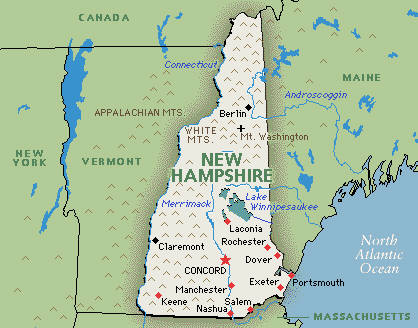
FairPoint Communications, which took control of Verizon landlines in Maine, New Hampshire, and Vermont in 2009 and then promptly went bankrupt is now appealing to New Hampshire’s regulators and legislature for deregulation.

Teresa Rosenberger, the company’s New Hampshire president, told the Nashua Telegraph that before FairPoint Communications took over Verizon’s northern New England landlines in 2009, that means of communication was the “only game in town.” Now that Verizon’s “monopoly” no longer exists, FairPoint wants the “shackles [removed from] our ankles.”

Setting aside the fact Verizon and FairPoint both faced identical competitors — Comcast and AT&T in parts of the state, the primary difference between the incumbent landline phone company and its cable competition is that the latter enjoys the right to choose its customers.  Landline providers must deliver universal access to basic service, something both FairPoint and Verizon managed for more than a century.

Rosenberger claims that with the rapid decline of landlines, FairPoint should be free from regulatory constraints it argues limits its ability to compete on pricing and service.  Rosenberger uses FairPoint’s biggest failure — its rapid loss of customers — as the core argument for allowing deregulation, which would deliver few checks and balances from state regulators.

FairPoint’s market share in New Hampshire is now down to 49% and dropping.  Its competition — Comcast and wireless mobile providers, now account for the majority of phone lines in the state.  FairPoint’s line losses spiked when the company took over providing service in northern New England from Verizon Communications.  Many FairPoint customers would describe that level of service as poor, with billing and service complaints reaching epic proportions before the company ultimately declared bankruptcy.

Rosenberger points out that the traditional way utility services deal with changing business models is to sell off non-performing or excess assets.  Electric utilities sell excess power, but phone companies like FairPoint have few things other providers want.

In particular, FairPoint is upset it is saddled with a statewide network of telephone poles that “nobody wants.”

“We lose a ton of money on these poles” when work has to be done on them, Rosenberger told the newspaper. “There is the flag rate, the excavation fee, paying for a cop out there – and that’s before taxation and reporting requirements.”

FairPoint notes their competitors gets to use those poles, and are not necessarily contributing their fair share towards their upkeep.

FairPoint isn’t asking to abandon its universal service obligation, something AT&T has lobbied for throughout its territories.  But it does want to do away with pricing regulations and reporting requirements.  If FairPoint offers a business customer a special discount rate, it must file that rate publicly with state regulators, which is public information.  FairPoint says its competitors may be using that information to undercut them in contract negotiations.  But the public price regulations are in place to prevent a phone company from offering dirt cheap service for a select few, effectively subsidized by other ratepayers.

FairPoint also wants quality of service reporting regulations eased, and that comes as a concern to some New Englanders who lived through FairPoint’s messy transition from Verizon service.  Even today, there are ongoing disputes over whether FairPoint is meeting state obligations on everything from how quickly they answer customer calls to whether or not service problems are resolved on a timely basis.

AT&T Illinois President: “T-Mobile is Going To Go Away”

Phillip Dampier October 17, 2011 AT&T, Competition, Editorial & Site News, Public Policy & Gov't, Rural Broadband, T-Mobile, Wireless Broadband Comments Off on AT&T Illinois President: “T-Mobile is Going To Go Away”

La Schiazza

AT&T Illinois president Paul La Schiazza is in the business of predicting the future of other mobile phone companies.  In an interview with the Journal-Star, La Schiazza said AT&T should be permitted to complete its purchase of T-Mobile, because if they don’t, T-Mobile will never make the investment in 4G upgrades and “whether we buy them or not, (T-Mobile) is going to go away eventually.”

That’s ironic for Mr. La Schiazza to say, considering his employer made a decision not to make substantial investments in 4G upgrades itself, before suggesting it would with the purchase of T-Mobile.

La Schiazza admits AT&T has thrown its landline business under the bus, now considering it antiquated and irrelevant for a growing number of Americans.

“More people, especially young people, are cutting the cord,” he said, referring to customers who drop landline service completely. “We’ve changed our business model to be a mobile/broadband company,” said La Schiazza.

La Schiazza was also willing to call out AT&T itself when he noted wireless companies in Illinois, including his, have put rural areas at a “significant disadvantage.”  That’s because wireless companies ignore rural areas where providing coverage does not make economic sense.  Yet La Schiazza oddly claimed that with the absorption of T-Mobile, 97 percent of Illinois could get enhanced AT&T service.  He did not explain exactly what business formula was used to justify the enhanced proposed coverage maps he brought with him to the interview.

David Kolata, executive director of the Chicago-based Citizens Utility Board, provided the newspaper with a countering viewpoint — rare in newspaper stories featuring interviews with AT&T executives.  Kolata told the newspaper he was less thrilled about a possible T-Mobile-AT&T merger. “The cellphone industry is already pretty concentrated. When one of the biggest players buys another large company, it raises competitive concerns,” he said.

“The fact that the Department of Justice and five or six state attorney generals (including Lisa Madigan in Illinois) across the country oppose the merger as currently proposed is an indication that it could be bad for consumers,” said Kolata.

[Thanks to Stop the Cap! reader Bob for the news tip.]

Cell Phone Companies Hoarding Cash/Credit for Spending Blitz on Canadian Spectrum

Phillip Dampier October 13, 2011 Astroturf, Broadband Speed, Canada, Competition, Consumer News, Mobilicity, Public Policy & Gov't, Rogers, Vidéotron, Wind Mobile (Canada), Wireless Broadband Comments Off on Cell Phone Companies Hoarding Cash/Credit for Spending Blitz on Canadian Spectrum

Upcoming wireless spectrum auctions are critically important for some of Canada’s newest players in the cell phone marketplace.  Most are working hard to make sure they have plenty to spend to secure new frequencies for advanced wireless services that will help them remain competitive with larger players.

Globalive Holdings, the parent company of Wind Mobile, has convinced backers to provide hundreds of millions of dollars in financing, so long as all of the money is spent on acquiring wireless spectrum.

Wind’s nearly 400,000 customers will appreciate the additional room for growth, and new customers may keep Wind in mind for advanced 4G networks most Canadian providers intend to build and expand into the new spectrum they acquire at an auction next year.

Much of the funding, estimated to approach nearly a half-billion dollars, is coming from Wind’s parent entities, Egypt-based Orascom Telecom and the European conglomerate VimpelCom that acquired Orascom earlier this year.  Because the Canadian government is expected to set-aside some of the valued 700MHz spectrum exclusively for bidding among new entrants in the market, Wind could walk away a big winner, particularly if other similar-sized competitors Mobilicity and Vidéotron Ltee./Quebecor have trouble raising enough money to remain competitive in the bidding.

As far as Canada’s largest cell companies are concerned, set-asides are unnecessary and they prefer a winner-take-all auction.  Rogers, in particular, has been lobbying hard to convince Canadian officials it needs access to the 700MHz spectrum up for auction to roll out service in rural communities and upgrade networks in larger cities.

Those who feel Canada’s cell phone marketplace is already too concentrated have little sympathy for Rogers’ point of view, and expect an auction free-for-all will mean the largest incumbent players will walk away with everything they can bid on.

Among smaller players, assuming the set-asides are in place, analysts expect Wind will probably secure the most spectrum, but Vidéotron is expected to stay competitive and walk away with at least some frequencies for use in its home province of Quebec.  Big losses among the smaller players could fuel calls for additional mergers and acquisitions among those carriers deemed to have been left behind.

The Canadian government is expected to be the biggest winner of all, netting a potential $3-4 billion from the spectrum sale.

Why Is Anyone Still Wasting Their Time With a Blackberry? Day 4 Of the Global Outage

Blackberry Butter Spreader

As Blackberry owners enter their fourth day of a serious global service outage, a growing number are now wondering why they are still wasting their time with a phone that has been increasingly abandoned “for something better,” — namely smartphones running Apple’s iOS or Android-powered handsets that now have the largest share of the smartphone market.

Only Nokia is facing market share challenges greater than Waterloo, Ontario-based Research in Motion, the maker of the formerly popular device.  After days of service disruptions, RIM may be getting a lot more acquainted with their town’s namesake than they’d like.

The trouble started Monday with a switch problem at the company’s offices in Slough, Great Britain.  Yes, the same Slough that is home to the workers of British television’s original rendition of “The Office.”

The switch failure soon began impacting customers in Europe, Africa, and the Middle East — the remaining places where RIM still commands a respectable position in the handset market.  On Tuesday, problems spread across South America and India.  Yesterday, North Americans joined the growing crowd of users who found e-mail service and instant messaging spotty, when it worked at all.

Company officials suggest the spreading outages were caused by a cascading series of failures.  When the switch failed, backup systems proved inadequate, and the inevitable sea of “is your Blackberry working?” and “test… test… test” messages started piling up, arriving faster than RIM’s backup systems could handle.  The more frustrated users became trying to send and receive messages, the worse the problems got.

[flv width=”512″ height=”308″]http://www.phillipdampier.com/video/Blackberry Outage 10-13-11.flv[/flv]

The Blackberry outage caused a sensation in the United Kingdom, where the phone still maintains a significant market share.  British reporters and analysts had no time to throw softball questions at Blackberry officials.  Watch as Sky News and the BBC report the service failure as a veritable crisis for the company, followed by an increasingly uncomfortable managing director for Research in Motion’s UK operations who faced sharp questioning from a reporter intent on getting beyond the pre-written damage control statement.  In the United States, the declining market share for the Blackberry gave ABC News license to have some fun with the service outage, poking fun at the phone that is increasingly irrelevant to Americans.  (11 minutes)

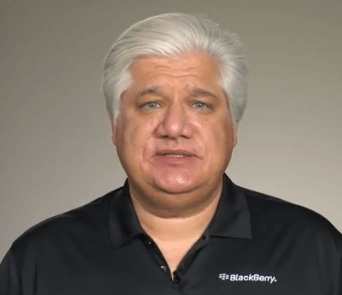
RIM Founder and co-CEO Mike Lazaridis Apologizes

Blackberry users are dependent on RIM’s networking infrastructure because the company distributes messages through its own servers.  That can deliver more control to RIM’s network engineers, but also exposes the company to spectacular service failures when things go wrong.  And they have gone wrong repeatedly, as customers worldwide report regular sporadic service outages.

Wireless phone companies faced the wrath of angry customers, who initially blamed them for the service outages, but in fact the problems reside with RIM’s own network.

Loyal Blackberry customers have been forced, much to the amusement of other handset owners, into desperate measures.

“My God, I actually had to walk down the hall to my co-worker’s cubicle to ask him a question,” wrote one angry customer.  “Damn you, Blackberry!”

“So much for today’s lunch meeting,” shared another. “Nobody knew what to do or where to meet until someone suggested we call everyone on the phone.  The phone??? Are you kidding me?”

The New York Times shared other serious side effects of the outage:

By Wednesday morning, Wall Street was alight with e-mails from technology departments notifying employees of the problem. Bankers’ meetings fell through when attendees couldn’t look up the locations. Employees were reduced to leaving voice-mail messages.

Perhaps more concerning is the ultimate future of Research in Motion, which has seen better days.  Just three years ago, Blackberry enjoyed a 46 percent market share for mobile devices around the world, according to data from IDC, a research firm. This year, it’s 12 percent and dropping (and is already much lower in North America.)

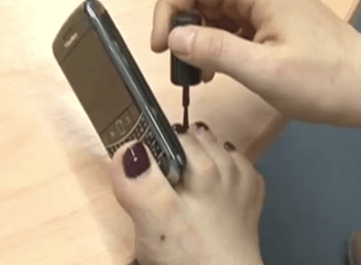
The Blackberry toe spreader

Wall Street is furious, of course.

“[The outage] is symbolic of what’s going on at the company,” Colin Gillis, an analyst at BGC partners who follows the telecom industry told the Times. “It’s a bloodbath.”

The same can be said for the company’s stock price, which one analyst compared to a train wreck in slow motion.

This morning, Research in Motion made the riskiest move of all — trotting out the historically idiosyncratic and impatient RIM Founder and co-CEO Mike Lazaridis to apologize.  He appeared more contrite than an earlier appearance with the BBC’s Rory Cellan-Jones.  Lazaridis turned up to that earlier interview with his press handler and a lot of attitude.  He soon found himself being questioned by the reporter about the company’s user privacy policies in the Middle East.  After slamming the reporter for the question, Lazaridis ended the interview.

Today, the founder of the company still couldn’t answer the all-important, “when will service be fully restored?”  But as of late this morning, RIM’s co-Chief Executive Officer Jim Balsillie claimed all is well again with the Blackberry, but wouldn’t answer questions about whether customers were entitled to refunds for lost service.

That’s a question mobile carriers are starting to ask RIM as well, particularly as customers look for service credit for the outages cell companies were not responsible for causing.

“This is it. This is the boiling point. Someone has to go over to Waterloo and slap those in charge at RIM,” wrote Crackberry.com forum user BlackLion15.

With tomorrow’s release of Apple’s latest iPhone, RIM officials may prefer a good customer spanking over the alternative — customers throwing their Blackberries in the trash and switching to a new handset.

[flv width=”512″ height=”308″]http://www.phillipdampier.com/video/Lazaridis Before After.flv[/flv]

Before and After.  During better days for Research in Motion, RIM Founder and co-CEO Mike Lazaridis had no time for ‘impertinent’ questions from British reporters and called an early end to one interview.  Earlier today, he checked his attitude at the door to issue an apology to upset customers.  (3 minutes)

Search This Site:

Contributions:

Recent Comments:

Your Account:

Stop the Cap!