Home » Competition » Recent Articles:

Let Consumers Buy Cable Boxes and Stop Endless Rental Charges

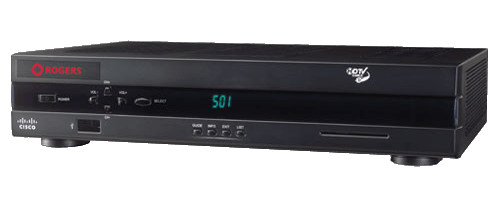
Rogers Cable lets their customers purchase this cable box outright to avoid rental charges.

Stephen Simonin first came to our attention in January 2010 when he proposed charging cable operators room and board for their expensive cable set top boxes they require subscribers to rent.  Now, the chairman of the Litchfield (Conn.) Cable Advisory Council is back with another salvo — demanding an end to mandatory rental charges for cable TV equipment and access to competing providers:

The biggest industry in the US that has money for jobs is the entertainment industry. Federal law requires Cable to carry local broadcast and public channels in the clear for all. If we contact our Federal representatives and ask them to add: “Must carry adjacent competitors programming” We would add a million USA jobs immediately. Paid for by corporate cable and NOT tax dollars!

Cable has forced all of us to RENT cable boxes. We are not allowed to buy them because this is guaranteed free revenue forever for them. A box costs less than $100 and we pay nearly $10 a month for rental and power each month. Cablevision makes over $1,000,000,000 a year on set top box rentals alone. This is only one company! They have compressed TV to less than 20% of the transport. They use the other 80% for business and not covered under TV franchise (Wi-Fi, data, phone business). However, they use the TV franchise for this monopoly access to our front doors.

Adding this must carry clause will allow up to 5 different cable providers at our front doors for lower costs, higher quality and real competition. Cable will not want to give up that fat 80% business revenue they have today and will need to add a new fiber/co-ax transport across the country on their nickel! Think how many local jobs $1,000,000,000 can pay for. Now remember that we have several cable companies here in CT!

These are American jobs! Please help us get this passed! Call our Federal Congressman and Senators today. Remind them of the details I have sent them on behalf of the People.

Simonin’s proposal, sent to Stop the Cap!, enjoys some precedent… in Canada.

Sky Angel, a Christian television distributor, abandoned satellite in favor of IPTV several years ago. Their subscribers watch Sky Angel's channel lineup over a broadband connection.

Consumers there can purchase cable boxes in stores like Best Buy ranging from $80 for a refurbished unit that works with Shaw Cable to $500 for a cable box with DVR designed for Rogers Cable customers.  Buying your own box puts an end to rental fees, often $7+ per month, which never stop, even after the box is effectively paid for in full.  But for those seeking a built-in DVR, the initial price tag is on the steep side.  The practice of buying boxes has also generated some surprising competition between Rogers and itself.  When customers call to inquire about new service, Rogers often includes discounts including free box rentals, making it unnecessary to purchase the box at all (as long as you remember to re-negotiate an extension of the promotion when it ends).  That’s a savings of nearly $100 a year for some customers.  Buying DVR equipment guaranteed to work with your current provider also makes it easy to upgrade the device with larger capacity hard drives that can store more programming.  Since the failure point for most DVR’s is the hard drive, occasional replacements and upgrades can keep a box running for years.  Many pay providers in the United States charge higher rental prices for higher capacity equipment, with no option to buy.

Simonin’s proposal to open up cable networks to other providers is more novel, and probably a lawyer’s dream come true for the endless litigation it offers.  It’s highly unlikely the courts will side with the notion of forcing cable operators to open their infrastructure to competing providers, and considering the amount of informal collusion between companies today, it’s probably not going to deliver much savings.

A bigger hope on the horizon is the ongoing march to IPTV — television programming delivered using Internet technology.  With strong Net Neutrality policies in place (and a strong position against Internet Overcharging with usage caps or usage-based billing), dozens of new virtual “cable companies” could be launched, delivering their lineups over the Internet, direct to computer and television screens.  That could deliver consumers an endless choice of providers, assuming regulatory oversight is in place to make sure programming is available to all at fair and reasonable prices and that broadband providers are not allowed to block or impede access to the offerings that result.

It’s much easier to do an end run around Big Cable than trying to find a way to get them to change their business plans.

Union Cheerleading of AT&T/T-Mobile Merger Gets Lost in the Math

Phillip Dampier October 25, 2011 AT&T, Competition, Public Policy & Gov't, T-Mobile, Wireless Broadband Comments Off on Union Cheerleading of AT&T/T-Mobile Merger Gets Lost in the Math

Communications Workers of America president Larry Cohen got himself off script and tangled in the percentages over the weekend when he told German magazine Focus the merger deal between AT&T and T-Mobile that the CWA has been cheerleading since it was first announced had little chance of coming to pass.

Cohen told Focus the chance of the deal getting beyond the current court challenge from the U.S. Department of Justice was around 20 percent. That seemed to signal the union was getting in line with those prepared to throw the current merger deal under the nearest bus.

Soon after that quote came home on the Bloomberg News wires (and reached AT&T), it didn’t take long for a revised quote (that a union spokesperson would later claim to be a “clarification”) to appear in a subsequent story:

There is about a 60 percent chance of a settlement between the companies and the Justice Department, Cohen said in a telephone interview today. Should the case go to court, it would be 50-50 on which way the decision would go, he said.

But the fuzzy math truly got exposed when the Wall Street Journal got this explanation for the discrepancy:

A spokeswoman for CWA said it was mostly a case of fuzzy math. Mr. Cohen’s point, she said, was that there was a 60% chance that the Justice Department’s lawsuit against the deal would be settled out of court.

But in the 40% chance that it didn’t, then there was a 50-50 chance that the company would prevail, which he may or may not have stated as 20 percent.

In reality, he meant to say that it was more likely than not that the case would be settled and the merger would succeed, the spokeswoman said.

“Perhaps it wasn’t the best of use of math,” she said. “Things got lost in the percentages.”

So, did AT&T push for the comments to be clarified? “I had some exchanges with my counterpart at AT&T, yes,” she said. “I sent her our clarification… which is good.”


Comcast Kicks CenturyLink Around With Very Aggressive ‘Switch Provider’-Discount Deals

Phillip Dampier October 24, 2011 Comcast/Xfinity, Competition, Consumer News, Editorial & Site News Comments Off on Comcast Kicks CenturyLink Around With Very Aggressive ‘Switch Provider’-Discount Deals

Stop the Cap! reader Wayne A. dropped us a line to let us know Comcast has been getting very aggressive in the Denver area, poaching CenturyLink customers with enormous discounts:

My wife and I just accepted a package from Comcast to leave CenturyLink for a package that includes:

  • Digital Premier HD with DVR
  • HBO, Cinemax, Showtime, and other premium movie channels
  • Broadband service at 25/5Mbps
  • Unlimited Long Distance Digital Phone Service

Comcast’s price?  An amazing $109.99/month for the first year, $129.99/month for the second.  Wayne says that’s a savings of $90 a month over ordinary Comcast prices, and compared with what he was paying CenturyLink, he will save $912.12 during the first year and around $600 for the second.

What makes Comcast’s pricing so aggressive is the fact they include much faster broadband speed than many other retention or “capture” customer deals.  They also throw in free premium movie channels.  We’ve seen Time Warner Cable offer triple-play retention deals for less than $90 a month for the first year, but they don’t include movie channels and deliver broadband service at the standard 10/1Mbps speed.

If you are paying Comcast more, it may be time to pick up the phone and threaten to walk unless you can have the same deal.  We’ve found dealing with customer retentions to be a real “your results may vary”-experience.  Don’t be willing to take the first offer.  Don’t be afraid to dismiss weak deals with a non-committal “I’ll think about it” if the price is not right for you.  Then call back.

In the last few weeks, we’ve found Time Warner Cable’s best deals still go to customers who actually schedule a service disconnection. Within hours, Time Warner starts calling, looking to “make an offer you cannot refuse.” The retention specialists at Time Warner who reach out to you generally have the most aggressively priced deals. You qualify if you call, schedule a disconnect a week or two out, and wait by the phone. You can keep your service running while company representatives try to convince you to stick with them.  Just make sure you answer those unfamiliar Caller ID-calls — it’s probably the cable company.  Most will ask why you disconnected.  If you answer “price,” the deals start coming.

Unfortunately, there was no way we could take advantage of any of their latest offers, which literally started two hours after disconnecting my late grandmother’s cable service.

It’s a buyer’s market for telecommunications products, so never settle for the regular price when a substantial discount is a phone call away.

Internet Service Providers’ Claims of Expensive Bandwidth Costs are a Myth, Concludes Report

Phillip Dampier October 24, 2011 Competition, Data Caps, Wireless Broadband 3 Comments

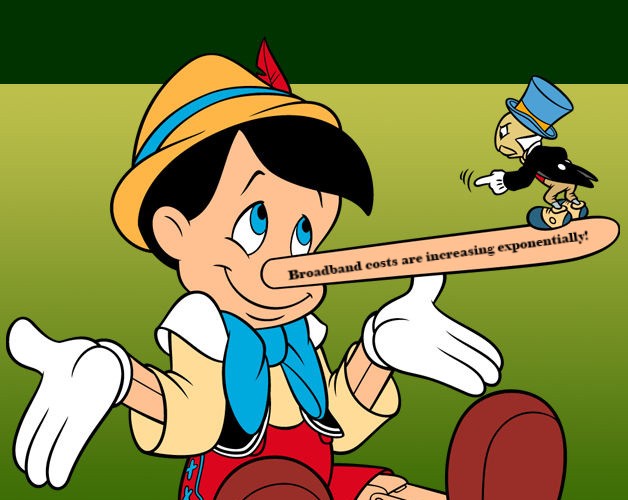
Internet Service Providers who use “increasing bandwidth costs” as an excuse to raise prices or implement an Internet Overcharging scheme like usage limits or usage-based billing are being dishonest.

That’s the conclusion of a new British report that found providers grossly overestimating the costs of meeting increasing usage demands of their customers.  In some cases, providers are inflating the price of usage by 1,000 percent or more over their own costs.

“Traffic-related costs are a small percentage of the total connectivity revenue, and despite traffic growth, this percentage is expected to stay constant or decline,” claims the report, commissioned by the British Broadcasting Corporation, Britain’s Channel 4, and Skype.  “Studies in Canada and in the UK put the incremental cost of fixed network traffic at around €0.01-0.03 per GB.”

That represents a cost of pennies per gigabyte, yet many providers charge anywhere from $0.20-10.00 or more to residential customers, an incredible markup.

The study further concludes ISP claims of “ballooning costs” are simply “a myth,” and points to company financial reports which clearly show “for fixed networks, traffic-related costs are low, falling on a unit basis and likely to fall overall given declines in traffic growth and on-going cost-reducing technical progress.”

In fact, most broadband providers are reporting decreasing costs and investment in their broadband product line, while enjoying unprecedented increased profits.

As broadband traffic increases, the technology to sustain that traffic has improved, and brought unit costs for broadband traffic to an all-time-low.

The report admits that costs for wireless technology are higher, primarily because of limited airwaves, a shared usage infrastructure, and initial expenses in delivering improving connectivity with cell or wireless radio towers.  But with the advent of 4G technology, providers can sustain increased speeds, traffic, and revenue from selling wireless service that can handle higher bandwidth applications.

Plum Consulting authored the new report.

Plum Consulting, which wrote the report, concluded that even in more expensive wireless service areas like the United Kingdom, smartphone data tariffs amounting to around €10 per GB are not justified on 4G networks.

“The cost to the mobile network operator is under €1 per GB,” Plum Consulting found.

Predictably, service providers are dismissive of the report’s findings.

Trefor Davies, CTO of communications provider Timico and a member of the board at the Internet Service Providers’ Association (ISPA) says bandwidth costs are a real problem, especially for smaller ISPs that rent access on a usage-based, wholesale access plan.

“Bandwidth is by far the greatest proportion of cost for an ISP,” Davies told PC Magazine. “It’s very much you pay for what you use,” he said. “If you use twice as much bandwidth, you’re going to be paying twice as much.”

[Thanks to Stop the Cap! reader Bill H. for sharing the news.]

Cord Cutters Can Now Buy Package of Streaming News Channels

Phillip Dampier October 20, 2011 Competition, Editorial & Site News, Online Video 1 Comment

Besides sports, the biggest challenge for cord-cutters is to find access to 24-hour news channels they give up when they cancel pay television service.  While cable news often doesn’t actually spend much time on “news” when breaking stories are few and far-between, when something serious does happen, cord-cutters looking for live coverage can and do miss access to news networks.

But now a New York startup, RadixTV, has a solution for news junkies: Rtv.

Yesterday, the company launched a package of four cable news networks — Bloomberg, CNBC, CNBC World, and MSNBC streamed live 24 hours a day for $14.99 a month.

That’s a steep price for four channels, of which MSNBC is arguably the most important.  The company plans to expand to 10 channels in the future, including CNN, Fox News, and international news networks like BBC World, France 24 and Al Jazeera English that American cable companies routinely ignore.

Kaul

Rtv is pitched primarily to Wall Street — financial firms, brokerages, and investment businesses that want access to continuous business news but don’t need a traditional cable package.  In fact, the package is technically only supposed to be sold to business customers, but anyone can sign up if they say they are stock traders, accountants, investors, etc.

Stop the Cap! sampled Rtv this morning and found the service to work well with our broadband connection, although at times crawling news and stock prices found at the bottom of the screen on some channels seemed less smooth than they could be.  It occasionally was distracting.  MSNBC was the most compelling channel in the lineup, although we’d love to see international news channels even more.  But $15 a month is still a high price to pay.

The company’s CEO, Bhupender Kaul, worked for Time Warner Cable for nearly two decades, and believes the future of cable TV is likely to be Internet-based, with programming sold in niche packages like his.  True a-la-carte may be too unwieldy for providers to pull off, but selling groups of channels together might not.  Still, Kaul seems intent on not aggravating the industry as much as earlier cord-cutting online viewing services, which have all since been sued out of existence.  Local broadcast and general interest programming does not come with Rtv.  While a six figure-salaried Wall Street banker won’t mind $15 a month, you might.

Further reading: In New Web TV Service, A Glimpse of the Future

Search This Site:

Contributions:

Recent Comments:

Your Account:

Stop the Cap!