Home » Competition » Recent Articles:

Mediacom Merry Christmas Rate Hike: Naughty/Nice, You’ll Pay More in 2012

Phillip Dampier December 6, 2011 Competition, Consumer News, Mediacom, Public Policy & Gov't, Video Comments Off on Mediacom Merry Christmas Rate Hike: Naughty/Nice, You’ll Pay More in 2012

Mediacom is announcing broad price increases for many of its customers scheduled to take effect on Dec. 15.  Most cable-TV subscribers will pay $2-3 more a month for basic cable, an additional $2 a month for Cinemax and Showtime, and $2 extra a month for “Digital Plus” cable service.  To add insult, the paperless bill credit that used to knock $1 off your bill if you chose not to receive a mailed billing statement is also being eliminated.
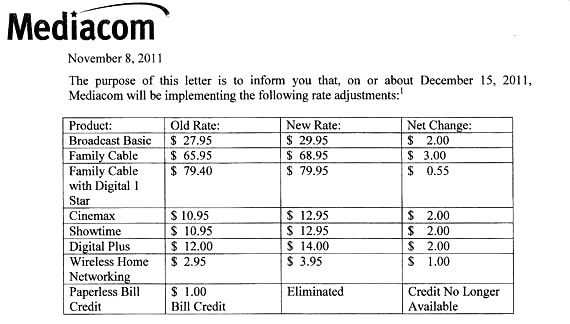
Lee Grassley, Mediacom’s chief lobbyist, delivered the company line about the rate increase in letters mailed to subscribers.  In essence, he blamed everyone but Mediacom for the rate hikes, and in poetic language one normally doesn’t get from a cable company rate increase notification:

As our nation struggles to pull itself out of what has been called the Great Recession, we recognize that these are challenging times for the hardworking men and women living in the communities that we serve.

[…] Over the past few years, many broadcasters have used their monopoly powers to demand 100%, 200% and even 300% rate increases during contract negotiations.  This has driven up cable and satellite rates and forced American consumers to pay billions of dollars for “free” over-the-air television.

The problems with sports programming are equally alarming.  One look at the skyrocketing rights fees announced with recent deals and it is easy to see that the marketplace for live televised sports is out of control.

[…] Contrary to public perception, cable companies are reluctant to raise video prices because when we do, we lose subscribers.  Mediacom does not make money when we raise video rates, since we remit virtually every penny of the increase on to programmers.  In fact, over the last three years, our programming cost increases were more than double our video revenue increases.

Since the programming community has been unwilling to exercise even the slightest measure of self-restraint when it comes to reigning in their spending or increasing their price demands, Mediacom has taken the fight to Washington.

Mediacom as new-found-friend fighting for lower cable rates comes across as ironic, at best, to Stop the Cap! reader Noel, who lives in Mediacom’s Iowa footprint.

“This is the same cable company who pocketed rate increases annually for as long as I’ve been a subscriber, and if they can’t raise the price of the television service, they’ll just make it up on the broadband side,” Noel writes.  “They have their nerve complaining about monopolies.”

Noel points out the local station retransmission consent fees are a more recent phenomenon, and Mediacom rate increases in prior years were the same or higher.

“I think they are realizing there is an absolute maximum people in Iowa can afford for cable, and years of rate increases have allowed all of the players to assume they can slice a bigger piece from that pie for themselves, and we’re tapped out,” Noel adds.

Noel called Mediacom and threatened to cancel service and received a nice consolation price: customer retention pricing normally reserved for new customers.

“I have a year reprieve, but rest assured I will start dropping things after the deal expires at these prices.”

[flv width=”480″ height=”290″]http://www.phillipdampier.com/video/KCCI Des Moines Mediacom Rate Increases 11-28-11.flv[/flv]

KCCI in Des Moines covers Mediacom’s rate increases and the reaction from local residents who will have to pay more for cable service.  (2 minutes)
Big Cable Customers: A Portion of Your Cable Bill Buys Votes

Phillip Dampier December 5, 2011 Astroturf, Community Networks, Competition, Editorial & Site News, Public Policy & Gov't Comments Off on Big Cable Customers: A Portion of Your Cable Bill Buys Votes

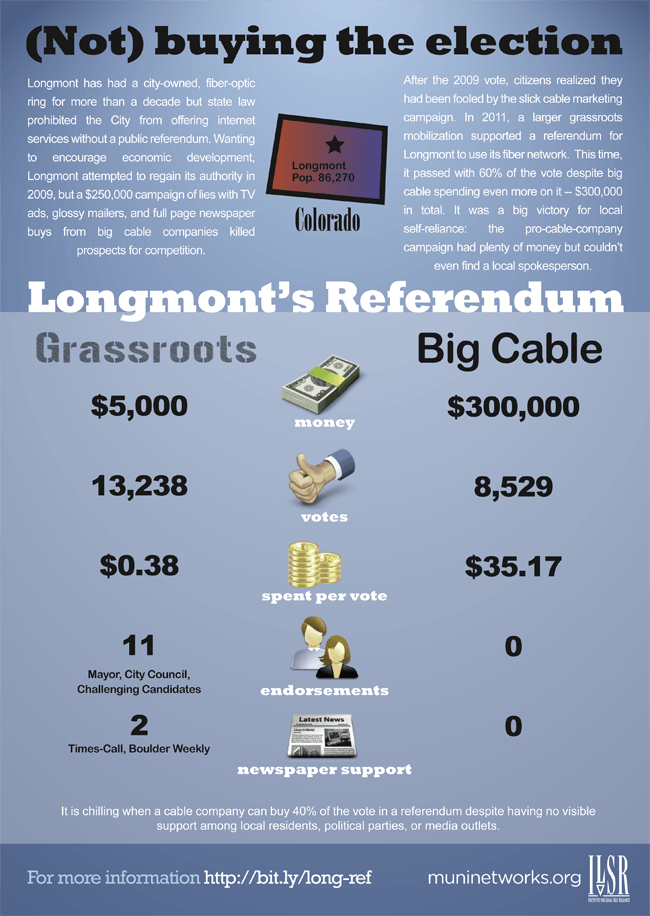
Comcast’s decision to spend $300,000 attempting to defeat one community’s public broadband initiative illustrates how America’s largest cable company invested a portion of your monthly cable bill.  It turned out to be a bad investment — Longmont voters saw right through the dollar-a-holler vote buying operation run by a Denver-based “public strategies” firm.  Every vote in favor of the cable company cost Big Cable $35.17 — a bit less than many pay for a month of broadband service.

The pro-fiber forces spent a collective $5,000, some of which came from individuals who want more competition in Colorado.  The Institute for Local Self-Reliance notes the cable industry couldn’t even find a local spokesperson to cheerlead their campaign.

It is proof positive citizen activism can still beat back corporate-financed propaganda campaigns and make all the difference.

Customers “Probably Don’t Need Higher (<1Mbps) Speed," Editorializes N.M. Newspaper

Phillip Dampier December 5, 2011 Broadband Speed, CenturyLink, Community Networks, Competition, Editorial & Site News, Kit Carson Telecom, Public Policy & Gov't, Rural Broadband, Wireless Broadband Comments Off on Customers “Probably Don’t Need Higher (<1Mbps) Speed," Editorializes N.M. Newspaper

Sometimes you can’t please some people no matter what you do.

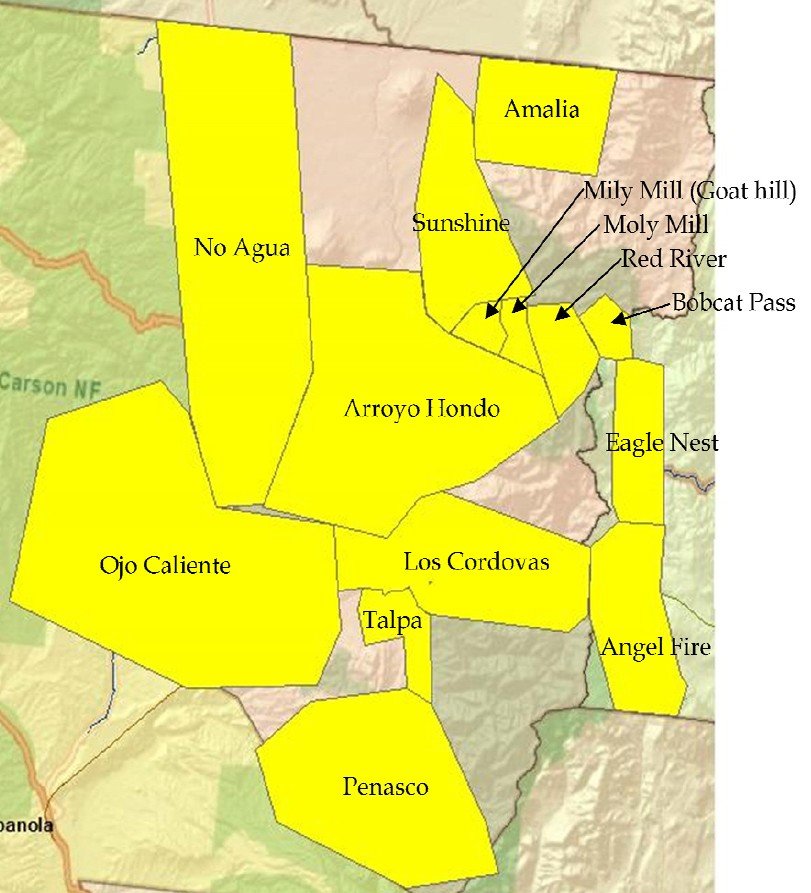
Kit Carson Electric Cooperative’s $64 million fiber-to-the-home expansion project will finally bring 21st century broadband speeds to northern New Mexico. The electric co-op intends to deliver broadband speeds up to 100Mbps to 20,000 largely rural residents and businesses in Taos, Colfax, and Rio Arriba counties who have had limited access to cable broadband or live with speeds often less than 1Mbps from CenturyLink-delivered DSL.

“It’s a whole new ballgame for rural New Mexico,” shares Stop the Cap! reader Raul. “But the pinheads at the local weekly newspaper are ringing their hands over the project, suggesting only businesses deserve 100Mbps while the rest of us should be satisfied with speeds under a megabit per second.”

Indeed, editors at the Sangre de Christo Chronicle are wringing their hands over the project:

But many of us in the Kit Carson service area already have Internet service — and we’re completely happy with it. Kit Carson CEO Luis Reyes, Jr. said a large portion of the organization’s electric customers are currently under-served by other providers with Internet speeds of less than one megabit (1,000 kilobits) per second.

We have no reason to doubt that, but many of these customers probably don’t need the higher speeds. For the Internet customers who use the Internet for email, Facebook, news and other basic functions, Kit Carson’s prices will be most important. Most of us will not pay more for faster Internet speed we don’t need, but we will consider switching to a local provider if it offers identical or better service and prices.

“CenturyLink barely delivers DSL today, and has shown no interest in investing substantially in northern New Mexico, and outside of concentrated built-up areas there is no cable competition,” Raul says. “Kit Carson is the only local concern that has shown any real interest in making our community better, and the local newspaper is complaining about it.”

Proposed service area for Kit Carson Electric's new fiber to the home network serving northern New Mexico.

Kit Carson Electric’s project will provide a true fiber-to-the-home service bundling television, telephone, and broadband service — a substantial upgrade over what the telephone company has on offer.  With speeds far beyond what cable and phone providers in New Mexico are accustomed to providing, the region stands to benefit from entrepreneurs building digital economy businesses over a broadband network that can actually help, not hinder online development.

Currently, area residents pay CenturyLink up to $55 a month for 1.5/1Mbps DSL service.  Residents are so excited by the prospects of much faster speeds at significantly lower prices, Kit Carson Electric has developed an innovative stop-gap service for residents still waiting for direct fiber connections — fiber-to-wireless service.  New and existing customers can sign up for the service for a $100 installation fee and choose from three service tiers:

  • 3Mbps — $29.95/month
  • 7Mbps — $39.95/month
  • 10Mbps — $49.95/month

A three year contract is required (early termination fee is $200).  But customers who eventually obtain Kit Carson Electric’s fiber service will automatically satisfy their contract requirement.

“Kit Carson’s wireless project already blows away CenturyLink’s speeds and pricing, and that is for inferior wireless,” Raul argues. “The Chronicle doesn’t have a clue.”

We can’t understand the newspaper’s concerns either.  Kit Carson Electric has already demonstrated their prices (and interest) in northern New Mexico is superior to that of CenturyLink, owner of former Baby Bell Qwest, which serves New Mexico.

Republican Sen. Jeff Bingaman is thrilled with Kit Carson’s broadband initiative.

“This major investment in broadband technology is exactly the kind of project I had envisioned when I voted for the American Recovery and Reinvestment Act,” U.S. Senator Jeff Bingaman said. “This grant is not only creating jobs now in northern New Mexico, it is laying the groundwork to attract new businesses, improve healthcare services and create new education opportunities in the future.”

The electric co-op has been successful operating non-profit businesses selling propane, telecommunications, and economic development space.  The fiber project will also allow the electric utility to deploy “smart grid” technology to increase the efficiency of their electric service.

A groundbreaking ceremony at the broadband project’s command center held this past summer also coincided with a public emergency communications network upgrade which will increase the efficiency and reliability of first responders and other emergency and public safety agencies.

Newspapers Teach Readers How to Cut Cable Cord, Even If It Means Going Underground for TV

Watch these shows online, if you want to risk some uninvited guests.

There is nothing new about news outlets promoting tips and tricks to lower your monthly cable bill.  We publish similar stories ourselves here on Stop the Cap!  But some newspapers take things further, openly advocating you disconnect your cable service for good and watch everything online.  This week, we found one even willing to publish website addresses that skirt copyright laws and take online video underground.

The State Press encourages Arizona State students to thumb their noses at Cox Communications’ latest offer — cable television for $29.99 a month, good for six months (regular price $70).  Instead, they encourage, take your viewing online to Netflix and Hulu — the former for movies, the latter for television series.  But with cable companies and Hollywood studios conspiring to tackle the growing problem of cord-cutting, new restrictions are finding their way to fans of both websites, including waiting periods, limited series runs, and higher subscription fees.  This means war to the State Press:

There is a dark side to these two corporate entities, however. In their attempt to slowly weasel their way into your pockets a bit more, Hulu has gone Plus and Netflix has divided their packages, limiting your viewing. Hulu has seemingly said, “You can pay a little more to watch it the day after, right? No? Well, then I guess you’re waiting five more days for that recent episode,” while Netflix has exclaimed, “Unlimited to our choosing! You’re going to have to pay up if you want every movie out there.” So we must retaliate and go a little dark ourselves.

The author advises readers there is a way around the roadblocks — visiting a website already shut down once by copyright enforcement action (but has since resurfaced with a Chinese web address), providing a list of links to other websites that host copyright-infringing videos you can’t watch on Hulu or Netflix.

While the author of the State Press story may not realize it, a brief test visit to the “pirate-streamed site” opened the door to some nefarious extras.  With the help of Malwarebytes’ Anti-Malware, we stopped unwanted browser toolbars, various intrusion attempts, and even a few pieces of actual malware that wanted in on the party.  Without the most robust security software, visits to websites with underground video content can wreak havoc, and there are not that many TV shows worth watching to make that headache worthwhile.

The website owner disclaims responsibility from just about everything:

“[This website] does not host, provide, archive, store, or distribute media of any kind, and acts merely as an index (or directory) of media posted by other webmasters on the internet, which is completely outside of our control. Whereas we do not filter such references, we cannot and do not attempt to control, censor, or block any indexed material that may be considered offensive, abusive, libellous, obnoxious, inaccurate, deceptive, unlawful or otherwise distressing neither do we accept responsibility for this content or the consequences of such content being made available.”

We encourage you to exercise caution visiting websites that are willing to skirt copyright laws.  Up-to-date antivirus and spyware detection software when visiting is a must at all times.  Many of these sites stay in business selling ad space to anyone, and those ads can come with unwanted malware that can find its way onto your computer long after the viewing is over.  Be careful.

What Spectrum Crunch? Rogers Caps Your Data Usage But Plans Unlimited LTE Video-on-Demand

Wireless operator (and cable company) Rogers Communications likes to spend big dollars pushing the message Canada is in the midst of a wireless spectrum crunch — a big reason why it wants “equal treatment”-bidding in upcoming spectrum auctions that may include “set-asides” exclusively for emerging Canadian wireless competitors.

But apparently the spectrum shortage only impacts areas outside of the province of Quebec, because Rogers plans to experiment with a new LTE wireless video on demand service it plans to pitch Quebecers, perhaps as early as next year.

Rogers CEO Nadir Mohamed told the Montreal Gazette the cable company intends to enter the Quebec market with an “over-the-top” on-demand video service, distributed over Rogers’ growing LTE wireless broadband network.  While Mohamed was quick to say this doesn’t mean Rogers intends to launch a full-scale competitive invasion against provincial providers Videotron, Ltd., and Bell Canada Enterprises, it is pre-emptively getting into the business of serving cord-cutters who drop traditional cable packages to watch online video.

The new service is expected to be accessible on phones, tablets, and Internet-enabled televisions and video game consoles, presumably through a wireless Internet adapter.

Mohamed

“Video for wireless has huge potential for growth,” Mohamed told the Gazette. “It’s sort of the mirror image of (how cable evolved), which went from video, to data to voice.”

Nothing eats bandwidth like online video, and Rogers traditionally caps this and other usage on their mobile wireless network, citing spectrum and capacity shortages. But Rogers sees few impediments serving up certain kinds of online video: namely their own.

That’s not a message the company continues to deliver consumers on its “I Want My LTE” website, part of a robust lobbying effort to get its hands on as much new spectrum as possible, even if it means locking out would-be competitors.  In fact, leaving the impression the company has spectrum to spare is so politically dangerous, Mohamed took the wind out of his own announcement by mentioning, as an aside, their networks still don’t have enough capacity to deliver full-motion video to a large number of customers at the same time.

“I think wireless networks in the foreseeable future will not have the capability to deliver full-motion video to a large number of customers at the same time, even with LTE,” he said. “So what you will see is an integration of wired and wireless, where the wireless network will off-load the traffic to a wired network.”

Rogers’ decision to limit the service, both in scope and range, is also designed to protect itself (and other cable operators) from unnecessary competition.  Rogers won’t offer a full menu of video services outside of its traditional cable system areas in Ontario, New Brunswick, and Newfoundland, and only Quebec residents (where Rogers doesn’t sell cable TV) will have the option of signing up for the wireless video-on-demand service.

Search This Site:

Contributions:

Recent Comments:

Your Account:

Stop the Cap!