Home » Competition » Recent Articles:

Your Victory: Georgia Legislature Shelves Anti-Broadband Measure We Helped Expose

Consumers and community leaders across Georgia can now rest a little easier knowing AT&T’s plans to throw up roadblocks against community broadband have gone awry.  SB313, a custom-written corporate welfare bill designed to protect cable and phone companies from competition, has reportedly been turned into a “study bill” — a graceful way to kill bad legislation without hurting too many feelings.

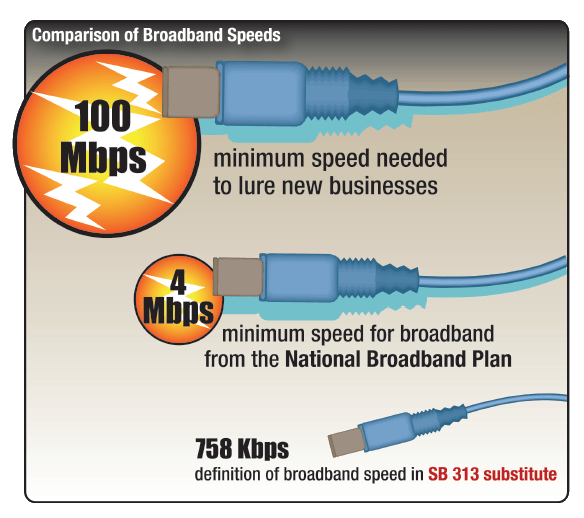
It wasn’t just the fact incumbent phone and cable companies wanted to stop community broadband projects from wiring communities they’ve ignored for years.  It wasn’t even the absurdity of the bill defining Georgia’s “broadband” speeds at just 200kbps (later ‘generously’ amended and increased to 758kbps).  This bill died because of consumer and community outrage — local officials working hand in hand with woefully under-served Georgians asking their elected officials why they seemed to care more about AT&T’s interests than those of the people who elected them to office.

Specious political arguments about “government/taxpayer involvement in broadband” and a sudden blitz of campaign contributions for the bill’s backers simply couldn’t overcome the reality of broadband-challenged rural Georgia.
According to the National Broadband Map, Georgia ranks 20th in the nation for broadband access. According to the forward of a report by Rich Calhoun, Program Director of the Georgia Technology Initiative, “As I traveled through the state to talk with leaders in municipalities, counties and community anchor institutions, I found that many places throughout Georgia indicated that they did not have access to affordable or sufficient broadband services. Telecommunications firms who have made significant investments in Georgia indicated that in some areas of the state the return on investment would not qualify for further investment at the present time.”

As Stop the Cap! exposed to our readers, AT&T isn’t interested in serving the broadband needs of rural Georgia and doesn’t want anyone else serving them either.

We exposed the well-financed propaganda campaign that maligned some of Georgia’s past experiences with municipal broadband, many projects derailed not by government ‘failure’ but through political interference and the private sector.  We showed readers how to follow the money to see the connection between campaign contributions and the sudden interest in effectively banning community broadband.  We exposed the fact this is a coordinated, nationwide effort by a corporate backed lobbying group (ALEC) that pays to wine and dine lawmakers and then sell them on a catalog of bills ghost-written by some of the nation’s largest telecommunications companies.  Legislation that hamstrings competition and protects monopoly profits, while always conveniently exempting incumbent providers from the terms of the bills they effectively wrote.

But the real victory goes to readers who picked up the phone or sent e-mail letting Georgia legislators know you were watching them and paying attention to this obvious corporate welfare bill.  You made it more expensive for lawmakers to vote with AT&T, despite their campaign contributions, than to vote for -your- interests.  The next election is never too far away.

Why We Fight: These are the minimum speeds needed by some of Georgia's most important institutions. While state lawmakers have 100Mbps access in Atlanta, some are content to define 758kbps "broadband" as just fine for the rest of the state.

We also applaud the Institute for Local Self-Reliance.  Their Community Broadband Networks project was able to educate, coordinate, and rally local governments who may not have been aware their broadband future was about to be indefinitely held ransom by AT&T and Comcast.

We never underestimate AT&T’s power and money.  But they continue to underestimate us and the communities they are supposed to be serving.

Common sense prevailed in Georgia.  South Carolina may be a different story.  Their own anti-broadband measure is still alive and kicking.  We’ll be holding additional “calls to action” on this bad bill shortly.

Stay involved in the fight.  The better broadband you protect may be your own.

Verizon’s Broadband Answer for Rural America: Wireless Internet $60/Month, Up to 10GB of Usage

Verizon Wireless today introduced HomeFusion Broadband: a new service that provides high-speed in-home Internet access using the company’s 4G LTE wireless network.

Designed primarily to reach households with limited broadband options, HomeFusion will deliver download speeds of 5-12Mbps and upload speeds of 2-5Mbps. While installation will come free of charge, a one-time equipment charge of $199.99 applies.  Pricing is nearly identical to Verizon’s mobile broadband service:

  • Up to 10GB — $60/month
  • Up to 20GB — $90/ month
  • Up to 30GB — $120/month
  • Overlimit fee: $10/GB

Verizon's 4G LTE antenna must be mounted on an outside wall of your home to assure good reception. (Picture: The Verge)

Verizon says HomeFusion is their broadband answer for rural America.

“HomeFusion Broadband is just one of the new products and services that is made possible with our 4G LTE network,” said Tami Erwin, vice president and chief marketing officer, Verizon Wireless. “Customers want to connect more and more devices in their homes to the Internet, and HomeFusion Broadband gives them a simple, fast and effective way to bring the most advanced wireless connection from Verizon into their homes.”

A third party company, Asurion, will handle installation of Verizon’s cylinder-shaped antenna, installed on the side of a customer’s home.  The antenna is designed to pick up the best possible signal from Verizon’s growing 4G network.  The antenna transmits the signal to a company supplied router capable of connecting up to four wired and 20 wireless devices.

HomeFusion Broadband will be available beginning later this month in Birmingham, Ala., Dallas and Nashville, Tenn., with additional markets to follow.

Verizon’s product is unlikely to attract substantial interest in more populated areas where a 10GB monthly usage cap would prove unacceptable in many homes where multimedia content is a growing part of the Internet experience.  But is could compete with satellite broadband, which also has low monthly usage caps.  Verizon may also win back customers in service areas it sold to independent providers like FairPoint and Frontier Communications, which have since saddled most of their rural customers with 1-3Mbps DSL service.  But Verizon’s pricing puts rural America at a usage disadvantage because of the low monthly limits and higher price tag.

The development of HomeFusion could reduce Verizon’s investment and interest in further expanding its traditional rural broadband product — DSL.  But Verizon will have to expand its still-urban focused LTE 4G network further into the countryside for HomeFusion to serve its intended market.

Updated for 2013: Getting a Better Deal from Time Warner Cable… Five Minutes to Save Almost $700

Readers: Please find our 2015 Guide to Getting a Better Deal from Time Warner Cable here. You will find the latest negotiating strategies and deal information in that updated article. 

Time Warner Cable just won’t let you say goodbye, if they can help it.

A year ago, your editor fought for a better deal from the cable company that has served him since the 1980s.  With a tough economy and downsizing, paying a cable bill that was approaching $175 a month in early 2011 for ‘all their best’ was simply no longer an option.  Time Warner Cable’s customer retentions office responded with a promotion that slashed the bill to just $88.44 for Turbo Internet, cable-TV, and unlimited “digital phone” service with nationwide calling.  Incidental charges included leasing a whole house DVR ($7.04), a second cable box ($6.84), $1 for “digital programming” and $0.34 for the remote control.

When the cable operator introduced DOCSIS 3 broadband speed upgrades, an additional $20 a month brought 30/5Mbps speeds.  The total — $123.66 (before taxes and fees).  That’s a whole lot less for a great deal more service.

When the promotion ended in February, the rate shot back up to $160, but $7.95 of that was for a year of Showtime at a special promotional price.  Showtime was destined for the cancel corner anyway (we didn’t watch more than two hours of anything on Showtime in the last year), but even without it, the rate increase was on the steep side.

So we complained.

Unlike last year, which resulted in considerable confusion and arguing back and forth with different representatives to find the best deal, this year we let Time Warner’s social media representatives do the hard work for us.  Within 24 hours, our rate for all of the same services, plus a special promotion that includes HBO, Cinemax, Showtime, and The Movie Channel at no additional charge, brought the bill down even lower than we managed last year: $102.33 a month for a year.  That includes the 30/5Mbps Road Runner Extreme, Whole House DVR, and one extra cable box.  It doesn’t include taxes and fees, which typically add another $6.50 to the bill.

The whole process was painless, and you can follow in our footsteps if you have a Twitter account:

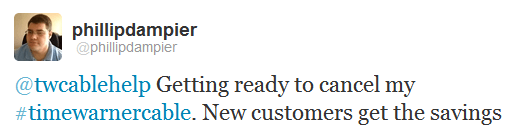
Step One: Tweet Time Warner (Note the Twitter address has changed from @twcablehelp to @TWC_help):

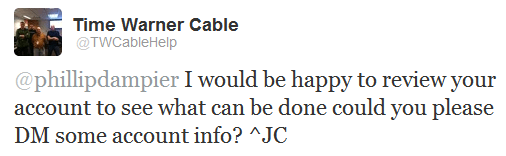
The key phrase in whatever Tweet you send is to include: @TWC_help, which brings you to their social media customer service representatives.  I also “followed” @TWC_help so I could see how active they were.  During business hours, you should expect to see a reply like this within the hour:

For those new to Twitter, “DM” refers to a “direct message” — a private Tweet seen only by the intended recipient.  I finally found the menu option that allows me to send a “direct message” on Twitter’s page for Time Warner Cable:

Note the red box around the option on the top right.  By clicking that you will see a drop down menu that includes an option to “Direct Message” TWC_help.  You will want to include your Time Warner Cable account number (as seen on your bill) and include your contact phone number.

Within 24-48 hours, a senior retentions specialist should call you to negotiate a better offer for your service.  Make sure you answer those unfamiliar caller ID calls!  But before they call, visit Time Warner Cable’s website and note any currently running new customer promotions.  Also check to see if the competition is offering anything even lower.  Those prices are typically the starting point for your negotiations, and the company should have little trouble meeting them.  However, customers with a poor payment record or past due account may discover the company less willing to negotiate.  Bring account balances current before negotiating for a lower rate.

Some Time Warner Cable territories offer “price protection agreements” or term contracts that lock customers into 1-2 years of service.  Negotiating around these contracts can be difficult to impossible.

An alternative contact method is to direct e-mail Time Warner at: [email protected] (don’t forget the “.” in twcable.help).

The total time spent this year on finding a better deal that will save us $58 a month — $696 a year — about five minutes, far less than the time it took to write this article.  Give it a try and let us know in the comments what kind of deals you can negotiate.

Mobile Phone Companies Seek to Curtail Free Text/Calling Alternatives

Phillip Dampier February 29, 2012 Competition, Consumer News, Wireless Broadband Comments Off on Mobile Phone Companies Seek to Curtail Free Text/Calling Alternatives

As wireless carriers watch their revenues from texting and calling begin to decline as consumers increasingly turn to third-party applications that offer free alternatives, some companies are striking back.

Vodafone Group (part owner of Verizon Wireless) and Deutsche Telekom (owner of T-Mobile USA) are introducing new instant messaging applications this summer that will directly confront free services offered by Google and third party providers like WhatsApp.

Operators have already lost nearly $14 billion is text/SMS revenue in 2011 as subscribers shut off lucrative texting and messaging plans, according to Ovum, a mobile market researcher.

The companies blame messaging competitors like WhatsApp, Apple and Skype for the loss of that revenue and will confront them with the launch of Joyn, a new service that will offer a suite of features such as instant messaging and video-calling.  Joyn will quickly achieve prominence as carriers intend to automatically install the application on smartphones as the service launches.

Joyn will first be offered in Spain and Germany, and possibly also eastern Europe.  But providers expect to expand the service to North America if the initial launch is successful.

In Europe, Vodafone already bans Skype calls that travel over the company’s data network unless customers pay an additional charge.  Deutsche Telekom blocks these external services for customers in the United Kingdom altogether.  In the United States, Verizon Wireless routes domestic Skype calls over Verizon’s network.

KPN, the largest mobile phone company in the Netherlands, summed up providers’ attitudes about third-party apps and services bypassing the company’s own services by raising rates on smartphone customers to win back the revenue they lost.

“You can’t just have free services,” Deutsche Telekom’s Kobus Smit told Bloomberg News. “Because who is going to pay for it.”

Cablevision Capitulates on New Customer Promos; Verizon FiOS’ Price Slashing Really Hurt

Phillip Dampier February 28, 2012 Broadband Speed, Cablevision (see Altice USA), Competition, Consumer News Comments Off on Cablevision Capitulates on New Customer Promos; Verizon FiOS’ Price Slashing Really Hurt

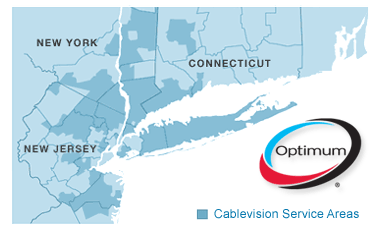
The cable company best known for serving suburban New York City.

Cablevision Industries has cried “uncle” in light of relentlessly aggressive competition from Verizon Communications, which offers its fiber to the home FiOS service in much of the cable operator’s service area.

Cablevision’s 4th quarter and year-end financial results, reported earlier today, are underwhelming investors.  Cablevision executives warned the company will have lower cash flow in 2012 due to increased investments in set-top boxes, network upgrades, and more importantly — no planned subscriber rate increases this year.

Some highlights:

Video – Losing Customers Like Everyone Else: Cablevision lost 14,000 video customers in the last quarter, many to Verizon FiOS and ongoing cord-cutting.  Analysts expected just 9,000 defections.  Cablevision will soon launch both HBO and Max Go online video for their customers nationwide.  Additional on-demand video options, online and off, are also anticipated.

Broadband – Cablevision finally admitted its own network was responsible for last year’s faltering broadband speeds that delivered poor marks in ongoing FCC speed tests.  The company originally denied the speed test results were accurate.  Today CEO James Dolan told investors the company invested in its broadband network to improve speeds and service.  Cablevision feels strongly it must compete effectively with Verizon to survive.  The company added 20,000 high-speed data customers and 31,000 phone subscribers in the quarter.  The company is doing well allowing customers easy access to broadband speed upgrades.

Wi-Fi – Cablevision sees strong value in its wireless broadband network as customers increasingly take their content mobile and need connectivity to the web.

Upgrades – CEO Jim Dolan said 2012 will be “a year of investment” in Cablevision upgrades and improvements.  The company is even accelerating projects originally envisioned for 2013.  Cablevision will continue to expand its “next day” installation offer across the eastern United States by the end of the first quarter.

Promotions – The escalating war of promotions between Verizon and Cablevision are likely to cease as Cablevision yanks their most aggressive new customer offers.  Earlier this year, Verizon was pitching a two year triple play offer that included an incredible $500 prepaid card rebate as part of the promotion.  “I don’t think you’ll see those [low introductory rates from Cablevision] again ever,” said Dolan.

“The main theme that people should take away from the call today is that we continue to be focused on moving the business in a direction where we both retain existing subscribers and have attractive, economically sensible offers for new subscribers,” said Cablevision chief financial officer Gregg Seibert.

Search This Site:

Contributions:

Recent Comments:

Your Account:

Stop the Cap!