Bell Canada Enterprises, Inc. announced Monday it extended its Fibe Internet and television service to most parts of Quebec City.
Unlike in most other Fibe-enabled Canadian cities, Bell’s network in Quebec City offers true fiber to the home service, not a combination of fiber to the neighborhood/copper wire. That means increased broadband speeds — downloads up to 175Mbps and uploads of up to 30Mbps. Quebec City was selected for true fiber service because of of the predominance of overhead aerial wiring, which is much easier and cheaper to replace with fiber than underground wiring. For other major Canadian cities like Montreal and Toronto, Bell has made do with a lesser network that combines fiber and existing copper phone wiring that offers lower capacity for broadband and video services.
Bell says Fibe is now open for business in the region’s boroughs of Quebec, Beauport, Sillery, Ste-Foy, Cap-Rouge, Charlesbourg, L’Ancienne-Lorette, Loretteville, Sainte-Therese-de-Lisieux and Montmorency. Service for Levis is expected shortly.
The company says it intends to reserve additional fiber to the home service primarily for multi-dwelling units and new housing developments in Ontario and Quebec, primarily between Windsor in the west and Quebec City in the east.
The company’s aggressive deployment of fiber is an effort to stem landline losses in eastern Canada. Between cell phone providers and cable companies like Rogers, Cogeco, and Quebecor’s Vidéotron Ltee., Canadians have been hanging up permanently on Bell landlines at an alarming rate for the company.
Dvai Ghose, analyst at Canaccord Genuity told his clients, “Bell is now reporting amongst the worst residential line losses in North America.” In the last quarter alone, 90,000 Bell customers said goodbye, perhaps permanently.
Bell has lost more than 1.2 million customers in the last two years. Even Fibe may not be enough to stem the losses. Canadians are not excited by the company’s video or broadband services, adding only around 27,000 new customers in the last quarter. Bell’s notorious love of Internet Overcharging schemes like usage caps may be partly responsible. The company enjoys a poor reputation among Internet enthusiasts for its wholehearted support for usage-limiting Canada’s online experience.
Financial analysts believe aggressive deployment of Fibe may be critical to the company’s long term survival. Not only must Bell compete with a trend towards wireless phones, it has cable competitors selling triple play packages of phone, Internet and television service at prices that are frequently lower than what Bell charges.
Fibe is expected to be expanded to include the entire island of Montreal and some of the surrounding region by the end of 2012.
[flv width=”640″ height=”380″]http://www.phillipdampier.com/video/Bell Entertainment Fibre Internet and TV in Canada.flv[/flv]
An extended length introductory commercial for Bell Canada’s Fibe TV and Internet. (6 minutes)
[Stop the Cap! has written extensively about the pervasive influence some of the nation’s largest cable and phone companies have on telecommunications legislation in this country. On the state level, one group above all others is responsible for quietly getting company-ghost-written bills and resolutions into the hands of state lawmakers to introduce as their own.]
The American Legislative Exchange Council (ALEC) is the latest corporate response to campaign finance and lobbying reform — a Washington, D.C.-based “middle man” that brings lawmakers and corporate interests together while obfuscating the obvious conflict of interest to voters back home if they realized what was going on.
ALEC focuses on state laws its corporate members detest because, in many cases, they represent the only regulatory obstacles left after more than two decades of deregulatory fervor on the federal level. State lawmakers are ALEC’s targets — officeholders unaccustomed to a multi-million dollar influence operation. The group invites lawmakers to participate in policy sessions that equally balance corporate executives on one side with elected officials on the other. Consumers are not invited to participate.
ALEC’s telecom members have several agendas on the state level, mostly repealing:
Local franchising and oversight of cable television service;
Statewide oversight of the quality of service and measuring the reliability of phone and cable operators;
Consumer protection laws, including those that offer customers a third party contact for unresolved service problems;
Universal service requirements that insist all customers in a geographic region be permitted to receive service;
Funding support for public, educational, and government access television channels;
Rules governing the eventual termination of essential service for non/past due payments;
Local zoning requirements and licensing of outside work.
But ALEC is not always focused on deregulation or “smaller government.” In fact, many of its clients want new legislation that is designed to protect their position of incumbency or enhance profits. Cable and phone company-written bills that restrict or ban public broadband networks are introduced to lawmakers through ALEC-sponsored events. In several cases, model legislation that was developed by cable and phone companies was used as a template for nearly-identical bills introduced in several states without disclosing who actually authored the original bill.
ALEC specializes in secrecy, rarely granting interviews or talking about the corporations that pay tens of thousands of dollars to belong. Corporate members also enjoy full veto rights over any proposal or idea not to their liking, and aborted resolutions or legislative proposals are kept completely confidential. More often than not, however, legislators and corporate members come to an agreement on something, and the end product ends up in a central database of model bills and resolutions ready to be introduced in any of 50 state legislatures.
Many do, and often these proposed bills are remarkably similar, if not identical. That proved to be no coincidence. In July 2011, the Center for Media and Democracy was able to obtain a complete copy of ALEC’s master database of proposed legislation. The Center called it a stark example of “corporate collaboration reshaping our democracy, state by state.”
National Public Radio takes an inside look at the American Legislative Exchange Council and how it works to help major corporations influence and change state laws. (October 29, 2010) (8 minutes)
You must remain on this page to hear the clip, or you can download the clip and listen later.
ALEC’s Corporate Telecom Members
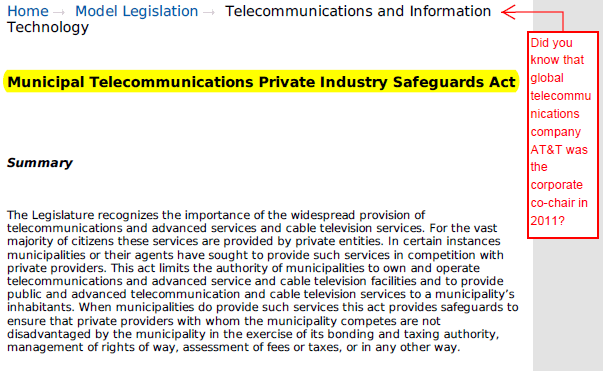
ALEC defends itself saying it does not directly lobby any legislator. That is, in fact true. But many of its corporate members clearly do. AT&T is one of ALEC’s most high profile members, serving as a “Private Enterprise Board” member, state corporate co-chair of Arkansas, California, Connecticut, Louisiana, Mississippi, and Texas (all AT&T service areas), a member of the Telecommunications and Information Technology Task force, and “Chairman” level sponsor of the 2011 ALEC Annual Conference (a privilege for those contributing $50,000).
AT&T’s lobbying is legendary, and is backed with enormous campaign contributions to legislators on the state and federal level.
CenturyLink (also including Qwest Communications), “Director” level sponsor of 2011 ALEC Annual Conference ($10,000 in 2010)
Cincinnati Bell
Comcast, State corporate co-chair of Georgia, Minnesota, Missouri and Utah and recipient of ALEC’s 2011 State Chair of the Year Award
Cox Communications, “Trustee” level sponsor of 2011 ALEC Annual Conference ($5,000 in 2010)
Time Warner Cable, State corporate co-chair of Ohio, “Director” level sponsor of 2011 ALEC Annual Conference ($10,000 in 2010)
Verizon Communications, Private Enterprise Board member and State corporate co-chair of Virginia and Wyoming
ALEC supporters among trade groups and astroturf/corporate-influenced “non profits”:
National Cable and Telecommunications Association, ALEC Telecommunications and Information Technology Task Force member
Free State Foundation (think tank promoting limited government and rule of law principles in telecommunications and information technology policy)
Heartland Institute, Exhibitor at ALEC’s 2011 Annual Conference, Telecommunications and Information Technology Task Force member, Education Task Force member, Commerce, Insurance and Economic Development Task Force, Financial Services Subcommittee member and Energy, Environment and Agriculture Task Force member
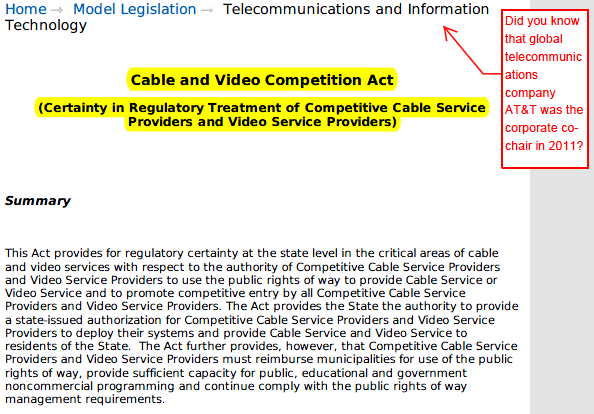
This model bill for increased cable competition strips most of the authority your community has over cable television operations and transfers it to under-funded or less aggressive state bodies. Although the bill claims to protect local oversight and community access stations, the statewide video franchise fee almost always destroys the funding model for public, educational, and government access channels.
These municipal broadband bills are always written to suggest community and private players must share a "level playing field." But bills like these always exempt the companies that actually wrote the bill, and micromanage and limit the business operations of the community provider.
Legislators: Bring the family to Mardi Gras World on us, sponsored by America's largest telecommunications companies.
WHYY Philadelphia’s ‘Fresh Air’ spent a half hour exploring who really writes the legislation introduced in state legislatures. When ALEC gets involved, The Nation reporter John Nichols thinks the agenda is clear: “All of those pieces of legislation and those resolutions really err toward a goal, and that goal is the advancement of an agenda that seems to be dictated at almost every turn by multinational corporations.” (July 21, 2011) (32 minutes)
You must remain on this page to hear the clip, or you can download the clip and listen later.
Unfortunately, state lawmakers are not always sophisticated enough to recognize a carefully crafted legislative agenda at work. National Public Radio found one excellent example — the 2010 Arizona immigration law that requires police to arrest anyone who cannot prove they entered the country legally when asked. America’s immigration problems remain a major topic on the agenda at some ALEC events, curious for a corporate-backed group until you realize one of ALEC’s members — the Corrections Corporation of America — America’s largest private prison operator, stood to earn millions providing incarceration services for what some estimated could be tens, if not hundreds of thousands of new prisoners being held on suspicion of immigration violations.
CCA was in the room when the model immigration legislation, eventually adopted by Arizona’s legislature, was written at an ALEC conference in 2009.
Bring the Kids, Stay for the Corporate Influence
Getting legislators to attend these seminars isn’t as hard as it might sound.
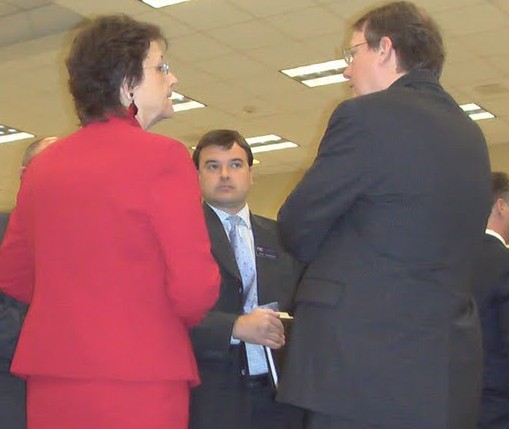
In January, we reported members of the North Carolina General Assembly, who showed their willingness to support telecom industry-written bills when it passed an anti-community broadband initiative in 2011, were wined and dined (along with their staff) by ALEC at the Mardi Gras World celebration in New Orleans. Rep. Marilyn Avila (R-Time Warner Cable), who introduced the aforementioned measure, brought her husband to Asheville to enjoy a special weekend as the featured guest speaker at a dinner sponsored by North Carolina’s state cable lobbying group:
The North Carolina Cable Telecommunications Association reported they not only picked up Marilyn’s food and bar bill ($290 for the Aug. 6-8 event), they also covered her husband Alex, too. Alex either ate and drank less than Marilyn, or chose cheaper items from the menu, because his food tab came to just $185.50. The cable lobby also picked up the Avila’s $471 hotel bill, and handed Alex another $99 in walking-around money to go and entertain himself during the weekend event. The total bill, effectively covered by the state’s cable subscribers: $1,045.50.
Rep. Avila with Marc Trathen, Time Warner Cable's top lobbyist (right) Photo by: Bob Sepe of Action Audits
ALEC makes it easy because it pays the way for lawmakers and families to attend their events through the award of “scholarships”:
The organization encourages state lawmakers to bring their families. Corporations sponsor golf tournaments on the side and throw parties at night, according to interviews and records obtained by NPR.
[…] Videos and photos from one recent ALEC conference show banquets, open bar parties and baseball games — all hosted by corporations. Tax records show the group spent $138,000 to keep legislators’ children entertained for the week.
But the legislators don’t have to declare these as corporate gifts.
Consider this: If a corporation hosts a party or baseball game and legislators attend, most states require the lawmakers to say where they went and who paid. In this case though, legislators can just say they went to ALEC’s conference. They don’t have to declare which corporations sponsored these events.
Reporter John Nichols told NPR ALEC’s focus on state politics is smart:
“We live at the local and state level. That’s where human beings come into contact more often than not,” he says. “We live today in a country where there’s a Washington obsession, particularly by the media but also by the political class. … And yet, in most areas, it’s not Washington that dictates the outlines, the parameters of our life. … And so if you come in at the state government level, you have a much greater ability to define how you’re going to operate.”
Resources:
ALEC Exposed: Access a database of more than 800 corporate ghost-written bills and resolutions intended to become state law in all 50 states. Sponsored by the Center for Media and Democracy.
ALEC’s Database Revealed: A more general indictment of ALEC and its coordinated agenda to allow corporate influence to hold an increasing role in public policy.
Fibrant, a community-owned fiber-to-the-home provider in Salisbury, N.C., has discovered the importance of redundancy. A major service outage knocked out phone and broadband service for several hours Monday, due to a fiber cut between Concord and Salisbury. Fibrant’s provider, DukeNet, restored service after four and half hours by rerouting around the cable cut, but the incident left Fibrant looking for a backup provider to reduce the chance such a service outage will occur again.
City Manager Doug Paris, who was instrumental in getting Fibrant up and running in Salisbury, said the incident underlined the need to have redundancy to keep customers online. While the city asks DukeNet for an explanation of the most recent service outage, Salisbury is taking bids for backup service.
Redundancy is a lesson virtually every service provider learns — commercial or otherwise. What company has not suffered a significant service outage from an errant backhoe or construction crew severing a vital fiber link? Without a backup provider, service fails and customers howl. Those companies experiencing multiple outages soon learn having a second provider can keep service disruptions to a minimum and more importantly make them invisible to customers.
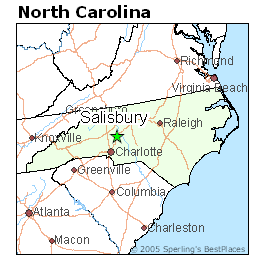
Salisbury is located northeast of the city of Charlotte, N.C.
Paris told the Salisbury Post the city’s intent to contract with a second supplier has its benefits. A large educational institution has now signed up for service, with several potential new business customers considering Fibrant as well.
Fibrant has won a 13% market share in Salisbury, supplying phone, Internet, and cable TV to more than 1,700 customers. Fibrant offers the fastest broadband service in the city and competes primarily with Time Warner Cable. It also faces perennial opposition from anti “government broadband” critics, many nipping at the provider for political reasons.
Opponent John Bare has compared Fibrant to welfare, opposing it because it is not operated by the private sector.
But Fibrant has kept its competitors on their toes, forcing both the local cable and phone company to offer cut-rate deals for new customers and those threatening to switch. Those low prices and retention deals have cut into Fibrant’s projected share of business in the community, but city officials note the customers who do sign up stay with the provider. Fibrant has a 99% customer retention rate.
Fibrant’s biggest challenge remains its start up costs and debt. The provider spends nearly $1,350 for each residential installation, for which it charges customers nothing unless they depart within a year of signing up. Fibrant recoups installation and network construction costs from customers over time. But the company does have plans to more aggressively market its service to Salisbury’s 34,000 residents in light of competitive offers from cable and phone companies. Fibrant manages to win around 30 new customers a week.
Salisbury’s fiber network does not pitch customers “teaser rates” that rise considerably after the promotion expires. It prefers to market its superior speeds and service, and notes all of the revenue earned by Fibrant stays in the local community instead of being pocketed by Wall Street banks and investors.
Phillip DampierMarch 13, 2012Comcast/Xfinity, Competition, Consumer NewsComments Off on Comcast Tries to Sell Customer Phone Service While He Reports a Service Outage
Rick Munarriz has a bone to pick with Comcast after discovering his cable television and broadband service was out of commission. It was the fourth prolonged outage in four weeks. But the Comcast customer of more than a dozen years was surprised when he called the cable company and they immediately tried to sell him Comcast’s “digital phone” service:
[…] An otherwise cordial representative tells me that he’s looking into my account. I could save some serious money if I switch my landline to Comcast’s XFINITY Voice offering.
“If I did that, how would I be reporting this outage?” I asked.
“Don’t you have a smartphone?” he responds, not realizing that he has just killed his own sales pitch.
Who needs a landline when you have a wireless phone? Who needs a Comcast triple play — especially when I’m already dealing with two outs?
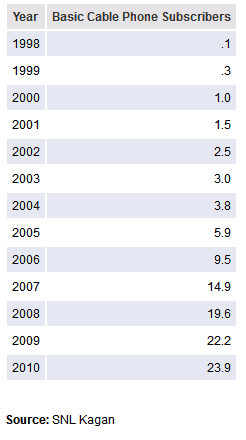
Although not losing customers as fast as traditional landline phone companies, cable-delivered phone service is no longer growing as fast as it once did. Most companies picking up “digital phone” customers are winning them these days from product bundling, with aggressively priced triple-play packages of phone, Internet, and cable service. Many of these packages include the phone line for less than $10 a month more than a double-play package of Internet and cable-TV.
SNL Kagan collects statistics from cable operators who pitch phone service and documents the highest growth in cable-provided phone service came during 2004-2009. Now that growth has slowed. Customers who were willing cut their landline phone off in favor of a cell phone don’t need wired phone service from the cable company either.
It seems Comcast is willing to admit the same, even when pitching its own phone product.
Sen. Linda Runbeck, a dues-paying member of ALEC, a corporate funded pressure group that advocates for legislation advantageous to ALEC's corporate sponsors.
Rural Minnesota is facing a full frontal assault on community broadband, courtesy of a state representative so proud of her involvement in a corporate front group, she’s actually a dues-paying member.
State Sen. Linda Runbeck (R-Circle Pines) introduced HF 2695, a bill to prohibit publicly-owned broadband systems:
A bill for an act relating to telecommunications; prohibiting publicly owned broadband systems; proposing coding for new law in Minnesota Statutes, chapter 237.
BE IT ENACTED BY THE LEGISLATURE OF THE STATE OF MINNESOTA: Section 1. [237.201] PUBLICLY OWNED BROADBAND SYSTEM; PROHIBITION.
(a) Notwithstanding section 475.58, subdivision 1, other state law, county ordinance, or any authority granted in a home rule charter, a city or a county may not use tax revenues raised within its jurisdiction or issue debt to construct, acquire, own, or operate, in whole or in part, a system to deliver broadband service.
(b) Notwithstanding sections 123A.21, 123B.61 to 123B.63, 125B.26, and 475.58, subdivision 1, no school district or service cooperative may use state revenues, tax revenues raised within its jurisdiction, or issue debt to construct, acquire, own, or operate, in whole or in part, a system to deliver broadband service.
(c) For the purposes of this section, “broadband service” means a service that allows subscribers to access information from the Internet by means of a physical, terrestrial, non-mobile, or fixed wireless technology.
(d) This section applies to a system to deliver broadband service whose construction begins after the effective date of this section, but does not apply to:
the city of Minneapolis, St. Paul, or Duluth; or
the maintenance or repair of a system delivering broadband service whose initial construction began before the effective date of this section, provided that the geographical area in which the system delivers broadband service is not expanded as a result of the maintenance or repair.
EFFECTIVE DATE. This section is effective the day following final enactment.
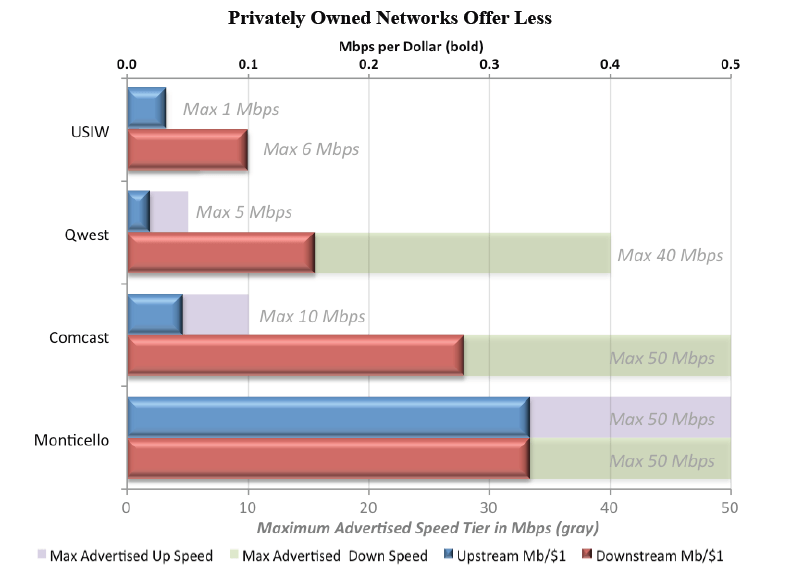
The public broadband option delivers the most bang for the buck, which is why some providers want to see it banned.
Runbeck is a dues-paying member of the American Legislative Exchange Council (ALEC), a secretive corporate front group that lobbies lawmakers to introduce business-friendly legislation, often on the state level. Runbeck told the Minnesota Independent via email that she paid $100 for a two-year membership in the organization, and says she’s never used ALEC’s “model legislation,” bills that are sometimes written by corporate members of the group and that pop up in state capitols across the country.
But Runbeck’s sudden interest in banning community broadband coincides with similar efforts in states like Georgia and South Carolina backed by big cable and phone companies. Runbeck’s bill would directly target rural Minnesota, where broadband is the least robust, while exempting Minneapolis, St. Paul, and Duluth (and incumbent phone and cable companies) from the bill’s provisions. Runbeck’s bill also constrains existing public broadband services from expanding, an important matter for providers still rolling out service to additional neighborhoods in their communities.
Community broadband is already hampered in Minnesota by laws that make such projects difficult to approve and build. When projects do break ground, incumbent providers do everything possible to throw up roadblocks to delay or abort the progress being made. In Monticello, TDS Telecom filed nuisance suits against that city’s public broadband network before finally deciding to upgrade service themselves. Mediacom and Charter, two major Minnesota cable operators, have objected to public broadband projects that don’t even serve communities they’ve wired.
When the networks are in operation, providers like Charter work to undercut them by selling service at prices so low, they’re predatory. But when competitors are driven out, prices rise… quickly.
Runbeck’s $100 membership in ALEC is paying dividends, if you are a big incumbent cable or phone company. Consumers will pay much more than that if broadband competition is curtailed.
Be Sure to Read Part One: Astroturf Overload — Broadband for America = One Giant Industry Front Group for an important introduction to what this super-sized industry front group is all about. Members of Broadband for America Red: A company or group actively engaging in anti-consumer lobbying, opposes Net Neutrality, supports Internet Overcharging, belongs to […]
Astroturf: One of the underhanded tactics increasingly being used by telecom companies is “Astroturf lobbying” – creating front groups that try to mimic true grassroots, but that are all about corporate money, not citizen power. Astroturf lobbying is hardly a new approach. Senator Lloyd Bentsen is credited with coining the term in the 1980s to […]
Hong Kong remains bullish on broadband. Despite the economic downturn, City Telecom continues to invest millions in constructing one of Hong Kong’s largest fiber optic broadband networks, providing fiber to the home connections to residents. City Telecom’s HK Broadband service relies on an all-fiber optic network, and has been dubbed “the Verizon FiOS of Hong […]
BendBroadband, a small provider serving central Oregon, breathlessly announced the imminent launch of new higher speed broadband service for its customers after completing an upgrade to DOCSIS 3. Along with the launch announcement came a new logo of a sprinting dog the company attaches its new tagline to: “We’re the local dog. We better be […]
Stop the Cap! reader Rick has been educating me about some of the new-found aggression by Shaw Communications, one of western Canada’s largest telecommunications companies, in expanding its business reach across Canada. Woe to those who get in the way. Novus Entertainment is already familiar with this story. As Stop the Cap! reported previously, Shaw […]
The Canadian Radio-television Telecommunications Commission, the Canadian equivalent of the Federal Communications Commission in Washington, may be forced to consider American broadband policy before defining Net Neutrality and its role in Canadian broadband, according to an article published today in The Globe & Mail. [FCC Chairman Julius Genachowski’s] proposal – to codify and enforce some […]
In March 2000, two cable magnates sat down for the cable industry equivalent of My Dinner With Andre. Fine wine, beautiful table linens, an exquisite meal, and a Monopoly board with pieces swapped back and forth representing hundreds of thousands of Canadian consumers. Ted Rogers and Jim Shaw drew a line on the western Ontario […]
Just like FairPoint Communications, the Towering Inferno of phone companies haunting New England, Frontier Communications is making a whole lot of promises to state regulators and consumers, if they’ll only support the deal to transfer ownership of phone service from Verizon to them. This time, Frontier is issuing a self-serving press release touting their investment […]
I see it took all of five minutes for George Ou and his friends at Digital Society to be swayed by the tunnel vision myopia of last week’s latest effort to justify Internet Overcharging schemes. Until recently, I’ve always rationalized my distain for smaller usage caps by ignoring the fact that I’m being subsidized by […]
In 2007, we took our first major trip away from western New York in 20 years and spent two weeks an hour away from Calgary, Alberta. After two weeks in Kananaskis Country, Banff, Calgary, and other spots all over southern Alberta, we came away with the Good, the Bad, and the Ugly: The Good Alberta […]
A federal appeals court in Washington has struck down, for a second time, a rulemaking by the Federal Communications Commission to limit the size of the nation’s largest cable operators to 30% of the nation’s pay television marketplace, calling the rule “arbitrary and capricious.” The 30% rule, designed to keep no single company from controlling […]
Less than half of Americans surveyed by PC Magazine report they are very satisfied with the broadband speed delivered by their Internet service provider. PC Magazine released a comprehensive study this month on speed, provider satisfaction, and consumer opinions about the state of broadband in their community. The publisher sampled more than 17,000 participants, checking […]


 Subscribe
 Bell Canada Enterprises, Inc. announced Monday it extended its Fibe Internet and television service to most parts of Quebec City.
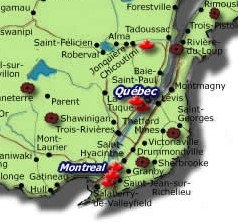 The company says it intends to reserve additional fiber to the home service primarily for multi-dwelling units and new housing developments in Ontario and Quebec, primarily between Windsor in the west and Quebec City in the east.