Home » Competition » Recent Articles:

Rep. Walden’s “Less is More” Rant About FCC Speaks Volumes About His Contributors

Phillip Dampier March 27, 2012 Competition, Editorial & Site News, Net Neutrality, Public Policy & Gov't Comments Off on Rep. Walden’s “Less is More” Rant About FCC Speaks Volumes About His Contributors

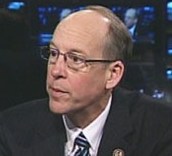
Walden

When lawmakers talk about “unleashing” anything for “innovation,” it’s a safe bet we’re about to be treated to an anti-regulatory rant about how government rules are ruining everything for big business.  Rep. Greg Walden (R-Ore.) does not disappoint.

Walden is chairman of the Communications and Technology Subcommittee of the House Energy and Commerce Committee, an important place to be if you want to influence telecommunications policy in the United States.  Walden slammed the Federal Communications Commission this morning in an editorial piece in Politico, accusing the agency of regulating communications companies before they have a chance to engage in bad behavior:

Sometimes the FCC acts before thoroughly examining whether regulation is needed. It’s now time to stop putting the regulatory cart before the horse. That’s why this bill requires the FCC to survey the marketplace, identify a failure and conduct a cost-benefit analysis before imposing rules.

[…] When the FCC reviews a merger, it now often imposes unrelated conditions. These extraneous agreements may not correspond to any harm presented by the transaction, may not be justified industry-wide and, in some cases, are outside the commission’s jurisdiction.

Such bootstrapping is unfair to the singled-out parties. It also results in poor policy. Imposing extraneous conditions on a transaction that is not otherwise harmful is inappropriate. And if a transaction is harmful, imposing extraneous conditions cannot cure it. Merger conditions should be directly related to transaction-specific harms, and within the FCC’s general authority.

Walden’s concerns coincide with the corporate agendas of some of the nation’s largest telecommunications companies he oversees as chairman.  That may not be surprising, considering seven of the top 10 corporate contributors to his campaign fund are all telecommunications companies.
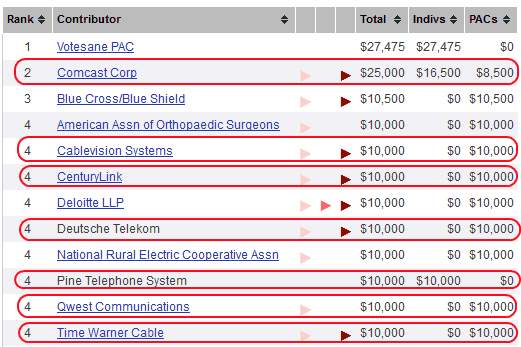
Walden's top campaign contributors (Source: Opensecrets.org)

Walden’s record on “innovation” is open to interpretation.  He is on record opposing Net Neutrality, has sought to “streamline” the FCC by hamstringing its authority, and has favored a variety of mergers and acquisitions that have effectively reduced competition for American consumers.

The FCC’s zeal for increased competition appears occasionally in its rulemakings, although the agency under Chairman Julius Genachowski can hardly be considered aggressive and out of control when it comes to some of the most contentious telecom issues that have arisen during the Obama Administration.  It only followed the Justice Department’s lead opposing the AT&T/T-Mobile USA merger.  It punted on Net Neutrality enforcement, doesn’t oppose Internet Overcharging, and has granted more mergers and acquisitions than it has sought to block.

FCC Chairman Julius Genachowski has not always successfully stared down industry efforts to consolidate and deregulate.

Some examples of “unrelated conditions” the FCC has imposed on mergers include no price hikes for consumers for a limited time (Sirius-XM), a discounted Internet service for poor families (Comcast-NBC Universal), and spinoffs of acquired cellular network assets in barely competitive markets (Verizon Wireless-Alltel).

Sirius-XM mostly kept to their agreement, but promptly raised prices when it expired, Comcast followed the FCC’s agreement to the letter but found ways to limit the number of qualified families, and Verizon Wireless sold some of their acquired Alltel assets to AT&T, which at least provided improved AT&T reception in certain markets they largely ignored earlier.

Consumer advocates would argue the FCC should never have approved these transactions in the first place, and the conditions the FCC imposed were so mild, they faced little opposition from the companies involved. But apparently even that is too much for Walden, who we have a hard time seeing opposing any of these mergers.  Besides, some of the largest companies donating to Walden’s campaign fund are already adept at working around the FCC, suing their way past the regulations they oppose.

Walden advocates the FCC only perform its oversight functions after the industry is proven to have imposed unfair, anti-competitive, and discriminatory policies against consumers, not to act to prevent those abuses in the first place.  In short, he wants the FCC to regulate only after the damage has been done. That would be akin to calling the fire department after your house burned to the ground. Companies would be free to walk away with their ill-gotten gains with little threat the FCC would punish bad behavior and fine the bad actors.

If you are Comcast, that is innovation.  If you are a consumer, it’s something else.
New Zippy Fast 4G iPad Burns Through AT&T/Verizon Usage Allowances in Hours

The new 4G LTE-equipped Apple iPad you picked up late last week may be burning a hole in your wallet more than you think.  Across the country, consumers are reporting shock and surprise when they discover the new, faster mobile broadband-equipped tablet is capable of blowing through AT&T and Verizon Wireless’ monthly usage caps in a matter of hours.

The culprits: online video and giant-sized app downloads.

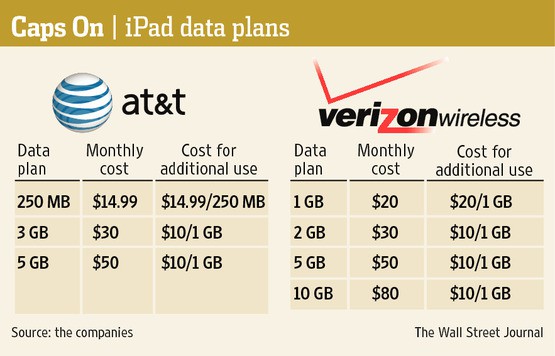
Online video on a usage-limited mobile broadband plan simply does not last long on Apple’s newest sensation.  A Wall Street Journal article found one new iPad owner discouraged after a two hour basketball game completely obliterated his 3GB usage allowance provided by AT&T.  With $10/GB overlimit fees just around the corner, AT&T is set to earn enormous data fees from customers who use their iPads to stream video.

[flv width=”512″ height=”308″]http://www.phillipdampier.com/video/WSJ New Apple iPad Eats Up Monthly Data Plans 3-21-12.flv[/flv]

The Wall Street Journal reports the newest iPad has been out for less than a week and buyers are already burning through their monthly data allowances on usage capped 4G mobile plans.  (3 minutes)

USA Today tech columnist Edward Baig also blew through his allowance in less than one day:

Less than 24 hours after purchasing the Verizon Wireless version of the iPad + 4G — and choosing a $30, 2GB monthly data plan from Verizon — I was shocked by the notification on my iPad’s screen: “There is no data remaining on your current plan.”

My remaining options for the month included changing to a $50 5GB data plan or an $80 10GB plan. (AT&T offers a 250MB plan for $14.99; 3GB for $30; and 5GB for $50.)

[…] In my case, I wasn’t watching video. What nailed me, I think, is that I was wirelessly downloading a number of the apps that I had already purchased for my older iPad onto the latest model. Those apps were made available through Apple’s iCloud.

To help avoid just this situation, the new iPad has a 50MB per app download limit on 4G. Anything over that, and you’re directed to Wi-Fi. (The over-the-air download limit on 3G-capable iPads was 20MB.) But that’s a per-app limit, and all those smaller-sized apps I was moving to the new iPad collectively added up.

Storing anything on Apple’s iCloud service or other backup storage sites like Dropbox can prove costly when relying on 4G service from AT&T and Verizon.  That’s on top of Apple’s premium price for 4G-equipped iPads, which start at $629 (comparable Wi-Fi only models are priced at $499 and above).  As a result, consumers are shutting off the wireless mobile feature they paid $130 extra to receive.

“All the advantages of the iPad device are completely neutralized by [AT&T’s] two gigabyte data limit,” Steve Wells told the Journal.

Some customers are upgrading their mobile data plans to 5GB for $50 a month, offered by both AT&T and Verizon.  Others are learning to stick to Wi-Fi.  According to a study conducted by the consulting firm Chetan Sharma, nearly 90% of tablets bought in the United States are Wi-Fi only models.  The added cost for mobile-equipped tablets and the expensive data plans that accompany them are largely responsible.

Consumer Advice:

  1. You can still leverage 4G mobile broadband speeds on a cheaper Wi-Fi-only equipped iPad if your smartphone supports the “mobile hotspot” feature. When activated, your phone becomes a Wi-Fi hotspot your iPad can connect to for wireless data. If you have an unlimited mobile hotspot plan from Verizon Wireless (now difficult to obtain unless you are grandfathered on an unlimited data plan), you are not subject to Verizon’s usage limits for mobile devices.
  2. Rely as much as possible on Wi-Fi, especially for file downloads or streamed content. Since the iPad can seamlessly switch between Wi-Fi and expensive mobile data service, protect yourself by shutting off Cellular Data within the settings menu when you don’t absolutely need to use it.
  3. Turn off LTE service when not needed. 4G consumes battery life faster and its speeds encourage the kind of increased usage that can exhaust your allowance.
  4. Monitor how much data you’ve used from the settings menu. Web browsing and e-mail will not consume a lot.  Online video and giant app downloads will.

[Thanks to our regular readers Scott and Earl for sending in several stories reporting on this.]

Apple iPad in the News:

[flv width=”360″ height=”290″]http://www.phillipdampier.com/video/Bloomberg Brown Says He Wouldnt Ditch iPad 2 for New Version 3-16-12.mp4[/flv]

Joe Brown, editor-in-chief at Gizmodo.com, talks about Apple Inc.’s new iPad, the outlook for Amazon.com Inc.’s Kindle Fire and the tablet market. Brown speaks with Jon Erlichman on Bloomberg Television’s “Bloomberg West.” (6 minutes)

[flv width=”360″ height=”290″]http://www.phillipdampier.com/video/WNYW New York Record Breaking Sales for iPad 3-19-12.mp4[/flv]

Shelly Palmer talks about the record-breaking sales numbers of the new Apple iPad. He discusses what is great and not so great about the new tablet on New York’s WNYW-TV.  (4 minutes)

[flv width=”360″ height=”290″]http://www.phillipdampier.com/video/Bloomberg Reynolds Sees No Danger Despite New IPad’s Higher Heat 3-20-12.mp4[/flv]

Paul Reynolds, electronics editor for Consumer Reports, talks about the magazine’s temperature test of Apple Inc.’s new iPad. The newest iPad runs “significantly hotter” than the earlier model when conducting processor-intensive tasks such as playing graphics-heavy games, Consumer Reports said on its website.  (9 minutes)

[flv width=”360″ height=”290″]http://www.phillipdampier.com/video/WFXT Boston New Ipad Is it Worth it 3-22-12.flv[/flv]

It’s the hottest item in the tech world – literally. WFXT in Boston also takes a look at how other tablet manufacturers are doing in competition with Apple.  (4 minutes)

HissyFitWatch: Shepard Smith Calls Time Warner Cable an Anti-American Monopoly

Phillip Dampier March 22, 2012 Competition, Consumer News, HissyFitWatch, Verizon, Video 9 Comments

[flv width=”640″ height=”380″]http://www.phillipdampier.com/video/Fox News Time Warner Cable Has a Monopoly In New York City And It’s Un-American 3-21-12.mp4[/flv]

Shepard Smith has a bone to pick with Time Warner Cable.  (1 minute)

Fox News’ Shepard Smith has the same problem lots of Americans have with telecommunications providers: he hates them.

Smith is angry again

Just a few weeks after slamming AT&T for its creative reinterpretation of the word “unlimited,” Smith is now on the warpath against Time Warner Cable for delivering lousy service to his home in Manhattan.

It all started with Smith’s alienation over reports that Apple iPad users are being advised to switch to Wi-Fi to avoid burning through their 4G mobile broadband data allowances.

“Well I would use that Wi-Fi connection if that Time Warner Cable would get over there and fix it,” Smith responded. “It’s been six weeks, I talked to ten people. They won’t fix it, and […] I’ve about had it.”

“I could scream at Time Warner until the cows come home and make new cows,” Smith added. “And nothing would still happen. Know why? Because it’s Time Warner Cable, that’s why.”

Smith is certain Time Warner Cable has a monopoly on service to his New York neighborhood, primarily because he can’t sign up for Verizon FiOS, which is only slowly becoming available in the New York metropolitan area.

“Look if they let me go and [I can get] FiOS, I’d take the FiOS with a smile and say sayonara; I don’t have that option,” Smith said. “It is a monopoly and it’s un-American and I’m done with them but I can’t get rid of them.”

Welcome to Virgin Mobile’s Higher Calling: The 2.5GB/256kbps Usage Throttle Starts Friday

Not quite.

Virgin Mobile founder Richard Branson is trying to convince customers they should sign up with a phone company that only sells you the services you need, but if “unlimited data” is one of them, look somewhere else.

Starting Friday, Virgin Mobile will quietly begin to throttle “heavy users” who reach 2.5GB of usage on their “unlimited use” data plans.  For the remainder of the billing cycle, Virgin will reduce mobile broadband speeds to just 256kbps — comparable to a significantly congested 3G connection.

It’s a long fall from Virgin Mobile’s original unlimited data offer which the company briefly attempted in the summer of 2010.

Entirely reliant on Sprint’s mobile network (and now operates as the prepaid division of Sprint), Virgin Mobile couldn’t handle the demand and quickly threatened to slow down the connections of their heaviest users.

The carrier’s decision to set a specific limit for its speed throttle was originally intended to take effect last October, but was delayed until March 23, 2012.

[flv width=”640″ height=”380″]http://www.phillipdampier.com/video/New Virgin Mobile Ad.flv[/flv]

Virgin Mobile’s delayed implementation of its speed throttle coincides with this imaging “refresh” of the “New Virgin Mobile” starring a timeless Richard Branson. (1 minute)

Virgin Mobile explains its reasons:

This change comes about because of the enormous data usage driven by our new more sophisticated smartphones, and the more extensive uses customers are finding for these devices.  We want to be able to serve our Beyond Talk customers who use these unlimited plans for their data-centric daily activity, primarily for regular access to email, the Internet, and social networking sites. Our goal is to ensure our products perform at the best possible level and that we have the best possible experience for all subscribers.  These control options are similar to those other carriers have in place ? and that Virgin Mobile maintains for its Broadband2Go product as well.

These plans are still unlimited.  There is no cap or limit on how much you can consume in any given month.  In order to ensure optimal network performance and a good customer experience for all subscribers, we are moving forward in establishing some parameters.

Most Beyond Talk customers will not experience a change in the performance of their Virgin Mobile service or notice any difference.  If you use this service for typical email, internet surfing and downloading, your throughput speeds should not be noticeably impacted.  For Beyond Talk subscribers who are using more than 2.5GB during a monthly plan cycle, limits to throughput speeds for the remainder of their monthly plan cycle will enable us to preserve overall network performance and customer experience.

The company’s redefinition of the word “unlimited” in nothing new in the world of mobile data.  T-Mobile, AT&T, and Cricket all throttle their customers when they exceed a certain level of usage, yet some still market “unlimited use” plans that many customers don’t realize are limited in usefulness when arbitrary allowances are exceeded.

Concerns for “optimal network performance” and “a good experience for all” disappear when you pull your wallet out. Virgin Mobile will reset your usage allowance to zero if you agree to pay for a new month of service the moment they’ve throttled your service.  That will get you another 2.5GB of usage, whether it preserves overall network performance or not.

[flv width=”640″ height=”380″]http://www.phillipdampier.com/video/Richard Branson Message.flv[/flv]

Watch Virgin Group’s Richard Branson explain why Virgin Mobile wants to change the image consumers have about their mobile phone company.  A fine print disclosure that “unlimited” mobile data really isn’t may not change things for the better.  (2 minutes)

Video: Verizon/Cable Deals: Harmless Collaboration or Threat to Competition

[flv width=”640″ height=”380″]http://www.phillipdampier.com/video/Senate Hearing on Verizon-Comcast Deal 3-21-12.flv[/flv]

This afternoon, the U.S. Senate’s Subcommittee on Antitrust, Competition Policy and Consumer Rights held a hearing on the potential antitrust implications of a deal between Verizon and some of the nation’s largest cable companies that would deliver Verizon warehoused, unused wireless spectrum owned by four of the nation’s largest cable operators and open the door to Verizon Wireless pitching cable television subscriptions.  The hearing: “The Verizon/Cable Deals: Harmless Collaboration or a Threat to Competition and Consumers?” lasts 2 hours, 23 minutes.

Search This Site:

Contributions:

Recent Comments:

Your Account:

Stop the Cap!