Home » Competition » Recent Articles:

New York’s Digital Phone Legislative Silliness: Deregulated Providers Want… Deregulation

Phillip Dampier March 28, 2012 Competition, Consumer News, Frontier, Public Policy & Gov't, Rural Broadband, Verizon Comments Off on New York’s Digital Phone Legislative Silliness: Deregulated Providers Want… Deregulation

Cuomo

New York’s telecommunications providers are up in arms over Gov. Andrew Cuomo’s decision to yank permanent deregulation for the “digital phone” industry (otherwise known as “Voice Over IP/VoIP”) from his budget, even though the phone service is already deregulated in New York.

Now Verizon Communications and Time Warner Cable are claiming that without the deregulation they already enjoy, innovation, investment, and competition will be stifled.

“Verizon is very disappointed that New York’s lawmakers, who want the public to believe that New York is open for business, will not be acting on this important measure to modernize the state’s outdated telecommunications laws in this year’s budget,” Verizon spokesman John Bonomo told the Albany Times-Union.

“It’s about new technologies, it’s about new services,” echoed Rory Whelan, regional vice president of government relations for Time Warner Cable. “We want New York to be at the forefront of where we roll out our new products and services.”

That notion has left consumer groups and telecommunications unions scratching their heads.

“They are saying that this is going to open the flood gates to more investment,” said Bob Master, political director for one chapter of the Communications Workers of America, which represents Verizon workers. “It’s ridiculous.”

Master says Verizon has been abandoning and ignoring their landline network for years, preferring to invest in Verizon Wireless and its limited FiOS fiber-to-the-home service which is available in only selected areas of the state.

New York’s Public Service Commission has largely not regulated competing phone service since Time Warner Cable first introduced the service as an experiment in Rochester.  As part of then-Rochester Telephone Corporation’s (now Frontier Communications) “Open Market” Plan, competing telephone companies could offer landline service in the company’s service area, so long as Rochester Telephone received the same deregulation benefits.  Only the cable company showed serious interest in providing home phone service, which it first delivered using traditional digital phone switches phone companies like Verizon and Rochester Telephone use.  Time Warner later abandoned that service for a VoIP alternative it branded as “digital phone.”
Time Warner’s “digital phone,” as well as Verizon’s own VoIP service sold with FiOS, have co-existed regulation-free.  Consumer advocates suspect the push to deregulate could eventually benefit Verizon more than cable operators, because it gives the phone company the right to question why any of its telephone services are regulated.  Verizon’s FiOS fiber-based phone lines do not operate on the same network its still-regulated landlines do.  Verizon, along with all traditional phone companies in New York, are subject to “universal service” guidelines which assure even the most rural New Yorkers have access to reliable telephone service.

But Verizon, like most traditional phone companies, sees substantial investment in “modernizing” legacy copper-based networks as an anachronism, especially as they continue to lose customers switching to cheaper cable providers or wireless phones.  The company recently declared its fiber optic replacement network, FiOS, at the end of its expansion phase.  That leaves the majority of New Yorkers with a copper-based telephone network companies only invest enough in to keep functioning.
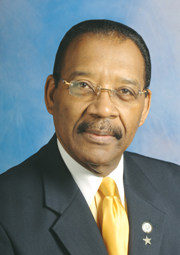
Diaz

Bronx Borough President Ruben Diaz, Jr., joined many New York Assembly Democrats in strong opposition to the bill, which Diaz thinks undercuts New York consumers:

If this proposal were to become law, all consumers would lose out. For starters, customers would not be able to bring service complaints to the Public Service Commission, as they currently can with traditional service. Additionally, there would be no way for the state to set standards for quality or for service in underserved regions — meaning that customers could get stuck with exorbitantly high rates or be unable to obtain service at all in some areas of the state.

Verizon FiOS, one of the main options for VoIP coverage, has now been installed in many regions of the state, including most of downstate. However, Verizon has chosen not offer the service in upstate cities like Albany, Binghamton, Buffalo, Rochester, Syracuse and Utica. The result is both a virtual monopoly for the cable companies in those areas and another blow to lower-income working families who live in cities. That’s precisely why the state should be able to guarantee common sense regulations for VoIP service.

The problems with deregulating VoIP service are multifold. While traditional phone companies pay into a fund that supports “lifeline” phone access for elderly and disadvantaged New Yorkers, VoIP providers would not have to. We do not have to guess at how things would look if the state gives up its right to regulate internet phone service — we can just look at the states where traditional land line service has been deregulated. According to a recent survey of 20 states that have seen land line deregulation, 17 of those states have seen rate increases. We simply cannot afford that, particularly when our fragile national recovery is just beginning to take hold.

Verizon appears undeterred by the governor’s decision to pull the deregulation measure from consideration in his budget measure.  Bills to deregulate continue to float through the Republican-controlled Senate and Democratic-controlled Assembly, but New York’s legislature is notoriously indecisive and slow to act.  Time Warner’s Whelan believes the best chances for the deregulatory measure will be in the GOP-controlled Senate where a similar bill passed last year.  Verizon says it will continue to push for the bill in both chambers.

“We intend to continue pushing for this important measure, and for other measures that will benefit the state’s consumers and businesses to keep up with technological change and help the state thrive and succeed,” Bonomo said.

The Bell/Rogers Anger Continuum: Where Do You Fall? Conglomermate Can Help!

Phillip Dampier March 28, 2012 Bell (Canada), Canada, Competition, Rogers, Video Comments Off on The Bell/Rogers Anger Continuum: Where Do You Fall? Conglomermate Can Help!

All Canadians fall somewhere on the Bell/Rogers Anger Continuum.

[flv width=”640″ height=”380″]http://www.phillipdampier.com/video/Conglomermate.flv[/flv]

Introducing Conglomermate — “Only Conglomermate makes sure you’re matched up with someone in the same phase you are.” — The Rick Mercer Report  (1 minute)

Call to Action: Thank Cox for Calling Overlimit Fees “An Error,” But Demand Caps Come Off

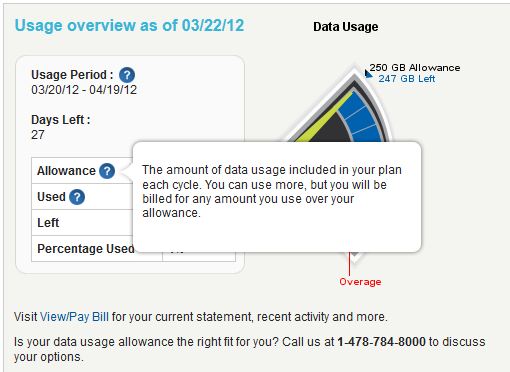
Our good friends at Broadband Reports reported they discovered a new usage meter for Cox Cable customers that implied overlimit fees were on the way for those who exceeded the company’s arbitrary usage caps.

Now Cox Cable’s director of media relations is calling the appearance of the new glitzy usage gauge, and references to “overages” all a ‘big mistake‘:

“Thanks for bringing this to our attention,” Cox Director of Media Relations Todd Smith tells Broadband Reports. “This is an error and the language is being removed from the site. Our policy remains the same, we do not currently charge customers for exceeding bandwidth allowances.”

Cox did not make it clear how exactly the language was included in the meter by accident, and their statement does not preclude the possibility that they’re interested in moving this direction eventually.

Cox's New Meter (Courtesy: Broadband Reports)

Cox Cable customers upset the cable company has a usage meter and caps should first thank them for backing down on charging broadband users overlimit fees for “excessive use.”

After that, it is time to take Cox on and tell them you don’t want your broadband usage metered at all, especially at the prices they are charging for broadband service.

Just last June, Cox Communications President Pat Esser told an audience at the National Cable & Telecommunications Association Cable Show that the industry must keep asking customers what they want and find ways to satisfy those demands.

‘Cable must accept that fact that a robust broadband platform means the ‘industry won’t control everything,’ Esser told fellow cable executives.

Stop the Cap! thinks Esser needs help understanding Cox Cable customers do not want their Internet access limited with caps and additional fees.

You don’t want to check a usage meter and cannot understand why a company that earns incredible profits from broadband that costs less and less to deliver needs to cap your access.

Cable operators don’t unveil new usage meters and mentions of overlimit fees by mistake. It is likely their new usage meter “jumped the gun” and the company temporarily withdrew it.

This is your opportunity to deliver a death blow to Cox Cable’s Internet Overcharging.

Get Involved and Send Cox Executives the Message!

Call Cox Corporate Relations at (888) 566-7751 or e-mail them at [email protected]

Better yet, you can write directly to Cox’s top executive.  We have provided a sample, but you can be most effective writing it in your own words:

Mr. Pat Esser
President, Cox Communications
1400 Lake Hearn Drive
Atlanta, GA 30319

Dear Mr. Esser,

Last June, you told attendees at the National Cable & Telecommunications Association annual meeting that the cable industry needs to keep asking customers what they want and then find ways to satisfy those demands.  As a loyal Cox customer, I am taking advantage of that opportunity to write and express my profound concern Cox Cable has started to limit my Internet usage.  I cannot understand why Cox needs usage caps at a time when broadband revenue is skyrocketing and the costs to deliver the service are actually in decline. There is simply no justification for these limits, particularly after Cox upgraded its network to DOCSIS 3, which supports a considerably larger data pipeline.

Cox and other cable operators are introducing new, faster speeds for customers to earn more revenue.  But with usage caps, there is little incentive to pay more for faster service that remains constrained with a usage limit.  Would you buy a race car you could only drive around the block?

As competition for my telecommunications dollar continues to increase, I am willing to cancel my Cox service over this issue and take my business to another provider.  Some have shown a willingness to waive usage caps in order to win my  business, and I am happy to oblige. I’d prefer to stay with Cox, but not if your company keeps refusing to listen to its customers on this issue.

If you were serious in your remarks last summer in Chicago, then you should follow the lead of companies like Verizon, Cablevision, and Time Warner Cable which have all avoided imposing usage limits on customers. Time Warner Cable believes unlimited broadband should always be available to customers. Cox has imposed limits on everyone, and that has to change.

Very truly yours,

// Your signature here

No Wireless Spectrum Swap Until We See FiOS, Say Cities Waiting for Verizon Fiber Upgrade

Cities left out of Verizon Communications’ fiber to the home upgrade FiOS are telling the Federal Communications Commission to reject any wireless spectrum swap between the phone company and the nation’s largest cable operators unless Verizon commits to getting the fiber upgrade done in their cities.

Coordinated by the Communications Workers of America, which represents many Verizon workers, elected officials and community groups in Boston, Baltimore, and the upstate New York cities of Albany, Syracuse, and Buffalo collectively blasted the proposed swap as bad news for consumers.  On a city-by-city basis, they each filed comments with the FCC opposing the deal unless the Commission mandates Verizon complete fiber upgrades as a condition for the approval of the spectrum swap.

Buffalo’s argument:

For the past few years, we have watched as Verizon Communications has built its all fiber FiOS network in 10 suburban communities that ring our city. In those communities, we have seen what happens when Time Warner Cable, our local cable monopoly, competes head-on with Verizon’s FiOS to provide video and broadband services. Consumers benefit from competitive choice; small businesses benefit from truly high-speed connections to suppliers and customers; schools and hospitals benefit from education and health-related applications; communications workers benefit from the jobs building, maintaining, and servicing networks; and families and communities benefit from the 21st century jobs and expanded tax base.

But the residents and small business owners in Buffalo have not been able to reap these benefits. To date, Verizon has chosen not to deploy its all-fiber FiOS network to the more densely-populated city of Buffalo. The proposed Verizon Wireless/cable company partnership would cement this digital divide and foreclose the possibility of effective high-speed broadband and video competition in our city. Verizon Wireless is a subsidiary of Verizon Communications. We are deeply concerned that as a result of the new joint marketing agreement, Verizon will no longer have the incentive to invest in an all-fiber network that competes with Verizon Wireless’ new partner, the cable company. Therefore, to promote high-speed broadband investment and video competition, especially in heavily minority and lower-income areas like the city of Buffalo, the FCC should include as a condition for approval of this Transaction a requirement that Verizon continue to invest in and build-out its FiOS network to currently unserved areas that are inside its traditional telephone service area footprint, including the city of Buffalo and the surrounding areas.

Cole

In response, Verizon confirmed it never had any intention of wiring any of those cities for fiber service.  Multichannel News reports:

But a Verizon exec points out that those cities are all areas that were not scheduled to get FiOS, whether or not the cable spectrum deal goes through. As Verizon has pointed out, the company decided back in 2010 that it was going to build out the franchises it had already secured and target those 18 million customers in and around New York City, Washington, D.C., and Philadelphia, rather than spend any more of its shareholders money in a wider buildout. The above cities were not in those franchise areas.

Baltimore City Council member William H. Cole accused Verizon of leaving the city of Baltimore behind in a letter he addressed to the Commission this week:

High-speed, fiber-optic networks are vital for economic competitiveness. Currently, Verizon’s FiOS is the only all fiber-optic commercially-available network for businesses and households. Other advanced industrialized nations have already deployed fiber-optic networks on a large-scale; they recognize that high-speed fiber is the competitive infrastructure of the 21 st century. Much of the suburban areas outside of Baltimore already have FiOS. The City of Baltimore will never get a fiber-optic network if this deal is approved, which concerns me greatly. I am not willing to see Baltimore permanently relegated to the wrong side of the digital divide.

Verizilla: Bad for Competition, Bad for Consumers, Bad for You, Says CWA

Phillip Dampier March 27, 2012 Broadband Speed, Competition, Consumer News, Public Policy & Gov't, Verizon, Video, Wireless Broadband Comments Off on Verizilla: Bad for Competition, Bad for Consumers, Bad for You, Says CWA

Verizilla

The Communications Workers of America has a new, decidedly low-budget video decrying a spectrum swap between America’s largest cable companies and Verizon Communications that will leave Verizon Wireless stores pitching cable television service from one of Verizon’s cable company competitors.

To the CWA, this is nothing less than the birth of Verizilla, a new monster of a telecommunications company that has capitulated on competing with Big Cable and will instead devour the wireless communications marketplace for itself.  The CWA interest is obvious: many of its employees are responsible for constructing and maintaining Verizon’s now-stalled FiOS fiber to the home network.

From the CWA:

The deal, struck behind the closed doors of America’s corporate boardrooms, poses a threat to consumers and workers. If it goes through, it will be the death knell for competition between cable and telecom companies. Verizon Wireless, Time Warner, Comcast, and other cable companies will become a giant, unregulated quasi-monopoly. Verizon will have no incentive to challenge cable by building FiOS into new areas — meaning less competition, consumer choice, and higher prices for consumers.

Less FiOS also means fewer jobs building, maintaining, servicing, and installing the network. This deal will create a corporate behemoth that will use exclusive quad-play market power to shrink its future workforce.

Worst of all, Verizon Wireless and the cable companies are refusing to come clean about the details of the deal. Even as the FCC and Department of Justice review it, we still don’t know what it means for consumers or workers.

The CWA has so far collected more than 135,000 signatures on its petition opposing the current form of the deal. 

[flv width=”640″ height=”380″]http://www.phillipdampier.com/video/Verizilla.flv[/flv]

America, say hello to Verizilla, wreaking reduced investment havoc on Verizon service areas across the northeastern United States.  (2 minutes)

Search This Site:

Contributions:

Recent Comments:

Your Account:

Stop the Cap!