Home » Broadband Speed » Recent Articles:

Philly Gets Ready to Rumble: Comcast, RCN, and Verizon Prepare for Broadband Battle

Phillip Dampier July 23, 2009 Broadband Speed, Comcast/Xfinity, RCN, Verizon 5 Comments
Photo by K. Ciappa for GPTMC

Photo by K. Ciappa for GPTMC

The city of Philadelphia will witness a three-way battle for your broadband dollar in the coming months as three competitors race to upgrade their networks to deliver the kind of “blazing fast speeds” only dreamed about in much of the rest of the country.

Comcast, the dominant cable provider in Philadelphia, today announced 50Mbps broadband service for greater Philadelphia residents for $99 a month.  The new, faster speeds are available because Comcast’s Freedom Region has been upgraded to the DOCSIS 3 standard.  Comcast’s Freedom Region includes metro Philadelphia and the counties of Bucks, Chester, Delaware, and Montgomery, as well as northern Delaware and southern New Jersey.

Comcast also doubled the speeds of many of its broadband customers today.  Here’s a roundup of the affected tiers:

Performance — 12Mbps/2Mbps — $42.95/month
Performance Plus — 16Mbps/2Mbps — $52.95/month (no change of upload speed from previous tier)
Ultra — 22Mbps/5Mbps — $62.95/month
Extreme 50 — 50Mbps/10Mbps — $99/month

*DOCSIS 3 modem upgrade required.

Meanwhile, cable overbuilder RCN, which serves parts of Philadelphia and the Lehigh Valley to the west announced it was aggressively moving to upgrade its own network to DOCSIS 3, and is taking the dramatic step of dumping all of its analog channels from the lineup, switching to all-digital cable, starting in Allentown.  RCN has already confirmed it will offer up to 50Mbps service in upgraded areas, but has the capacity to expand to 100Mbps service if needed.  RCN had been planning to launch upgraded DOCSIS 3 service starting in New York and Boston, but market conditions in Philadelphia will make it necessary to expand there as well.

The newest player in town is Verizon, whose fiber to the home FiOS service is capable of the fastest download and upload speeds in the marketplace.  Verizon has offered packages with equal download and upload speeds (20Mbps/20Mbps being the most common) in the past, but is capable of achieving even faster speeds.  It currently provides 50Mbps/20Mbps service in many areas.

“We have a lot of work ahead of us. We will wire the entire city with the nation’s most advanced fiber-optic network, starting with Chestnut Hill, and we expect the first customers to have FiOS services by later this year,” Verizon spokesman Eric Rabe wrote in a blog post. “Other neighborhoods where we will begin building soon are Brewerytown, East and West Mount Airy, South Philadelphia, and the Kensington sections of the city.”

Verizon expects the entire city to be FiOS-ready by 2016, reaching about 660,000 houses and apartment buildings. It is already available in 182 communities surrounding the city.

Incremental Progress: Verizon Makes DSL Available to Nearly 200 Lines in West Virginia

Phillip Dampier July 22, 2009 Broadband Speed, Rural Broadband, Verizon 2 Comments
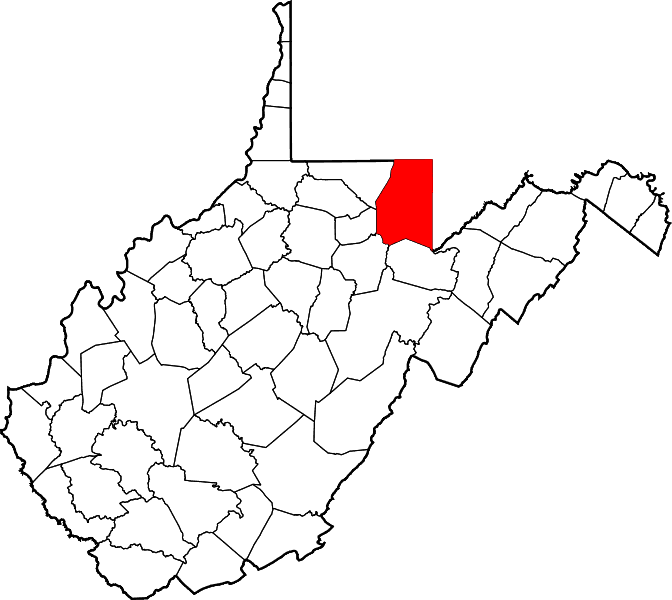
Preston County, WV

Preston County, WV

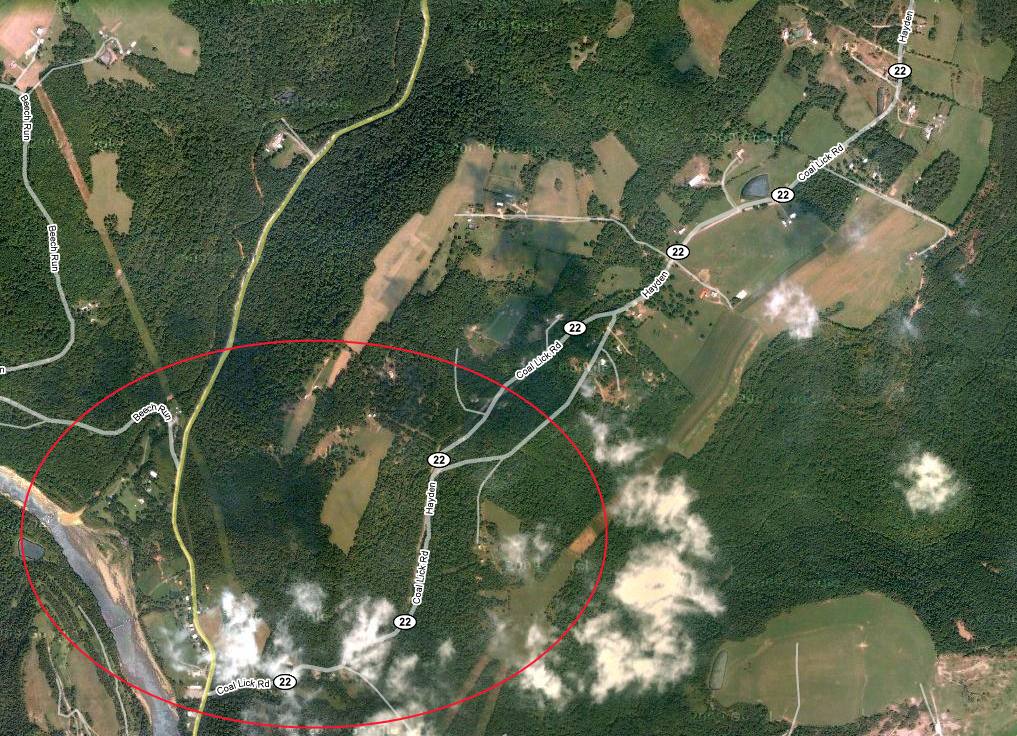
Verizon issued a press release this morning celebrating the availability of DSL service to nearly 200 new lines in Albright, West Virginia.  They even pinpointed the service expansion to “areas along Coal Lick Road near the intersection of Route 22 and 26.”

Satellite image showing the sparsely populated Coal Lick Road/Rt. 26 Intersection (click to enlarge)

Satellite image showing the sparsely populated Coal Lick Road/Rt. 26 Intersection (click to enlarge)

While that presumably makes residents on Coal Lick Road happy, vast areas of West Virginia remain unserved by DSL or any other broadband service option, except for prohibitively expensive satellite Internet.  Preston County has 30,000 residents spread 0ut over 651 square miles, and is typical of many sparsely populated counties in West Virginia.  The nearest large city is Pittsburgh, Pennsylvania.

Verizon has stopped referring to its broadband solution for copper wire telephone networks as “DSL,” now marketing it as “Verizon High Speed Internet” instead.  Speed is in the eye of the customer, however.  Like most rural areas with Verizon DSL, the entry level tier offers speeds only up to 1Mbps downstream and 384kbps for the upstream.  Customers willing to pay more can select the “premium” service offering up to 3Mbps downstream and 768kbps upstream.  In larger towns and smaller cities, service up to 7.1Mbps may be available.

“Verizon is enabling more residents and businesses across West Virginia to make the high-speed connections that are important to them,” said B. Keith Fulton, president of Verizon West Virginia.  “Verizon’s investment in the Albright area means that more customers have access to affordable High Speed Internet service, backed by the reliability and security of Verizon’s network.”

Verizon is also demonstrating its commitment to West Virginia by leaving the state, intending to sell off its telephone service to Frontier Communications, a deal still pending regulatory approval.

For West Virginia, broadband expansion to just a few hundred homes, warranting a press release, demonstrates the incremental, slow progress of broadband expansion outside of urban America.

‘Qwest’ for Speed in the West: Phone Company Introducing 40/20Mbps Service in 23 Cities

Phillip Dampier July 20, 2009 Broadband Speed 5 Comments

top_imageThe west was won with higher upload speed.

Qwest, one of the nation’s largest telephone companies serving the western half of the United States, has proven that telephone company broadband need not be stuck in the past with slow and unreliable DSL speeds. Today, the company announced it was unveiling new super fast upload speed tiers for its entire lineup of broadband plans.  During the promotional period, current subscribers with a 7, 12, or 20Mbps download tier can upgrade to 5Mbps upload speed for $5 more a month.  That upload speed is far faster than what cable companies are providing customers across Qwest’s service area.

Neil E. Cox, executive vice president of Qwest Product and IT emphasized the growing importance of upload speeds for consumers.

“Faster download speeds are important, but upload speeds are getting more attention. By increasing connection speeds in both directions, Qwest is poised to support user-generated content and simultaneous high-bandwidth applications, like multiple online video streams and downloads or multiple players of online video games,” Cox said.

The company also announced a new super fast 40Mbps download and 20Mbps upload tier in selected cities.

Amy Lind, IDC Research Manager, Consumer Broadband and Mobile Services said that consumers are clamoring for faster speed and their research shows customers aren’t simply passively accessing web content any longer.

“Broadband providers have primarily focused on download speeds because, until recently, the Internet has been mostly a source for content, especially online video. Now, as more people create and share their own content, upload speeds have become increasingly important,” she said.

“Qwest has recognized this rapidly growing user-generated content trend and is encouraging the evolving Internet habits of its customers by adding new broadband tiers that emphasize upstream speeds,” Lind added.

The upgrades are possible because Qwest is deploying VDSL2 technology, a modern version of DSL, across its service area.  The technology works over a combination fiber optic/copper wire telephone network.  As long as a neighborhood is reached with a fiber optic line, VDSL2 can work over existing telephone wiring in the home.  Consumers subscribing to the service are provided with an Actiontec® Wireless VDSL2/ADSL2+/2 Universal DSL Wireless Gateway (modem).  The company warns that although the service is very fast, download and upload speeds will be up to 15% lower “due to network requirements and may vary for reasons such as customer location, Web sites accessed, Internet congestion and customer equipment.”

Pricing of Qwest’s New Speed Offerings

40 Mbps download with 5 Mbps upload, $99.99 a month for the first 12 months when combined with a qualifying home phone package.
40 Mbps download with 20 Mbps upload, $109.99 a month for the first 12 months when combined with a qualifying home phone package.
An introductory rate of $5 more a month for qualified customers with 7 Mbps, 12 Mbps or 20 Mbps speed tiers who upgrade to 5 Mbps upstream speeds.

A fact sheet is available with more information about the upgrade.

Read more and see a company video below the break.

… Continue Reading

Read Your E-Mail At Blazing Speed; Because We’re No Good For Anything Else!

Phillip Dampier August 1, 2008 Broadband Speed, Data Caps, Frontier 2 Comments

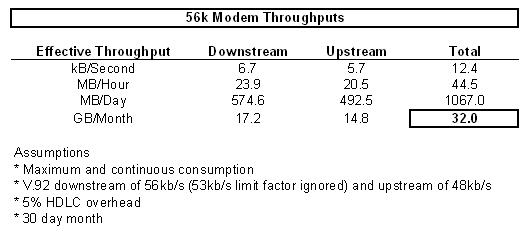
Robb from Hillsboro, Oregon graciously gave permission to share his own research on what a 5GB cap means in the real world.   Some upset about the usage cap announced by Frontier have suggested that’s almost as bad as going back to dial-up.   But as Robb discovered, you would be better off with 56k dialup! That’s because an unlimited Frontier dial-up account can deliver more to you in a month than a crippled DSL account with a 5GB usage cap on it.

See the numbers for yourself:

Courtesy: Robb (a/k/a 'funchords'), Hillsboro, Oregon

Courtesy: Robb (a/k/a 'funchords'), Hillsboro, Oregon

Bandwidth Hog – Log Off Now!

Phillip Dampier July 31, 2008 Broadband "Shortage", Broadband Speed, Competition, Data Caps, Video Comments Off on Bandwidth Hog – Log Off Now!

The cable industry used to face the wrath of DSL companies who ran very effective advertising telling people that cable modem users were all sharing the same bandwidth and slowing down the network for everyone.   They’ve used enough Internet – log off now!   The cable industry’s proposal to start capping usage opened a unique opportunity for DSL providers to finally get some competitive advantage.   Hampered by an aging network, slower speeds, and less ability to rapidly increase speeds, DSL has tried to compete on price.   Imagine if the telephone companies saw cable caps and tailored ads like this to their cable competitors, telling families they’ve used too much Internet and they’d better log off or else.

But telephone companies always take the opportunity to miss a great opportunity and, in the case of Frontier, have elected to one-up them with a cap so low that dial-up users could consume more bandwidth.

So let’s take a look back to the good old days, when the Internet was our friend, and DSL was a noble competitor in the broadband marketplace.

Search This Site:

Contributions:

Recent Comments:

Your Account:

Stop the Cap!