Home » Broadband Speed » Recent Articles:

Providing Internet in Rural America: Bland County, Virginia Expands Wireless Service Town By Town

Phillip Dampier October 16, 2009 Broadband Speed, Community Networks, Rural Broadband, Video, Wireless Broadband Comments Off on Providing Internet in Rural America: Bland County, Virginia Expands Wireless Service Town By Town
Mechanicsburg is located in Bland County, Virginia

Mechanicsburg is located in Bland County, Virginia

Sunday was an exciting day for the nearly 200 residents of rural Mechanicsburg, a small community in southwest Virginia.  It was launch day for the community’s new wireless “broadband” service, which turned the community into one large hot-spot, bringing Internet access to the community at speeds beyond dial-up.

The service expands on a Wireless ISP (WISP) network already serving the nearby communities of Rocky Gap and Bastian, and was funded by a broadband grant, with assistance from Rep. Rick Boucher (D-Virginia).

Residents can subscribe to the service, transmitted from an antenna tower located in each community, or visit the local community center, which will have computers available for Internet use.

antennaWhile the service represents an improvement over dial-up, it’s not exactly 21st century broadband.

The service, provided by Trificient Broadband Technologies, uses Frequency Hopping Spread Spectrum technology in the unlicensed 900MHz, 2.4 and 5.8GHz bands (also used by consumer wireless phones and wireless routers).

Last fall, Trificient owner Jim Ingram told SWVA Today that he defined broadband at anything above 256kbps.  Bland County’s BCNet WISP service provides 512kbps service for $27.95 per month with an annual contract and $99 installation fee.  The Federal Communications Commission currently defines broadband service at speeds of 768kbps or faster.

Providing wireless Internet service in the hilly terrain of southwestern Virginia can be challenging.  The antennas delivering the service have been mounted on antenna towers to be above nearby obstructions, and Ingram told the newspaper every customer gets an on-site survey to determine whether they can receive the service.  If they are within 10 miles of the antenna and have a reasonably clear signal, a small antenna is mounted on the customer’s home and service can begin.

The company offers faster service for a higher price, assuming the customer is close enough to the transmitter to be able to obtain higher speeds.

For rural customers with no option for cable television or DSL service, wireless service at these speeds can provide basic connectivity for e-mail and web page access, but utilizing the Internet’s higher bandwidth services like video and other streaming media can prove challenging.

[flv width=”320″ height=”240″]http://www.phillipdampier.com/video/WVVA Bluefield Mechanicsburg VA Gets Wireless Broadband 10-12-09.flv[/flv]

WVVA-TV Bluefield/Beckley, West Virginia covers the October 11th launch day in Mechanicsburg as wireless Internet service begins for nearly 200 residents in rural Virginia. [2 minutes]


Finland Joins Switzerland In Declaring Broadband “A Right” For Citizens

Phillip Dampier October 14, 2009 Broadband Speed, Community Networks, Public Policy & Gov't, Rural Broadband Comments Off on Finland Joins Switzerland In Declaring Broadband “A Right” For Citizens

Suvi Lindén, Finland's Minister of Communications

Suvi Lindén, Finland's Minister of Communications

Yleisradio Oy, the public broadcasting service in Finland, today reported starting next July, every person in Finland will have the right to a one-megabit broadband connection.

The announcement from the Ministry of Transport and Communications makes Finland the second European nation to consider broadband service more than just a modern day convenience.

Minister of Communications Suvi Lindén said broadband service must be universal, and at equitable speeds throughout Finland.  Private providers have been unable or unwilling to bring universal service to the country, so the Finnish government is compelled to do the job they won’t.

“No-one can be left outside the day-to-day functioning of the information society. As the telecommunications network needed cannot be provided on market terms in all respects, its construction must be supported by public funds,” she said.

Permanent Secretary Harri Pursiainen confirmed Lindén’s views about universal access in a study concluding it is impossible to expect commercial providers to provide regionally equal service throughout the country.

Finland intends to construct an advanced broadband network, starting with the guarantee of 1Mbps minimum speeds for virtually every citizen.  The plan recognizes that reaching the most remote parts of the country will require a mobile broadband network, and have made provisions to tolerate lower speeds on those networks, for now.

But the Finnish government does not consider 1Mbps anywhere near adequate to provide 21st century connectivity.  It has declared that anything less than 100Mbps service is simply unacceptable in the new “information economy.”

The 100Mbps minimum service standard would be mandatory, and targeted to be achieved no later than 2015, if the recommendations are approved by the Finnish Parliament.

“Citizens and businesses need increasingly effective data transfer. This is necessary, among other things, for teleworking, business, e-commerce, and access to social and health services,” Lindén states.

Harri Pursiainen

Harri Pursiainen

Television broadcasting also faces a turning point in the next few years, as channels become more diverse and high-definition transmission enters the picture. Here, high-speed broadband is an essential factor,” Lindén stresses.

The report proposes that the state, regions and municipalities share in the costs of improving the telecommunications network in those areas where the target level for 2015 cannot be reached by commercial means. The purpose is for the Regional Councils to organize competitive bidding among the telecommunications operators.

Where public funds are needed to construct networks, money will be raised by auctioning off certain radio frequencies for commercial use, as well as a telecommunications tax levied on providers in the country, somewhat equivalent to the United States’ Universal Service Fund, which helps subsidize rural telephone service.

Finnish consumers can still elect not to purchase broadband service, and can still select among several providers, choosing the speed and technology they want for the connection.  The Finnish government will offer a “domestic help credit,” akin to a tax credit or subsidy, to help disadvantaged Finns purchase computers and other equipment to use broadband service.

Finland joins Switzerland in providing universal access to broadband.  The Swiss government was the first in Europe to mandate broadband service availability throughout the country as of January 1, 2008.  But the Swiss definition of broadband is much more limited, setting minimum acceptable speeds at just 600kbps downstream and 100kbps upstream.

Both the United States and the United Kingdom have universal service goals as well.  The UK government targets 2Mbps speed to “virtually all” homes by 2012, funded by a telephone line tax.

Thanks to Stop the Cap! reader Greg for the news tip.

Time Warner Cable to Rochester: No Faster Speeds for You! — TWC Upgrading FiOS Cities to Ultra-Wideband Service

Rochester, NY - New York's second largest economy on the shores of a broadband backwater

Rochester, NY - New York's second largest economy on the shores of a broadband backwater

Broadband Reports this morning received word from an “insider” that Time Warner Cable is laying the groundwork to introduce “wideband” broadband service up to 50Mbps throughout New York State’s Verizon FiOS-wired communities.  According to the report, Time Warner Cable plans to launch faster DOCSIS 3.0 service in Buffalo in mid-November, Syracuse in December, and Albany in January.  The company introduced “wideband” service in metropolitan New York City a few weeks ago.

Omitted from the upgrade list is New York’s second largest economy and high tech capital of upstate New York — Rochester.  The city was in the news in April when Time Warner designated Rochester as one of the “test cities” for an Internet Overcharging experiment.  The plan was shelved when customers organized a mass revolt against the plan and two federal legislators intervened.

From a logical standpoint, it wouldn’t seem to make sense for a broadband provider to omit a region with more than one million residents, many who have been highly educated and work for the community’s largest employers – the University of Rochester/Strong Health, Eastman Kodak, Xerox, ViaHealth/Rochester General Hospital, Rochester Institute of Technology, Paychex, and ITT.

But from the all-important business standpoint, Time Warner Cable enjoys extraordinarily limited competition in the area, and the gap only widens in the coming future.  The area’s telephone provider, Frontier Communications, is known mostly for providing service in rural communities, and has so far offered lackluster plans for a 21st century broadband platform, preferring to rely on now-aging DSL technology while Verizon wires most comparably-sized cities in the rest of the state for advanced fiber-to-the-home FiOS service.

While Frontier can live comfortably in rural communities where cable television is not an option, customers who live and work in their largest service area continue to find disadvantages from a company business plan that these days seems more focused on mergers and acquisitions, and is content with language that defines an appropriate amount of monthly broadband usage at a ridiculously small 5 gigabytes per month.

Against a competitor like that, why would Time Warner Cable bother?

Cable ONE: Turning Broadband Service Into a Math Problem

Phillip Dampier October 8, 2009 Broadband Speed, Cable One, Data Caps, Video 1 Comment

Cable ONE, owned by the Net Neutrality-bashing Washington Post, has turned the art of broadband service into a science of confusion for its customers.

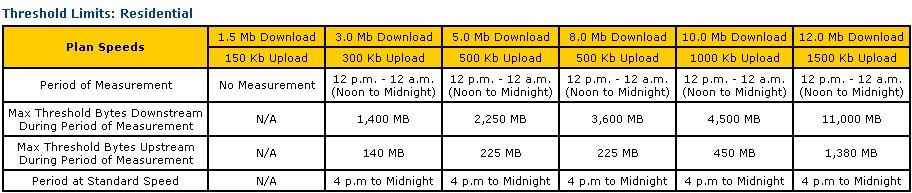
In addition to introducing a forthcoming new, faster tier of service, offering speeds at 12Mbps downstream and 1.5Mbps upstream, Cable ONE has been tinkering with their convoluted usage capping system, which combines a daily usage allowance with throttled speeds and exempt periods during traditionally lower usage hours.

See if you can understand their new usage limit chart, and even if you can, ask yourself if your parents will pick up what they are putting down:

(Click to enlarge)

(Click to enlarge)

Karl Bode at Broadband Reports thinks “Standard Speed” refers to Cable ONE’s throttle — reducing effective speeds by half, assuming you exceed your “threshold.”  The limits shown are reset daily.  Exceeding that limit many times during a month can technically get your service suspended, but we’ve not heard of anyone who either hasn’t been able to talk their way out of it with company officials or who haven’t been bothered by local system managers who are probably just as confounded by this crazy cap scheme as we are.

Cable ONE customers like the new speed offering, if and when it arrives in their respective communities, but hate the silly usage allowances and speed throttles that accompany them.  As Stop the Cap! has always said, consumers are beating the doors down waiting to throw more dollars at broadband providers who offer them the higher speed service they desire.

Instead, some providers would rather create Internet Overcharging schemes to reduce demand and expenses, and profit the proceeds.  If given a competitive choice, consumers will leave a cap-happy provider for someone else who actually listens to customers.  Unfortunately, for too many Americans, the key words are “if given a competitive choice.”

A customer in Boise notes, “I can’t even watch a full movie from Netflix without getting my speed cut in half.  I started the movie at 12pm and by 1pm my speed was cut in half.  When I called Cable ONE and asked about my bandwidth, they wouldn’t even tell me if I crossed the threshold limit.  They kept dancing around my question with ‘it may have been reduced.’  Wake up Cable ONE!”

Many Cable ONE customers are located in smaller cities and communities that currently have just one other option – DSL service from the local phone company.  For many residents, that tops out at 1.5Mbps or 3Mbps downstream.  But for some, it’s better than being usage capped by cable.

Perhaps Cable ONE would do good to watch their own advertisements, which promise: “It’s the way we always listen, to every word you say; loud and clear is how we hear, there’s just no other way.”

<

p style=”text-align: center;”>

Stop the Cap! calls on Cable ONE to discard confusing, impenetrable usage allowances that few customers can find on their website and even fewer actually understand.  Investing in your network with the proceeds of higher speed premium service tiers and making upgrades to DOCSIS 3 can provide additional bandwidth and profit opportunities while customers can sit back, “enjoy the fun with Cable ONE,” and relax with the broadband service they pay good money to receive.  Cable ONE already provides customers with a way to self-regulate their usage, by selecting a speed tier that is comfortable for them and their anticipated Internet needs.

Incremental Progress in Australia on Usage Limits: Pipe Networks’ New Fiber Link Goes Live This Week

Phillip Dampier October 5, 2009 Broadband Speed, Competition, Data Caps, Internode (Australia) Comments Off on Incremental Progress in Australia on Usage Limits: Pipe Networks’ New Fiber Link Goes Live This Week
"PPC-1" - Pipe Network's new fiber link opens this week

"PPC-1" - Pipe Network's new fiber link opens this week

Ongoing connectivity issues and lack of competition continue to leave Australians with expensive, slow, and usage-limited broadband service.

This week, Pipe Networks will make a small dent in improving international connectivity when it activates its new PPC-1 fiber link between Sydney and the U.S. territory of Guam in the Pacific. The project, first envisioned in December 2006, took nearly three years to complete at a cost of more than $175 million U.S. dollars, and has a design capacity of 1.92Tb/s run over two fiber pairs.

Telecommunications analyst Paul Budde said Pipe Networks, along with others “would help to reduce this problem and will therefore provide ISPs with better prices,” which was supposed to result in a lifting of Internet Overcharging schemes like usage caps.

Not so fast.

Broadband providers in Australia have taken notice of Pipe Networks’ new pipeline, but many have not lowered prices or removed usage caps.  The lack of competition has kept a price war from taking place.  Ovum senior telecommunications analyst David Kennedy told Australian IT that without a price incentive, a lot of customers, particularly those served by Optus and Telstra, are unlikely to switch providers.

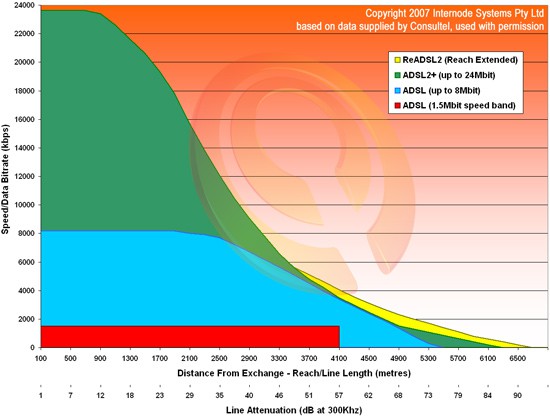
ADSL2+ Speeds drop dramatically the further away you live from the phone company's switching office

ADSL2+ Speeds drop dramatically the further away you live from the phone company's switching office

One DSL provider in Australia, Internode, has made some changes to its service offerings in response to the new fiber link.  The Adelaide-based company has simplified some of its service plans, cut the price of small office/home office pricing by about $9 per month, and increased the paltry usage cap on its Easy Broadband plan from 30GB per month to 50GB per month.  Internode’s Easy Broadband charges $44 a month for DSL service at 1.5Mbps/256kbps,  or in areas upgraded to ADSL2+ service, up to 24Mbps/1Mbps.  Actual speed on the latter service is highly dependent on how far away you live from the telephone company local switching office.

Internode chief executive Pat Tapper doesn’t think PPC-1 will make a huge difference for his company.

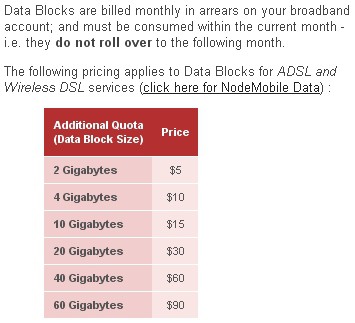
Internode sells "data blocks" for consumers intending to exceed their allowance.

Internode sells "data blocks" for consumers intending to exceed their allowance.

“In the whole scheme of things the PPC-1 circuit doesn’t represent a huge spend in terms of what it costs to run the network. It will change a little bit in terms of our overall cost but only a very small amount,” he said.

“What it does give us is the ability to deliver more capacity to customers in downloads.”

That means a larger usage cap, but not cheaper pricing.

Internode customers that exceed the cap can purchase additional usage blocks, at pricing starting at $2.20 per gigabyte.

Search This Site:

Contributions:

Recent Comments:

Your Account:

Stop the Cap!