Home » Broadband Speed » Recent Articles:

Road Runner Upload Speed Increased for Standard Customers in Rochester, No Change for Turbo

Phillip Dampier January 25, 2010 Broadband Speed 14 Comments

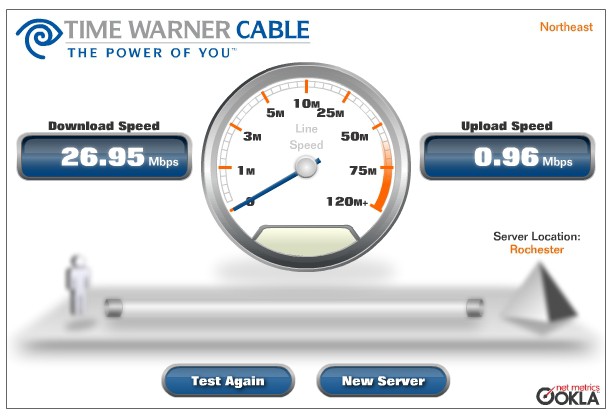
Time Warner Cable Speed Test Results (Turbo)

The Rochester-Finger Lakes Division of Time Warner Cable has upgraded upload speed for Road Runner Standard service customers, up from 384kbps to 1Mbps effective over the weekend.  Stop the Cap! reader Sergey first noticed a change on Thursday evening, but it took the weekend for the upgrade to make its way across the region.  Standard service is now 10/1Mbps in Rochester, although the Powerboost feature, also included for all Road Runner customers, can create speed test results showing 20-25Mbps download speeds, at least at the start of a file transfer.

The upgrade may make Road Runner Turbo less valuable, as no corresponding increase in upload speed for that package has been noted.  Turbo provides Rochester Road Runner customers with 15/1Mbps service and remains at those speeds.

According to Time Warner Cable’s website, the increase brings Rochester closer to the speeds other nearby cities have.  Buffalo enjoys double the upload speed, however.

  • Buffalo/Western NY:  Standard: 10/1Mbps   Turbo: 15/2Mbps
  • Syracuse/Central NY: Standard: 10/1Mbps  Turbo: 15/1Mbps
  • Albany: Standard: 10/1Mbps  Turbo: 15/1Mbps

If you are not receiving improved speeds yet, unplug your cable modem briefly and plug it back in.

Road Runner Customer Speed Test

Approve Verizon-Frontier Deal Because Frontier Can’t Do Any Worse for West Virginia?

We’ve heavily covered the proposed sale of Verizon landline service to Frontier Communications since the deal was announced last spring.  This should not come as a big surprise, considering Frontier Communications’ decision to insert a 5GB monthly usage limit in their Acceptable Use Policy in the summer of 2008 was what instigated the launch of Stop the Cap! in the first place.  Frontier’s decision was boneheaded at best in a city like Rochester with a very aggressive cable competitor only too willing to bash Frontier for implementing it if they thought it would win more customers.

But of course Frontier Communications’ Rochester operation is an anomaly for ‘rural America’s phone company.’  For the majority of rural customers, it’s far easier to slap customers around with a usage cap and 1-3Mbps DSL service when those customers have few, if any practical alternatives.  Unfortunately, there is real money to be made from their business plan serving frequently non-competitive communities with incrementally-upgraded “just enough” broadband service with unfriendly terms and conditions attached.

In several of the 14 states impacted by the proposed sale, the relatively small number of customers involved made it easy for regulators to quickly approve the proposal with few conditions attached. The deal flew under the radar and got scant press in most of these states.  Washington, Ohio, and West Virginia are another matter.  Regulators are taking a closer look at the deal in all three states where most of the controversy is taking place.  The deal is most contentious in West Virginia, where Verizon’s exit threatens to turn most of the state’s landline business over to Frontier Communications.

Stop the Cap! has been reviewing the public comments left on more than a dozen news sites, forums, and printed letters to the editor regarding the deal.  We’ve seen comments obviously coming from Frontier employees, union members, politicians, business leaders, and competitors.  But the vast majority come from ordinary consumers who have concerns about what the deal will do to their telephone and broadband service.  Most of the comments from consumers that embrace the sale don’t do so because they are fans of Frontier.  They simply loathe Verizon and want an alternative.  Boiled down, the consensus among those in favor of Frontier taking over is “let them try… they can’t do any worse than Verizon.”

[flv]http://www.phillipdampier.com/video/WCHS Charleston PSC Phone Hearing 1-12-2010.flv[/flv]

WCHS-TV in Charleston covers West Virginia’s Public Service Commission hearings reviewing the proposed deal.  Frontier employees arrived in Charleston to lobby for the sale. (1 minute)

Desperate for Broadband

There are a lot of West Virginians who still have no broadband options.  Frontier claims Verizon provides only 60 percent of their customers with a broadband option — DSL service that tops out at 7Mpbs, if you live in an urban area.  Those that don’t have often waited years for Verizon to extend DSL service into their communities or neighborhoods.  It’s a problem common in mountainous, often rural states like West Virginia where infrastructure costs can be prohibitive.  Customers believe that Frontier Communications will tolerate a lower return on their investment providing DSL service to those customers Verizon ignored.

Promising to expand broadband service in rural, unserved areas is a common sales point for all of the prior Verizon sell-offs.  Hawaiian Telcom promised improved broadband service and speed.  Fairpoint promised to expand DSL availability to 75 percent of all access lines within 18 months of the sale, 85 percent within two years and 95 percent within five years.  Frontier Communications promises to expand broadband service as well, claiming they already provide 92 percent of their existing West Virginia customers with the option.  Of course, Hawaiian Telcom and FairPoint both reneged on their commitments before going bankrupt.  Frontier Communications hasn’t yet been held to any specific commitment or timeline in West Virginia as part of their proposed takeover of service.

Consumer Reports rated TV, phone, and Internet providers, including Verizon and Frontier, in its February 2010 issue

To those suffering with dial-up or satellite fraudband, -any- broadband option seems like a miracle, even if it turns out to be 1-3Mbps DSL service with a 5GB allowance.  But as those kinds of anemic speeds arrive, cutting edge multimedia-rich broadband applications will become increasingly mainstream and leave these customers behind, again.  With a 5GB usage limit, it wouldn’t matter anyway, because customers will never be able to take advantage of services that will rapidly blow through those limits.  Make no mistake, a user’s broadband experience at 1.5Mbps with a 5GB allowance is going to be considerably different than a customer enjoying online multimedia from a cable provider or the next generation broadband service from Verizon FiOS or AT&T’s U-verse.  Think e-mail and basic web browsing, and that’s about all.

What kind of broadband experience does Frontier Communications bring?  This month, Consumer Reports rated Frontier dead last among DSL providers that own and operate their own broadband networks (subscription required).  The magazine rated 27 regional fiber, cable, and satellite providers and Frontier’s DSL ended up #19 on the list, the lowest rating of any DSL provider selling service on its own network.  Only Earthlink, which usually buys access on other providers’ networks came in lower among DSL providers.  Verizon actually scored higher than Frontier.

Frontier’s DSL service merited a 67 out of 100 score, rating only fair on value, speed, reliability, and customer support, based on 56,080 Consumer Reports subscribers who have a home Internet account.

Frontier’s phone service rated even lower, second to last in the survey.  Frontier was rated fair on value, reliability and call quality.  Only Mediacom did worse.  Verizon scored much better on reliability.  The magazine’s survey of phone companies was based on 37,484 respondents with phone service and was completed in the spring of 2009.

The consumer magazine did not recommend DSL for broadband access, suggesting consumers would do better with fiber optic broadband first, and cable modem service second.

Union Bashing – The enemy of my enemy is my friend

A significant minority of comments were focused entirely on union bashing, completely ignoring the specifics of the Frontier-Verizon sale.  All these people knew was that if the Communications Workers of America or other union was involved, they were the “real problem,” accusing union bosses of opposing the deal until they were paid off.

Nonsense.

Reality trumps anti-union talking points.  Consumers can review for themselves who correctly predicted the outcome of the last two deals of the recent past.  They were the CWA and the International Brotherhood of Electrical Workers, who accurately identified the service problems, the network transition problems, the debt load that prevented service expansion and upgrades, and the eventual bankruptcies experienced at Hawaiian Telcom and FairPoint Communications.  It turns out that asking front line employees who work in the office and out in the field maintaining the network are well positioned to give an honest assessment of these transactions that others seek to candy coat to get the deal done.

[flv]http://www.phillipdampier.com/video/WSAZ Charleston Frontier Defends Deal 1-12-2010.flv[/flv]

WSAZ-TV in Charleston delivered this decidedly pro-Frontier news report on the company’s efforts to counter opposition to the proposed sale. (3 minutes)

The Opposition

A large number of comments from those who oppose the deal believe they will actually be far worse off with Frontier.  Most relate the experiences of themselves or their friends and family who live in Frontier service areas, and they’re unhappy with Frontier’s poor customer service, reliability, and slow speed DSL.  Many were also unhappy with Frontier’s automatically-renewing contracts committing customers to stay with the company or face a steep early cancellation penalty.  Many more lament the lack of a future with Verizon fiber optics.

David Swanson, who blogs from his home in Golden Valley, Arizona just dumped Frontier for his local cable provider – Golden Valley Cable & Communications.  He says he was overpaying for Frontier’s DSL and phone package.  Together, after fees and taxes, $90 a month went to Frontier and $73 a month went to DirecTV for television service.  With his new cable bundle, he pays $100 a month for everything.  He uses Boost mobile for his phone, and has no need for a landline.

Reviews on DSL Reports aren’t exactly positive about Frontier either.

One Rochester customer isn’t happy with the “spotty service” he’s experienced on Frontier’s aging copper wire infrastructure, noting they don’t seem to be in any hurry to upgrade facilities in western New York.  He’s stuck with unreliable DSL service far slower than what Time Warner Cable’s Road Runner service can provide. Another customer in Lowville, New York admits he has to live with Frontier’s slow speed DSL because there is no other provider available.  In Kingman, Arizona one customer rated the company’s DSL service “slightly better than nothing.”

Even customers who had had good things to say about Frontier in forums often acknowledge their service simply isn’t a good value when considering the high cost charged for the slow speed received.

What Can Be Done?

At this point, it is critical impacted customers contact their state utility commission and state representatives and tell them this deal does not work for you.  It is true Verizon wants out of these service areas, and should they win the right to withdraw someone will have to assume control of landline operations in these communities.  But the terms and conditions for the company seeking to provide service should favor customers and not the Wall Street dealmakers.  Strict financial pre-conditions should be in place to guarantee the buyer is up to the task of providing service and upgrades.  Historically, it’s been far too easy to simply renege on the deal with a quick trip to Bankruptcy Court to shed the debt these deals pile on, and be rid of the service commitments that were part of the approval process.

A company that believes they’ll earn plenty from this deal should be spending plenty to provide quality broadband service starting at 10Mbps, not the 1-3Mbps service Frontier provides most of its rural service areas.  What chance do communities in West Virginia have to stay competitive in a digital economy that requires faster broadband access without the ridiculously low usage limits Frontier includes in their customer agreements?  In fact, usage limits and other Internet Overcharging schemes should be explicitly banned as part of any sales agreement.

Holding Verizon responsible for the outcome of deals that benefit them and their shareholders while sticking customers with a bankrupt provider must be considered.  An important component of past Verizon’s landline-dumping-deals involves the Reverse Morris Trust — delivering a tax-free transaction for Verizon and piles of debt for the buyer. That puts all the risk on ratepayers, lower level employees who are among the first to go when cost-cutting begins, and head-scratching regulators wondering where it all went wrong.  The only ones not doing any hand-wringing are Verizon’s accountants and the executive management of both companies who conjure up such deals.  That’s because they are rarely held accountable, and often win retention bonuses even while a company is mired in bankruptcy.

Regulators should insist Verizon play a fundamental role in insuring that customers are protected even after the deal closes, honoring commitments and financing operations should the buyer fail soon after the sale is complete.  Under these conditions, customers are protected and Verizon might think twice about structuring a deal that loads the buyer down in insurmountable debt.

“This deal is driven by greed — and we can learn from Northern New England’s and Hawaii’s experience to make sure it does not come to pass here or in the other 13 states,” said CWA’s District Two Vice-President Ron Collins, who has been leading the campaign in West Virginia.

Internet in the Heartland: Continuing Broadband Adventures in Lawrence, Kansas

Phillip Dampier January 13, 2010 Broadband Speed, Competition, Data Caps, WOW! 9 Comments

Lawrence, Kansas is a unique place to live.  Its local newspaper, the Lawrence Journal-World, was one of the first in America to begin an online edition in 1995.  Its owner, The World Company, just so happens to also own the independent cable system serving the community, which also provides broadband and phone service to the city’s 90,000 residents.  Its biggest competitor is AT&T, which has been upgrading parts of Lawrence with its U-verse system to stay competitive.

Sunflower Broadband, which provides a “triple play” package of Internet, cable TV and telephone service, has remained controversial among service providers because it instituted an Internet Overcharging scheme with usage caps and overlimit fees.  The company has been used by the American Cable Association, a trade and lobbying group serving independent cable operators, as a poster child for effective rationed broadband schemes that reduce demand and increase broadband profits.
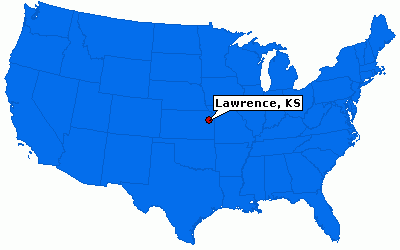
Lawrence, Kansas

Customers generally have loathed usage caps, particularly when they were stuck choosing between Sunflower’s faster, usage capped broadband service or a low speed DSL product from AT&T.  Stop the Cap! receives more complaints about Sunflower Broadband than any other provider, except Time Warner Cable during its own Internet Overcharging experiment in April 2009.  Lawrence residents appreciate the relatively fast speeds Sunflower can provide, but complain they can’t get much use from a service that limits customers to a set allowance and then bills them up to $2 per gigabyte in overlimit penalties when they exceed them.

Last fall, things started to change in Lawrence as AT&T began offering it’s U-verse service in parts of the community.  We began receiving e-mail from Lawrence residents pondering a new service plan Sunflower Broadband introduced — Palladium, an unmetered broadband option priced at $49.95 per month.  It sounded like a good deal, perhaps introduced to protect them from U-verse customer poaching, until they noticed Sunflower was  selling the plan without a fixed downstream or upstream speed.  In fact, no speed was mentioned at all.  Indeed, Sunflower’s Palladium is nothing new to those living abroad under various cap ‘n tier broadband regimes.  It’s comparable to New Zealand Telecom’s Big Time plan, where customers need not fear overlimit fees and penalties, but have to live with a “traffic management” scheme that gives priority to customers on other plans living under a usage cap.

In other words, Palladium customers get last priority on Sunflower’s network.  If the network is not congested, these customers should enjoy relatively fast connections.  But during primetime, expect speeds to drop… and dramatically so according to customers writing us.
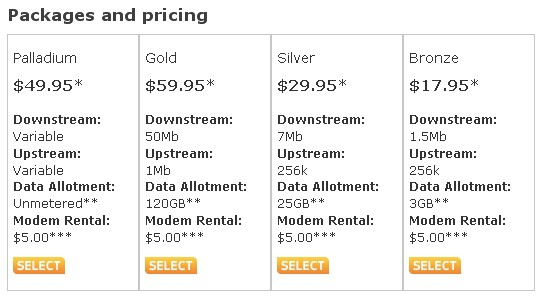
Sunflower Broadband's Internet pricing - add $10 if you want standalone service

That customers debate just how slow those speeds can get testify to the nature of cable’s “shared infrastructure.”  Groups of subscribers are pooled together in geographic areas and share a set amount of bandwidth.  As usage increases, so does congestion.  Responsible operators measure that congestion and can split particularly busy neighborhoods into two or more distinct “pools,” each sharing their own bandwidth.  Based on the variable reports we’ve read, it’s apparent Palladium works better in some parts of Lawrence, namely those with fewer broadband enthusiasts, than others.

Network management is a major concern of Net Neutrality proponents.  It allows an operator to artificially impede traffic based on its type, who generates it, and potentially how much a customer has paid to prevent that throttling of their speed.  In the case of Palladium, network management is used to give usage-capped customers first priority for available bandwidth, and push Palladium customers further back in line.

Judging the quality of such a service is a classic case of “your results may vary,” because it is entirely dependent on when one uses the Internet, how many others are logged in and trying to use it at the same time, how many customers are saturating their connections with high traffic downloading and uploading, and how many people are sharing your “pool” of bandwidth.  Oh, and the quality of your cable line can create a major impact as well.

Sunflower Broadband representatives claim Palladium is “optimized for video” and should provide at least 2Mbps service during peak usage and up to 21Mbps service at non-peak times.  That’s a tremendous gap, and we wanted to find out whether most customers were getting closer to the low end or the high end of that range.

Back in October, we wrote a request in the comments section of the Journal-World asking customers to e-mail us with answers to several questions about their experiences with Sunflower Broadband:

  • 1) whether you ever exceed the cap.
  • 2) do you think there should be one.
  • 3) would you prefer faster speed with a cap or slightly slower speed with no cap.
  • 4) your experience with the new unlimited option.
  • 5) whether you would contemplate switching to AT&T U-verse if it meant escaping a usage cap, even if it had slower speeds.
  • 6) Would you pay more for faster speed and no cap?
  • 7) your overall feelings about Sunflower Broadband.

We heard from just over two dozen readers sharing their thoughts about the company and its service.  The response was mixed.

Generally speaking, customers hate the usage caps Sunflower Broadband maintains on most of their broadband tiers.  All thought it was unfair and unreasonable to limit broadband service under Sunflower’s Bronze tier to just 2GB per month and their Silver tier to just 25GB per month.  Most customers who wrote subscribed to the Silver tier of service with 7Mbps/256kbps speeds at $29.95 per month.  They also paid a $5 monthly modem rental charge.  Those who wrote who fit the “broadband enthusiast” category were internally debating whether the Gold plan, with its assured 50Mbps/1Mbps speeds for $59.95 per month was a better option, even with a 120GB allowance, or whether they should opt for Palladium’s $49.95 option to escape the usage cap.

Among enthusiasts, some felt Sunflower responded to customer demands by offering an unlimited plan in the first place, and thought it was an acceptable trade-off to obtain lower speeds at peak usage times for a correspondingly lower price, and no cap, as long as speeds were reasonable at all times.  Others were offended they had to make the choice in the first place.

“If I lived anywhere else, I wouldn’t have to choose between a throttled service or one that asks for $60 a month for 120GB of service,” writes Steve from Lawrence.  “AT&T DSL for me is 1.5Mbps service because I live close to the edge of the distance limit from AT&T’s exchange.”

But Justin, also from Lawrence, has a more favorable view. “I hate their usage cap with a passion, but when you look at what small cable companies usually offer their customers, it’s slow speed service at terribly high prices,” he writes. “At least Sunflower did DOCSIS 3 upgrades and can offer big city speeds here.  How long will that take other small independent providers?”

Troy adds, “at least they gave us one choice for unlimited service.  Time Warner Cable and Comcast sure didn’t.”

About half of those who wrote did exceed their usage cap by underestimating the amount of usage in their respective households.  Most of those who did were on the Silver plan.

Dave writes, “I knew right off the bat the Bronze tier was ridiculous for anyone to choose, and our family has three teenagers so we knew that was not an option.  We tried the Silver plan when we switched from AT&T DSL service and blew the lid off that 25GB cap probably within two weeks and got a crazy bill.  At least Sunflower forgave the overlimit fees for the first month, but they could afford to because we upgraded to Palladium, paying them $20 more per month.”
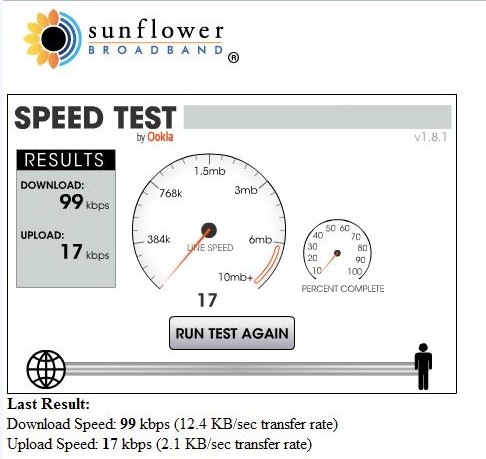
One customer's dismal Palladium speed test result from last October, likely the result of a signal problem

Angela, who shares an apartment with two other roommates had their share of fights over who used up all the broadband allowance.

“We have a wireless network and everyone splits the bill, but when we ran up almost 200GB of usage, we freaked.  Nobody would admit to using that much Internet.  Thanks to my boyfriend, we discovered our wireless router was wide open and one of our lovely neighbors probably hopped on to enjoy,” Angela writes.

Sunflower also forgave their overlimit bill for the first month, but they decided to take advantage of an introductory offer from AT&T and switched to U-verse and are much happier.

“At least with AT&T, we know what our broadband bill is going to be and we don’t have fights or worries about getting a huge bill from Sunflower,” she adds.

Among those answering our question about reduced speed in return for no cap, the consensus view was “we would need to know what speed they are providing.”  Broadband speed was important to most who wrote.  While many may not be able to discern a difference between 10 and 20Mbps service for most online activities, obtaining 2Mbps service when expecting closer to 20Mbps is readily apparent, and that was the biggest problem with Palladium users unimpressed with its performance.

“Palladium is god awful, and close to unusable on the weekends and during the early evening when everyone is online,” writes Kelly, also in Lawrence.  “We have college students all over the neighborhood and these people can’t be unconnected for a minute, so I’m not surprised Palladium crawls when everyone is online.”

Kyle, a regular Stop the Cap! reader writes the whole concept of Palladium leaves a bad taste in his mouth.

“Palladium is the equivalent of going into a restaurant and eating leftovers — whatever speed is leftover, it’s yours.  Sometimes it might be a whole meal, other times scraps!  It’s an example of crappy customer service coming from a provider which doesn’t have much competition (although maybe that will change with U-verse),” he says.

Kyle is on the Gold plan, but remains unimpressed with Sunflower:

“Is there another DOCSIS 3 system in the country that limits upload speed to 1Mbps or has a bandwidth cap this low (120 GB) with DOCSIS 3?”

Stop the Cap! also obtained access to the company’s subscriber-only forums and discovered considerable discontent with Sunflower’s broadband service.

“I recently switched over to Palladium to avoid the new Gold price gouging. I bought the new modem set it up and much to my surprise my speeds were HORRIFIC! Consistently 4.5Mbps service over the course of a week at various times. Upload speeds were so terrible it took 15 minutes to send emails with one minute movies,” writes one user.  “So, for $20 more a month Palladium offers much slower speeds BUT unlimited bandwidth (which according to Sunflower’s own statistics almost no one exceeds their limits anyway.)  What a rip-off. All I want is my old Gold back, same speed and price. I am absolutely disgusted with Sunflower. Calling Palladium “variable speed” is a lie. You are throttling customers – period.”

“So I have Palladium and the speeds are decent, usually around 10Mbps down (we won’t talk about up speeds.) But every time I run a torrent my speeds go down to about 500kbps. The second I turn off my torrent client and run a speed test again its right back up to 10. Has anyone else been having similar issues? It seems like Sunflower throttles my entire connection when they detect a torrent,” writes another.

One Lawrence resident claims he was blacklisted by Sunflower Broadband after criticizing them.

“Their blacklisting of me served as a warning to others after I spoke out nationally.  They are quite pissed and I’m not allowed to go to any event sponsored by them.  I even got removed from the local Twitter festival,” a person who I have chosen to keep anonymous writes. “The nutshell is that the bandwidth from DOCSIS 3.0 is extremely throttled for Palladium users. If they have done heavy downloading the throttle drops speed to about 2Mbps.”

For Lawrence residents who have decided they don’t like the choices Sunflower provides for broadband service, the good news is that AT&T is upgrading their network in the city to provide U-verse service, and many who wrote us have switched just because AT&T does not engage in Internet Overcharging caps and limits in Lawrence.

There is even a blog devoted to comparing Sunflower Broadband service with AT&T U-verse.  The Lawrence Broadband Observer has been reporting on the dueling providers since August.  His verdict: AT&T U-verse wins for broadband for its more stable speeds, and no Internet Overcharging schemes, even if it costs more:

We decided to go with U-verse for our Internet service, canceling our Sunflower Broadband Internet, which we had used for over 13 years. U-verse’ top line internet costs $15 more per month then Sunflower’s; we decided that the advantages of U-Verse for Internet were enough to make this extra $15 per month a reasonable value.

Furthermore, the speed of U-verse has been remarkably consistent, always ranging between 16 and 17Mbps down and about 1.4Mbps up, no matter the time of day.

While Sunflower’s service is very fast at certain times of day, it frequently slows down during evenings or other times of heavy network use, sometimes to less then half of the speed we were paying for.

The other primary reason we went with U-verse was because U-verse does not have bandwidth overage fees or any kind of bandwidth limits. Although we have been careful with Sunflower and managed to avoid any bandwidth overage charges, having “the meter running” all the time was annoying, and we worried that we could always be surprised with an unexpected charge. With U-verse we do not have this worry.  One could almost think of the $15 extra for U-verse as an insurance policy…it buys peace of mind not having to worry about bandwidth overages.


Verizon Wireless’ LTE Next Generation Wireless Broadband: ‘Long Term Expensive’ Usage-Based Billing On The Way

Phillip Dampier

Verizon Wireless’s next generation LTE wireless broadband network threatens to bring expensive “usage-based billing” to millions of Americans using technology products that depend on wireless networking to communicate  — from the handheld tablet you use to enjoy USA Today over morning coffee, the car that delivers news, weather and traffic reports to and from work, to the portable television you use to catch up with the game while running around town.

At the Consumer Electronics Show, Verizon chief technology officer Dick Lynch warned that Verizon is likely to abandon any notion of flat rate usage pricing, particularly when Verizon doesn’t get a piece of the action from the sale of the devices that connect to their network.

Instead, Verizon Wireless will adopt a wireless version of Internet Overcharging — usage-based billing that isn’t entirely “usage-based.”

A true consumption billing system charges consumers only for what they use — don’t use the service that month and customers would pay little or nothing for service that billing period.  Instead, providers maximize revenue with arbitrary “usage allowances” which are part of the steep monthly service fee.  The unused portion of the allowance typically does not roll over, in effect lost at the end of the month.  That means you pay for not using their network.  Imagine if your electric company charged you for leaving the lights on 24/7, but you were out of town that month.  If you exceed your allowance, the overlimit penalty kicks in, and most providers set those prices high enough to sting you while rewarding them.

“The problem we have today with flat-based usage is that you are trying to encourage customers to be efficient in use and applications but you are getting some people who are bandwidth hogs using gigabytes a month and they are paying something like megabytes a month,” Lynch said. “That isn’t long-term sustainable. Why should customers using an average amount of bandwidth be subsidizing bandwidth hogs?”

Lynch

The first step to broadband pricing enlightenment is to recognize the only true “hog” here is the broadband provider with an endless appetite for your money.  Usage-based pricing schemes carry the one-two punch for consumers, with no pain for providers:

  1. They discourage usage, as consumers fear using up their monthly allowance and getting socked with an enormous bill filled with penalties and overlimit fees;
  2. The corresponding reduction in usage lowers the providers’ capital spending requirements to meet consumer demand, and increase profits dramatically from those who find allowances too limiting and are willing to pay the exorbitant pricing providers charge those who exceed them.

Does Verizon actually believe that $60 a month for their wireless broadband service represents a fair price for someone using “something like megabytes a month?”  Can Verizon show it is losing money on its wireless broadband service?  I think not.

Predictably, Lynch provides a “between-the-lines” slap at government intervention to force open wireless networks to additional competition in the equipment marketplace:

“The whole paradigm of how we sell devices into the public is changing,” Lynch said. “At the same time that we announced LTE, we announced an open development initiative where we encouraged third-party developers to deploy devices on our network.”

That initiative was hardly the result of a sudden change of heart from Verizon.  It came from pressure Washington applied over the “closed network” practices the American wireless industry has followed for years.  Handsets and the applications that run on them have traditionally been closely controlled by providers.  Features built into smartphones and other handsets were disabled or limited by providers before the phones were sold to the public.  Usually, this forced customers to use the services either provided directly by their wireless company, or one of their “affiliated partners.”

Verizon Wireless is signaling the consequence of a more competitive, open market for wireless products and services: usage limits and a higher bill. That’s because you didn’t buy that device at a Verizon store at their asking price, and you’ve been using it too much.

Consumers would make a grave mistake in blaming a more activist watchdog role by the federal government to force open the wireless industry to competition and innovation by third parties.  Despite Verizon’s hints that those pesky regulators in Washington are to blame for your usage being limited and your bill being higher, the blame really belongs with the carriers pocketing those proceeds.

Since regulators will get the blame regardless, isn’t it time to go all out for American consumers by transforming the wireless provider marketplace?  Here are our suggestions:

  1. An end to the ongoing consolidation of existing wireless players into a shrinking number of what will soon be two or three “too big to fail” national providers;
  2. Insistence on additional competition coming from new, independent players, not simply those directly affiliated with the dominant four carriers (Verizon, AT&T, Sprint, and T-Mobile);
  3. Justification for confiscatory data pricing made possible from the highly concentrated wireless marketplace, particularly in smaller cities and communities.

Verizon and AT&T have both engaged in a lot of scare talk about usage and their costs to manage it.  We’d believe them, except we read their financial reports and neither company is hurting.  We’d even be willing to meet them halfway and advocate additional allocations of spectrum to provide the bandwidth an increasingly wireless world will demand, but not at their asking price with those pesky terms and conditions that ration service to consumers at top dollar prices.

Rebutting Bray Cary’s Cheerleading For the Verizon-Frontier Deal in West Virginia

Phillip "Doesn't Worship Wall Street" Dampier

Bray Cary, president and CEO of a group of West Virginia television stations enjoying advertising revenue from Frontier Communications, was back on his Decision Makers program to allow an opposing viewpoint to the puff piece interview he held earlier with Frontier’s Ken Arndt, Frontier’s Southeast region chief.  This time, he invited Ron Collins, vice-president of the Communications Workers of America to give the CWA side.  Cary’s Tea-‘N-Cookies Breakfast Club With Ken this was not.  Cary decided to play hardball with Collins, leaving no viewer in doubt where Cary stood on the question of Frontier’s proposed purchase of West Virginia’s phone lines from Verizon.

Unfortunately, Collins was not completely prepared to rebut Cary’s pro-Wall Street, pro-deal propaganda and looked ill at ease at times during the interview.  We’re not, and Cary’s “facts” deserve some investigation.  After all, how hard should it be to rebut a guy who believes Wall Street and the banks have all the right answers for West Virginians’ phone service?

  • Video No Longer Available.

Right from the outset, Cary wants to play “devil’s advocate” with Collins, asking why in the world the CWA is opposed to this deal.  That was a major departure from his cheerleading session with Arndt.

Bray Cary, Host of Decision Makers

“I’ve looked at this […] their stock has been extremely stable.  Wall Street appears to be signaling their financial viability is okay.  Why is the stock market not reacting negatively?  If it’s good for stockholders, how can it be bad for their financial stability.  Stockholders want financial stability,” Cary said in a series of statements about the deal, including mentioning a Moody’s report on the deal.

The Moody’s report Cary talks about is for shareholders who will reap the rewards or suffer the losses based on the success or failure of the deal.  Moody doesn’t rate the deal’s impact on consumers who have to live with the results.  What’s good for Wall Street is not necessarily what’s best for customers.

“What you don’t have is anyone in the financial community suggesting this is a bad financial deal,” Cary said December 13th.

Wrong.  Almost a week earlier, on December 7th, D.A. Davidson, a respected Wall Street analyst said the opposite.  In a story published in Barron’s: “Frontier Communications’ Shares Not Wired for Success,” the analyst firm argued the regional telecom’s acquisition of Verizon’s rural lines will be… wait for it… bad for the stock.

Cary’s claim that Wall Street is concerned with the long term viability of companies belies the growing reality that much of the investment culture in America has a long term obsession with short term results.  Your company is only as good as your last quarter’s financial earnings statement, and several bad ones in a row are usually enough to bring a recommendation to dump shares.  Frontier has kept its stock value stable largely as a result of their steady dividend payment.  Collins claims Frontier has gone beyond reason, paying 125% of earnings in dividends.  That may make the stock a popular choice for income investors, but is also eerily familiar.

FairPoint Communications also enjoyed a healthy stock price because of its high dividend payout.  Wall Street only got concerned when they thought that deal might not go through.  Morgan Stanley issued a report in 2007 suggesting the deal between FairPoint and Verizon to take control of landline customers in Vermont, New Hampshire, and Maine, was itself helping to prop up the stock’s value.  We saw how far that got FairPoint when the company declared bankruptcy a few months ago.

Ron Collins, CWA's vice president

Indeed, smaller independent phone companies commonly use high dividends to remain attractive to investors and stay viable in a tough market.  Windstream is another such company and even CNBC’s Jim Cramer gave due diligence to the fact high dividends and stock value by themselves don’t necessarily predict the company’s long term success or failure.

Make no mistake, Frontier has sold this deal to investors based on dividend payouts, claimed cost savings, and a safe bet that any broadband in rural America will earn them increased revenue, especially where consumers have no other place to go for service.

Frontier will take on massive additional debt to finance the deal, but on paper it actually appears to reduce their debt ratio.  That’s because when you add millions of new customers, the debt doesn’t look so big next to the increased revenue those additional customers will bring, assuming they stay with Frontier.  Should Frontier’s performance underwhelm customers, they’ll drop service if they can.  If mobile phone networks do a better job of reaching these rural customers, many will drop landline service anyway.  When wireless broadband service becomes a more realistic option, customers might toss Frontier’s slow speed DSL overboard.

AT&T and Verizon have read the writing on the wall — an ongoing decline in landline service and the eventual death of the kind of service Frontier is providing its customers on its legacy network.  Would you be better off with a company that recognizes the truth about the future of wired basic phone service, or the one that wants to buy up obsolete networks and hang on until the last customer leaves?

Cary’s concern starts and stops with shareholder value, not the individual long term needs of consumers across West Virginia.

“All of the bankers and all of Wall Street are saying financially this is a good deal financially for Frontier,” Cary argued.

“Good for Wall Street, bad for West Virginia,” Collins replied.

“Well, see I disagree… that has been a myth put out there, and the reason we don’t have any jobs in this state is companies don’t want to come here just because of that mentality.  People need to make money.  You look at where companies are flourishing, the workers flourish when they do,” Cary said.

Really.  Then why are several of these telecommunications companies awash in revenue also continuing to reduce their workforce in their relentless effort to obtain “cost savings.”  Someone is making money, just not the average employee.  Every state has pro-business acolytes claiming businesses don’t want to come to their state because of regulation and a hostile business climate, even those with the fewest regulations, lowest taxes, and little protection for employees and consumers.

Cary does make one valid point: Verizon wants out of West Virginia and refuses to invest a dime in the state as it looks for a quick exit.  Instead the company has diverted resources from serving smaller states’ phone service needs into its larger city FiOS fiber to the home system where it believes it can reap more revenue.  Whether that disinvestment should be permitted in the first place is a question that needs to be asked.

Verizon is a regulated utility that is required to meet certain performance standards, and the company’s long history of operations under that framework, under which it profited handsomely, does require consideration.  But the state can also provide additional incentives to make it more attractive for Verizon to commit more resources in the state, ranging from tax credits, public-private investment, rewards for performance and service improvements, etc.  It can also find someone else to provide the service, or let local communities band together into cooperatives to run their own networks, should customers find that could deliver better service.

At the very minimum, Frontier should he held to strict conditions that require a fiscally responsible transaction for ratepayers, not just for shareholders and management.  Verizon’s workforce, already cut to the bone, should not bear the brunt of “cost savings” either, both now and into the future.  If Frontier wants to deliver broadband, they should commit to offering 21st century speed (not the 1-3Mbps service typical for their smaller service areas) without their draconian 5GB usage limit in their Acceptable Use Policy.

Cary doesn’t concern himself with those kinds of details, but consumers and small businesses in his state sure do.

Cary wants more jobs and more earnings for West Virginia.  In the changing digital economy, high speed broadband isn’t an option — it’s a necessity.  Verizon has a proven track record of being able to provide 21st century broadband — Frontier does not (sorry, 1-3Mbps DSL is more 1999, not 2010).

Cary makes an astonishing statement in the third segment of the interview which makes me question his ability to grasp the reality-based community most Americans live in today.

“I have great faith in the banking system in America, in Wall Street, to evaluate these things.”

That stunned Collins, who asked, “even after the 2008 crash?”

Cary seems to think “everything is back to normal.”  Unfortunately, after the bailouts and big lobbying dollars being spent in Washington to preserve the status quo as much as possible, everything is back to normal… for Wall Street and the banks.  The rest of the country, including West Virginia, is another matter.

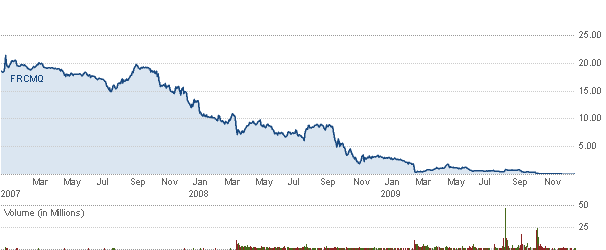
FairPoint's Stock Price from 2007, when it announced the deal with Verizon, to late 2009 when the company declared bankruptcy. By late 2008/early 2009, what seemed like a great deal for investors was apparently not, as the panicked rushed for the exits.

I’ll put my trust in the wisdom of West Virginians who want good service and reasonable prices.  If Cary wants to read from the Good Book of the “paragons of virtue” like AIG, Bear-Stearns and Goldman Sachs, let him sell his TV stations to help finance the bailouts.  Remember that when we went through this before with Hawaii Telecom and FairPoint Communications, the cheerleading session on Wall Street lasted only as long as the quarterly balance sheets looked good.  At the first sign of trouble, they bailed on the stock and both companies ended up in bankruptcy.

For them, it represented just another roll of the dice in the giant financial casino we call Wall Street.

For the rural residents of states like West Virginia who ultimately have to live with the results, this is their phone and broadband service we are talking about.  Before all bets are placed and the dice are thrown, isn’t it worth considering them?

Search This Site:

Contributions:

Recent Comments:

Your Account:

Stop the Cap!