Home » Broadband Speed » Recent Articles:

Revisiting Virgin Mobile Wireless Broadband: Supper Time Blues

Last week, Stop the Cap! took a look at Virgin Mobile’s new unlimited $40 prepaid wireless broadband service.  Early testing looked promising, with speed test results that were well within economy tier DSL service and better than expected.  But by early this week the story began to change.

We’ve continued testing the service here and have noticed that while Virgin Mobile’s service turned in respectable performance during the business day (East Coast time), once people started heading home, it’s a completely different story.  For the last five days the service has deteriorated to the point of unusability by dinnertime.

It had gotten so bad, we went back to using Cricket’s wireless broadband.

So what’s happening?

First, it’s important to distinguish that these problems are impacting only Virgin Mobile.  Sprint’s postpaid customers can use the same cell tower and backbone network and not experience any performance issues.  Virgin Mobile’s home location on Sprint’s data network is in San Francisco, and until September 2nd, all traffic headed for the Bay Area to what is basically a virtual LAN on Sprint’s network.  The IP address we were assigned was actually an internal address for that virtual LAN.

Our problems started appearing Monday afternoon when we noticed web pages refused to load completely.  Since many web pages are composed of content from a variety of different web hosts (Google Analytics, advertising, embedded content, etc.), if parts of the page refuse to load, the page itself may not appear at all.  Advertising blocks were the worst problem, often leaving one staring at a blank web page waiting for the ad content to render.

By Wednesday, this problem simply made using Virgin Mobile for broadband untenable.  Few pages — even Google’s home page, refused to load reliably.  When pages did appear, they took longer than dial-up in many cases.  We tried to perform some diagnostics but found trace-routing impossible after the third hop and speed tests could not be loaded, much less run reliably.

The fact the worst problems occurred in the late afternoon and evening hours point to a network completely overloaded with customers.

And indeed, Virgin Mobile admitted as much when it replied to some tweets indicating it had quadrupled capacity by the end of this week.  Some users also reported they no longer connected exclusively through the San Francisco (Walnut Creek) location.

As of Thursday, anecdotal reports indicated some service improvements, but the service is still prone to slowdowns during peak usage times.

A few things are evident now that a week has passed:

  1. Virgin Mobile Wireless Broadband does not share the better performing Sprint postpaid data network those customers receive.  Virgin Mobile customer traffic shares a much smaller “pool of bandwidth” because of the limitations imposed by its routing.
  2. The company needs to either abandon its current routing scheme or dramatically modify it to accommodate the traffic.
  3. Refunds for disgruntled customers are often available for the hardware, but don’t expect to get a refund for data usage.
  4. The service problems come regardless of the device used or the number of signal bars you receive.
  5. New routing cities have popped up since Thursday to supplement San Francisco — Charlotte, N.C., New York, Atlanta, Boston, Southfield (Mich.), Los Angeles, Philadelphia, and a few others.  Feel free to share yours in the comments section.

On Friday, Virgin Mobile suffered a major outage caused by a power failure that has stopped or seriously delayed delivery of text messages.  The outage is also affecting some data connections and customer service availability.  Angry customers have been pelting the company’s Facebook page with hostile remarks since the outage began.

If you signed up for Virgin Mobile wireless broadband, please share your experiences in our comments section!


Suddenlink Cable CEO: ‘People Don’t Realize the Days of Cable Company Upgrades are Basically Over’

Kent

Suddenlink president and CEO Jerry Kent sends word that the days of cable companies spending capital on system upgrades are basically over.

Interviewed on CNBC, Kent was responding to concerns about the cable industry’s long history of leveraged buyouts — amassing enormous debt to launch buyouts of small and medium sized cable companies as the march towards industry consolidation continues.

Kent’s own cable system — Suddenlink, was built partly on purchased cable systems from Cox and Charter Cable.  In the changing economy, Wall Street now wants to see cable companies with plenty of free cash flow on hand as part of their balance sheets, not just potential revenue growth through increased numbers of households made possible through debt-ridden acquisitions.

Kent sees Suddenlink, and many other cable operators, performing better as they transition away from making investments in system upgrades to accommodate demand.

“I think one of the things people don’t realize [relates to] the question of capital intensity and having to keep spending to keep up with capacity,” Kent said. “Those days are basically over, and you are seeing significant free cash flow generated from the cable operators as our capital expenditures continue to come down.”

Kent told CNBC Suddenlink had the fastest residential Internet service in the country — 107Mbps. (EPB in Chattanooga claims it offers 150Mbps residential service, although we don’t see much about it beyond a June press release on their website.)  Suddenlink’s speeds are one-way only, however.  The upstream speed for that tier of service is considerably slower — 5Mbps.  EPB offers the same upstream and downstream speeds.

Kent appeared on CNBC to discuss the “threat” to cable television company business models by online video.  Kent believes Suddenlink, and the cable industry more generally, is positioned to protect cable-TV profits with the TV Everywhere concept — offer online video of cable programming, but only to authenticated, current cable subscribers.  Those without cable subscriptions can’t watch.

Financial reports submitted by many of the nation’s cable operators confirm Kent’s claim that capital spending is being reduced.  Even among cable systems that claim they need to enact usage caps and other Internet Overcharging schemes to “invest in broadband upgrades,” the financial reports don’t lie — they are not using increased revenue for system upgrades.  They are instead retaining the revenue as free cash – available for other purposes, paying down debt, or returning it to shareholders through dividend payouts.

[flv]http://www.phillipdampier.com/video/CNBC Internet v. Cable 8-20-10.flv[/flv]

CNBC interviewed Suddenlink CEO Jerry Kent on how the cable industry intends to cope with invasive online video, threatening to erode cable-TV profits.  (8 minutes)

The Fiber Revolution Continues in the South Pacific – Cable Project Seeks Unlimited Broadband for Consumers

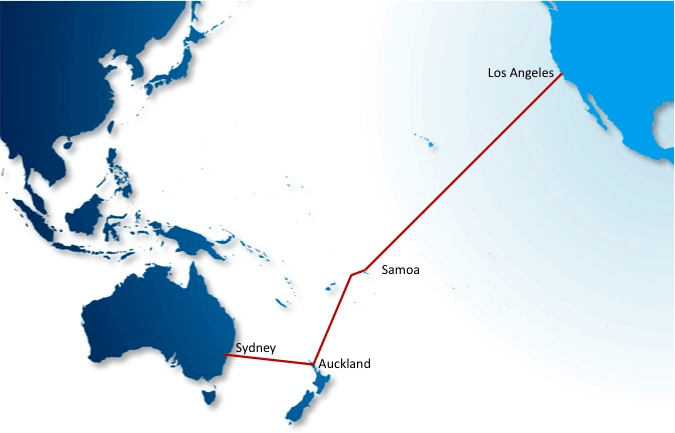
Pacific Fibre's planned undersea fiber optic cable set to begin service in 2013. (click to enlarge)

Australia and New Zealand remain the two countries most notorious for Internet Overcharging schemes like usage caps and speed throttles.  The lack of international broadband capacity is routinely blamed for limiting broadband usage for consumers in both southern Pacific countries, and now a major undersea fiber optic cable project seeks to end those Internet Overcharging schemes once and for all.

Pacific Fibre hates usage caps.  The company, which is one of the partners in a planned 5.12 terabits per second undersea cable connecting the United States with New Zealand and Australia, believes limiting broadband consumption is bad for business — theirs and the digital economies of both nations.  Now the company is reportedly willing to put its money where its mouth is, charging broadband providers a flat rate per customer for unlimited access to its backbone network.

The company believes such pricing will force providers into selling more generous, often unlimited broadband service packages for businesses and consumers.  Providers have routinely blamed insufficient international capacity for restrictive data caps.  But increasing capacity, including Pacific Fibre’s new cable set to begin service in 2013, removes that excuse once and for all.

Co-founder Rod Drury believes there will be so much capacity, if providers continue to engage in Internet Overcharging schemes, most of the newly available bandwidth could actually go unsold.

“Why don’t we flip the model around and go to a per-person charging model and then try to give internet providers as much bandwidth as we possibly can for that?,” Drury told BusinessDay.  “The charges could be segmented by customer type; you could do it for mobile connections, home connections, schools, hospitals and businesses, and set a reasonable price.”

[flv]http://www.phillipdampier.com/video/CNBC Interview With Pacnet CEO June-July 2010.flv[/flv]

CNBC talked with Pacnet CEO Bill Barney, one of the partners in the Pacific Fibre project, about bandwidth needs in Asia and how new undersea fiber cables will meet the growing demands.  (Segment one of the interview was done in June, segment two in July.)  (10 minutes)

Telecommunications Users Association chief executive Ernie Newman said Drury’s idea was long overdue. “The way the world is moving is towards all-you-can-eat-type plans and any move like that has got to be the way of the future.”

But one of Pacific Fibre’s competitors, Southern Cross, which currently provides undersea fiber connections for South Pacific Internet Service Providers, said he wasn’t sure Drury’s idea would work.

Southern Cross marketing director Ross Pfeffer said broadband providers haven’t been justified limiting broadband usage for some time, as newly available capacity has already helped ease the bandwidth crunch.  Instead, critics contend existing providers don’t want to give up the massive profits they are earning limiting usage, maximizing revenue from users who think twice before using high bandwidth services, thus reducing required investments in network upgrades.

“New Zealand internet providers [are] using data caps to segment the retail market and maximize their own revenues,” Pfeffer noted.

Both Australia and New Zealand are embarked on National Broadband Plans to take back some control of their broadband futures from private providers many accuse of monopolizing an increasingly important part of both countries’ digital economies.

Drury’s project, and others like it, may become important components of newly constructed national fiber-to-the-home projects proposed in Australia, and dramatically improved service in New Zealand.

[flv width=”480″ height=”292″]http://www.phillipdampier.com/video/Underwater cable laying 1936.flv[/flv]

The history of deploying underseas cables is a fascinating one.  Check out this 1936 documentary showing how AT&T made undersea phone cables to connect the San Francisco Bay area.  Back then, companies didn’t use rubber or plastic cable jackets to keep the water out.  They used jute fiber and paper!  Some other companies used gutta percha, which is today best known for root canal fillings, or tar mixtures.  (5 minutes)

[flv width=”484″ height=”292″]http://www.phillipdampier.com/video/BBC Cable Under the Sea.flv[/flv]

Before there was telephone service, the challenges of connecting the far flung components of the British Empire were met by underseas telegraph cables beginning in the 1870s.  A fascinating BBC documentary visited Porthcurno, located at the tip of Cornwall, England, where 14 undersea telegraph cables stretched from a single beach to points all around the globe. Then something called “wireless” arrived and threatened to ruin everything.  (8 minutes)

[flv width=”480″ height=”380″]http://www.phillipdampier.com/video/Fiber Optic Cable.flv[/flv]

But what exactly is “fiber optic cable” and how is it made?  More importantly, how do they store thousands of miles of fiber optic cable on a single ship, ready to drop to the bottom of the ocean?  The answers to both are here.  (12 minutes)

The Dishonorable Senator from Time Warner Cable: David Hoyle’s Disgraceful Exit from Public Service

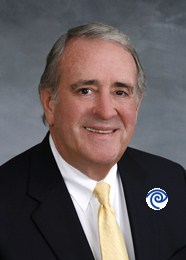
Sen. David Hoyle (D-Time Warner Cable)

After 18 years representing the people of Gaston County, N.C., Senator David Hoyle closed out his ninth and final term in the North Carolina Senate with a disgraceful admission:  He allowed the state’s largest cable company, Time Warner Cable, to draft legislation in his name to thwart competition and allow skyrocketing cable and broadband bills for his constituents.  Worse yet, he admits he’s proud he did it.

Hoyle, who calls himself a “pro-business Democrat,” ignored his own constituents’ interests when he introduced legislation earlier this year that would effectively curtail municipal broadband projects across the state from providing enhanced broadband at significant savings for residents.

Stop the Cap! has covered Hoyle’s water-carrying for the cable and phone companies since he announced his pro-cable legislation and accompanying municipal broadband moratorium.  Our regular reader Tim sent word Hoyle blurted out whose interests he really represented on a Charlotte TV newscast last week.  Not having to answer to voters in a future election gave Hoyle remarkable courage to tell viewers he carried more water for Time Warner Cable than Gunga Din:

When the I-Team asked him if the cable industry drew up the bill, Senator Hoyle responded, “Yes, along with my help.”

When asked about criticism that he was “carrying water” for the cable companies, Hoyle replied, “I’ve carried more water than Gunga Din for the business community – the people who pay the taxes.”

Evidently Hoyle forgot his constituents pay taxes too, along with ever-increasing bills from Time Warner Cable.  With Hoyle’s help, North Carolina’s phone and cable companies hoped to limit competition, guaranteeing future rate increases and higher bills — a Hoyle Tax that consumers across the state would pay indefinitely.

Last December, Hoyle was more high-minded when announcing his imminent retirement from office:

[…]Having had the honor and privilege to serve my community and state in every way that has been asked of me, beginning 45 years ago as mayor of Dallas, it is now the time and the season to welcome the next phase of my life.

After much thought, I have made the difficult decision not to seek re-election to the Senate. While I will not seek re-election, please be assured that I will serve the rest of my term with the same diligence, dedication and integrity with which I have served from my first election. Public service has always been a central part of my life and my commitment to our community and our state remains strong.

Hoyle’s actions prove that his diligence, dedication, and integrity only extend to the businesses that heartily supported him while in office.  That pact protected each others’ interests while trampling yours.

Despite Hoyle’s dogged efforts to place a moratorium on municipal broadband projects in the state, even going as far as to suggest fiber was “obsolete,” several of his colleagues thought better and blocked the attempt.

For consumers in Salisbury, not too far from Charlotte, the good news is fiber optic broadband will outlast memories of a  senator working at the behest of the cable industry.

Fibrant, the city-owned fiber broadband provider, will commence beta testing of its new service in September.  It will deliver broadband service 10 times faster than that offered by Time Warner Cable and AT&T U-verse at highly competitive prices.  Standard 15Mbps service — upstream and downstream — will cost 10 percent less than the competition’s slower services.

Salisbury has spent $50 million to construct the network using bond money that will be paid back from revenue earned by the system.

For Hoyle, spouting traditional industry talking points, that’s a recipe for disaster.  Considering Hoyle raked in substantial contributions from Time Warner Cable, Sprint/Nextel PAC, and telecom lobbyist Parker, Poe, Adams, and Bernstein PAC, among others, voters may wonder whether Hoyle’s anti-municipal broadband declarations were also written by the telecom industry.

Opponents like Hoyle declare earlier municipal broadband efforts have been financial failures for cities.  If so, why the industry fulminates about such “failures” that would hardly threaten them is more than a little curious.

Other opponents claim government cannot do anything right, so they should stay out of the private sector cable business.

This "financial failure" in Dalton, Georgia has cornered 70% of the residential market offering superior service, and keeps $1.5 million in monthly revenues at home in northwest Georgia.

Yet residents in decidedly red-state Dalton, Georgia had more than enough of their free market cable system — Charter Cable.  The community of 38,000 supported a move in 2003 by Dalton Utilities to build a publicly-owned alternative.  They couldn’t install service fast enough, and today Dalton Utilities’ Optilink brings in $1.5 million in revenue every month which stays in Dalton.  The local government option today reaches nearly 70 percent of the residential market and last week was voted 2010 #1 Internet Provider in the Daily Citizen’s Readers’ Choice Awards for the third year in a row.

Opelika, Alabama also rejected the “government can do nothing right” talking point in a referendum to support a fiber to the home network for their community as well.

In reality, although no government is perfect, Americans do trust local government to provide safe drinking water, put out fires, and arrest criminals — all incredibly vital services.  As broadband increasingly joins electricity, gas, phone and water as an essential utility, providing it at unregulated monopoly pricing just isn’t going to cut it any longer.

Hoyle has a future as a paid mouthpiece for the industries he befriends, but more importantly, he’s represents s a teachable moment.  The next time an elected official scoffs at the notion he’s bought and paid for by the companies who write him generous campaign contribution checks, just remember Senator David Hoyle… North Carolina’s first senator from Time Warner Cable, but almost certainly not the last.

[flv width=”432″ height=”260″]http://www.phillipdampier.com/video/WCNC Charlotte Salisbury to test fiber-optic cable system 8-24-10.mp4[/flv]

WCNC-TV in Charlotte got Sen. David Hoyle’s remarkable admission that Time Warner Cable wrote the bill he introduced to stop cable competition for North Carolina consumers.  (3 minutes)

Comcast: We’ve Just Increased Your Speed by 50 Percent… Oh Wait, Never Mind – Not Yours

The Consumerist covers a minor bungle by Comcast, which sent e-mail to a whole mess of their customers heralding a 50 percent speed increase in huge, bold print that was not to be:

Screen shots courtesy of the Consumerist

Customers who waded into the text accompanying the festivities discovered the speed increase was only meant for so-called “Economy Service” customers who were getting upgrades from 1Mbps to 1.5Mbps.  A few days later, the requisite “apology for our error” e-mail was headed out — to the wrong customers:

Screen shots courtesy of the Consumerist

The entire debacle was amusingly chronicled by one of Comcast’s social media representatives:

This email was only meant for folks who have our economy tier of service… except when we sent out the apology, it went to everyone… instead of the folks with economy service.

We messed up, apologized, but messed up the apology by sending out the email to the wrong folks. SO… Apologies for the apology? That sounds weird, but that’s what happened. Not trying to fool anyone with fake promises or anything like that… This is almost like when you accidentally hit reply to all on an email… but on a bigger scale.  — ComcastBonnie

But wait, if the speed increase was intended only for “Economy Service” customers, why would Comcast send the apology to them when they were the customers originally targeted to receive the speed boost?

It makes the head hurt.

Search This Site:

Contributions:

Recent Comments:

Your Account:

Stop the Cap!