Home » Broadband Speed » Recent Articles:

Hy·poc·ri·sy: Frontier Attacks Fiber Project Claiming Municipalities Don’t Know How to Run Them

Sibley County's fiber future?

It takes a lot of chutzpah to vilify a community’s proposed fiber to the home network when you’ve managed to completely screw up the one you’ve acquired from another company, but Frontier Communications tries anyway.

Instead of relying on Frontier’s overpriced (and soon to be rationed) slow speed DSL from an earlier era, Sibley County, Minnesota is proposing a municipally owned fiber project that will bring much needed connectivity to area businesses, homes, and farms.  Community Broadband Networks found a certain phone company in strong opposition.  Frontier warned county officials not to make the mistake of delivering better service than they can provide themselves:

As a provider of telephone, internet, and video services to our customers in the Green Isle, Arlington, and Henderson areas, Frontier Communications is obviously interested in the “fiber to the home” proposal that has been presented. As a nationwide provider, Frontier is aware of other efforts by municipalities of various types to build and operate their own telecommunications network. While these proposals are always painted in rosy tones, it is important for officials to carefully review the underlying assumptions and projections that consultants make when presenting these projects. Unfortunately, history tells us that the actual performance of most of these projects is significantly less positive than the promises. Often times, these projects end up costing municipalities huge amounts of money, and negatively impact their financial status and credit ratings.

Frontier even “runs the numbers” on the county proposal.  But Sibley County should carefully consider the source.  This is the same company that couldn’t manage its fiber to home network it acquired with landline purchases from Verizon Communications.  Instead, this month it dumped $30 rate increases on its fiber customers in the Pacific Northwest and Indiana.

Frontier has a vested interest in maintaining the status quo, which means leaving many rural Minnesotans with one choice for broadband: Frontier.

Of course the company opposes the county’s fiber project — they would be crazy not to, considering it will cost them many of their customers.

Cherry-picking a small percentage of the municipally-owned networks facing difficulties is just a scare tactic, and doesn’t prove their case.  County officials should consider the growing number of projects that are a breath of fresh air for the communities they serve, all at no risk to taxpayers: projects like EPB in Chattanooga, Greenlight in Wilson, or Fibrant in Salisbury — both North Carolina.

Or DSL past?

Those projects all faced the same provider-financed campfire scary stories, too — just because incumbent cable and phone companies didn’t want the competition.

When wild claims about failing projects don’t work, Frontier officials hilariously offered up this absurdity in a story in the Arlington Enterprise that ran Dec. 16.

“What we can do is provide the same speed of service as fiber can provide,” said Todd Van Epps, Frontier’s regional manager.

Really, on Frontier’s pre-existing, decades-old copper wire network?  The same one that Frontier currently sells “blazing fast/up to” 3Mbps DSL service on for $50 a month?

In comparison, the fiber network proposed for Sibley County would deliver at least 20/20Mbps service for less than $50 a month.  That fiber network is infinitely upgradable as well, with service up to 1 gigabit per second if a customer needed that much.

Our advice when dealing with Frontier’s promises: get them in writing.

When a company tells customers to throw away their Frontier FiOS fiber and switch to a competitor’s satellite television service or else pay $30 more per month for basic cable, their helpful advice about how to manage the fiber business should be taken with a grain of salt.

The State Time Warner Cable Forgot: South Carolina’s Yesterday Broadband

Phillip Dampier January 24, 2011 Broadband Speed, Consumer News 6 Comments

While Time Warner Cable trumpets upgraded broadband services in many of the states it provides service, South Carolina and some other southeastern areas are the exception.

Stop the Cap! reader Brett writes Time Warner’s broadband experience in South Carolina is so four years ago.

“Check out the paltry speeds that Time Warner Cable offers in Columbia. As far as I can tell we are the slowest region around.  The very best package they offer, with PowerBoost, is 10Mbps for downloads, 512kbps for uploads,” Brett writes.  “How sad.”

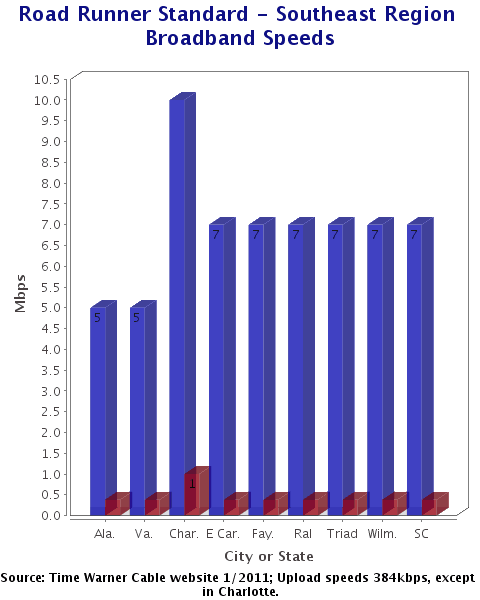
Most Columbia customers get less than that.  The standard Road Runner package has been stuck at 7Mbps down and 384kbps for some time.

While broadband speeds have not changed, the rates have.  Time Warner Cable announced rate increases throughout the Carolinas in December, boosting prices for many services.

Time Warner Cable spokeswoman Rose Dangerfield said needed upgrades were part of the reason for the rate increase.

“The company spent $380 million in the past year to upgrade equipment in South Carolina and North Carolina,” she said.

A review of Time Warner Cable’s speeds in the Carolinas and the states of Virginia and Alabama makes one wonder where the money went, because Brett shares company with other customers across most of the region.

Bray’s Back: Getting a Reality Check on West Virginia’s Broadband Picture

[flv]http://www.phillipdampier.com/video/WOWK Charleston Frontier vs CityNet Pt 1 12-11-10.mp4[/flv]

DecisionMakers: Frontier vs. Citynet, Part One  (10 minutes)

Bray Cary

Bray Cary, who runs a Sunday news-talk-interview show on his network of West Virginia-based television stations, turned his attention back to the mediocre broadband picture across the state.  Once again, the “free market can do no wrong”-host showered attention and praise on Frontier Communications for their promises to improve West Virginia’s bottom-of-the-barrel rankings in broadband adoption, availability, and speed.  Only this time, one of his guests took him to school on why Frontier Communications is not the state’s broadband savior.

In this round, Cary invited Frontier’s senior vice president Dana Waldo and Citynet president and CEO Jim Martin to discuss where the state’s broadband is today and where it is going tomorrow.

The community of French Creek can't get Frontier broadband even after promising the company dozens of new broadband customers.

Cary wears his opinions on his sleeve, and he’s no fan of the Obama Administration’s broadband stimulus program, believing private companies will deliver West Virginia from its broadband doldrums. That’s wishful thinking Cary can afford as he browses the web from well-wired cities like Charleston.  But if you live in a community like French Creek in Upshur County, that talk isn’t going to get you broadband from Frontier or anyone else.  Stop the Cap! has heard from residents in the community who have delivered petitions from dozens of residents ready and willing to sign up for -any- broadband service, but Frontier hasn’t responded.

Martin opines that as long as stimulus money is available, using it to get the best bang for the buck could improve service for residents from the Panhandle to the Virginia border, instead of simply improving Frontier’s bottom line.

Cary did seem concerned that Frontier was ill-equipped to deliver service to all residents, regardless of cost.

Martin argues Frontier’s broadband network will do nothing to stimulate competition and bring better service.  Martin wants funds redirected into a robust middle-mile statewide backbone, preferably fiber-based, that is open to all-comers at reasonable wholesale pricing.  Citynet has been aggressively complaining about broadband stimulus grants in the state which seem to benefit a handful of companies and projects that don’t actually result in service to individual residents.

The reality is, Cary’s “free market” approach will not deliver service to tens of thousands of West Virginians who will never get wired because of “return on investment” requirements for service in the mountainous state.  Martin’s middle-mile mentality won’t bring access to the last mile, critical for wiring individual homes, either.  But one thing Martin does see that Frontier doesn’t — fiber is the future.

There is a third way to get service without waiting from Frontier’s 1-3Mbps service with an Internet Overcharging scheme or Martin’s middle-mile network that goes past your home but never stops there — petition your local government to empower itself and build a community-owned network that answers to residents, not to Frontier’s dividend-obsessed shareholders.

[flv]http://www.phillipdampier.com/video/WOWK Charleston Frontier vs CityNet Pt 2 12-11-10.mp4[/flv]

DecisionMakers: Frontier vs. Citynet, Part Two  (9 minutes)

Knology Retains Internet Overcharging Ripoff for Lawrence, Kansas Customers

"If you have to ask how much, you can't afford it."

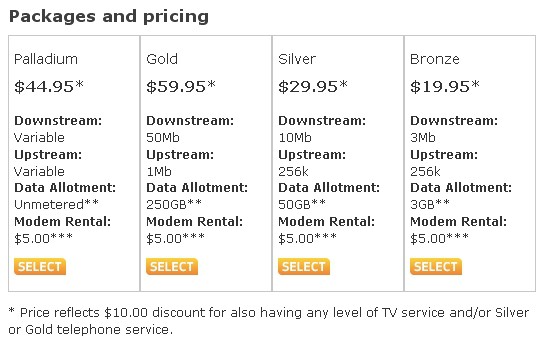
Knology, which bought out Sunflower Broadband last year, has elected to carry forward the old owner’s Internet Overcharging schemes, charging broadband customers penalty rates for exceeding their usage allowances.

The company’s explanation for their overpriced bandwidth comes with a tall tale about their competitors they simply made up out of thin air:

Data transfer allotments allow Knology to offer higher speed service with lower prices. Unlimited, open usage plans offered by other providers typically employ network controls to slow down the high usage customers.

That’s news to us, and to their nearest competitor AT&T.  They deny speed throttling any of their U-verse or DSL customers.

While the company’s download speeds are impressive — up to 50Mbps — their upload speeds are not, topping out at a paltry 1Mbps.

Knology's pricing is nearly identical to its predecessor Sunflower Broadband, except for the $5 rate hike for its most popular Silver plan.

Knology claims they expand usage allowances based not on network capacity, but by the percentage of customers they gouge with overlimit fees:

Data transfer allotments: Each level of internet above includes the amount of data transfer indicated measured in Gigabytes (GB). The data transfer allotments are increased regularly, based on usage patterns, to ensure the number of customers who go over their allotments remains under 10%. Additional GB of data transferred beyond the allotment is billed at $1.00 per GB if not purchased at a discount before the end of the billing period. The percentage of Knology customers charged for extra data transfer beyond their allotment was 6.1% in April 2009.

Paul Bunyon, Knology's new director of marketing

Bemusingly, customers with time machines who can travel into the future and determine they will exceed their allowance for the month can pre-purchase an increase in their usage allowance at a discount.

No time machine?  Then you either pay the standard overlimit rate, watch your usage like a hawk, or potentially over-buy excess usage that expires at the end of the month.

Customers tell Stop the Cap! the company’s single, unlimited use package is “the same piece of garbage it always was,” writes Larry who lives in Lawrence.  He had high hopes Knology would do the right thing and abandon Sunflower’s overcharging schemes.

“Apparently not, and after a month with their unlimited service, I have scheduled my U-verse installation with AT&T,” Larry writes. “Even on Knology’s limited packages, they don’t provide the speeds they promise.”

Larry also says the higher speed tiers Knology offers deliver diminishing returns.

“If their uplink is congested, or the web sites you visit are busy, it won’t matter if you have 10Mbps or 50Mbps — the speed is effectively the same,” he says. “Besides, upload speed is more important these days and 1Mbps is just plain lousy in 2011.”

“Bye, bye SunKnology.”

Sunflower's Old Broadband Plans & Pricing (February 2010)

Saginaw, Mich.: Another Wireless ISP Faces Down Usage Growth By Implementing 5GB Usage Limit

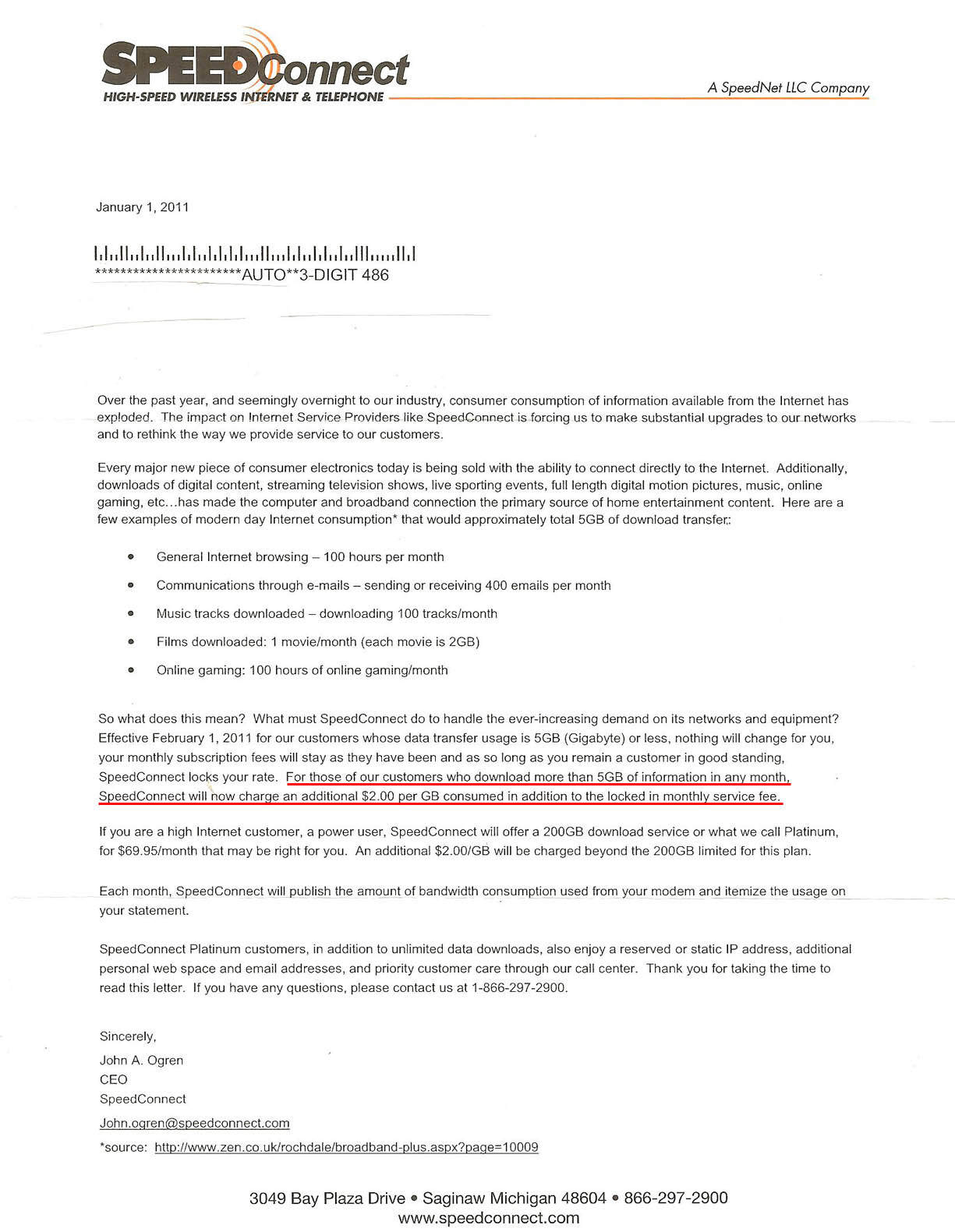
A wireless ISP (WISP) serving parts of Michigan and eastern Iowa has informed customers that due to their enthusiastic use of the Internet, the company was slapping a 5GB monthly usage limit on customers effective Feb. 1.

SpeedConnect, based in Saginaw, Mich., informed customers in a letter that those who exceed the company’s new usage limit face a penalty overlimit rate of $2.00 per gigabyte.  An alternative 200GB “Platinum” monthly usage plan, including phone service, was also announced for $69.99 per month.

That’s a steep rate increase for customers accustomed to receiving around 3Mbps download x 384Kbps upload speeds for $39.95 per month.

Too much for our reader Greg, who says he has been a SpeedConnect customer for the last decade.

“Ouch,” Greg writes.  “I’m changing ISPs over this.”

Company officials blame the usage limits on usage growth.  The company’s letter states, “[growth] is forcing us to make substantial upgrades to our networks and to rethink the way we provide service to our customers.”

Now customers will rethink using SpeedConnect for their Internet access.

SpeedConnect's letter to customers.

SpeedConnect’s attempt to collect upgrade funds from their customers, which the company admits are increasingly turning to broadband for home entertainment and information, comes at the same time the company had no trouble dipping into the kitty to buyout CommSpeed of Arizona’s 2.5GHz spectrum holdings and customers based in Eastern Iowa.

Saginaw, Mich.

AT&T DSL is one alternative.

The same CEO that signed the letter telling customers to use less of their service or pay dramatically more was thrilled about “the exciting new chapter” its merger/acquisition would open.

“The completion of this acquisition is a significant event for our customers, communities, investors, and employees,” said John A. Ogren, President and Chief Executive Officer.

Saginaw residents are not well-served by AT&T, which has left major gaps in the economically-stressed region’s broadband coverage options.  We had a hard time finding landlines in Saginaw and nearby townships pre-qualified for AT&T DSL to offer a price comparison.  After much searching, we discovered AT&T heavily markets DSL Pro ($35/$19.95 new customer promo price for one year) which delivers 3Mbps/512kbps service, or Elite ($40/$24.95 new customer promo price for one year) which offers 6Mbps/768kbps service to those who -can- get the service.

AT&T’s Pro plan delivers comparable speeds at lower prices than SpeedConnect charges, all with no usage limits.  Users seeking higher speeds can use them without fear of overlimit penalties or a $70 broadband bill using AT&T’s Elite DSL plan.

SkyWeb is the other.

Greg also notes he has another wireless option, as do many residents and business across central Michigan’s Tri City area, from SkyWeb, which delivers wireless access at speeds ranging from 3-10Mbps.  The company does not limit usage and offers new customers a month of free service.  A comparable package of services from SkyWeb at 3Mbps is priced $10 less than what SpeedConnect charges.

Wireless ISPs have unique problems trying to keep up with usage demands:

  1. Many are individually owned and operated and lack sufficient capital to invest in required upgrades to meet today’s Internet multimedia reality;
  2. Many WISPs serve rural areas where growth opportunities are often limited;
  3. A few very heavy users could create significant strains on a wireless network that is not infinitely expandable;
  4. The arrival of competition from telephone, cable, or even cell-phone wireless data plans can present a major threat to the business plans of some providers.

[flv width=”384″ height=”236″]http://www.phillipdampier.com/video/WNEM Saginaw Air Advantage Broadband Grant 9-2010.flv[/flv]

WNEM-TV covered Air Advantage, another regional WISP that won a broadband stimulus grant last fall to expand wireless access in mid-Michigan.  (2 minutes)

Search This Site:

Contributions:

Recent Comments:

Your Account:

Stop the Cap!