Home » Broadband Speed » Recent Articles:

Sprint Customers’ Treatment of 4G WiMAX: So Unimpressive They Shut It Off to Save Battery Life

Sprint’s 4G experience has been nothing to write home about for a number of their customers, who are increasingly disabling the service to save on battery life.

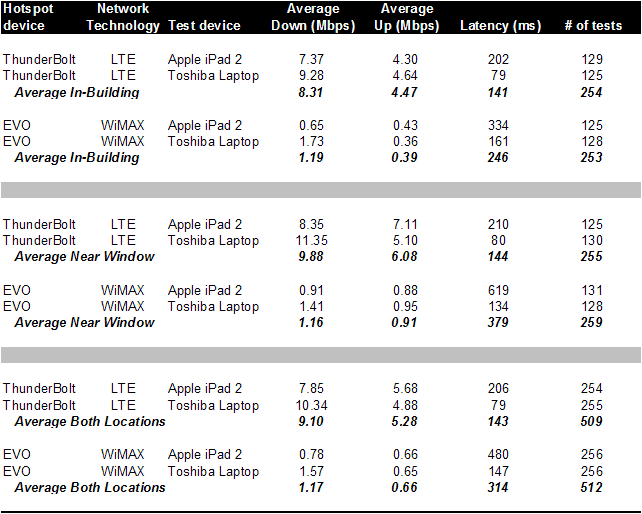
Speed tests of Sprint’s 4G WiMAX experience show increasingly unimpressive results, as the network grows exponentially more crowded with customers trying to capitalize on the higher speeds 4G is supposed to deliver.  The result?  BTIG Research in April found, after exhaustive testing, the average Sprint 4G customer was now getting around 1/1Mbps service from a network that promised to deliver speeds many times that.

This isn't even a contest. (Source: BTIG Research)

Now an increasing number of customers are simply switching the 4G service off completely to extend battery life.

Doug Mahoney, a contributing editor for TechZone360, says he has about given up on WiMAX:

WiMAX tends to stay turned off so I run 3G and there’s no big differences in the convenience of reading email or using simple apps like Twitter and Foursquare.  With more public places starting to offer free WiFi, the case for WiMAX — or LTE — on a smart phone starts to grow weaker between the extra cost and the battery life issue.

Mahoney complains Sprint’s 4G network is simply not robust enough to support consistent speeds and access.  In suburban Washington, he compares Sprint’s 4G coverage to an open air tree, with spotty service scattered across the region.  As a result, his 4G phone spends a lot of time desperately-seeking-signal — a process that accelerates battery depletion.

Given Sprint’s WiMAX “tax” of an additional $10 a month for the service, Mahoney isn’t so certain he’d pay it again on a future Sprint phone.

Are the same speed reductions in store on Verizon’s currently-lightning-fast LTE 4G network few customers use right now?  Perhaps, but Verizon’s brand may force the company to make sure coverage is much stronger than what Sprint customers currently tolerate:

LTE has the same power consumption issues as WiMAX. I suspect Verizon will have better, more ubiquitous LTE coverage just due to the characteristics of the 700 MHz spectrum and physics involved, so I should have faster broadband available in more places rather than the abstract green tree coverage map.

Cricket Drives Away Mobile Broadband Customers With Internet Overcharging Scheme

Phillip Dampier August 4, 2011 Audio, Broadband Speed, Competition, Cricket, Data Caps, Wireless Broadband Comments Off on Cricket Drives Away Mobile Broadband Customers With Internet Overcharging Scheme

Leap Wireless is trying to save face on less-than-impressive second quarter financial results showing the company is losing its mobile broadband customers who are increasingly weary of Cricket’s price increases and speed throttles.

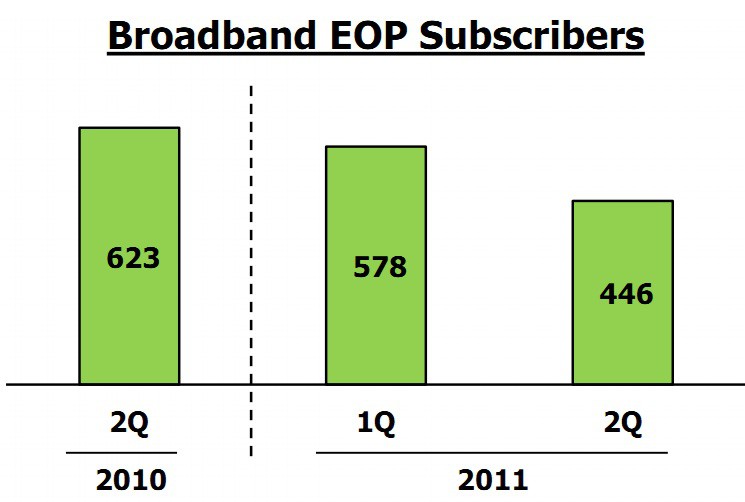
The company lost at least 132,000 broadband customers since the first quarter, mostly due to price increases, reduced usage allowances and “network management” practices, which reduce speeds to near dial-up for customers who are deemed to be “using too much.”

“On broadband, we tightened our focus to more profitable customers while shedding less profitable ones,” said Leap Wireless CEO Douglas Hutcheson.

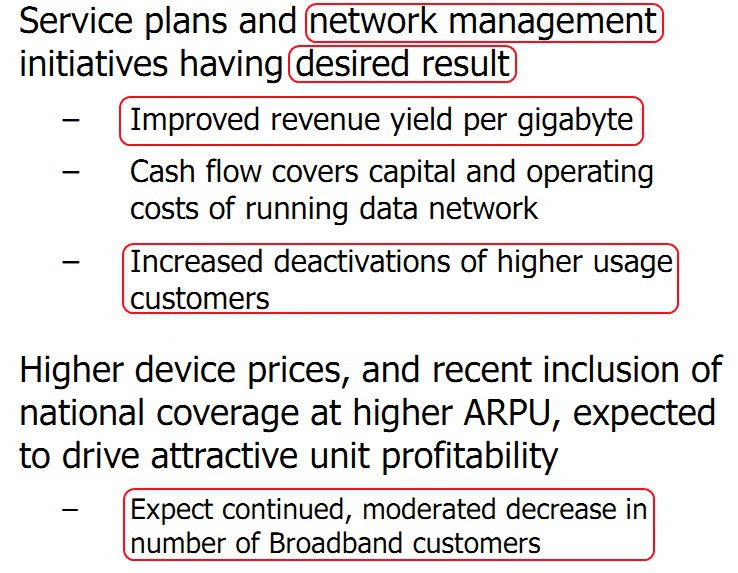
Internet Overcharging Facts of Life: What 'Network Management' tools are really used for. (Courtesy: Cricket's Second Quarter Results Investor Presentation)

Cricket recently announced increased pricing on their usage limited plans: $45/month for 2.5GB, $55/month for 5GB, or $65/month for 7.5GB.

With a less-than-robust regional 3G network and higher pricing, broadband customers have decided to take their business elsewhere, despite the company’s recently announced expanded data roaming agreement with Sprint.

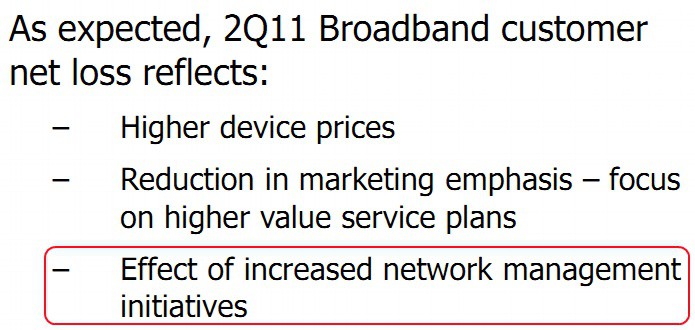
Cricket acknowledges their “increased network management initiatives” are partly to blame for the loss, but the company also says increased prices for mobile broadband devices, which used to be available for free after rebate, are also responsible.  Cricket’s least expensive mobile broadband modem now runs just under $90.

Company officials told investors the losses “were expected,” and that the company has been trying to make up the difference with higher value smartphone data plans.  Mobile broadband customers tend to consume more data than smartphone users, so the company’s emphasis on smartphone data users, who use less, will deliver increased revenue at a reduced cost.

Cricket’s CEO explains the company’s renewed focus on keeping highly-profitable mobile broadband customers while effectively getting rid of “heavy users” who have been targeted with aggressive speed throttling over the past year, and now face higher prices for lower usage allowances. Also explored: Cricket’s future 4G LTE network buildout.  August 3, 2011.  (4 minutes)
You must remain on this page to hear the clip, or you can download the clip and listen later.

Cricket's declining mobile broadband business

In fact, the company’s presentation to investors credits network management tools for driving away “higher usage customers,” allowing Cricket to reap the benefit of “improved revenue yield per gigabyte.”  In short, that means Cricket profits handsomely from data plans they hope customers will only occasionally use.

One of Cricket’s biggest product priorities this year is pitching its Muve Music service, bundled into an all-inclusive $55 wireless prepaid phone plan.  It gives Muve phone customers unlimited access to an enormous downloadable music library accessed on the phone.  Since the service does not allow customers to transfer the music to other devices, record companies are happy to participate.

The biggest downside for some is that the Muve phone becomes your music player — a phone many customers consider a work in progress.  Some critics have labeled the service a “total fail” because of sound quality and DRM restrictions. But since the service is already bundled into the wireless plan at no additional cost, more than 100,000 customers are using it, downloading at least 130 million songs since it was first introduced in January.

Muve Music is another way Cricket is trying to differentiate itself from other wireless providers, and the company may try to expand the Muve Music service to much-more-profitable smartphones in the near future. Cricket hopes to begin selling no-contract smartphones at prices below $100 by Christmas.

Cricket executives answer questions from Wall Street about how the company intends to deal with a decline in mobile broadband customers, and explains their use of network speed throttles. Cricket plans to “follow industry trends” and experiment with “session-based” throttles sometime next year. These allow customers to pay an extra charge to temporarily remove the speed throttle when they need additional bandwidth. It’s just one more source of lucrative revenue from conjured up network management schemes.  August 3, 2011.  (4 minutes)
You must remain on this page to hear the clip, or you can download the clip and listen later.

Cricket is also planning further expansion of its ‘welfare wireless’ plan — a Universal Service Fund-backed home phone replacement for customers receiving public assistance.  The Lifeline USF subsidy is designed to provide affordable home telephone service to the most income-challenged among us.  Many landline providers charge around $1 a month for the service (before fees), and then charge for every call made.

Cricket’s implementation of this subsidy could draw some controversy because it delivers a $13.50 monthly discount off -any- of their rate plans.  That means qualified customers could pay just over $40 a month for a high end smartphone service plan, subsidized by every telephone ratepayer in the country.

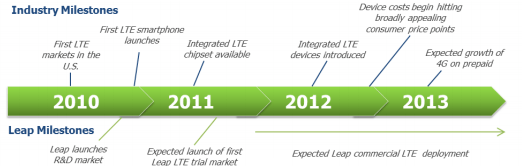
Cricket also plans to launch LTE 4G service starting in early 2012.

Cricket plans to introduce 4G LTE service in 2012.

Nice Try: Media Sells Rural Massachusetts Residents on Fiber Broadband They Won’t Get

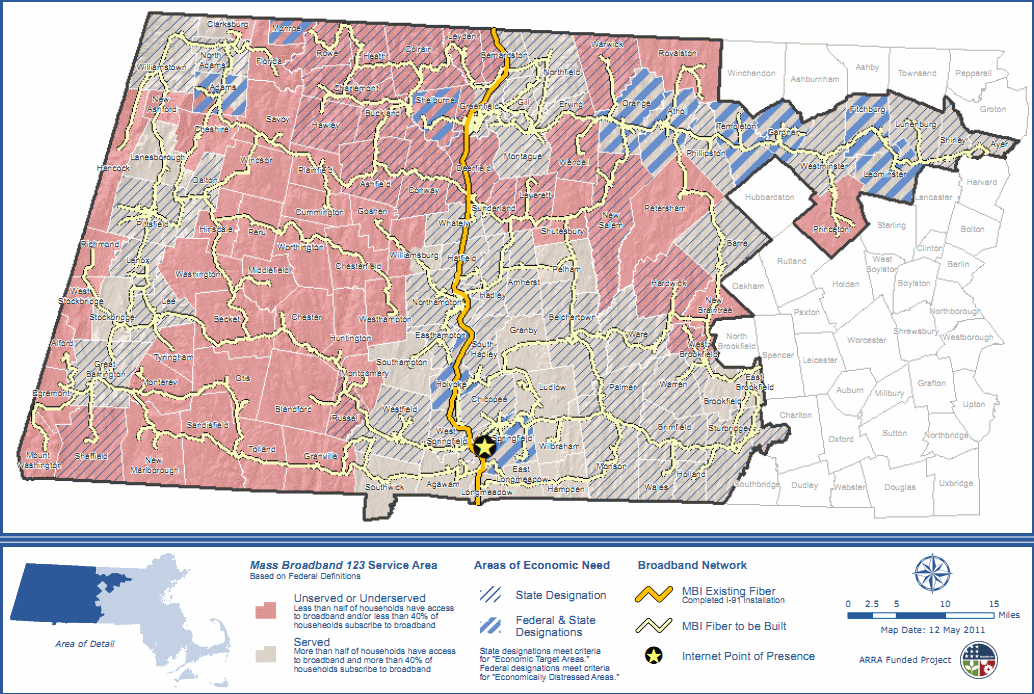
For the past two years, we’ve watched a lot of expansive fiber broadband projects get promoted by local media as broadband nirvana for individual homes and businesses that are either stuck with molasses-slow DSL or no broadband at all. Now, we’ve found another, sold by Springfield, Mass. media as salvation from Verizon’s ‘Don’t Care’ DSL for western Massachusetts.  But will the 1,300 miles of fiber actually reach the homes that need a broadband boost?

[flv width=”640″ height=”380″]http://www.phillipdampier.com/video/WSHM Springfield Broadband in Berkshires 7-26-11.mp4[/flv]

WSHM-TV in Springfield covered the start of MassBroadband 123’s fiber optic project as the solution to rural broadband woes in western Massachusetts.  But most residents won’t actually get to use the new network, at least initially.  (2 minutes)

Last month, Gov. Duval Patrick joined public officials and firefighters at the Sandisfield Fire Department to kick-off construction of the MassBroadband 123 fiber-optic network project to expand broadband access to more than 120 communities in western and north central Massachusetts.
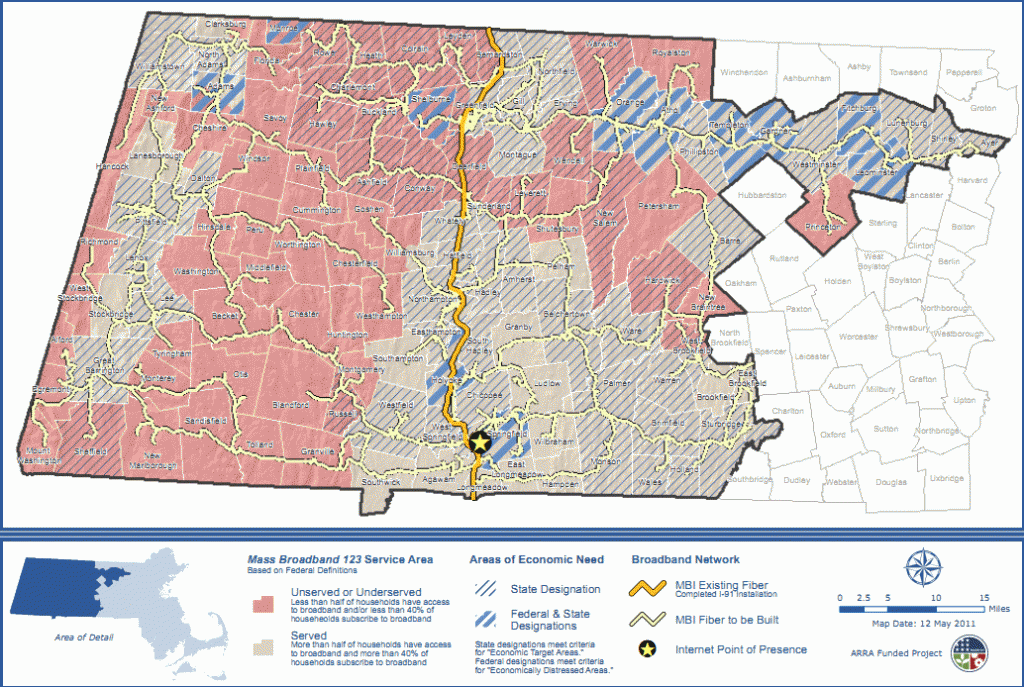
MassBroadband 123 Service Area (click to enlarge)

“For too long, families and businesses in western Massachusetts have lived without reliable and affordable high-speed Internet access,” said Governor Patrick. “Today, as we commence the installation of more than 1,000 miles of fiber-optic cable across the region, we start the critical final step in delivering broadband access to everyone. The digital divide in Massachusetts is about to close.”

Don’t hold your breath.

Don’t get me wrong.  The Massachusetts Broadband Institute means well.  Judith Dumont, the group’s director, is well-aware of the challenges rural Massachusetts has getting 21st century broadband.  She’s helping to oversee the construction of an enormous middle-mile, fiber backbone network that will eventually reach those ten dozen communities.  But much of the funding for the project precludes the possibility of directly wiring that fiber to the people who actually need it.  The incumbent providers’ lobbyists have seen to that, broadly warning it would represent ISP Socialism to allow government money to deliver service to homes and businesses — customers they themselves claim to be committed to serve.  But ask any resident in Sandisfield how well they manage that.

Gov. Patrick splices fiber cable at inauguration ceremony for fiber expansion project. (Courtesy: MBI)

A good part of upgraded broadband on the way in the Berkshires will be provided to government institutions like local government, public safety, schools, and libraries.  There is nothing wrong with that either, but when local media blurs this distinction into belief fiber-fast Internet access is on the way to Mr. & Mrs. Jones living on Maple Street, they do a real disservice to the cause for better broadband.

Dumont optimistically believes that opening the state’s fiber network to incumbent providers on a wholesale basis will dramatically help the pervasive problem of reaching rural customers.  Unfortunately, this has simply not been our observed experience watching these projects develop.  The “last mile” problem doesn’t get solved with the existence of a middle mile network, because providers are rarely willing to invest in the construction costs to wire the unwired.  Political and business matters too often get in the way.

Cable companies frequently boycott participation in these networks, and phone companies like Verizon Wireless -may- utilize them for backhaul connectivity to their cell towers, but don’t expect to see lightning-fast Verizon FiOS fiber to the home service springing up anytime soon in western Massachusetts, even if fiber connectivity is provided just a mile or so up the street.  If they didn’t build it themselves, many providers just are not interested.

“Last mile” is often the most expensive component in a broadband network.  It’s the part of the project that requires digging up streets and yards, stringing cables across phone poles, and literally wiring the inside and outside of individual homes and businesses.  Verizon FiOS works in densely populated areas where large numbers of potential customers are likely to deliver a quick return on investment in the network.  But Wall Street has always disagreed, declaring the capital costs too high to make sense.  AT&T won’t even match Verizon’s commitment, relying instead on fiber-to-the-neighborhood networks that deliver access over a more modern type of DSL, delivered on fiber to copper wire phone lines already in place.  That’s their way of not spending money rebuilding their own last mile network.

Wireless ISPs are expected to take advantage of the state's new middle-mile network.

If any part of the broadband network in rural America needed subsidies, the “last mile” is it.  But Washington routinely delivers the bulk of federal assistance to the construction of middle mile networks and institutional broadband that doesn’t deliver a single connection to a homeowner or business.  That suits incumbent providers just fine, judging from their lack of interest in applying for broadband subsidy funding made available two years ago and their hard lobbying against community broadband networks, or anything else smacking of “competition.”

Thus far, the limited grants that are available for “last mile” projects require substantial matching funds and are often limited to $50,000 — a ridiculously low amount to solve the “last mile” challenge.  Those trying are primarily fixed wireless providers valiantly attempting to serve the areas DSL and cable forgot, but deliver woefully slow speeds at incredibly high prices.  WiSpring, one such Wireless ISP, wants to expand coverage with the help of the new fiber network.  But their top advertised wireless speed for residential customers is 1.5Mbps, and that will set you back $100 a month after a $500 installation charge.  Oh, and their customer agreement limits use to 25GB per month with a $10/GB overlimit fee.  That’s hardly the kind of broadband solution a multi-million dollar fiber network should bring to individual consumers.  It’s as frustrating as filling a pool, one cup of water at a time, with an eye-dropper.

Now imagine if a quarter of the state’s $40 million investment in broadband — $10 million, was spent physically wiring individual homes with fiber broadband.  Would that make a bigger splash in the lives of ordinary consumers than a middle mile network they cannot directly access?  Is construction of a state-of-the-art fiber network a good investment when many of the providers scheduled to use it are Wireless ISPs delivering bandwidth suitable for e-mail and basic web browsing only?

In West Virginia, we learned last month the state is swimming in middle mile stimulus grant money it can’t spend fast enough on behalf of institutions — many who either already have super fast service or can’t afford the Cadillac pricing that represents the ongoing service charges not paid for by grant funds.  Is this a good way to spend tax dollars?

Communities large and small need to think big when it comes to broadband.  Building a middle mile network does not by itself solve the access problem.  It’s a fine start, but absolutely requires a follow-up commitment to solve the last mile problem.  Here are our recommendations:

  1. Demand the federal government eliminate restrictions on the kinds of network projects that can built with stimulus funds, especially those that prohibit investment in last-mile networks;
  2. Don’t believe for a moment large cable and telephone companies will bring better broadband to consumers just because you have a middle mile network.  Historically, they have lobbied hard against last-mile projects they do not own or control, and fund conservative political groups to oppose your community’s right to develop and govern your own broadband future;
  3. If incumbent providers won’t provide the service your community needs, consider exploring the possibility of doing it yourself.  Just as MBI contracts the wholesale part of its service out to a third party to administer, nobody says the village clerk has to be a billing agent for a community broadband service that directly serves your residents;
  4. Involve local citizens in rallying for better broadband instead of sitting around and waiting for the local phone or cable company to provide it.  They won’t.  It’s a simple matter of economics for them – will they get a sufficient return on their investment within five years? If not, you are not getting improved broadband.  That works for them but doesn’t work for your community, and providers have made it clear most of the networks they intend to build are already built.  That leaves a lot of communities behind.
  5. While wireless may be an answer for the most rural or difficult-to-reach homes, it is not a realistic solution for 21st century broadband inside village or town limits.  Wireless networks often lack the capacity to sustain the growing demand for multimedia, high-bandwidth content that is becoming more important for today’s online experience.  When a provider limits usage to 25GB a month, that’s a big problem for any community that will soon find itself stuck in a broadband swamp while the rest of the country passes it by.
  6. The biggest financial challenges seem to come to those who think small about broadband projects.  Don’t rely on yesterday’s technologies for tomorrow’s networks.  Fiber-based broadband will deliver the best bang for the buck and is infinitely upgradable.  That’s why rural phone companies and cooperative telecom providers are constructing fiber networks themselves.

[flv width=”640″ height=”380″]http://www.phillipdampier.com/video/WGBY Springfield The State Were In Judith Dumont 7-11.mp4[/flv]

WGBY-TV in Springfield talked with Judith Dumont about western Massachusetts’ broadband future.  (19 minutes)

White Space Wi-Fi: 802.22 Benefits Rural Providers, Not Home Wi-Fi Users

Phillip Dampier August 2, 2011 Broadband Speed, Consumer News, Editorial & Site News, Public Policy & Gov't, Rural Broadband, Wireless Broadband Comments Off on White Space Wi-Fi: 802.22 Benefits Rural Providers, Not Home Wi-Fi Users

An example of an 801.22 Wireless Regional Area Network

The mainstream media and technology blogs have been running away with coverage about the IEEE’s recent approval of the so-called “white space” 802.22 wireless standard with stories of up to 100 kilometers of wireless coverage for home Wi-Fi over unused UHF television channels.  The thought of installing a router that can deliver reception of your personal broadband connection for up to 62 square miles sounds very exciting, but don’t get as carried away as some media outlets have.

The truth is, 802.22 benefits wireless providers, not consumers (unless you happen to receive your Internet service from a commercial provider over this technology.)

The new standard was designed to benefit Wireless Regional Area Networks (WRANs).  In general terms, this means Wireless Internet Service Provider (WISPs), who are most likely to adopt the new technology to enhance wireless service over long distances in rural areas not covered by DSL, cable broadband, or other wired networks.  To achieve the maximum amount of coverage noted in the popular press, providers will need to utilize specialized transmitters using antennas considerably higher than what one would find in a home environment.

Unlike today’s Wi-Fi networks, 802.22 uses much lower frequencies which tend to propagate over longer distances.  Using frequencies in the Megahertz range instead of the Gigahertz range makes it much more likely ground-based wireless signals will penetrate buildings and reach across the rural landscape.

To accommodate “white space” wireless, the Federal Communications Commission last year approved the use of unused broadcast channels for these data transmissions.  But providers will not simply be able to fire up their white space Wi-Fi network just anywhere.  The standard includes a provision that will automatically register the exact location of each transmission site with a central coordinating body.  Providers must agree to vacate channels if harmful interference to licensed broadcasters is “sensed” by the technology, and even though multiple operators may be able to operate concurrently in an area at the same time, there are important limitations on how many available “white space” channels will exist in different television markets.

Realistically, the most sensible implementation of 802.22 will come in very rural areas with few, if any, local broadcast signals to contend with.  If the FCC has its way, a considerable amount of the so-called “white space” will be sold off to America’s largest cell phone companies, leaving even fewer channels open for this kind of wireless broadband.  In large urban markets, it’s doubtful many channels will be available for 802.22 use, if any at all.  Currently, the FCC dictates these networks cannot operate on an occupied broadcast channel, or the adjacent channels on either side.  That means if your city has a station on channel 31, these networks cannot use channels 30, 31, or 32.

Another problem is the available bandwidth for individual users.  Each “channel” has 6MHz of bandwidth, which can realistically provide 12Mbps service to a single user.  The IEEE specifies a maximum speed of 22Mbps, but that is more theoretical than actual when taking into account the longer distances average customers will be from the transmitter.  Providers will almost certainly pack each channel with multiple users.  A dozen customers concurrently using the service would probably get around 1.5Mbps on average (384kbps upstream), assuming nobody saturates the channel at maximum speeds. That is equivalent to some rural DSL providers.  Should providers “oversubscribe” the network, and dozens of customers try and use the service at the same time, speeds could drop precipitously.  The further users are from the transmitter, the lower the speeds they will receive regardless of how many users are on the network at that time.

To handle demand, one solution is to run multiple transmitters to handle the traffic, but how many transmitters can operate will depend on how much “white space” is available.  That is why this technology is best suited for rural areas where UHF television signals, and customers, are few and far between.

Home Wi-Fi users will need to wait for the development of a different standard — 802.11af — to take any advantage of “white-space” Wi-Fi, sometimes called White-Fi or “Super Wi-Fi.”

Since the much used 2.4 GHz band for Wi-Fi is congested in urban areas, IEEE 802.11af can provide additional open frequencies for home users.  But most 802.11af home equipment will operate at considerably lower power and range, and will suffer some of the same bandwidth limitations created by narrow channel spacing.  An even bigger problem will be available channel space.  The same urban areas experiencing over-congested Wi-Fi will also likely have the largest number of operating television signals, limiting the use of this technology.

Some theorize White-Fi wireless will not be of much use to home broadband users at all, instead opening up connectivity for devices we might not normally associate with wireless connectivity.  A home security system could plausibly work well with limited bandwidth.  So could home electronic devices that want to communicate their status.  A washer and dryer could use the technology to communicate with each other to synchronize completion time and signal the homeowner that their laundry is ready.  Home weather stations could deliver data over longer distances, refrigerators could signal owners they need to be restocked, and so on.

If you are waiting for wireless broadband nirvana, unfortunately there is not much to see here with these developments.  Increasing usage demands continue to make wireless among the least suitable technologies to deliver the substantial-sized data pipeline broadband consumers increasingly require.

‘Measuring Broadband America’ Report Released Today: How Your Provider Measured Up

Phillip Dampier August 2, 2011 AT&T, Broadband Speed, Cablevision (see Altice USA), CenturyLink, Charter Spectrum, Comcast/Xfinity, Consumer News, Cox, Frontier, Mediacom, Online Video, Public Policy & Gov't, Rural Broadband, Verizon Comments Off on ‘Measuring Broadband America’ Report Released Today: How Your Provider Measured Up

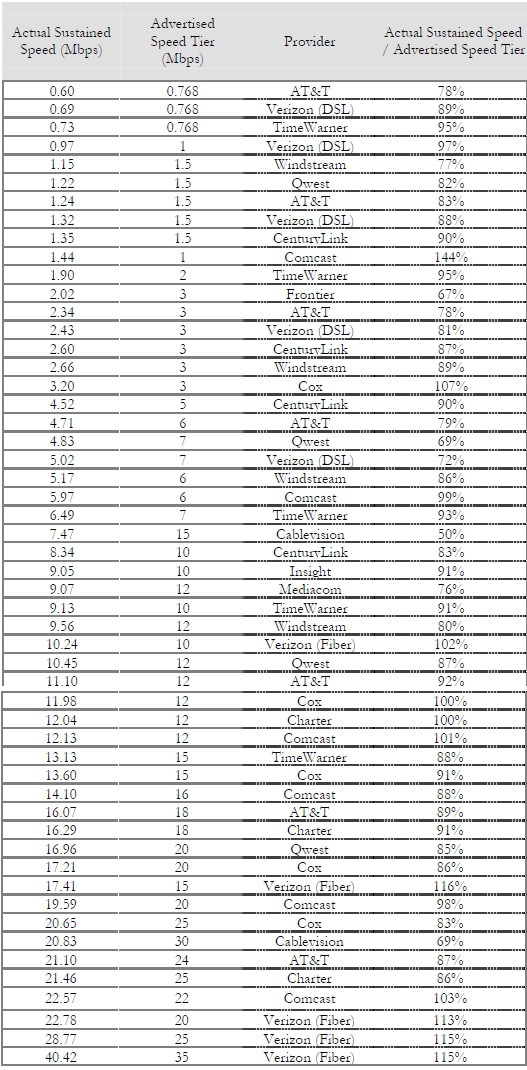
The Federal Communications Commission today released MEASURING BROADBAND AMERICA, the first nationwide performance study of residential wireline broadband service in the United States.  The study examined service offerings from 13 of the largest wireline broadband providers using automated, direct measurements of broadband performance delivered to the homes of thousands of volunteers during March 2011.

Among the key findings:

Providers are being more honest about their advertised speeds: Actual speeds are moving closer to the speeds promised by those providers.  Back in 2009, the FCC found a greater disparity between advertised and delivered speeds.  But the Commission also found that certain providers are more likely to deliver than others, and certain broadband technologies are simply more reliable and consistent.

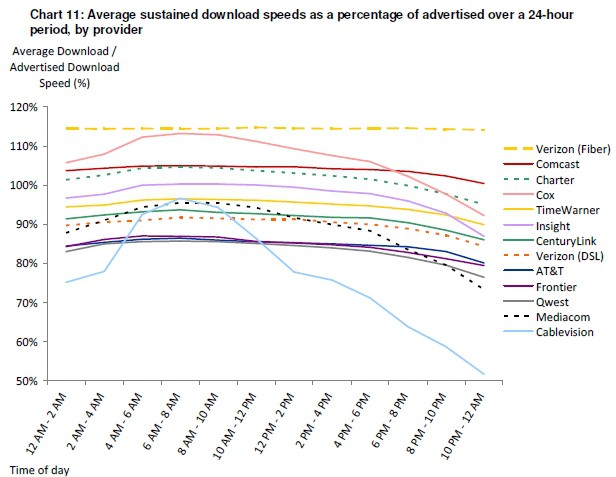
Fiber-to-the-Home service was the runaway winner, consistently delivering even better speeds than advertised (114%).  Cable broadband delivered 93% of advertised speeds, while DSL only managed to deliver 82 percent of what providers promise.  Fiber broadband speeds are consistent, with just a 0.4 percent decline in speeds during peak usage periods.

Cable companies are still overselling their networks.  The FCC found during peak usage periods (7-11pm), 7.3 percent of cable-based services suffered from speed decreases — generally a sign a provider has piled too many customers onto an overburdened network.  One clear clue of overselling: the FCC found upload speeds largely unaffected.

DSL has capacity and speed issues.  DSL also experienced speed drops, with 5.5 percent of customers witnessing significant speed deterioration, which could come from an overshared D-SLAM, where multiple DSL customers connect with equipment that relays their traffic back to the central office, or from insufficient connectivity to the Internet backbone.

Some providers are much better than others.  The FCC found some remarkable variability in the performance of different ISPs.  Let’s break several down:

  • Verizon’s FiOS was the clear winner among the major providers tested, winning top performance marks across the board.  Few providers came close;
  • Comcast had the most consistently reliable speeds among cable broadband providers.  Cox beat them at times, but only during hours when few customers were using their network;
  • AT&T U-verse was competitive with most cable broadband packages, but is already being outclassed by cable companies offering DOCSIS 3-based premium speed tiers;
  • Cablevision has a seriously oversold broadband network.  Their results were disastrous, scoring the worst of all providers for consistent service during peak usage periods.  Their performance was simply unacceptable, incapable of delivering barely more than half of promised speeds during the 10pm-12am window.
  • It was strictly middle-of-the-road performance for Time Warner Cable, Insight, and CenturyLink.  They aren’t bad, but they could be better.
  • Mediacom continued its tradition of being a mediocre cable provider, delivering consistently below-average results for their customers during peak usage periods.  They are not performing necessary upgrades to keep up with user demand.
  • Most major DSL providers — AT&T, Frontier, and Qwest — promise little and deliver as much.  Their ho-hum advertised speeds combined with unimpressive scores for time of day performance variability should make all of these the consumers’ last choice for broadband service if other options are available.

Some conclusions the FCC wants consumers to ponder:

  1. For basic web-browsing and Voice-Over-IP, any provider should be adequate.  Shop on price. Consumers should not overspend for faster tiers of service they will simply not benefit from all that much.  Web pages loaded at similar speeds regardless of the speed tier chosen.
  2. Video streaming benefits from consistent speeds and network reliability.  Fiber and cable broadband usually deliver faster speeds that can ensure reliable high quality video streaming.  DSL may or may not be able to keep up with our HD video future.
  3. Temporary speed-boost technology provided by some cable operators is a useful gimmick.  It can help render web pages and complete small file downloads faster.  It can’t beat fiber’s consistently faster speeds, but can deliver a noticeable improvement over DSL.

More than 78,000 consumers volunteered to participate in the study and a total of approximately 9,000 consumers were selected as potential participants and were supplied with specially configured routers. The data in the report is based on a statistically selected subset of those consumers—approximately 6,800 individuals—and the measurements taken in their homes during March 2011. The participants in the volunteer consumer panel were recruited with the goal of covering ISPs within the U.S. across all broadband technologies, although only results from three major technologies—DSL, cable, and fiber-to-the-home—are reflected in the report.

Search This Site:

Contributions:

Recent Comments:

Your Account:

Stop the Cap!