Home » Broadband Speed » Recent Articles:

Verizon Customer Claims Company Throttled Him Over “Excessive 4G Usage”

Phillip Dampier October 11, 2011 Broadband Speed, Data Caps, Editorial & Site News, Verizon, Wireless Broadband Comments Off on Verizon Customer Claims Company Throttled Him Over “Excessive 4G Usage”

A Verizon Wireless 4G/LTE customer that managed to consume nearly 56GB of data over a two-week period has found he has temporarily lost his 4G privileges during peak usage times on Verizon’s network.

Droid Life reports Verizon’s speed throttle apparently also works on the company’s much-faster 4G network, because the customer found his 4G speeds reduced to dial-up during peak usage periods.  The throttle reduces speeds so much, even browsing web pages becomes a painful experience.  Remarkably, the customer tells Droid Life he still has regular speed access to Verizon’s more congested 3G network, which he now uses when his 4G speeds are reduced.

Verizon Wireless specifically exempts 4G customers from wholesale enforcement of their speed throttle, but the company’s standard Acceptable Use Policy still gives Verizon broad latitude to deal with customers who create an “adverse impact” on their network:

Network disruptions and unfriendly activity: Using the Services for any activity that adversely affects the ability of other people or systems to use either Verizon Wireless Services or other parties’ Internet-based resources. This specifically but without limitation includes excessive consumption of network or system resources whether intentional or unintentional. This also includes “denial of service” (DoS) attacks against another network host or individual user. Interference with or disruption of other network users, network services or network equipment is prohibited.

Such policies are commonplace at every Internet Service Provider, but they are typically enforced only in instances where a neighborhood or region is experiencing especially heavy traffic loads.  That seems to be the case with Droid Life‘s reader, because other customers report they have managed to rack up nearly 120GB in 4G usage over 10 days with no speed reductions.  Verizon reportedly told the throttled customer his speeds were reduced because his ‘excessive downloading’ was an “abuse of the network.”

To run up tens of gigabytes of usage over two weeks usually means the customer is using a tethering application or mobile hotspot app, services for which Verizon charges extra.  We don’t know if this customer is paying for those services or using one of the third-party apps Verizon frowns on.

The selective enforcement of speed throttles may be the result of an overeager Verizon employee subjectively cracking down.  It might also result from the subscriber using services on an especially congested cell site.  We cannot be certain, and Verizon isn’t commenting on the record.  The company officially claims it is standing by the terms of its original plans to throttle the top 5% of 3G users.

With the ongoing crackdowns on what providers deem to be “excessive usage,” it is safe to assume those attempting to use any wireless broadband plan as a home or office broadband replacement is risking the wrath of their providers who consider anything beyond 2-4GB of usage per month on an “unlimited data plan” to be “too much.”

Frontier Tells Consumers They Can Buy Metro Ethernet Service Most Can’t Afford

Frontier Communications has announced the availability of Metro Ethernet service to a total of 55 cities in 11 states, with one Frontier representative describing it as perfect for individuals “who are serious gamers, people who download videos and those who watch TV and movies on their computers.”  Apparently Diana Anderson, technical supervisor for Frontier in Kennewick, Wash., has not read Frontier’s Washington State service tariff (5.7.7b) to understand the cost implications of signing up for the service.

Metro Ethernet falls between DSL and fiber optic connectivity, and delivers service at speeds that can approach 100Mbps or more, depending on telephone company facilities and the distance of copper between your home or business and the central switching office.  There are Metro Ethernet services that work over fiber networks, fiber-copper hybrid networks, and even traditional copper landlines — the ones Frontier uses to deliver its MetroE service.

Frontier is pitching Metro Ethernet primarily to medium and large-sized businesses who need more speed than the phone company can offer over its traditional DSL products.  The reason it’s not marketed to consumers is the cost.  Frontier’s Metro Ethernet service is included in Frontier’s tariff for Washington with an installation fee of $320 and a Metro Ethernet-Special Transport fee of $75 a month per DS1 (1.544Mbps).  Customers can get additional speed above 1.544Mbps by paying for additional DS1’s.

We called Frontier’s customer service and asked about service pricing in the Rochester area.  A residential customer service representative had to transfer us to the business products office — they do not sell “residential” Metro Ethernet.  A representative there said the service was available in several parts of Rochester, but was “completely unfeasible” for residential customers because of its cost.  Frontier DSL is the recommended solution for all residential customers in western New York, despite the fact the service does not exceed 3Mbps in our neighborhood (although it is marketed at speeds up to 10Mbps locally).

The following communities now have access to Frontier MetroE service:

  • Coeur d’Alene, Idaho
  • Bloomington, Carbondale, DeKalb, Freeport, Jacksonville, Lincoln, Marion and Olney, Illinois
  • Elkhart, Fort Wayne, Lafayette, Richmond, Terra Haute and Valparaiso, Indiana
  • Adrian, Coldwater, Mount Pleasant, Muskegon and Sturgis, Michigan
  • Bryson City, Burnsville, Cherokee, Creedmoor, Durham , Hayesville, Marion and Murphy, North Carolina
  • Gardnerville, Nevada
  • Athens, Bowling Green, Delaware, Jackson, Marion, Medina, Troy and Wilmington, Ohio
  • Beaverton, Coos Bay, Gresham and Hillsboro, Oregon
  • Myrtle Beach, South Carolina
  • Everett and Kennewick, Washington
  • Merrill, Sun Prairie and Wausau, Wisconsin

Let us know what kind of pricing and promotions you can get from Frontier for Metro Ethernet in your area in our comments section.

Telephone Companies Bilking Consumers for Fatter Revenue Is as Simple as “ABC”

The primary backers of the ABC Plan

Today, Federal Communications Commission Chairman Julius Genachowski is scheduled to deliver a major announcement on reforming the Universal Service Fund (USF) — a federal program designed to subsidize the costs of delivering telecommunications services to rural America.

The reform, long overdue, would transition a significant percentage of USF fees every telephone customer pays towards broadband deployment — a noble endeavor.  For years, Americans have paid more than $5 billion annually to phone companies large and small to maintain rural landline service.  Small co-op phone companies depend on the income to deliver affordable service in places like rural Iowa, Kansas, and Alaska.  But large companies like AT&T and Verizon also collect a significant share (around $800 million annually) to reduce their costs of service in the rural communities they serve.

That’s particularly ironic for AT&T, which time and time again has sought the right to abandon universal rural landline service altogether.

Genachowski’s idea would divert USF funding towards broadband construction projects.  The argument goes that even low speed DSL requires a well-maintained landline network, so phone companies that want to deploy rural broadband will have to spend the money on necessary upgrades to provide just enough service to earn their USF subsidies.  The lower the speed, the lower the cost to upgrade networks and provide the service.  Some may choose wireless technology instead.  Since the telephone companies have fought long and hard to define “broadband” as anything approaching 3-4Mbps, that will likely be the kind of speed rural Americans will receive.

At first glance, USF reform seems like a good idea, but as with everything at the FCC these days, the devil is always in the details.

Dampier: Another day, another self-serving plan from the phone companies that will cost you more.

While headline skimmers are likely to walk away with the idea that the FCC is doing something good for rural broadband, in fact, the Commission may simply end up rubber stamping an industry-written and supported plan that will substantially raise phone bills and divert your money into projects and services the industry was planning to sell you anyway.

Stop the Cap! wrote about the ABC Plan a few weeks ago when we discovered almost all of the support for the phone-company-written proposal comes from the phone companies who back it, as well as various third party organizations that receive substantial financial support from those companies.  It’s a dollar-a-holler astroturf movement in the making, and if the ABC Plan is enacted, you will pay for it.

[Read Universal Service Reform Proposal from Big Telcos Would Rocket Phone Bills Higher and Astroturf and Industry-Backed, Dollar-a-Holler Friends Support Telco’s USF Reform Plan.]

Here is what you probably won’t hear at today’s event.

At the core of the ABC Plan is a proposal to slash the per-minute rates rural phone companies can charge big city phone companies like AT&T and Verizon to connect calls to rural areas.  You win a gold star if you correctly guessed this proposal originated with AT&T and Verizon, who together will save literally billions in call connection costs under their plan.

With a proposal like this, you would assume most rural phone companies are howling in protest.  It turns out some are, especially some of the smallest, family-run and co-op based providers.  But a bunch of phone companies that consider rural America their target area — Frontier, CenturyLink, FairPoint and Windstream, are all on board with AT&T and Verizon.  Why?

Because these phone companies have a way to cover that lost revenue — by jacking up your phone bill’s USF surcharge to as much as $11 a month per line to make up the difference.  In the first year of implementation, your rates could increase up to $4.50 per line (and that fee also extends to cell phones).  Critics have been widely publicizing the increased phone bills guaranteed under the ABC Plan.  In response, advocates for the industry are rushing out the results of a new study released yesterday from the Phoenix Center Chief Economist Dr. George S. Ford that claims the exact opposite.  Dr. Ford claims each customer could pay approximately $14 less per year in access charges if the industry’s ABC Plan is fully implemented.

Genachowski

Who is right?  State regulators suggest rate increases, not decreases, will result.  The “Phoenix Center,” unsurprisingly, has not disclosed who paid for the study, but there is a long record of a close working relationship between that research group and both AT&T and Verizon.

But it gets even worse.

This shell game allows your local phone company to raise rates and blame it on the government, despite the fact those companies will directly benefit from that revenue in many cases.  It’s a real win-win for AT&T and Verizon, who watch their costs plummet while also sticking you with a higher phone bill.

The USF program was designed to provide for the neediest rural phone companies, but under the new industry-written rules being considered by the FCC, just about everyone can get a piece, as long as “everyone” is defined as “the phone company.”  There is a reason this plan does not win the hearts and minds of the cable industry, independent Wireless ISPs, municipalities, or other competing upstarts.  As written, the USF reform plan guarantees virtually all of the financial support stays in the Bell family.  Under the arcane rules of participation, only telephone companies are a natural fit to receive USF money.

Genachowski will likely suggest this plan will provide for rural broadband in areas where it is unavailable today.  He just won’t say what kind of broadband rural America will get.  He can’t, because the industry wrote their own rules in their plan to keep accountability and oversight as far away as possible.

For example, let’s assume you are a frustrated customer of Frontier Communications in West Virginia who lives three blocks away from the nearest neighbor who pays $50 a month for 3Mbps DSL broadband.  You can’t buy the service at any price because Frontier doesn’t offer it.  You have called them a dozen times and they keep promising it’s on the way, but they cannot say when.  You may have even seen them running new cable in the neighborhood.

Frontier has made it clear they intend to wire a significantly greater percentage of the Mountain State than Verizon ever did when it ran things.  Let’s take them at their word for this example.
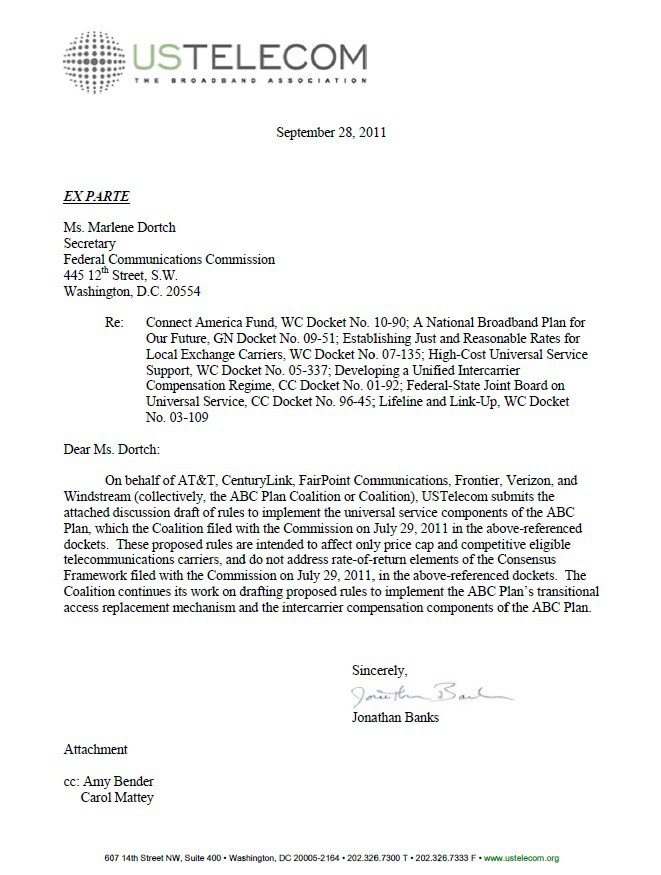
The telephone companies have helpfully written their own rules for the FCC to adopt.

Frontier’s decision to provide broadband service in West Virginia does not come out of the goodness of their heart.  At a time when landline customers are increasingly disconnecting service, Frontier’s long-term business plan is to keep customers connected by selling packages of phone, broadband, and satellite TV in rural markets.  Investment in DSL broadband deployment has been underway with or without the assistance of the Universal Service Fund because it makes financial sense.  Our customer in West Virginia might disconnect his landline and use a cell phone instead, costing Frontier any potential broadband, TV and telephone service revenue.

Under the ABC Plan, Frontier can be subsidized by ratepayers nationwide to deliver the service they were planning to provide anyway.  And what kind of service?  The same 3Mbps DSL the neighbors have.

If your county government, a cable operator, or wireless competitor decided they could deliver 10-20Mbps broadband for the same $50 a month, could they receive the USF subsidy to build a better network instead?  Under the phone company plan, the answer would be almost certainly no.

Simon Fitch, the consumer advocate of the Federal-State Joint Board on Universal Service, which advises the FCC on universal service matters, says the ABC Plan is a consumer disaster.

“Although a stated goal of the FCC’s reform effort is to refocus universal-service funding to support broadband, the industry’s ABC plan requires no real commitment to make broadband available to unserved and underserved communities,” Fitch writes. “Companies would receive funds to provide broadband with upload and download speeds that are already obsolete. States would be given no real enforcement power.”

Fitch is certain companies like AT&T and Verizon will receive enormous ratepayer-financed subsidies they don’t actually need to provide service.

Back to AT&T.

In several states, AT&T is seeking the right to terminate its universal service obligation altogether, which would allow the same company fiercely backing the ABC Plan to entirely walk away from its landline network.  Why?  Because AT&T sees its future profits in wireless.  Under the ABC Plan, AT&T could build rural cell towers with your money to provide “replacement service” over a wireless network with or without great coverage, and with a 2GB usage cap.

At the press conference, Genachowski could still declare victory because rural America would, in fact, get broadband.  Somehow, the parts about who is actually paying for it, the fact it comes with no speed, coverage, or quality guarantees, and starts with a 2GB usage cap on the wireless side will all be left out.

Fortunately, not everyone is as enamored with the ABC Plan as the groups cashing checks written by AT&T.

In addition to state regulators, Consumers Union, the AARP, Free Press, and the National Association of Consumer Advocates are all opposed to the plan, which delivers all of the benefits to giant phone companies while sticking you with the bill.

There is a better way.  State regulators and consumer groups have their own plans which accomplish the same noble goal of delivering subsidies to broadband providers of all kinds without increasing your telephone bill.  It’s up to the FCC to demonstrate it’s not simply a rubber stamp for the schemes being pushed by AT&T and Verizon.


South Africa Says Good Riddance to Usage Caps: Telkom Takes the Limits Off

Phillip Dampier October 5, 2011 Broadband Speed, Competition, Consumer News, Data Caps, Wireless Broadband Comments Off on South Africa Says Good Riddance to Usage Caps: Telkom Takes the Limits Off

South Africa’s largest Internet Service Provider, the former state-owned telephone company Telkom, has introduced uncapped broadband service across the country.

Telkom’s Do Uncapped offering removes usage limits after “intensive market research” and “data usage trials” concluded South African consumers absolutely despise usage limits on their Internet access.

In fact, in overwhelming numbers, consumers preferred unlimited access over faster broadband speed packages.  Even throttled “fair use” policies which slightly reduce speeds during peak usage periods are more tolerable than restricted usage allowances, overlimit fees, and punishing “dial-up” speeds when customers exceed their usage limit.

“To feed the hunger for data, Telkom has tailored its Do Uncapped range according to consumer usage patterns derived from findings of the Company’s broadband trials on higher cap trials conducted earlier this year,” the company said in a statement.

Inexpensive, lower speed offerings are available at 384kbps and 1Mbps, but do come with certain daytime speed restrictions, especially on peer to peer traffic.  The premium 4Mbps package is truly unlimited.

South Africa’s challenged telephone network has resulted in relatively low broadband speeds when compared against Asia, North America, and Europe, but the unlimited offerings are being welcomed by Telkom customers across the country.

Because DSL service from the phone company has traditionally been slow and, until recently, expensive, many South Africans rely primarily on wireless mobile services, which can be more reliable in some parts of the country.  Some purchase wireless broadband service from providers like MTN instead of DSL from the phone company.

As a home broadband replacement, wireless mobile broadband has always meant compromising on usage, because most plans are heavily capped and some block access to certain web content.  But MTN is responding to Telkom’s move away from usage caps by removing them from its own wireless network, at least during a promotion.

MTN is kicking off the South African summer with its newest promotion, unlimited speed and uncapped wireless data access on the company’s HSPA+ network, effective Oct. 1.

The limits stay off until the end of summer — Jan 2012.

“We have seen a significant number of our customers taking up latest smartphones, tablet PCs, wireless routers and laptop deals that MTN is offering,” said Serame Taukobong, MTN South Africa Chief Marketing Officer. “This promotion is a response to the increased data appetite that comes with the usage of these devices.”

That’s an attitude foreign to North American mobile operators, who see those devices as enemies of their wireless network (or the basis for future profits).  In South Africa, consumers adopting new wireless devices and increased usage has triggered a marketplace response that eases or ends usage caps.  In North America, the opposite is happening.

MTN has slashed its mobile broadband prices over the course of 2011 for the highest speed, unlimited access package from a budget-busting $248 a month to $111 a month.  A slower speed unlimited package now sells for $37 a month.  That becomes very affordable for Internet users who use their mobile devices exclusively for access.  Even a package selling over $100 a month may be comparably affordable to an American who is required to maintain a home broadband and mobile broadband account.

MTN even allows wireless peer to peer traffic, but the company asks subscribers to be reasonable and not leave it running 24/7.

CenturyLink Copies Comcast: Another 1.5Mbps Low Income Broadband Plan With Gotchas

CenturyLink has unveiled its own discounted Internet access program for the income-challenged, loaded with tricks and traps buried in the fine print.

Dubbed CenturyLink Internet Basics, the 1.5Mbps DSL service is available to those who currently qualify for Lifeline Affordable Telephone Service, a federal program that provides discounts on basic monthly telephone service to eligible low-income consumers.  The service sells for $9.95 a month, before taxes and fees.

But buried in the fine print are a number of surprises that deliver higher prices and some nasty surprises (underlining ours):

  • Listed High-speed Internet rate of $9.95/mo. applies for first 12 months of service (after which the rate reverts to $14.95/mo. for the next 48 months of service), and requires a 12-month term agreement or 24-month term agreement (if purchasing Netbook);
  • Customer must either lease a modem/router from CenturyLink for an additional monthly charge or purchase a modem/router from CenturyLink for a one-time charge, and a one-time High-Speed Internet activation fee applies;
  • A one-time professional installation charge (if selected by customer) and a one-time shipping and handling fee applies to customer’s modem/router;
  • Taxes, Fees, and Surcharges – Applicable taxes, fees, and surcharges include a carrier Universal Service charge, carrier cost recovery surcharges, state and local fees that vary by area and certain in-state surcharges. Cost recovery fees are not taxes or government-required charges for use (which means they are little more than bill padding junk fees). Taxes, fees, and surcharges apply based on standard monthly, not promotional, rates;
  • The first bill will include charges for the first full month of service billed in advance, prorated charges for service from the date of installation to bill date, and one-time charges and fees described above.
  • Netbook purchase must be paid in full to CenturyLink prior to shipment. Shipping and handling fees, and applicable taxes will apply. If customer purchases Netbook as part of the CenturyLink Internet Basic service, all warranty and support for the Netbook and accompanying equipment will be covered by the manufacturer or other identified third party, not CenturyLink.
  • No software applications or wireless service are included with the Netbook.
  • An early termination fee will apply based on the applicable monthly recurring service fee multiplied by the number of months remaining in the minimum service period, up to $200.

Unlike Comcast, CenturyLink claims it will provide equivalent discounts for faster speeds — an important consideration for those with school-age children at home who may need multimedia capability for research and studies.

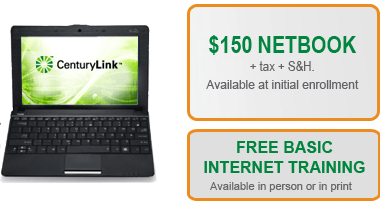
CenturyLink also offers a netbook computer for an additional $150, plus shipping and taxes, at the time of enrollment in the program.  The service also includes educational training, a 30-day money back guarantee, Norton Security Suite, and parental controls.

“While the Internet has become part of daily life for most Americans, many still aren’t connected because the cost is beyond their reach. CenturyLink is pleased to introduce this new program that offers affordable High-Speed Internet service and computers to those who need help getting online,” said CenturyLink CEO and President Glen F. Post, III.

That and the fact the company was required to offer discounted Internet service as a condition for the approval of their acquisition of Savvis, a web hosting company, according to Broadband Reports.

Like Comcast, participation in the program requires meeting a number of terms and pre-conditions:

  • Reside where CenturyLink offers Internet service;
  • Have not subscribed to CenturyLink Internet service within the last 90 days and are not a current CenturyLink Internet customer;
  • Do not have an overdue CenturyLink bill or unreturned equipment;
  • Follow current guidelines for Lifeline/TAP phone service programs.

Free training programs will be introduced starting this fall in Foley, Ala.; Dumas, Ark.; Eagle, Colo.; Tallahassee, Fla.; Phoenix; Galesburg, Ill.; Franklin, Ind.; Billings and Great Falls, Mont.; Las Vegas; Farmington, N.M.; Rockingham, N.C.; Lorain, Ohio; Columbia River Gorge, Ore.;  Greenwood, S.C.; Seattle and Yakima, Wash.; and Glenwood City, Wis. Other communities where the training is taking place will be announced in 2012.

Many of the terms and conditions of the discounted Internet program are not very different from standard CenturyLink new customer promotions, which promise discounted service but leave a lot of surprise charges, fees, and contract commitment details to the tiny fine print customers have to search to find (or wait to find out on their first bill.)

Yet like Comcast, CenturyLink will seek to take credit for addressing the digital divide when in fact they are not selling the service to those who don’t want or need $40 Internet bills, but are not poor enough to qualify for the $10 Internet program on offer here.

Search This Site:

Contributions:

Recent Comments:

Your Account:

Stop the Cap!