Home » Broadband Speed » Recent Articles:

Usage Caps Leave Bell Customers Test Driving Their New Broadband Speeds

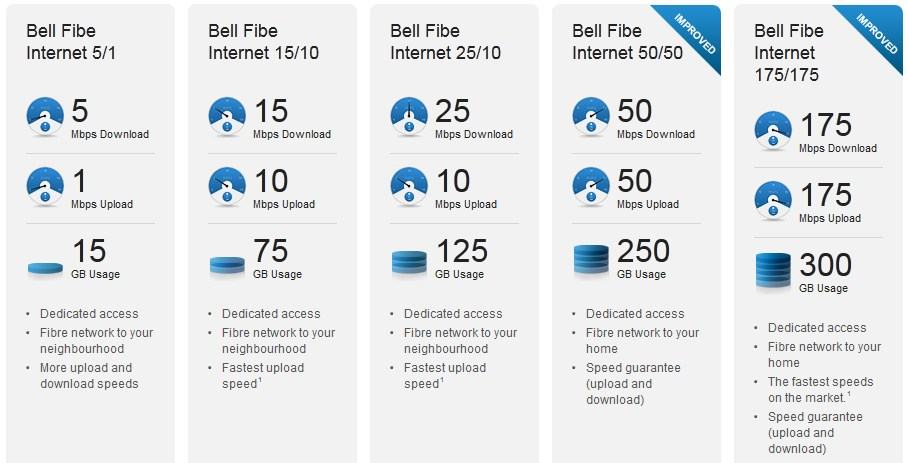
Bell Canada has boosted speeds of its fiber-to-the-neighborhood and fiber-to-the-home Fibe Internet services in Ontario.  But our regular reader Alex notes Bell’s Internet Overcharging usage cap scheme remains firmly in place, which leaves customers taking the company’s fastest offerings out for little more than a test drive before the overlimit fees kick in.

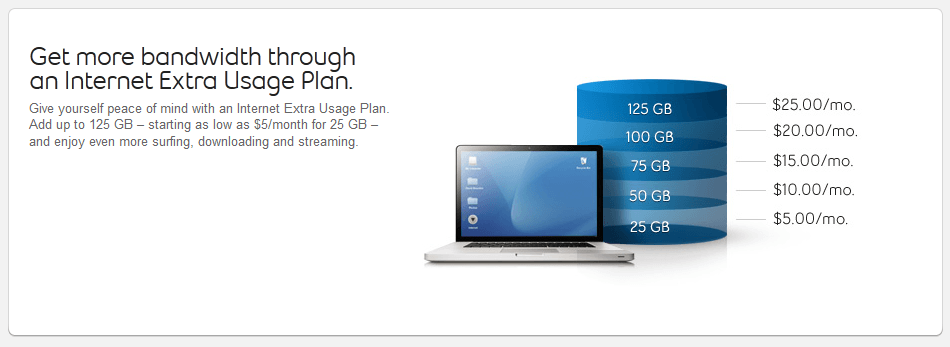
But no worries, Bell says.  The company has invented the concept of Internet Usage Insurance, selling you extra usage allotments ranging from 20GB ($5) to 125GB ($25) per month for usage that costs Bell just pennies per gigabyte.

The new speeds are admittedly very fast, but their value is well-tempered by the usage allowances that accompany them.

North Dakota Co-Ops Bring Out the Better Broadband: Fiber Transforms Lives

Phillip Dampier May 8, 2012 Broadband Speed, Community Networks, Competition, Editorial & Site News, Public Policy & Gov't, Rural Broadband, Video Comments Off on North Dakota Co-Ops Bring Out the Better Broadband: Fiber Transforms Lives

When broadband advocates talk about the advantages of fiber-to-the-home service, commercial providers and their friends routinely criticize us for demanding “Cadillac” networks in areas that “don’t need” fiber-fast broadband speeds. Despite the fact the United States and Canada continue to fall further and further behind in the global broadband speed race, companies that answer to stockholders simply won’t hear of upgrading networks to the technology Asia and Europe increasingly takes for granted.

There is no question fiber broadband is costly to build, especially in rural communities where the cost per home will require a long-term payback for the upfront investment required. But that doesn’t stop community-owned networks and public co-ops from advancing forward.

Dakota Central Telecommunications and Dickey Rural Networks last month celebrated the completion of the largest fiber-to-the-home network in North America… in rural North Dakota.

Both providers, operated as co-ops, deliver speedy service to every home and business within a 10,000 square mile area.  Broadband at speeds of 20Mbps starts at $39.95 a month.  Want faster speeds? For $89.95 a month, you can purchase 50Mbps service.  A triple-play package of phone, broadband, and cable TV service runs $113.75 a month.

While DSL has been available in the past, it simply could not deliver the 21st century broadband speeds businesses and consumers need.

Both providers, collectively owned by the members who subscribe to the service, spent a combined $90 million on the expansive fiber network. But instead of throwing a hissyfit over the price tag, the collective feeling was this represents an investment in North Dakota’s future. Area businesses have already taken advantage of the new speeds to improve efficiency and think about new ways they can market their products and services online.

The decision to deploy fiber to the home service made sense because of its infinite expandability, dependability, and capacity.  Commercial providers like AT&T and Verizon that embarked on fiber upgrades deploy them only in the largest cities, where the cost per subscriber is lower and where investors believe the costs to build the networks will be recouped the fastest.  Now both companies have declared those networks to be largely complete, leaving large numbers of their customers off the upgrade list, stuck indefinitely with yesterday’s DSL technology.

That isn’t happening with community-owned providers and co-ops, where the goal remains to reach every possible customer. Rapid cost recovery is not the highest priority — delivering good service in their communities is. Most are willing to wait a little longer to pay off network construction costs in return for better service for everyone today.

USDA Under Secretary Dallas Tonsager says North Dakota’s fiber network is a “great role model” for the rest of the country.

“We’re going to use you as an example over and over and over again,” he said.

The USDA administers grants for rural broadband networks to help expand broadband service in underserved/unserved rural areas.

[flv width=”475″ height=”288″]http://www.phillipdampier.com/video/WDAY Fargo South central North Dakota touts largest fiber optic broadband network in the nation 4-11-12.flv[/flv]

WDAY in Fargo traveled to the unveiling of North America’s largest fiber broadband network and talked with residents about the transformational nature of fiber broadband.  (2 minutes)

[flv width=”640″ height=”380″]http://www.phillipdampier.com/video/North Dakota Fiber 4-12.flv[/flv]

This video shows how south-central North Dakota managed to build a fiber network that reaches every home within a 10,000 square mile area and how it is changing lives.  (7 minutes)


Consumer Reports Releases 2012 Top-Rated Telecom Providers, Quotes Stop the Cap!

Phillip Dampier May 8, 2012 Broadband Speed, Competition, Consumer News, Data Caps, Editorial & Site News, Rural Broadband, Video Comments Off on Consumer Reports Releases 2012 Top-Rated Telecom Providers, Quotes Stop the Cap!

Consumer Reports today released its 2012 list of America’s best phone, broadband, and pay television providers (subscription required), giving top scores to fiber-to-the-home and cable broadband and exposing some familiar phone and cable companies which year-after-year deliver “bottom of the barrel” scores.

Nearly 70,000 readers of the consumer magazine participated in rating their local telecommunications providers for value, reliability, customer service, and broadband speed.  No provider scored higher than “average” for value, but wide discrepancies in broadband speed and the quality of service made choosing winners and losers easy.

Top-rated WOW! (formerly WideOpenWest), is the 15th largest cable provider in the United States, but regularly wins top scores from Consumer Reports readers for the quality of its services. WOW! currently serves mostly suburban subscribers in a handful of cities in Illinois, Ohio, Michigan and Indiana. But the provider will soon be coming to several new locations thanks to its April purchase of cable overbuilder Knology, which provides service in multi-dwelling units and administers some community-owned broadband networks around the country.  This could provide relief for customers dealing with onerous usage caps in cities like Lawrence, Kan., where Knology’s buyout of Sunflower Broadband kept that company’s Internet Overcharging scheme in place. WOW! has no usage limits on their broadband service.

Verizon’s FiOS fiber to the home network is also a consistent winner in the ratings, especially for its fast broadband service.

AT&T’s U-verse also scored high in the ratings for broadband.  AT&T’s fiber-to-the-neighborhood service still works with existing copper phone wiring inside the home and delivers 20+Mbps broadband, a major improvement over AT&T’s traditional DSL service, which usually tops out at 7Mbps.

Among top-rated cable companies you have heard of, Bright House Networks scored a major coup, winning third place for its broadband service.  Ironically, consumers gave very high marks to Earthlink delivered over Time Warner Cable, scoring it fourth place for broadband. But Earthlink’s performance on Time Warner Cable is actually slightly less than the cable company’s own broadband service. Although both services share exactly the same network, Time Warner adds “speedboost,” a temporary speed increase for downloads. But the cable company got no respect from customers, who put TWC in 19th place.

Other findings of interest:

  • TDS, an independent phone company serving primarily rural areas scored a very high fifth place in broadband, despite offering only traditional DSL service (except in limited areas where it has built fiber networks to stay competitive with community-owned providers and cable companies).  But the company won high marks for service reliability;
  • Frontier Communications’ inherited FiOS fiber to the home services in Indiana and the Pacific Northwest were that company’s only bright spots for broadband, putting both systems in sixth place.  Everywhere else… forget about it. The company’s traditional DSL service was rated a lousy value and delivered mediocre speeds, earning 24th place.
  • Satellite fraudband providers Wildblue and HughesNet continue to torture their customers, scoring dead last for lousy value, speeds, reliability, and everything else.
  • Still awful after all these years: Mediacom, Charter, and FairPoint Communications all continue their dubious distinction scoring at the bottom of the barrel for broadband. It’s nothing new for any of them, and it appears nothing is likely to change those rankings in the immediate future.

Americans still hate the big boys.  Outside of AT&T and Verizon’s shorter history delivering triple-play-packages of cable, phone, and Internet service, the legacy of lousy pricing and service from the country’s largest cable operators still hold them back in the ratings.  Comcast managed only 24th place, dragged down by terrible customer service and worse value.  Cablevision did better at 16th place with higher marks for everything but value.  It was the same story for 12th place Cox Cable.

What was the top choice for telephone service in 2012?  Ooma, a Voice over IP phone company that works with an existing broadband connection.  Phone companies that have been in the business of phone service for decades (or longer) were all bottom-rated: AT&T, Verizon, FairPoint, and Frontier Communications.  Only Mediacom, a cable operator, kept Frontier from scoring dead last.  And they wonder why Americans can’t wait to disconnect traditional landline service?

In fact, Consumer Reports says no other industry alienates consumers more than America’s telephone and cable companies.

But you can fight back and score a better deal.  Stop the Cap! was quoted in the magazine piece with our advice to play hardball with cable and phone companies who charge too much and deliver too little.

“The magic word is ‘cancel,’ ” says Phillip Dampier, of the website Stop the Cap! He suggests you schedule your disconnection date for a week or two in the future. “When you’re on their disconnect list, they are going to start calling you offering very aggressive deals,” he says.

Top-rated WOW! only delivers service in a handful of cities in the midwest, but is getting larger after acquiring Knology in April 2012.

Indeed, Consumer Reports found most providers willing to deal… eventually, but they have gotten wise to halfhearted negotiation tactics by consumers looking for a better deal. If a provider suspects you won’t follow through on a threat to change providers, they often stubbornly refuse to deal. That’s why we recommend requesting to be placed on a “pending disconnect” list — proof you are prepared to leave in a week or two if they won’t negotiate.

We’ve followed investor conference calls for most major providers over the past two years. Every provider has gotten more aggressive with customer retention offers, in part because of the poor economy and increased competition. Customers are paring back cable packages and cutting out extra channels and services they can no longer afford. Some have become expert at bouncing between new customer promotional offers. Cable operators like Time Warner Cable have tried to keep customers, even those coming to the end of promotions, with slightly less aggressive discounting.

“We have a very well-choreographed program for moving people from the most heavily discounted promos into the rational next-step pricing packages,” Rob Marcus, president of Time Warner Cable told the magazine. “Over time, that discount will decrease, but you’d probably still save 20 to 30 percent off the rack rate,” or regular price.

But we found consumers who get back on the disconnect list usually do much better than Time Warner’s “next-step” pricing, some even earning a better retention offer than what they received in 2011. The more serious customers are about their willingness to leave, the better the offer in return.

Dead last place for cable companies... again.

The magazine also offers solace for customers who literally have nowhere else to go for service:

Alan Curtis of Manchester, N.H., whose condominium is served only by Comcast, says his rates go up each year but he pushes back. “If you say, ‘We’ll have to buy less,’ occasionally they’ll come up with a cost-cutter that will apply to you,” he says. Similarly, a staffer who lives in a New York City apartment served only by Time Warner Cable more than offset a $5 increase in his overall bill by negotiating an $8-a-month cut in his DVR rental fee for 12 months.

Consumer Reports also warns customers to choose broadband providers wisely, because the speeds they advertise may never materialize. Case in point, Frontier Communications’ dreadful DSL service, which the magazine found met the company’s speed marketing claims only 67% of the time. Frontier has been struggling with a vastly oversold broadband network, causing speeds to slow dramatically during peak usage times, particularly in states like West Virginia.  The magazine recommends fiber to the home providers and cable operators for more consistent broadband performance that comes closer to the broadband speeds advertised.

At all costs, avoid satellite broadband, which remains slow, expensive, and heavily usage-capped.


Frontier Confirms Stop the Cap! Report That Company Is Considering AT&T U-verse Deployment

Frontier Communications has confirmed a Stop the Cap! exclusive report that the company has shown an interest in a licensing arrangement with AT&T to deliver U-verse to Frontier customers in larger markets.

Maggie Wilderotter, CEO of Frontier Communications today told investors on a morning conference call that the company likes the U-verse product and is considering deploying it.

“We’ve been evaluating a lot of other alternatives of which U-verse is one of the alternatives,” Wilderotter said. “We think it’s a product that can work, not just on fiber, but it also works on copper as well. So it’s a lot more forgiving in the market.”

Wilderotter claimed the company has no immediate plans to introduce the technology, but Stop the Cap! has obtained documentation that shows the company now refers specifically to “U-verse” in internal communications, is hiring new leadership to oversee the company’s IPTV plans, and has plans to dramatically expand VDSL technology, a prerequisite for deploying AT&T’s fiber to the neighborhood platform.

Wilderotter

Frontier Communications has had a difficult time supporting its Verizon-inherited FiOS fiber-to-the-home networks in the Pacific Northwest and Indiana.  The company has found itself unable to compete effectively in the video business because it negotiates programming contracts independently, which locks Frontier out of the volume discounts that other independent providers routinely receive from participating in programming purchasing co-ops.  Frontier lost 4,800 FiOS video customers in the last quarter alone.

Wilderotter said as a result of programming costs, Frontier has no plans to pursue any additional fiber expansion to deliver video programming.

However, a licensing arrangement with AT&T U-verse could open the door to Frontier receiving the same volume discount prices for programming that AT&T already receives as part of its own operations. Because Frontier would have to significantly upgrade its existing, primarily middle-mile fiber network to reduce the amount of copper wiring in its network, the company faces significant capital investment costs wherever it chooses to deploy the more advanced broadband network.

Wilderotter hinted Frontier’s plans for the enhanced technology would be limited to a handful of cities.

“It doesn’t make sense in all of our markets,” she said. “It’s only a handful of markets other than where we have FiOS today. So there’s more to come on that over time. Video is very important. We think over the top video is probably more important than anything else.”

The most likely target for any IPTV expansion would be Frontier’s western New York operation in and around Rochester, where the company currently competes against Time Warner Cable with a mediocre DSL product that can no longer compete with the cable operator’s superior speeds and pricing promotions.  Frontier is steadily losing market share in most of its more-populated service areas.

Other likely targets for expanded broadband include larger cities in Pennsylvania, Illinois, West Virginia, and California.

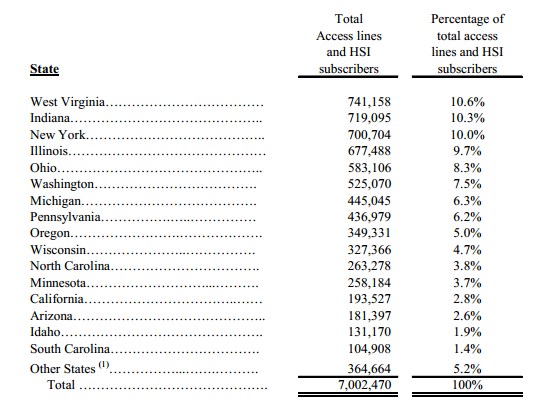
Frontier's Broadband Customers (as of 12/31/11)

Chief Operating Officer Daniel McCarthy added Frontier also has plans to improve broadband speeds in most of its service areas.

“We’ve been working pretty steadily to improve the core network around the country,” McCarthy said. “You’ll see us aggressively move forward with sort of VDSL and bonded ADSL2 copper.”

Currently, Frontier only informally offers bonded service to residential customers in very limited areas, notably in parts of the Genesee Valley in western New York.  The company has been marketing an extra line of traditional ADSL service to customers elsewhere who want more broadband capacity, but that requires a second broadband modem and delivers no speed improvements.

Frontier’s time frame to deploy enhanced speeds in within 12-24 months, according the company officials.

In other developments, Frontier Communications customers formerly served by Verizon will likely find themselves choosing new service plans as Frontier prepares to migrate customers away from legacy Verizon service packages.

Wilderotter telegraphed that affected Frontier customers will see some rate increases when the new plans become effective.

“We do think that there is a pretty substantial revenue upside,” Wilderotter said. “We think the net-net is we’ll get customers on the right portfolio of products that will also be revenue enhancing for the company and we’re going to surround the products with the right kind of service experience, both online and off-line. We’re redesigning all of our online product sets for a better customer experience so they can manage their own broadband usage and actually upgrading or changing what they do with broadband themselves, if in fact, they want to do that.”

Take 90 Seconds And Learn Why You Should Support Community Broadband

Phillip Dampier May 3, 2012 Broadband Speed, Community Networks, Competition, Consumer News, Editorial & Site News, Public Policy & Gov't, Rural Broadband, Video Comments Off on Take 90 Seconds And Learn Why You Should Support Community Broadband

Can we have 90 seconds of your time, please?

Christopher Mitchell at Community Broadband Networks has put together some compelling evidence about how some of the most advanced broadband networks in the country are being built by and for the communities they ultimately serve.

You may think the best broadband around can be found in the biggest cities in America, but you’d be wrong.

“It may surprise people that these cities in Virginia, Tennessee, and Louisiana have faster and lower cost access to the Internet than anyone in San Francisco, Seattle, or any other major city,” says Christopher Mitchell, Director of ILSR’s Telecommunications as Commons Initiative. “These publicly owned networks have each created hundreds of jobs and saved millions of dollars.”

The fact is, public broadband is convincing some of the country’s biggest tech companies, including Amazon.com, to locate enormous distribution centers right in the middle of fiber-plentiful cities like Chattanooga, and that means job growth — a lot of it.

Unfortunately, too often today’s “broadband innovation” comes only from how to extract more money for less service from some of America’s top providers. Usage caps, overcrowded networks, and speed constraints conspire to help America lose the global speed race.  But some communities are fighting the good fight themselves, even as big phone and cable companies like AT&T, Time Warner Cable, Comcast, and CenturyLink are trying to smash those networks through special interest corporate welfare legislation.

Mitchell and his team have assembled the facts: BVU Authority’s OptiNet in Bristol, Virginia; EPB Fiber in Chattanooga, Tennessee; and LUS Fiber in Lafayette, Louisiana — all built by publicly-owned utilities, demonstrate the public sector can deliver effective, innovative service at prices consumers can afford.  Better yet, they’re doing it in places big telecommunications companies decided were unworthy of getting world-class service.

[flv width=”640″ height=”380″]http://www.phillipdampier.com/video/Community Broadband.flv[/flv]

Watch this video and learn why community broadband networks represent America’s most innovative broadband, and then learn more about how you can get involved and support better broadband in your community.  (2 minutes)

Search This Site:

Contributions:

Recent Comments:

Your Account:

Stop the Cap!