Home » Broadband Speed » Recent Articles:

Frontier Boosting Speeds in Select Areas; Premium Customers Win No Modem Rental Fee

Faster

Frontier Communications customers in selected communities will be able to receive faster Internet speeds by the end of the year because of network upgrades.

In late July, Frontier president and chief operating officer Daniel J. McCarthy announced the company was refocusing investment on improving the broadband experience for its customers, mostly serviced by ADSL.

Frontier’s rural customers primarily receive broadband service at real-world speeds of 768kbps-3Mbps. At least 74% of those customers will be able to sign up for speeds of 6Mbps by the end of the year. In more urban areas, 51% of customers will be able to sign up for 12Mbps, 42% for 20Mbps. Business customers in selected areas can qualify for speeds up to 40Mbps.

The upgrades will not come for free, however. Customers will pay more for higher speeds.

McCarthy

Frontier Max (3Mbps in rural areas, 6Mbps in urban areas) starts at $34.99 per month. Customers can move up to the next speed tier for an additional $10 per month. For example, a Frontier Max customer can move up to Ultra service (10-12Mbps) for $44.99, or Frontier Ultimate (20-25Mbps) for $55.99 per month. Once customers upgrade to a premium speed level, the modem rental fee (up to $6.99 a month) is reportedly eliminated.

Frontier’s upgrades are based on adopting more advanced forms of DSL technology. Most Frontier customers currently receive ADSL service — one of the oldest and slowest forms of DSL. Frontier is managing to boost speeds by bonding multiple DSL connections together, switching to ADSL 2+, or upgrading to VDSL technology. The company is also broadening its fiber middle mile network, which can reduce the length of copper wiring between the company’s central offices and customer homes, improving potential speeds.

Customers who do not change their level of service may still receive some benefits from area upgrades, as actual speeds come closer to matching those advertised by the company.

In some areas, customers will receive telemarketing calls announcing newly available speed options. But customers can also call 1-800-921-81o1 to find out what is currently available.

Stop the Cap! recommends proceeding carefully when considering a plan change. Be sure to ask about all terms and conditions, including installation/upgrade fees, modem rental fee (if any), contract terms, and whether any additional services are required (Frontier may attempt to sell an added-cost online backup service, home networking equipment, or technical support services you may not need).

Fact Check: Time Warner Cable’s $25 Million Fiber Upgrade: For Business Use Only

Despite glowing media reports about Time Warner Cable’s announcement it is investing $25 million to expand its fiber optic network in parts of Brooklyn and Manhattan, in fact the fiber expansion is part of a previously-reached franchise agreement with New York City officials and will only be available to large business customers that can afford the asking price.

Time Warner Cable’s press release, which generated favorable media coverage in The Wall Street Journal and Bloomberg News, focused considerable attention on fiber upgrades for the Brooklyn Navy Yard, since reborn as a modern tech-friendly business park.

TWCBC also announced that the Brooklyn Navy Yard Development Corporation, a 501(c)(3) organization, will receive a state-of-the-art Time Warner Cable Learning Lab in its Employment Center, located inside the massive complex and accessible to the public.

“We are very pleased to work with the City of New York to make significant investments to ensure that this city has the technology infrastructure to successfully compete in a worldwide marketplace,” said Ken Fitzpatrick, President of Time Warner Cable Business Class, East Region. “Our fiber optic network provides dedicated Internet access at incredible speeds and high-bandwidth capabilities to serve the communications needs of any business.”

Time Warner Cable was required to make its investment in the Brooklyn Navy Yard as part of its franchise agreement with NYC officials.

Time Warner Cable did not, however, provide this investment out of the goodness of their heart. They were required to under the terms of the current franchise agreement the company signed with city officials:

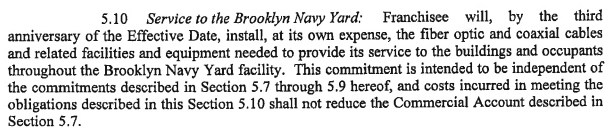
[Time Warner Cable] will install, at its own expense, the fiber optic and coaxial cables and related facilities and equipment needed to provide its service to the buildings and occupants throughout the Brooklyn Navy Yard facility.

Time Warner Cable is also extending its network to more commercial establishments throughout the city, in keeping with its previously-announced interest in expanding services to business customers. Nothing new to see here either.

That did not stop Bloomberg News from comparing Time Warner’s network expansion with Google’s gigabit network in Kansas City:

Time Warner Cable Inc. will expand fiber-optic lines to businesses in New York, a move that boosts Internet speeds as much as 20 times and provides an East Coast counterpoint to Google’s ultrafast network in Kansas City.

The company faces a threat from Google more than 1,000 miles away in Kansas City, where the Internet-search giant is building a fiber-optic network as a test project. Time Warner Cable is the main broadband provider for the area, which spans parts of Missouri and Kansas. While Google’s network will be available to both companies and households, Time Warner Cable’s New York fiber network is focused on businesses.

Google’s network initially will only be sold to residential customers, which are the primary targets for the service. Time Warner Cable’s fiber backbone network primarily works in tandem with its coaxial cable network and does not provide a fiber to the premises connection except for the company’s largest corporate customers.

Time Warner Cable Business Class sells different speeds and services to commercial clients. Most choose speeds considerably lower than 1,000Mbps because of the cost.

What was missing from the coverage is the fact ordinary residential Time Warner Cable customers in New York City will not benefit from these fiber upgrades — they are targeted only to commercial clients. Residential customers will continue to receive the same hybrid fiber-coax service they always have from the cable company.

If New York customers want fiber service, they will have to buy it from Verizon, assuming FiOS has made its way to your borough and neighborhood.

Just About Everyone Supports Levying New $1-5 Tax on Your Broadband Service

Outside of a handful of consumer groups, just about everyone — including one “anti-tax” Republican on the Federal Communications Commission — favors the imposition of a new broadband tax on your Internet connection.

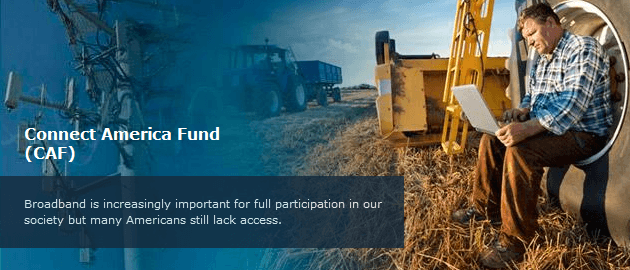
It is all a part of the Federal Communications Commission’s effort to transform a badly-outdated Universal Service Fund (USF) into the Connect America Fund (CAF) — an ongoing project to help defray the costs of wiring rural America for broadband service.

Phone and cable companies are on board. So are several state regulators. Even search engine giant Google favors applying a surcharge to consumer bills to retire a funding formula currently dependent on declining landline phone revenue.

In April, the FCC began accepting comments on its proposal to expand the number of telecommunications services subject to the surcharge, currently found on telephone bills. The FCC has proposed a number of possible taxes including the new broadband fee, a tax on text messages, or moving to a flat fee for each phone line instead of a variable tax rate (currently around 18%).

Virtually every major telecommunications company provisionally supports the new tax, for at least three reasons:

  1. Most can benefit from future CAF funding opportunities, dipping into the fund to help subsidize expanding broadband into areas where current “return on private investment”-standards make deployment unprofitable;
  2. Consumers will pay the tax, not providers;
  3. The companies are confident their fierce lobbying will get the FCC to drop a proposed requirement the fee be included in the advertised price of broadband service. They want the fee broken out separately on customer bills, in part because they fear higher-advertised-prices for broadband will discourage customers from buying.
Google also supports the new tax because they profit from a larger broadband audience accessing their web pages and services. If the FCC were to tax online services, as Google fears, it would be bad news.

“Saddling these offerings with new, direct USF contribution obligations is likely to restrict innovative options for all communications consumers and cause immediate and lasting harm to the users, pioneers, and innovators of Internet-based services,” Google argued.

The Fiber to the Home Council, another industry group, was disturbed by one FCC proposal that would levy an increasingly higher percentage of the new tax on customers with progressively faster high speed connections. Although the Council agreed with many consumer groups that any new broadband tax would discourage broadband adoption, it was alarmed with the proposition of taxing consumers the most for selecting the highest speed broadband tiers.

“The Commission should not impose a fee that increases with greater performance capabilities (capacity/speed) because that would discourage plant and service upgrades and hinder the expansion of critically important high-speed broadband services,” the Council wrote in its comments to the FCC.
The Fiber to the Home Council is concerned about one proposal that would levy increasingly higher taxes the higher your connection speed.

With 19 million Americans currently unable to obtain broadband service, adding a new tax on existing broadband customers’ bills would bring in millions that the CAF will ultimately award to rural landline providers and cable operators to encourage them to expand their broadband networks.

But consumer groups including Free Press worry the new tax would rob Peter to pay Paul, and further discourage poor Americans who can’t afford current broadband prices from ever signing up for service.

“In other words, as the Commission reforms the overall USF system in the name of greater broadband adoption, particularly among rural, poor and elderly consumers, assessing [a broadband tax] could lead to an overall lower level of broadband adoption, despite the availability of new broadband subsidies,” writes Free Press research director S. Derek Turner in an official filing with the FCC.

Free Press called the current comments from industry players largely as expected.

“Industry commenters simply offered self-serving proposals that will ensure that their (but not necessarily their customers’) contribution burdens are as low as possible,” Turner wrote. “We instead are strongly encouraging the Commission to conduct actual cost-benefit analysis prior to adopting rule changes that could have massive unintended consequences for consumers.”

Thinks a broadband tax will reduce broadband adoption.

Outside of a small handful of remarks from end users, the overwhelming majority of comments received by the FCC are from providers, industry groups, and telecommunications regulators. Almost none come from actual consumers, who will ultimately pay the proposed tax.

Some conservative anti-tax groups have been alarmed by the tax expansion and Republican FCC Commissioner Robert McDowell’s apparent support of it. McDowell issued a statement in April declaring his support for reform of the USF system to broaden the tax to additional telecommunications users:

[…] “To put the importance of contribution reform into perspective, the contribution factor, a type of tax paid by telephone consumers, has risen each year from approximately 5.5 percent in 1998 to almost 18 percent in the first quarter of this year. This trend is unacceptable because it is unsustainable. Furthermore, the cryptic language on consumers’ phone bills, combined with the skyrocketing “tax” rate, has produced a new form of “bill shock.” We must tame this wild automatic tax increase as soon as possible.

[…] “Controversy, however, should not deter us from lowering the tax rate while broadening the base according to the authority granted to us by Congress. The current pool of contributors is shrinking. It must be expanded, but we must do so only within our statutory authority while keeping in mind the international implications of our actions.”


Broadband Slow Lane? Connectify’s Dispatch Combines 10 Slow Connections Into 1 Fast One

Phillip Dampier August 23, 2012 Broadband Speed, Consumer News, Video 1 Comment

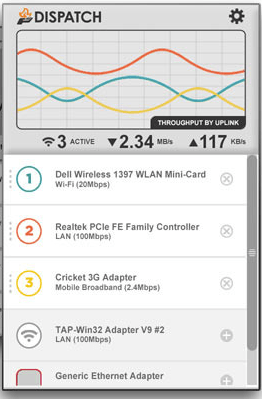
Stuck with snail slow DSL, spotty Wi-Fi, or usage-capped 3G and need faster access? A new project from Connectify is now attracting funding from the Kickstarter project to deliver a new broadband connection combiner that can turn up to 10 different wireless and wired connections into one super-sized broadband pipe.

Connectify’s Dispatch software will manage connections ranging from dialup to Ethernet through a hotspot application that can be run on a desktop PC. The Philadelphia company has been pushing the project primarily to the speed obsessed, demonstrating outdoor connections to multiple open Wi-Fi networks, 3G and 4G mobile broadband that when combined deliver more than 80Mbps of download speed. But the software may also prove useful as a connections management tool that can seamlessly switch from free Wi-Fi when your connection becomes intolerably slow to a different pipe — 3G or 4G wireless broadband — all without missing a beat.

With two weeks left in the Kickstarter campaign, Connectify has raised just over $33,000 of the $50,000 goal. The company recently sweetened the deal early investors get, perhaps to attract an additional burst of funding. Those investing $50 or more will receive a lifetime license with unlimited software upgrades forever.

Some mobile carriers are experimenting with similar technology, mostly to move customers automatically off of their mobile networks to Wi-Fi, where available. Others are experimenting with technology that would allow simultaneous connections to Wi-Fi and 4G networks, moving different types of data across one or both simultaneously.

[flv width=”640″ height=”380″]http://www.phillipdampier.com/video/Connectify Dispatch.mp4[/flv]

Introducing Connectify Dispatch, which can turn multiple slow broadband connections into one fast one. (4 minutes)

Frontier Introducting Wi-Fi in Fort Wayne; Free Service Limited & Slow

Free Wi-Fi is always popular and Fort Wayne, Ind. is welcoming news that Frontier Communications intends to install and operate a downtown network of hotspots offering what local newspapers characterize as “free access.”

The area being outfitted with wireless Internet is bordered by Clay Street to the east, Broadway to the west, Headwaters Park to the north and Lewis Street to the south, according to city officials.

Frontier says it plans to offer 512kbps access on most hotspots, 1Mbps service on others, with a limited number operating at still higher speeds where fiber optics are available.

But Frontier’s Wi-Fi networks in other cities have some important considerations for those expecting wide open, free access.

Free has its limits.

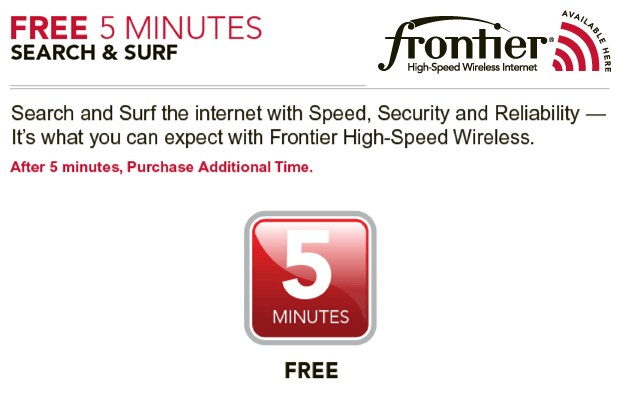
In Rochester, N.Y., free access hotspots are extremely limited in number and offer very slow speeds (often close to dial-up) to entice users to upgrade to a premium Wi-Fi speed plan starting at $9.99 per month for current Frontier customers, $30 a month for non-customers. The vast majority of hotspots only offer five minutes a week of free access.

In Terre Haute, free access is available to only the first 100 users connected to the network. All others are required to pay. Those who do choose to subscribe can only use one device at a time.

The scheduled rollout of Frontier Wi-Fi in Fort Wayne has yet to be announced.

Search This Site:

Contributions:

Recent Comments:

Your Account:

Stop the Cap!