
Home » Broadband Speed » Recent Articles:

Missouri Representative Introduces Community Broadband Ban Bill to Protect AT&T, CenturyLink

Rep. Rocky Miller (R-Lake Ozark)

Rep. Rocky Miller (R-Lake Ozark)

A Missouri state representative with a track record of supporting AT&T and other telecommunications companies has introduced a bill that would effectively prohibit community broadband competition in a bid to protect incumbent phone and cable companies.

Rep. Rocky Miller’s (R-Lake Ozark) House Bill 437 would strictly prohibit the construction of public broadband networks in any part of Missouri served by a private provider, regardless of the quality of service available or its cost, without a referendum that includes a mandated question observers consider slanted in favor of existing providers.

HB437 would banish community broadband networks as early as September unless services were already up and running. The bill would effectively stop any public broadband network intending to compete against an existing phone or cable company within the boundaries of a city, town, or village offering any level of broadband service. It would also require communities to schedule a referendum on any project budgeted above $100,000, and includes ballot language that implies public broadband projects would duplicate existing services, even if a private provider offers substantially slower broadband at a considerably higher price. (Emphasis below is ours):

“Shall [Anytown] offer [broadband], despite such service being currently offered within Anytown by x private businesses at an estimated cost of (insert cost estimate) to Anytown over the following five-year period?”

Miller’s proposal would also require voters to approve a specific and detailed “revenue stream” for public broadband projects and if the referendum fails to garner majority support, would prohibit the idea from coming up for a second vote until after two years have passed, allowing cable and phone companies to plan future countermeasures.

yay attThe proposed bill also carefully protects existing providers from pressure to upgrade their networks.

Miller’s bill defines “substantially similar” in a way that would treat DSL service as functionally equivalent to gigabit broadband as both could be “used for the same purpose as the good or service it is being compared to, irrespective of how the good or service is delivered.”

In other words, if you can reach Rep. Miller’s campaign website on a CenturyLink 1.5Mbps DSL connection and over a co-op gigabit fiber to the home connection, that means they are functionally equivalent in the eyes of Miller’s bill. Residents voting in a referendum would be asked if it is worthwhile constructing fiber to the home service when CenturyLink is offering substantially similar DSL.

Among the telecom companies that had no trouble connecting to Rep. Miller to hand him campaign contributions: AT&T, CenturyLink, Comcast, and Charter Communications

The Coalition for Local Internet Choice was unhappy to see yet another state bill introduced designed to limit competition and take away the right of local communities to plan their own broadband future.

“The state of Missouri is the latest legislature to attempt to erect barriers to the deployment of broadband networks that are critical to the future of its local economies and the nation, via House Bill 437,” said a statement released by the group. “High-bandwidth communications networks are the electricity of the 21st century and no community should be stymied or hampered in its efforts to deploy new future-proof communications infrastructure for its citizens – either by itself or with willing private partners.”
cell_towerThe group urged the Missouri legislature to reject the bill.

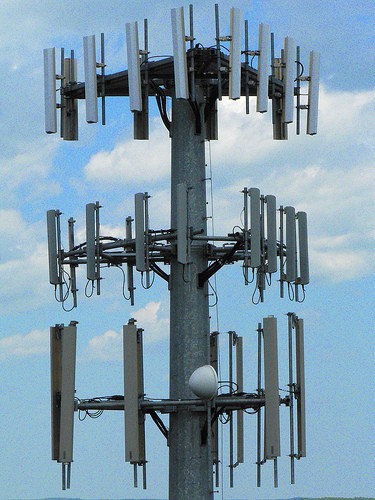
In 2013, Miller hit the ground running in his freshman year to achieve his campaign pledge of “getting the government out of the way of economic development.” In the Missouri state legislature, Miller strongly supported AT&T’s other state legislative priority: deregulation of cell tower placement. Miller traveled around Missouri promoting HB650, an AT&T inspired bill that would strip away local oversight powers of cell sites.

The issue became a hot topic, particularly in rural and scenic areas of Missouri, where local officials complained the bill would allow haphazard placement of cell towers within their communities.

“[The] bill inhibits a city’s ability to regulate cell towers as we have in the past,” Osage Beach city attorney Ed Rucker said. “The process we have in place has worked, and has worked well.”

Had HB650 become law, Osage Beach residents would today be surrounded by six new cell towers around the city, with little say in where they ended up. The bill Miller supported would have also eliminated a requirement that providers repair, replace, or remove damaged or abandoned cell towers, potentially leaving local taxpayers to pick up the tab.

Miller claimed the legislation would allow expansion of wireless broadband across rural Missouri and remove objectionable fees. HB650 would limit municipal fees to $500 for co-locating an antenna on a pre-existing tower and $1,500 for an application to build a new tower. Local communities complained those limits were below their costs to research the impact and placement of cell towers.

“That cost is an inhibitor to broadband,” Miller countered. “It’s beginning to look like the fees are an impediment to the expansion of broadband.”

Miller did not mention AT&T’s interest in cell tower expansion is also connected to its plan to retire rural landline service in favor of its wireless network, saving the company billions while earning billions more in new revenue from selling wireless landline replacement service over its more costly wireless network. The cell tower bill was eventually caught up in a legal dispute after a court ruled the broader bill that included the cell tower deregulation language was unconstitutional on a procedural matter.

AT&T to Federal Trade Commission: Our Speed Throttling is None of Your Business

Image courtesy: cobalt123AT&T has asked a federal judge in California to throw out a lawsuit filed by the Federal Trade Commission over wireless speed throttling, claiming the federal regulator has no authority over how AT&T manages its network.

The FTC filed a lawsuit in October 2014 alleging AT&T was throttling the speeds of its grandfathered “unlimited data” customers by as much as 90 percent and failed to sufficiently disclose the practice in violation of the FTC Act.

Although AT&T discloses its network management policies in broad terms deep within its website, the original complaint charges AT&T failed to directly notify customers identified as the ‘heavy unlimited users’ targeted for wireless speed reductions reportedly as low as 56kbps for up to 30 days or more.

AT&T’s lawyers claim the FTC has no jurisdiction to file the lawsuit because a portion of AT&T’s business — cellular voice service — is defined by the Communications Act as a regulated common carrier service by the Federal Communications Commission. The FTC had argued AT&T’s mobile data services are unregulated and do not fall under the FCC’s exclusive jurisdiction.

AT&T’s attorneys argue two apparently contradictory assertions about wireless regulation that both require the court, in AT&T’s view, to dismiss the FTC’s case:

  1. AT&T acknowledges that its mobile data services are not subject to Title II regulatory oversight by the FCC as a common carrier service. Therefore, federal agencies like the FTC have no jurisdiction to interfere in AT&T’s private business decisions on issues like data caps and speed throttling because it is an unregulated service;
  2. AT&T claims the FCC has asserted sweeping authority over wireless services under Section 706 of the Telecommunications Act of 1996. Therefore it should be up to the FCC alone (and not the FTC) to decide the fairness of AT&T’s network management practices. But AT&T doesn’t remind the court this is the same authority that large telecom companies sued into impotence by successfully arguing the FCC exceeded its mandate attempting to assert jurisdiction on data services to enforce concepts such as Net Neutrality and attempting to fine Comcast for throttling peer-to-peer network traffic.

ftcAT&T calls the FTC’s claims it can intervene in services not regulated by the FCC “irrelevant,” arguing once one of AT&T’s services is subject to the FCC’s common carrier regulation, all of its services become untouchable by the FTC.


“The FTC lacks jurisdiction to prosecute this action because AT&T is a common carrier subject to the Communications Act and therefore outside the FTC’s authority under Section 5 of the FTC Act. 15 U.S.C. § 45(a)(2),” argues AT&T. “Indeed, the FTC itself has recognized that, as drafted, the exemption altogether removes common carriers such as AT&T from its jurisdiction and has asked Congress to modify the statute. So far, Congress has refused.”

“But whether AT&T’s network management program is ‘unfair’ and whether its disclosures were ‘inadequate’ are issues for the FCC to decide, and in fact the FCC is in the process of so deciding, just as Congress intended,” AT&T said. “Congress drafted Section 5 to avoid subjecting common carriers like AT&T to precisely this sort of conflicting authority of separate federal agencies over the same conduct.”

Should the FCC find AT&T in violation of its transparency rules, AT&T will have a strong legal case to have that ruling tossed as well on the grounds the agency has no mandate from Congress to regulate mobile data services under Section 706/Title III of the Communications Act — the same case other telecom companies have successfully argued in the D.C. Court of Appeals.

Ironically, AT&T’s apparent regulatory loophole will vanish should the FCC order that broadband services of all kinds be reclassified as Title II telecommunications services as part of the ongoing effort to implement strong Net Neutrality policies.

4K Ultra HD Television Arrives Via Satellite; DISH Network Adding ‘4K Joey’ Set Top Box

4kjoey

That is DISH’s CEO banging the drum beside a panoply of kangaroos. (Image courtesy: Gizmodo)

The ultra high-definition, bandwidth chewing 4K television standard has arrived and like HDTV before it, the first place most Americans will get to sample the new standard is over satellite television.

DISH Network is planning to introduce HDMI/HDCP 4K television owners to its new 4K Joey this year — a souped-up set-top box that can handle the high demands of 4K video.

DISH is using a Broadcom dual-core chipset and 7448 ARM processor that can handle the next standard in high-definition viewing.

While DISH set-top boxes will be ready for 4K, many cable and DSL broadband networks in the United States will face difficulties handling the online video demands that 4K video will place on their networks. In tests, watching an average movie required a minimum of a maxed out 10Mbps broadband connection. Live programming, particularly sports, required considerably more broadband speed to keep up. Few DSL networks will be able to sustain more than a handful of customers attempting to stream 4K video before neighborhood nodes become overwhelmed. Even the DOCSIS cable broadband standard still relies on shared bandwidth, and a few video aficionados in the neighborhood could pose significant challenges and speed slowdowns for other customers in the area.

Besides satellite, only fiber optic broadband will be ready to handle the practical requirements of streaming 4K video without significant upgrades.

dish logoDISH’s plans to stream video content over the Internet could one day also include 4K programming, but viewers are likely to run smack into usage caps and usage billing that ISPs are using to deter online video from gutting cable television revenue as well as further monetizing already highly profitable broadband.

Downloading just three 4K movies consumed 90GB and took more than a day to download, even with Comcast’s 100Mbps broadband service. In usage-capped markets, fewer than a dozen 4K movies would eat your entire monthly allowance. Each additional movie would subject Comcast customers to overlimit fees averaging around $6 per title.

Although DISH will offer a set-top box to handle 4K viewing, content producers are still waiting to see whether the public embraces the next HD standard before investing heavily in programming delivered using the new standard. DISH would only promise content from “several providers” would be forthcoming by the time the 4K Joey is released during the second quarter.

Merry Christmas from Comcast: Colo., Wash., Ore., Utah Getting Speed Upgrades on Dec. 16

Phillip Dampier December 11, 2014 Broadband Speed, Comcast/Xfinity, Consumer News, Data Caps 8 Comments
Speed upgrades won't help customers if they exceed Comcast's market-tested 300GB usage cap that could extend nationwide in 2015.

Speed upgrades won’t help Comcast customers if they exceed a market-tested 300GB usage cap that could extend nationwide in 2015. (Image courtesy: “Funch”)

Comcast will double the broadband speeds of many of its broadband customers at no extra charge in the Pacific Northwest and Rocky Mountain region just in time for Christmas.

  • Performance will increase from 25Mbps to 50Mbps;
  • Blast! will increase from 50Mbps to 105Mbps;
  • Extreme 105 (105Mbps) will be replaced with Extreme 150 (150Mbps).
  • Certain areas will qualify for new speed plans of 305 and 505Mbps.

The new speeds are planned to begin on Dec. 16 and a modem reset may be required. Comcast indicates the speed increase excludes parts of New Mexico, Tucson, Ariz., and Fort Collins, Col.

These markets are not part of Comcast’s ongoing usage cap market trials testing a 300GB monthly usage cap with a $10 penalty for each 50GB customers exceed their allowance.

Although some customers are pleased about the speed increases, with usage caps potentially looming the benefits may prove fleeting.

One customer who has cut cable television and now streams all of his video entertainment online found Comcast would empty his bank account if the overlimit fee was in place in his area.

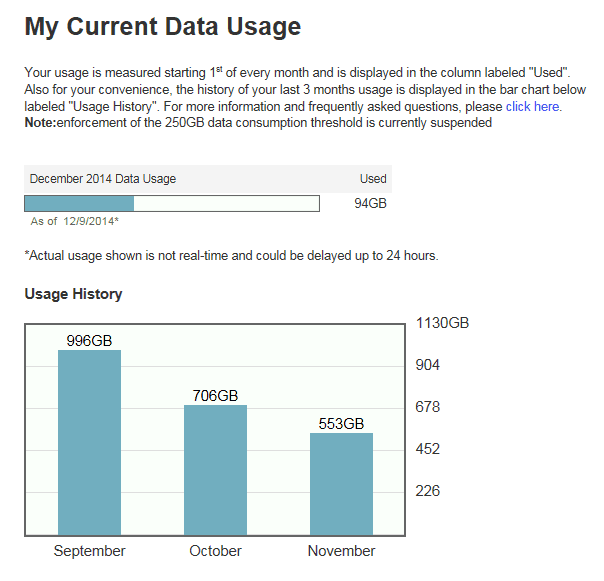
“I figured I’d go and see how much data I actually used in those months and found that I used 996GB in September, 706GB in October and 553GB in November,” wrote Funch. For the month of September, he would have owed Comcast an extra $140 in penalties on top of his usual Internet bill thanks to viewing Hulu and Netflix.

Customers in Comcast usage capped markets are turning down the video quality of Netflix to conserve their usage allowance, resulting in degraded video performance.

“They boost their speeds but then charge you more if you actually use them,” said Nashville customer Paul Frankel. “It’s the Comcast way.”

HD Smorgasbord: Rogers Tells Customers to Stop Worrying and Crank Up the Streaming Video

Phillip Dampier December 9, 2014 Broadband Speed, Canada, Competition, Consumer News, Data Caps, Online Video, Rogers Comments Off on HD Smorgasbord: Rogers Tells Customers to Stop Worrying and Crank Up the Streaming Video

In a complete about-face for eastern Canada’s largest cable operator, Rogers Communications is inviting customers to take the brakes off their usage and go hog-wild with high bandwidth HD streaming and downloading with an unlimited use plan.

“Whether you use shomi, Netflix, YouTube or all three as your go-to streaming service(s), if you’re a subscriber to an unlimited Rogers Internet package, you don’t have to worry about streaming video in anything other than their highest-quality settings – the image is pristine and the sound is awesome,” the company writes on its online blog.

Rogers had argued for at least five years before Canada’s telecommunications regulator that compulsory usage caps and overlimit fees were necessary to manage congestion on their networks and to make sure that heavy users pay their fair share.

Those days of congestion are evidently over because Rogers takes customers through several tutorials to teach them how to turn up their streaming settings to deliver HD and 4K video streams.

“Rogers comes very close to implying it is Netflix and YouTube that compromise the video experience of customers, despite the fact Netflix created its user-definable video playback settings precisely to help Canadians manage usage allowances from companies like Rogers,” said online video analyst Rene Guerdat. “It’s clear that competition from independent providers offering unlimited use accounts has made Rogers’ usage cap regime impossible and they were forced to market an unlimited option of their own.”

Here is Rogers’ guide for cranking up the video quality of video streams, useful for anyone else who subscribes to these services as well:

shomi

This new video-streaming service for Rogers Internet or TV customers has three video-quality settings (Good, Better, Best). Each uses different amounts of bandwidth and offers different levels of viewing quality. These settings can be individually changed for each user profile, and can be made only from the Web application via the account holder’s profile.

To check / change your stream settings

  1. In a browser, go to shomi.com and log in with your account credentials.
  2. Go to the dropdown menu at the top far-right corner of the Web page.
  3. Select ‘Manage Account and Profiles.’
  4. Select the profile that you want to edit (or create a profile if it is a new profile), and under the ‘Manage Profiles’ menu you’ll see your ‘Max Video Quality’ settings.
  5. Click ‘Edit’ and then select the video-quality setting that you want.

Note: These profile settings update all devices except your Rogers cable box (if you’re using one).

Netflix

Netflix has streaming-video playback settings that use less data (in case you have a small monthly data cap). If you’re on an unlimited Rogers Internet package, though, you can get a better experience by streaming at the highest settings. Here’s how.

To check / change your stream settings

  1. In a browser, go to Netflix.ca and sign in with your Netflix username and password.
  2. If prompted, select the appropriate user profile you want to change.
  3. In the top-right corner, click the downward arrow, then click ‘Your Account.’
  4. In the Your Profile section, click ‘Playback Settings.’
  5. Click the radio button to select the highest-quality streaming setting (‘High’), then click ‘Save.’

This setting will be your new default across all your devices. If you have multiple user profiles under your Netflix account, follow the above process for them, too.

YouTube

YouTube gives you a lot of playback control, and typically does a pretty good job of balancing video quality and connection. However, to ensure you’re seeing the best-quality video possible from YouTube, you can change the settings for the videos you watch. Here’s how.

Play a YouTube video in HD (when available)

  1. While playing a video, move your cursor over the player window. Video-player elements will appear.
  2. Click the gear icon in the lower right of the player.
  3. In the bottom of the pop-over menu that appears, click on the ‘Quality’ option.
  4. Select the highest video-quality setting and click it to apply.

Tip: Not all video content that’s uploaded to YouTube is available in full 1080p HD. If no HD option is offered, just choose the highest-quality setting that’s available.

Default to high-quality YouTube playback

Setting default playback behaviour on YouTube requires an account. If you have a Google account (Gmail, Google+, etc.), you already have everything you need.

  1. Log in to YouTube using your Google or Gmail account ID.
  2. Click on your username and, in the menu that appears, choose the gear icon. If you’re already logged in, click your profile image in the top-right corner to find the gear icon instead.
  3. In the left navigation pane, click ‘Playback.’
  4. Select ‘Always choose the best quality for my connection and player size.’
  5. Click Save in the top right.

Now, YouTube will give you the best-quality video it can, based on the above-mentioned factors. Double-click a video to launch it in full-screen and to get a full-HD version of the video, where available.

Search This Site:

Contributions:

Recent Comments:

Your Account:

Stop the Cap!