

Call for Apple to Get Involved in Campaign Against Internet Overcharging

Phillip Dampier June 29, 2009 Data Caps, Public Policy & Gov't 14 Comments
sunflower

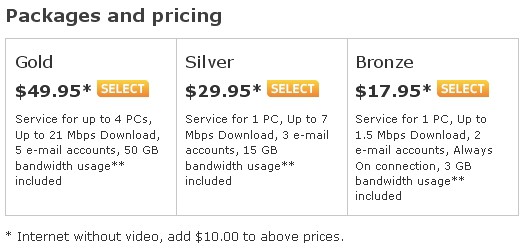
Sunflower Broadband Pricing - Note a $10/month surcharge applies for customers not subscribing to Sunflower's video package.

We’ve covered the story of Sunflower Broadband before here on Stop the Cap! This dubious provider has become well entrenched with its Internet Overcharging schemes in and around the Lawrence, Kansas region, charging top dollar pricing while imposing ridiculous limits on usage.  One Mac owner in the Lawrence area is fed up with Sunflower’s 3GB monthly usage limit for broadband users, charging a ludicrous $27.95 a month for standalone broadband service (that’s $9.32/GB!).  He’s calling on Apple Corporation to get involved in the opposition to price gouging and Internet Overcharging by providers like Sunflower.

Sunflower’s a big proponent of these pricing schemes.  Patrick Knorr, who works for Sunflower and is also ex-officio chair of American Cable Association, wants this kind of pricing for everyone.  No matter how much you consume, you are probably paying too little for your broadband account.  Sunflower’s pricing of its most deluxe Gold plan assumes you’ll never use more than 50GB per month, and for that charges customers $59.95 a month if all you want is broadband service.

Dave Greenbaum, writing for theAppleBlog, considers these kinds of limits to be abusive.

Apple is the leader in multimedia content creation; new Mac users are always pleasantly surprised by how easy it is to buy from the iTunes store, or create their own content. A common question we get in our local user group is “I’m not sure what I did wrong, but all of a sudden I have a substantial overage bill from my cable company.” Of course, the user did nothing wrong, other than subscribe to a few podcasts, and perhaps download a new Apple software update and buy some shows with iTunes! The Mac is also blessed with great online backup services like MobileMe, yet when our user group did a presentation on backup strategy, I had to warn novice users to be careful lest their backups end up costing them an arm and a leg in bandwidth overage fees!

Sunflower Broadband claims, with absolutely no independent verification, that nearly 50% of their customers consume less than ONE gigabyte per month and 98.9% of users had less than 40GB of bandwidth usage.  Of course, despite updates to its website, it curiously only provides statistics from April 2007, more than two years ago.

Greenbaum informs readers of Rep. Eric Massa’s proposed legislation, HR 2902, the Broadband Internet Fairness Act.

Ultimately, without an end to abusive broadband pricing, the implications for consumers go well beyond their own pocketbook:

Unfortunately, using the Internet normally with bandwidth metering is also unsustainable. When Mac owners are worried about downloading movies, doing backups or performing system updates, that hurts the Apple brand. Apple is continually innovating new ways to make the Mac OS the best Internet operating system, creating a whole ecosystem with iTunes, MobileMe and iLife. All of these great products rely on the ubiquity of the Internet. When Internet providers start making normal Internet use an expensive proposition, Mac users lose.

Apple should lead the way and come out against bandwidth caps. Given that many of the offerings on the iTunes store actually compete with cable TV, Apple should be vigilant that cable companies do not use bandwidth metering as a way to stifle alternative ways of viewing content.


From the Waterlogged Desk of Me

Phillip Dampier June 29, 2009 Editorial & Site News 4 Comments

Summer in western New York has been usage capped.

As alleged summer continues here in endlessly rainy and dreary western New York, and our basement suffers from the trickling of water ingress from the never-ending rains, I’ve had plenty of indoor time as of late, pondering various issues and strategies.

I wanted to bring everyone some updates on where we have been, where we are, and where we are going (in part to take care of some questions which I receive regularly from readers):

ISP Subscriber Agreement Change Notification Tracker

In private beta at the moment, this system is nearly ready for its first testing phase.  We’ll be running a special website that will track any changes to ISP Subscriber Agreements, terms of service, or Acceptable Use Policies, and automatically notify those who wish to subscribe to the updates.  We’ll also be calling out major changes right here on Stop the Cap! This has proven necessary because ISPs are not always consistent about informing their customers about changes to these agreements, and many others do not timestamp the date of changes.  We will, along with a representation of what exactly has changed.  When the test goes public, we’ll have a form up to allow readers to inform us about any ISP’s you would like us to track.

Rep. Massa’s Bill: The Special Interests Want Revenge!

As we suspected, Rep. Eric Massa has been targeted for takedown come the next election in 2010.  In fact, his opponents are going to make his district a hot target, with a ton of special interest money and outsider cash flooding in to force him out of office.  We cannot allow this to happen.  If he has our back, we have to have his, and we’ll be calling on everyone to help do what it takes to keep Congressman Massa right where he is — doing the business of the people, not the special interest telecommunications lobbies.  I will be putting up a contribution link this week for his re-election campaign and putting some of my money where my mouth is, and I hope anyone concerned with the Internet Overcharging issue will do the same.  We need to get started early and stick with him all of the way.

Naughty Phone Companies Need Their Own Special Site

I’ve heard from just about everyone on the issue of FairPoint, and our 13-part series on the nightmare that never seems to end for people in New England who are stuck with this god awful phone company.  Even regulators are dropping e-mail my way, some in other states facing the prospect of Verizon pulling out of their communities as well.  Everyone wants to know what happened, what’s being done to really fix it, and how they can prevent this from ever happening again.

Because this issue starts to diverge away from the mission of Stop the Cap!, a new pro-consumer website is forthcoming that will be the home for news and information about telephone companies behaving badly on pricing, service, and viability.  We’ll still bring all of the news that relates to Internet/broadband issues here, but some of the other deeper issues will work better on a different site.  Stay tuned for more details.

Not every phone company is evil, and some do a fine job for their customers.  But the days of rubber-stamped business deals that leave consumers out in the cold need to come to an end.

My Personal Ramblings

You will also find an eclectic mix of stories, opinion, and rantings about the telecommunications industry, the media, politics, and life in the Flower City on my personal blog.  It’s become more active as a place where I can cover stories and issues that won’t fit anywhere else, and allows people to figure out where I’m coming from on an entire range of issues.  It will look familiar to readers here, as it has the same basic look.

Tweets, Twitter & The Social Networking Thing

Stop the Cap! Official Twitter Channel

Phillip Dampier’s Personal Twitter Channel

Facebook

AT&T U-verse Introduced in Central Illinois & Corpus Christi, Texas

Phillip Dampier June 29, 2009 AT&T, Comcast/Xfinity Comments Off on AT&T U-verse Introduced in Central Illinois & Corpus Christi, Texas

Helping to spur additional competition, AT&T announced the availability of its U-verse service in parts of Corpus Christi, Texas and the communities of Springfield, Champaign, Danville and Decatur, all in central Illinois.

“Today’s launch of AT&T U-Verse reflects our commitment to make the investments necessary to bring consumers across central Illinois a new era of true video competition,” AT&T Illinois president Paul La Schiazza said in a statement.

In Illinois, dissatisfied Comcast customers were tearing up one of the local newspaper’s message boards.  Here’s a sampling:

  • Now maybe Comcast will get better service and lower their OUTRAGEOUS prices.
  • Comcast: Can you hear the sound of competition and angry customers? Can’t wait to get a cable carrier that actually plays all of the available Cardinals’ games.
  • Will they have it in Chatham? I will be ready to sign up to get rid of Comcast! What parts of Springfield will get U-Verse, and what parts will be left out in Comcast’s cold?
  • I can’t wait to get rid of Commiecast.

Mercury News Columnist Calls Out Broadband for Slow Upload Speed, Blames Cable/Telco Duopoly

Phillip Dampier June 29, 2009 AT&T, Comcast/Xfinity, Issues 6 Comments

Troy Wolverton had a problem.  He wanted to send 170 pictures to Kodak to arrange to have them printed in time for Father’s Day.  It turned out to be a true labor of love, as he waited hours to send the 800 megabytes of imagery to Kodak’s online processor.

troy

Troy Wolverton writes tech news for the Mercury News in California

As more than three hours passed, Wolverton began to ponder why the upload seemed some poky.  He subscribes to Earthlink, which supplied him with a 3Mbps connection.  Assuming that speed was available for both uploading and downloading, it would have taken less than an hour to get the job done.  But as virtually every customer of an Internet service provider finds, your download speed is many times faster than your upload speed.  In this case, Wolverton was suffering with a 384kbps upload speed to get those photos to Kodak.

In fact, while download speeds have been increasing at a steady clip, many have discovered upload speeds have barely budged, if at all, since broadband service became available in their area, often more than a decade ago.  Rochester, New York is one such example.  Time Warner Cable’s Road Runner service was introduced officially in 1998 with a download speed of around 5Mbps, but the upload was just 384kbps.  Today, standard Road Runner service provides 10Mbps for downloads, but the upload speed has remain unchanged, despite more than a decade having passed.

Networks were originally designed to provide more speed for downloading, and less for uploading, based on the presumption subscribers would take more than they “gave” to the Internet.  That remains essentially true today, but subscribers are increasingly relying on their upload connection to send pictures, movie clips, and other larger files to their friends, family, or work.

But broadband companies seem oblivious to this trend. If you look at the plans offered by the Bay Area’s two main providers, Comcast and AT&T, it’s all but impossible to find one in which the upload speed comes anywhere close to the download speed. To get an upload speed that’s faster than a slow download rate, you have to subscribe to one of the pricier plans, like Comcast’s Extreme 50, which gives you a 10 megabit per second upload connect — at a cost of $100 a month.

Comcast and AT&T officials say they are watching consumer Internet usage trends. They note that as their companies have ramped up download speeds, they’ve tended to increase upload speeds as well and will continue to do so. The download and upload speeds they offer are simply a response to market demand, they say, claiming that the vast majority of their customers still download far more data than they upload.

“We’re designing our products based on how we see consumers using them,” John Britton, an AT&T spokesman, told me.

Wolverton thinks the lack of competition also has a lot to do with it.

In terms of Internet access providers, the Bay Area essentially has a duopoly. There are numerous small players such as EarthLink, but Comcast and AT&T dominate — and duopolies tend to not have a good read on real market demand. People often buy one of their products because they don’t have any other choices — not because they meet their needs.

In other words, if the market were more competitive, a company might be able to build a successful business by catering to people who want faster upload speeds.

Just because consumers use their connections to download more data than they upload isn’t proof that they don’t want to upload more. The slow speeds could well discourage folks from doing more uploading. And they may well find a use for faster upload speeds — if they had them.

I’d love to be able to back up the videos, songs and documents on my computer to a server on the Internet. But with my slow upload connection, that’s not really an option because it would take days of uninterrupted uploading to back up any significant portion of my hard drive.

Deregulation + Lack of Competition = Rate Increase for Alabama AT&T Customers

Phillip Dampier June 29, 2009 AT&T, Public Policy & Gov't 1 Comment
AT&T Rate Increases Coming

AT&T Rate Increases Coming

AT&T is jacking up phone rates for residents of Alabama, one year after state officials deregulated the Alabama telephone service marketplace based on the premise that competition would bring about lower rates for consumers, not higher.

Darrell Baker, director of the Alabama Public Service Commission’s telecommunications division, said telephone companies heavily promoted the price deregulation plan by claiming competition would keep rates down.  An industry-friendly deregulation bill was passed in 2005 over PSC objections, and another bill the Alabama Legislature passed this spring expanded deregulation further.

Alabama residents will now pay for that free-market construct in a state with limited local line competition.

AT&T spokesman Hood Harris said customers with Basic Service, a single-line home phone, will see their bill rise 3 percent, from $16.95 per month to $17.45.  Approximately 15 percent of AT&T’s Alabama customers have basic service.

Customers with AT&T’s deluxe plan, the Residence Complete Choice Package, will see an increase of 9.5 percent, from $21 per month to $23.

Harris blamed the increases on inflationary costs.

Baker was unimpressed with the rate increase announcement.  “It doesn’t sound like the competitive market is having much impact,” he said.  Baker expects other telephone companies in the state to quickly follow suit.

AT&T increased rates in 2008 by 4.1%.

Search This Site:

Contributions:

Recent Comments:

Your Account:

Stop the Cap!
