HBO/Cinemax Go Now Available to All Time Warner Cable Customers: A Review

Phillip Dampier January 13, 2012 Editorial & Site News, Online Video Comments Off on HBO/Cinemax Go Now Available to All Time Warner Cable Customers: A Review

Time Warner Cable has opened up access to HBO GO and Max GO to all customers who subscribe to the premium movie channels.  A brief beta test for Time Warner’s super-premium Signature Home customers concluded earlier this week and the service is now available to all.

Stop the Cap! tested the HBO GO service earlier today and can report the service is up and running for Time Warner customers.

HBO GO's current movie selection includes a number of older titles.

The most cumbersome part of both services is the authentication process.  Graceful it is not.  Customers have to start their journey at either the HBO or CinemaxTV Everywhere” portal, select their cable operator, and then get prompted to authenticate their cable TV service.  Time Warner’s authentication process makes this especially confusing by notifying customers not to use their bill payment service account username and password.  Instead, customers are told to use login credentials for the cable company’s customer information and authentication portal — My Services.  It is easy to get confused which username and password to use.  If you do not have a “My Services” account, the registration process is even more tedious, because you have to wait for confirmation e-mail messages and hunt down a current cable bill, if you receive one in the mail at all.

Having registered for other TV Everywhere services from Time Warner Cable before, it was more than a little annoying going through the same process all over again for HBO.  HBO and Max GO also require the subscriber to choose a username and password on those sites as well, which means yet another account and password to remember.  After about 10 minutes of the irritating multi-step process, access was finally granted.

HBO Go currently has 230 movies available for instant viewing, a large number of which are hardly recent.  The 1953 version of Titanic, for example.  Really?  Oh, God with George Burns and John Denver, the 1979 please-edit-me snoozefest Star Trek: The Motion Picture, and all three Back to the Future movies seemed like a lot of dated filler material for a $15 a month premium movie channel.  Better offerings were found under the series, specials, and comedy categories which delivered a full library of a number of HBO productions, as well as current events shows like Real Time with Bill Maher.  (The latter only included a handful of episodes from the current season and some earlier editions.)

Our biggest trouble came when we tried playing from the menu of titles.  This is no Netflix.  We found picture quality often lacking, with plainly visible screen anomalies, and the stream was interrupted several times for buffering.  Either pent-up demand for HBO Go is causing Time Warner customers to pound the service during the business day, or HBO needs to beef up its server capacity. We did several speed tests and found our connection stable at 30/5Mbps, so this was not a Time Warner Cable broadband problem.

The best part about HBO and Cinemax GO is that it comes free with subscriptions to one or both channels.  We’d have a hard time justifying paying extra for the current online viewing experience.  It also remains ironic that Time Warner Cable executives continue to foster a desire to implement Internet Overcharging schemes like usage caps and/or consumption billing while encouraging customers to consume more bandwidth with online video services such as these.

Time Warner Cable partner Bright House Networks is anticipated to launch both services themselves shortly.


Judge Dismisses Hidden Cable Modem Fee Lawsuit Against Comcast

Phillip Dampier January 13, 2012 Comcast/Xfinity, Consumer News, Public Policy & Gov't 2 Comments

Motorola cable modem

A California federal judge has thrown out most of a class action lawsuit that charged Comcast with marketing broadband service plans without disclosing extra fees for cable modem equipment.

The head plaintiff, Athanassios Diacakis, claimed Comcast sold Triple Play promotions over the phone and in the media without mentioning customers would also have to pay additional fees to lease a cable modem.  Diacakis accused the cable operator of violating California’s tough false-advertising laws by not fully disclosing all fees and surcharges while explaining the promotion.

U.S. District Judge Saundra Brown Armstrong disagreed, however, dismissing most of the plaintiffs claims.  The judge didn’t declare Diacakis’ claims untrue, but ruled they were insufficiently documented to proceed to trial.

“The [amended complaint] fails to specify when or where Comcast advertisements were viewed, the content of those advertisements, or which of them in particular Plaintiff relied upon,” Armstrong wrote.

Diacakis is free to submit an amended complaint if he wishes to proceed with his class action case.

Comcast charges customers $7 a month to lease cable modem equipment, but invites customers to purchase their own cable modems to avoid rental fees.  Many customers do just that, choosing from several dozen approved models Comcast will provision for broadband customers.  The cost to purchase cable modem equipment ranges from $50-125 on average, depending on the cable modem selected.  It takes less than two years for purchased cable modems to effectively pay for themselves at Comcast’s current rental rate.

FCC Upset Over Comcast’s Admission It Had No Intention to Use Wireless Spectrum It Acquired

McDowell

Republican FCC Commissioner Robert McDowell is questioning whether Comcast misled the federal agency when the cable company acquired wireless spectrum it now says it had no intention of ever using.

McDowell was reacting to Comcast chief financial officer Michael Angelakis, who admitted this week his company really never had any interest in competing in the wireless space.

“Were they purchased under false pretenses?” McDowell asked.

Comcast has since sold their acquired spectrum to Verizon Wireless, which in Angelakis’ view makes sense.

“We never really intended to build that spectrum, so therefore it’s a really good use of that spectrum,” Angelakis said.

That admission puts Comcast in a difficult position, because FCC rules mandate that companies acquiring scarce wireless spectrum make a good faith effort to use it.  In McDowell’s view, had Comcast never intended to put the frequencies to use, the FCC probably would have disallowed the acquisition.

Verizon Wireless also plans to pick up unused spectrum originally acquired by Time Warner Cable in a deal that would let both companies cross-promote cable and wireless products and avoid head-on competition.

Both Comcast and Time Warner Cable have warehoused unused spectrum for several years.  Neither company appeared serious about building competing wireless networks, and with the spectrum off the market, would-be competitors couldn’t launch service either.

Verizon agreed to pay $3.6 billion to acquire the cable industry-owned spectrum, which it intends to use to bolster its LTE 4G network.

The FCC is now seeking public input on whether it should approve the spectrum sale. The Justice Department is also considering its antitrust implications.

4G LTE Broadband Makes Inroads… But Only When the Price is Right: Overcharging=Failure

Phillip Dampier January 11, 2012 Broadband Speed, Competition, Data Caps, Editorial & Site News, Rural Broadband, Video, Wireless Broadband Comments Off on 4G LTE Broadband Makes Inroads… But Only When the Price is Right: Overcharging=Failure

[flv width=”640″ height=”380″]http://www.phillipdampier.com/video/BBC News Will 4G be faster than home broadband 1-9-12.flv[/flv]

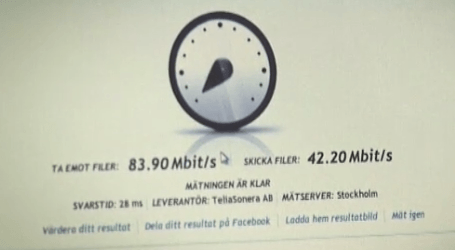
The BBC produced this mini-documentary about 4G LTE wireless broadband’s impact in Europe and the United States.  Providers in the UK and northern Europe see wireless 4G as the solution to rural broadband scarcity, but consumers in urban and rural settings won’t put up with stingy usage caps and ridiculously high prices.  Sweden pioneered 4G wireless, running the oldest and most robust 4G network in the world.  In Sweden, TeliaSonera delivers wireless broadband at speeds of up to 84Mbps — many times faster than what Verizon Wireless offers.  But even with those speeds, just 9,000 Swedes have signed up — rejecting the company’s “very high priced” service — $50US a month for 10GB.  (Verizon Wireless charges $80 a month for the same amount of data usage, a testimony to the price sensitivity of a much-more regulated and competitive European wireless marketplace.)

A TeliaSonera speed test shows their 4G LTE network can deliver nearly 84Mbps.

While Europe enjoys faster speeds at lower prices, providers in the United States are treating 4G as a luxury item.  With that in mind, plans by some U.S. carriers to create a home broadband replacement service for rural America that relies on 4G wireless networks will likely face strong consumer resistance because of the extremely high prices and low usage caps.  (The abrupt end of the video is intentional.) (10 minutes)


Local Governments Discover Cable Deregulation Leaves Them Powerless to Represent Consumers

Phillip Dampier January 11, 2012 Competition, Consumer News, Public Policy & Gov't Comments Off on Local Governments Discover Cable Deregulation Leaves Them Powerless to Represent Consumers

When Massena, N.Y. town supervisor Joseph D. Gray balked at Time Warner Cable’s demands for a 15-year franchise renewal agreement, especially after the cable company never bothered to show up at a hearing on the subject, he thought he could send a message by supporting a renewal expiring after just one year.

But there was a reason Time Warner never bothered to show up to defend their performance in northern New York State over the last decade of increasing rates and unwanted channels shoveled at subscribers — they did really have to answer to local officials.

Gray assumed playing some hardball with the cable company might get their attention and bring them to the table to discuss the demands of local Massena residents he hears from all the time.  At the top of the list is a-la-carte cable — paying only for channels you want.

No deal.

Gray

Mr. Gray has since admitted in conversations with the Watertown Daily Times he is frustrated by the town’s inability to effect “any real change.”

This despite the state cable franchise law which declares communities have the right to establish and negotiate “cable-related community needs” as part of the final contract with cable operators.

In fact, the cable industry has spent millions lobbying federal and state governments to deregulate their operations, even though most communities are served by just one cable operator.  While phone companies have made limited progress competing in larger urban areas, most of upstate New York is left choosing between a satellite provider or a cable company — usually Time Warner Cable.

That lobbying paid off in the 1990s when the federal government swept away considerable government oversight of cable operations.  While municipalities technically still control the basic franchising process, those dissatisfied with service from an existing provider rarely find other companies willing to take over.  That leaves Massena stuck with Time Warner Cable, who isn’t giving an inch on how they package their programming.

“We can make some gains for the community. Can we get free service for a couple of municipal buildings? Probably,” Mr. Gray told the newspaper. “They continue to say there’s nothing they can do about programming, there’s nothing they can do about bundling.  That’s from the programmer.  Until we get … a la carte, where people get the channels they want, we’re never going to satisfy people.”

Search This Site:

Contributions:

Recent Comments:

Your Account:

Stop the Cap!