Travesty: North Carolina’s Telecom Companies Oppose 4Mbps Broadband Service in Rural Areas

Despite today's setback, North Carolina's broadband hero is Rep. Bill Faison, who stood up for rural broadband.

In the North Carolina legislature’s Finance Committee, a one week timeout “to hear views from the public” actually means giving breathing room for cable and phone lobbyists to strip away surprise amendments not to their liking.  This morning, in a catastrophe for consumers, the state’s largest phone and cable companies got legislators to wipe out a provision that would have helped guarantee rural North Carolina at least 4Mbps broadband service, either from existing providers or new ones that develop in their absence.

During debate of H.129, the anti-Community Broadband bill, North Carolina consumer interests were kept out of sight and mind as lobbyists worked their magic to get rid of Rep. Bill Faison’s (D-Caswell, Orange) amendment that would set the state’s minimum acceptable definition of broadband at 4Mbps with a 1Mbps upload speed.  With the help of several flip-flopping representatives, they got their wish.

Faison’s amendment was designed to open the door to someone — anyone — to bring broadband into rural areas of the state.  While Time Warner Cable, AT&T, and CenturyLink dawdle, large numbers of rural residents simply go without any broadband service.  Faison’s amendment was simple and reasonable — if at least half of an area is not served with 4/1Mbps service, provisions should be made to allow local communities, if they wish, to establish service themselves to get the job done.

Last week, when Faison’s amendment appeared to be headed for incorporation into the bill, industry lobbyists blanched and fled the room, raising vocal objections and demanding a week timeout before a vote was taken.  After winning their reprieve, they managed to get the Republican majority in line to throw rural North Carolina under the bus, uniformly opposing Faison’s amendment.  Two Democrats, one representing the city where Time Warner Cable’s regional division is headquartered, joined them.

Hall of Shame: Rep. Carney does not care about North Carolina's digital divide.

In its place, they substituted a new amendment which defined broadband in the state of North Carolina as any service occasionally capable of achieving 768kbps downstream and 200kbps upstream.  That represents “well-served” among these industry-friendly legislators.

Among the worst offenders that stood out today were Reps. Jeff Collins (R-Nash) and Becky Carney (D-Mecklenburg).  Last week, they were standing with North Carolina consumers.  This week, they are voting for the interests of the cable and phone companies.  Rep. Carney, who lists her occupation as “homemaker”, voted to guarantee North Carolina families years of slow, expensive and erratic broadband service, if available at all.  Collins supported an amendment that says Nash County residents should do just fine with broadband speeds that don’t even manage to break 1Mbps.

The bill next moves to the floor of the House for consideration.

What is missing from this debate is a realization on the part of the legislature cable and phone lobbyists do not want anyone delivering basic broadband service in rural North Carolina unless it comes from them, and to date they have shown no interest in delivering it.

After all the debate, here is a fact no one can ignore.  The only networks in the state capable of delivering world class 100Mbps broadband are two fiber based community-owned networks in Wilson and Salisbury.  The companies that want to see them out of business see 768kbps as more than adequate to define broadband availability in North Carolina.  When members of the Finance Committee agreed, it helps explain how the state has managed to rank 41st in broadband excellence.

It’s time to ask your legislators what side they are on.  Yours or the state’s cable and phone companies.

AT&T Data Caps: Gizmodo’s Joe Brown In Over His Head on G4TV’s Attack of the Show

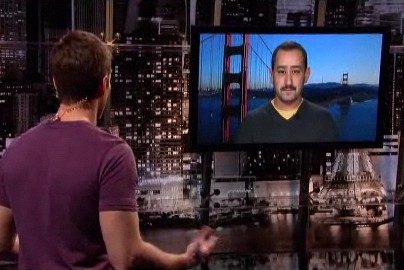
Joe Brown was obviously not the right person for G4TV’s Attack of the Show to talk to about the issue of Internet Overcharging.

As AT&T begins notifying their DSL and U-verse customers they are about to face usage limits on their broadband service, G4TV sought out reaction from the features editor of Gizmodo.com, who was wholly unprepared to inform viewers about the facts behind AT&T’s usage caps and their implications for customers.

While Brown and G4TV were joking about users having to curtail game downloads, for millions of AT&T customers, it’s no laughing matter.

AT&T’s announced 150-250GB limits will eventually cost customers $10 or more for each extra 50GB allotment, on top of their already-expensive broadband service package.

“It really had to happen eventually I think,” Brown told viewers.  “People are using a lot of bandwidth.”

Gizmodo's Joe Brown talks with G4TV's Attack of the Show

But Brown’s observation conflicts with AT&T’s own claim “only a tiny minority of customers” will use more than the company wants to allow, with the average AT&T customer consuming 18GB per month.  AT&T isn’t telling the full story about that either.

For those “heavy users” AT&T wants to restrict first, the implications go well beyond curtailing Netflix and playing online games.

“As a software developer who works under a Linux environment and is forced to telecommute from home one week per month, these caps would absolutely kill me,” writes Joe Stein from Sparks, Nev.  “If you are a retired person using your computer to check e-mail and browse the headlines, you will obviously never exceed AT&T’s caps, but for technology innovators and those like me in the software development field, 150GB is nothing.”

Stein downloads regular updates for Linux, exchanges software back and forth with the office several times a day, and uses video conferencing regularly when he works from home.

“Not all online video is about adult entertainment or downloading movies,” Stein says.  “Usage caps hurt anyone who has to work with large files or business-related video, and after the events this week, AT&T can afford to leave off the caps.”

Brown claims AT&T conducted “a study” in two cities which found that 98 percent of their customers used far less than the usage caps would allow.  What Brown does not know is that those two cities are Beaumont, Texas and Reno, Nevada — hardly superstars in the tech revolution.

“Nobody moves to greater Reno to be a software superstar, which is why I am in San Jose, Calif., all the time,” Stein says.  “But there is more to this area than casinos.”

Stop the Cap! has been helping consumers in both cities avoid AT&T because the company’s “study” came at the same time it was experimenting with an Internet Overcharging scheme that limited customers to as little as 20GB of usage per month — a strong incentive for customers to avoid high bandwidth services,  or better yet AT&T.  So it’s no surprise broadband users who know better chose an alternative provider, including Stein.

“I first became aware of the usage cap debacle a few years ago when AT&T tested usage caps in the Reno area, which covers Sparks,” Stein says.  “I saw the impact first hand when customers started getting notified they would have to pay substantially more for basic Internet service.”

Lvtalon

AT&T first limited their broadband customers to as little as 20GB of usage per month, then claimed the average customer only uses 18GB, making their 150GB DSL cap "generous."

Stein left for the cable company — Charter Communications, and they have usage caps too, but they are rarely enforced and much higher than what AT&T offers DSL customers, Stein says.

Brown claims AT&T is trying to “get out ahead of people using too much,” a point in conflict with the fact AT&T is willing to sell consumers additional bandwidth on its “overcongested” network.

Brown’s suggestion that “bandwidth costs money” is partially true, but not in the context of AT&T’s usage limits.  The company that can afford fiber optic upgrades to deliver limitless television and telephone service apparently cannot afford the pennies in bandwidth costs customers consume as part of their broadband service, which can run $50 a month or more.

Pondering broadband usage “fairness” is a losing proposition for consumers… and reporters, too.

Once someone blindly accepts the premise AT&T needs data caps, with no evidence usage presents a technical or financial challenge for the company, the debate is quickly reduced into a numbers game about “how much usage is fair.”

Clearly for Brown and his friends, who admit they are dangerously close to reaching or exceeding AT&T’s limits, the answer to Brown wondering aloud if the caps would “do it for him” should be no.

Stop the Cap! believes no cap is worth living with, especially on AT&T’s enormous-sized broadband network, now increasingly designed to handle the multimedia rich Internet and their U-verse platform.

It is doubtful many will be assuaged by Brown’s comments that “AT&T sounded pretty cool” about how they will deal with those who exceed their arbitrary usage limits.  Why?  Because after the “fair warnings” AT&T will provide customers on its artificially limited network, they will drop the sledgehammer of higher bills on top of customers’ heads.

Brown should know better, especially after finding AT&T unwilling to discuss how often it intends to revisit its usage cap levels.  AT&T’s counterparts in Canada have already foreshadowed the answer.  Once the cap regime is in place, several companies lowered them, sometimes repeatedly, to further monetize broadband usage.  They also raised the prices of overlimit fees, often substantially.

AT&T depends on uninformed consumers and reporters not understanding the true facts about Internet Overcharging schemes.  It’s not too late for reporters like Joe Brown to undo the damage, however.

Stop the Cap! strongly encourages everyone to examine the evidence we have compiled here over the past two and a half years.  It’s not hard to discover AT&T’s usage caps have nothing to do with fairness, are arbitrary and unnecessary, and come as a result of providers seeking higher profits in an undercompetitive marketplace.

If we do not uniformly and loudly oppose usage limits, America’s broadband rankings, digital economy innovation, and high technology jobs are all at risk, just to satisfy AT&T’s insatiable appetite for higher profits.

(P.S. – Joe: How did you miss Comcast has been capping their customers at 250GB for two years now.  Say it ain’t so, Joe!)

[flv width=”480″ height=”380″]http://www.phillipdampier.com/video/G4TV Attack of the Show ATT Caps Their Data Usage 3-15-11.flv[/flv]

G4TV’s ‘Attack of the Show’ misses the boat on AT&T’s Internet Overcharging scheme.  They did better covering Time Warner Cable’s attempt at Internet Overcharging in 2009.  It’s time to revisit this issue and get involved in the fight that could hurt the very audience watching this show.  (6 minutes)

NC Politician Under Fire for ‘Pay to Play’ Telecom Politics; Demands TV Camera Be Shut Off During Interview

"I wish you'd turn the camera off now because I am going to get up and leave if you don't," said Rep. Julia Howard. (WNCN-TV)

Rep. Julia Howard (R-Davie, Iredell) threatened to get up and leave an interview with a Raleigh television reporter if the NBC station didn’t “switch the camera off” after she was questioned about her support of an anti-consumer, anti-broadband bill written by the same telecommunications companies that donated more than $7,200 to her political campaign.

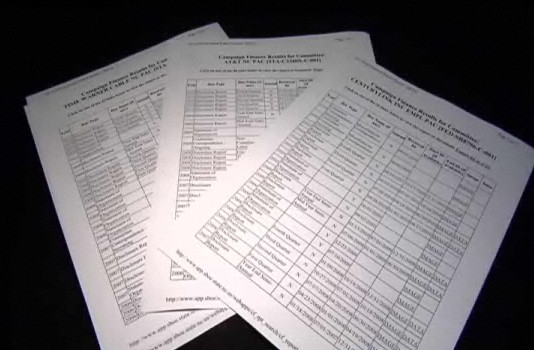
Howard was being interviewed by WNCN-TV in Raleigh about her strong support for legislation that would likely end community-owned broadband in one of America’s least-wired states.  The reporter asked Howard to explain her support for H.129, the so-called “Level Playing Field” bill that has received a considerable push from the state’s largest telecommunications companies, including Time Warner Cable, AT&T, and CenturyLink.

At first, Howard tried to defend her support for the bill, despite claims from the watchdog group Democracy North Carolina that the legislation raises ethical questions about the influence of money in state politics.

“I don’t care what they say. That’s not who I am,” she said. “As long as I’m here, I’m going to do what I feel like is right for the people of the state.”

But moments after being confronted with the fact she has received considerable financial support from all three companies, Howard demanded the reporter turn the cameras off.

“I wish you’d turn the camera off now because I am going to get up and leave if you don’t,” Howard told the reporter.

Bob Hall, director of Democracy North Carolina called the bill a classic example of “pay to play” politics — where large companies pay to get legislation favoring their businesses before the state legislature.

“The relationships that are built because of money that’s given, that then warps the whole discussion,” Hall said.

The Raleigh NBC affiliate uncovered pages of campaign contributions to lawmakers supporting H.129 from the state's largest cable and phone companies. (WNCN-TV)

Howard chairs the Finance Committee that will hear the bill tomorrow morning after a week’s delay.  Surprise amendments that would help hold existing networks exempt from the onerous provisions of the legislation and an easing of the bill’s requirements for unserved areas upset cable industry lobbyists.  In the interim, a growing number of media reports have called attention to the corporate contributions that seem to be helping drive the bill forward.

“There are a handful of politicians in the legislature that are either on the take or wear blinders when it comes to the real interests of voters like myself,” writes Raleigh resident Susan, who follows Stop the Cap! “Watching Julia Howard squirm in her chair when being asked pointed questions serves her right.”

Susan, who notified us of tonight’s news report, doesn’t believe for a moment Howard’s “feigned shock” over questions being asked by the reporter.

“Anyone pushing H.129 is a shill for Time Warner Cable, because there is not one single part of this bill that brings one new Internet connection, it just guarantees we will all pay higher rates so the cable company can donate more money to Howard’s campaign.”

Stop the Cap! continues to recommend North Carolina residents contact members of the Finance Committee and tell them to vote NO on H.129.  Tell Rep. Howard and others it is not too late to do the right thing and withdraw this bill from further consideration.  Explain to her that if her word is her bond, she can prove her honorable intentions by asking Rep. Avila to pull the bill because it is a mistake and won’t bring better broadband to anyone.  We want Rep. Howard to retain the goodwill of the people of North Carolina, but that becomes increasingly difficult if she can’t even defend what she is doing to a reporter asking if there is a connection between her support and the thousands of dollars of campaign contributions she has received from the industry that wrote the bill.

<

p style=”text-align: center;”>

WNCN-TV caught Rep. Julia Howard off guard when she was confronted with thousands of dollars in campaign contributions from large telecommunications companies and asked if this played a role in her support for their custom-written proposal to abolish community-owned networks in the state.  (2 minutes)

Finance Committee Members

(click each name for contact information)

Senior Chairman Rep. Howard
Chairman Rep. Folwell
Chairman Rep. Setzer
Chairman Rep. Starnes
Vice Chairman Rep. Lewis
Vice Chairman Rep. McComas
Vice Chairman Rep. Wainwright
Members Rep. K. Alexander, Rep. Brandon, Rep. Brawley, Rep. Carney, Rep. Collins, Rep. Cotham, Rep. Faison, Rep. Gibson, Rep. Hackney, Rep. Hall, Rep. Hill, Rep. Jordan, Rep. Luebke, Rep. McCormick, Rep. McGee, Rep. Moffitt, Rep. T. Moore, Rep. Rhyne, Rep. Ross, Rep. Samuelson, Rep. Stam, Rep. Stone, Rep. H. Warren, Rep. Weiss, Rep. Womble

Same Story, Different Countries: Whether It’s Bell or AT&T, Usage Billing & Caps Are Nonsense

[flv width=”640″ height=”380″]http://www.phillipdampier.com/video/UBB is Nonsense.flv[/flv]

François Caron produced this video succinctly smashing the myth that “usage-based billing” and “usage caps” are about fairness or fight congestion.  In this case, Caron refers to Canadian providers, but the story is much the same south of the border.  These Internet Overcharging schemes are nothing more than an effort to control what you can do with your broadband connection.  AT&T wants a 150-250GB usage cap on broadband, but has limitless capacity for television and telephone service.  They also have $39 billion to buy T-Mobile, but need to overcharge you for broadband service.  Bell in Canada wants -every- broadband user in Canada to pay this ripoff pricing.  Share with anyone who thinks paying for usage is anything like paying for water, gas, or electricity.  It’s not!  (6 minutes)

FCC Chairman Opens Wireless Industry Convention Mouthing AT&T Talking Points

Phillip Dampier March 22, 2011 AT&T, Broadband "Shortage", Competition, Editorial & Site News, Public Policy & Gov't, T-Mobile, Wireless Broadband Comments Off on FCC Chairman Opens Wireless Industry Convention Mouthing AT&T Talking Points

Genachowski

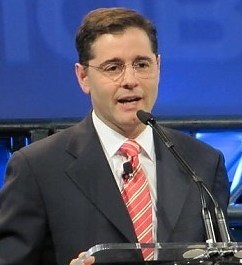
Federal Communications Commission Chairman Julius Genachowski spent this morning in Orlando delivering a keynote address opening the wireless industry’s annual trade show.

Stop the Cap! spent part of the morning following the event over a live stream that most wireless customers would never dare to watch — fearing they’d blow past their monthly usage limits.  Genachowski steered well clear of commenting on yesterday’s merger announcement between AT&T and T-Mobile.  But then AT&T must have hacked their way into the tablet the FCC chairman was reading from, because he suddenly launched into a series of talking points that could have come right off of AT&T’s government affairs website.

“Mobile broadband is being adopted faster than any technology in history, but there’s a catch,” Genachowski said. The chairman said the demand for wireless broadband is overwhelming the country’s wireless infrastructure. “The coming spectrum crunch threatens America’s leadership in mobile,” Genachowski said.

It appears Julius has been listening to AT&T executives who have made the spectrum crunch and “America’s leadership in wireless broadband” bullet points a hallmark of their argument for a merger with T-Mobile.

In fact, although T-Mobile delivers AT&T additional mobile broadband capacity in selected major cities, the company is likely to find many of T-Mobile’s cell sites redundant, and some of T-Mobile’s spectrum is incompatible with AT&T’s network unless customers are handed new devices.

America’s “leadership in mobile broadband” can be judged in many different ways.  For example, we feel many in Washington are helping AT&T lead the way to a mobile duopoly.  We are also leading with some of the most expensive mobile broadband service in the world, a fact of life that will never change in America’s shrinking competitive landscape.

Spectrum issues are solvable by the FCC without destroying competition with yet another colossal merger.  The chairman’s telegraphing of AT&T’s talking points can only be seen as an encouraging road map by which the huge telecom company can sell its deal to regulators by selling out consumers.

Search This Site:

Contributions:

Recent Comments:

Your Account:

Stop the Cap!