Home » Astroturf » Recent Articles:

Astroturf Group Heartland Institute Lies About Chattanooga’s EPB Fiber Network: “They Only Sell a Gig”

Heartland Institute: "By not disclosing our donors, we keep the focus on the issue."

In an eyebrow-raising exchange between the Heartland Institute’s Bruce Edward Walker and Dr. Joseph P. Fuhr, Jr., who produced a dollar-a-holler “research report” on behalf of corporate-backed astroturf group the Coalition for the New Economy (which lists the Heartland Institute’s Florida chapter as a member), the two dismiss Chattanooga’s award-winning EPB Fiber Network as providing lesser service than private competitors AT&T (also a member of the Coalition) and Comcast, in part because EPB “only sells customers a gig.”

An exchange between Heartland Institute’s Bruce Edward Walker and Dr. Joseph P. Fuhr, Jr. fundamentally misrepresents Chattanooga’s EPB Fiber network. At no point does Walker disclose Heartland Institute’s chapter in Florida is a member of the group that sponsored the production of Fuhr’s report. (1 minute)
You must remain on this page to hear the clip, or you can download the clip and listen later.

Walker: The government broadband services are always one step behind private industry and I’m thinking in Chattanooga, the law [sic] that they have the fastest download speeds of all government broadband in the United States, but they only offer 1Gbps service.

Fuhr: Well, one of the issues there is, well, the supply is there but they kind of have the feeling that if you build it, they will come.  Well, they haven’t come.  I mean they are charging $350 a month for that service and very few people are willing to subscribe.  People are, for the most part, happy with slower speeds.  Who really needs a gigabyte (sic) and the market shows that people don’t really need that.

Dr. Fuhr apparently does not know the difference between a “gigabyte” and a “gigabit,” so I am not sure how seriously we are supposed to take this “broadband expert.”  He also does nothing to challenge Walker’s wholly-inaccurate declaration that EPB only sells customers $350 1Gbps broadband.

In fact, most of Heartland Institute’s views about EPB broadband are a big bucket of wrong:

  1. EPB Fiber offers the fastest fiber broadband in the United States.  It is “private industry” providers Comcast and AT&T who are more than one step behind, and they refuse to sell faster service and upgrade their networks to the speeds seen in Asia and Europe that Chattanooga’s EPB customers can have today.
  2. There is no “law” involved in the delivery of broadband by EPB.  In fact, EPB fought off attempts by incumbent operators to sue the municipally-owned provider out of the broadband business, and some of those same companies are backing the “Coalition for the New Economy” in their efforts to curtail community broadband with new laws that would make networks like EPB next to impossible to provide.
  3. EPB does not only offer 1Gbps service.  Consumers and businesses are free to choose between several different speed tiers.  As any commercial entity will tell, you 1Gbps at just $350 a month is a steal compared to the prices AT&T and Comcast would charge.
  4. When EPB built their fiber network, private businesses did come.  In addition to media reports documenting expansion in Chattanooga from one Knoxville business, Amazon.com has announced hundreds of millions of dollars in new investments building and expanding distribution centers in and around Chattanooga, in part because EPB Fiber was available for their use.
  5. People are not happy with the slow speeds some providers force them to accept.  It is no surprise, however, that industry-funded astroturf groups would repeat the usual provider line that people “don’t need” fast broadband that they have no plans to deliver anyway.
Share

Another Bought & Paid-For Anti-Community Broadband Bill Appears in Georgia

Sen. Chip Rogers, a new-found friend of Comcast, AT&T, Charter Cable, Verizon, and the Georgia state cable lobby.

A new bill designed to hamstring local community broadband development with onerous government regulation and requirements has been introduced by a Republican state senator in Georgia, backed by the state’s largest phone and cable companies and the astroturf dollar-a-holler groups they financially support.

Sen. Chip Rogers (R-Woodstock), is the chief sponsor of the ironically-named SB 313, the ‘Broadband Investment Equity Act,’ which claims to “provide regulation of competition between public and private providers of communications service.”  The self-professed member of the party of “small government” wrote a bill that creates whole new levels of broadband bureaucracy, and applies it exclusively to community-owned networks, while completely exempting private companies, most of which have recently contributed generously to his campaign.

SB 313 micromanages publicly-owned broadband networks, regulating the prices they can charge, the number of public votes that must be held before such networks can be built, how they can be paid for, where they can serve, and gives private companies the right to stop the construction of such networks if they agree to eventually provide a similar type of service at some point in the future.

Even worse, Rogers’ bill would prohibit community providers from advertising their services, defending themselves against well-financed special interest attacks bought and paid for by existing cable and phone companies, and requires publicly-owned networks to allow their marketing and service strategies to be fully open for inspection by private competitors.

Rogers’ legislation is exceptionally friendly to the state’s incumbent phone and cable companies, and they have returned the favor with a sudden interest in financing Rogers’ 2012 re-election bid.  In the last quarter alone, Georgia’s largest cable and phone companies have sent some big thank-you checks to the senator’s campaign:

  • Cable Television Association of Georgia ($500)
  • Verizon ($500)
  • Charter Communications ($500)
  • Comcast ($1,000)
  • AT&T ($1,500)

A review of the senator’s earlier campaign contributions showed no interest among large telecommunications companies operating in Georgia.  That all changed, however, when the senator announced he was getting into the community broadband over-regulation business.

It is difficult to see what, besides campaign contributions, prompted Rogers’ sudden interest in community broadband, considering Georgia has not been a hotbed of broadband development.

Rogers claims cities like Tifton, Marietta and Acworth have tried unsuccessfully to be public providers and that the legislation “levels the playing field for public and private broadband providers.”  Hardly, and the senator’s dismissal of earlier efforts fails to share the true story of broadband expansion in those communities.

The new owner of Tifton's CityNet carries on the tradition the city started providing broadband to a woefully underserved part of Georgia.

Tifton: Either the city provides broadband or no one else will

Tifton’s misadventure with the city-owned CityNet, eventually sold to Plant Communications, was hardly all bad news.  When city officials launched CityNet a few years ago, much of the community was bypassed by broadband providers.  Today, the new owner Plant continues competing with bottom-rated Mediacom, which admitted in 2001 it bought an AT&T Broadband cable system that “underserved” the residents of Tifton.  At the same time, the Tifton Gazette, which has loathed CityNet in editorials from its beginnings, freely admits the network brought lower prices and competition to Tifton residents over its history:

At the same time, having CityNet here has meant increased competition and therefore lower service rates for residents. We would probably have had to wait longer for high-speed Internet to make it to Tifton, and the system makes it possible for local governments to receive services here.

That’s a far cry from Rogers’ claim that the “private sector is handling [broadband] exceptionally well.”

“What they don’t need is for a governmental entity to come in and compete with them where these types of services already exist,” Rogers added.

In fact, in Tifton they needed exactly that to force Mediacom to upgrade the outdated cable system they bought from AT&T.

The Curious Case of Marietta FiberNet: When politics kills a golden opportunity

On track to be profitable by 2006, local politics forced an early sale of the community fiber network that was succeeding.

In Marietta, the public broadband “collapse” was one-part political intrigue and two-parts media myth.

Marietta FiberNet was never built as a fiber-to-the-home service for residential customers.  Instead, it was created as an institutional and business-only fiber network, primarily for the benefit of large companies in northern Cobb County and parts of Atlanta.  The Atlanta-Journal Constitution reported on July 29, 2004 that Marietta FiberNet “lost” $24 million and then sold out at a loss to avoid any further losses.  But in fact, the sloppy journalist simply calculated the “loss” by subtracting the construction costs from the sale price, completely ignoring the revenue the network was generating for several years to pay off the costs to build the network.

In reality, Marietta FiberNet had been generating positive earnings every year since 2001 and was fully on track to be in the black by the first quarter of 2006.

So why did Marietta sell the network?  Politics.

Marietta’s then-candidate for mayor, Bill Dunway, did not want the city competing with private telecommunications companies.  If elected, he promised he would sell the fiber network to the highest bidder.

He won and he did, with telecommunications companies underbidding for a network worth considerably more, knowing full well the mayor treated the asset as “must go at any price.”  The ultimate winner, American Fiber Systems, got the whole network for a song.  Contrary to claims from Dunway (and now Rogers) that the network was a “failure,” AFS retained the entire management of the municipal system and continued following the city’s marketing plan.  So much for the meme government doesn’t know how to operate a broadband business.

Acworth: Success forces the city to sell to a private company that later defaults

Acworth CableNet: Too popular for its own good?

But of all the bad examples Rogers uses to sell his telecom special interest legislation, none is more ironic than the case of Acworth, Ga.  The Atlanta suburb suffered for years with the dreadfully-performing MediaOne.  Throughout the 1990s, MediaOne spent as little as possible on its antiquated cable system serving the growing population, many working high-tech day jobs in downtown Atlanta.  MediaOne had no plans to get into the cable broadband business, while other cable systems around metro-Atlanta had already begun receiving the service.  That left Acworth at a serious disadvantage, so local officials issued $6.8 million in tax-exempt bonds to construct Acworth CableNet.  Demand was so great, the city simply couldn’t keep up.

As Multichannel News reported in 2002, “the Atlanta suburb of Acworth, Ga., isn’t selling because business is bad. Rather, officials said they’ve received so many requests for service from outside the city limits that they’ve decided to sell the operation to an independent company that may expand beyond Acworth’s borders.”

That is where the trouble started.  The city contracted with United Telesystems Inc. of Savannah, Ga., a private company, first to lease and then eventually buy the cable system, maintaining and expanding it along the way.  But in 2003, United Telesystems defaulted on its lease-sale agreement, forcing the city to foreclose on the system and ultimately sell it to a second company.

Acworth’s “failure” wasn’t actually the city’s, it was the private company that defaulted on its contract.

So much for Rogers’ record of municipal broadband failure.

The Hidden Problems of Industry-Funded Research Reports

In fact, many of Rogers’ talking points about his new bill come courtesy of the industry-backed astroturf group, the “Coalition for the New Economy.”  With chapters in the Carolinas, Georgia, and Florida, this tea-party and AT&T/Time Warner Cable-funded group takes a major interest in slamming community broadband.

Most of their findings come courtesy of a shallow dollar-a-holler study, The Hidden Problems with Government-Owned Networks, by Dr. Joseph P. Fuhr, Jr., professor of economics at Widener University.  The report, mostly an exercise in Google searching for cherry-picked bullet points highlighting what the author sees as weaknesses and failures in community broadband, even slams success stories like EPB Fiber.  The Chattanooga, Tenn., network just earned credit for helping to attract hundreds of millions in new private investment and jobs from Amazon.com, but Fuhr’s conclusion is that EPB operates without any “real business plan concerning EPB’s investment.”

Fuhr and his friends at Heartland Institute even misrepresent EPB as delivering only 1Gbps service at $350 a month in an attempt to illustrate municipalities are out of touch with the private broadband marketplace.

Christopher Mitchell at Community Broadband Networks dismisses the bill as more of the same from a telecommunications industry that wants to tie down community broadband networks in ways that guarantee they will fail:

In short, this bill will make it all but impossible for communities to build networks — even in areas that are presently unserved. The bill purports to exempt some unserved areas, but does so in a cynically evasive way. The only way a community could meet the unserved exemption is if it vowed to only build in the least economical areas — meaning it would have to be significantly subsidized. Serving unserved areas and breaking even financially almost always requires building a network that will also cover some areas already served (because that is where you can find the margins that will cover the losses in higher expense areas).

The bill is presently in the Senate Regulated Industries and Utilities committee.  Stop the Cap! urges Georgia residents to contact state legislators and ask they oppose this special-interest legislation that is designed primarily to protect the broadband status quo and provider profits in Georgia, instead of allowing communities to manage their broadband needs themselves.  After all, they are accountable to the voters, too.

Share

Time Warner Cable Will Pay You $20K to Write “Research Reports” on Their Favorite Topics

Polly wants a $20K "stipend" for parroting the cable industry agenda.

Time Warner Cable is back again for the third year offering $20,000 in “dollar-a-holler” money to write “research reports” that meet the cable operator’s wish-list of current topics of interest.  While the cable company raises rates on customers, some of the proceeds pay for the Time Warner Cable Research Program on Digital Communications, which they say “awards stipends designed to foster research dedicated to increasing understanding of the benefits and challenges facing digital technologies in the home, office, classroom and community.”

After tearing through some of the earlier “award-winning” reports and topics over the past three years, we find it more an exercise in wasted cheerleading money, particularly when some of the authors happen to work for PR astroturf operations and other industry-connected/funded “think-tanks” that take money for dubious research and public statements that amplify the paymaster’s agenda.

It’s not much of a stretch to figure out exactly what kind of submissions the cable company is looking for after reviewing the topic list.  It’s a safe bet nothing we’d have to say to Time Warner would get them to cut us a check for $20K.  In case there is any doubt, we’ve provided a helpful “between-the-lines” analysis of what they are really looking for, should you wish to put pen to paper:

(1) The end-user experience for broadband services
In an increasingly competitive marketplace, more attention is being paid to the consumer experience. For service providers, it is essential to make it simpler and easier for customers to enjoy the benefits of broadband any time, any place, on any device. Key questions include identifying service characteristics consumers consider in evaluating broadband performance, the role of accessibility in design and engineering, how best to encourage innovation in services and business models, the role of pricing and packaging of services, and how best to meet the needs of diverse communities.

(Between the lines: how can we justify Internet Overcharging customers with usage caps and usage billing and make it sound all-consumery and good-newsy?)

(3) Internet governance
Internet governance is still largely framed by the way the Internet existed when it first became a mass-market phenomenon in the late 1990s. But more users rely on advanced digital communications for a diverse set of uses today. Networks and devices are more varied and more powerful than expected, and the Internet now supports a vast range of business models and drives economic growth . In this environment, the role of government and other intermediaries in framing and addressing policy goals continues to change. Key questions include examining the need for new methods of collaboration in multi-stakeholder processes, examining the role of standard-setting, how to measure and assess the performance of the broadband Internet, developing metrics that are meaningful to a wide range of stakeholders (from industry and policymakers to consumers), how to develop new forms of governance that convene stakeholders to solve problems cooperatively, and how to develop guidelines that protect settled expectations as well as enable continuing entry and innovation.

(Between the lines: This whole “open platform” free-for-all network the Internet was originally envisioned to be is so yesterday.  How can we convert it into a corporate-controlled playground by convincing legislators our ‘investments’ in it should justify our ability to “coordinate” it ((a/k/a run, manage, and control)) as we see fit.)

(5) Video Convergence and Internet Video
Online video is growing rapidly, comprising an increasing proportion of Internet traffic even as workable business models continue to evolve. Internet video thus increasingly competes with more traditional video services, while at the same time placing extraordinary burdens on the broadband networks owned and operated by those competitors. This emerging development raises a host of issues for video competition and regulation as well as for broadband policy. Key questions include how to identify and respond to the challenges posed by Internet delivery of video, and identifying the marketplace, legal, and policy barriers that stand in the way of innovation in video service delivery.

(Between the lines: Since we can’t blame peer to peer traffic for the Internet ‘exaflood’ any longer, we’ve designated online video the new Frankenstein that threatens to run our broadband network into the ground.  How can we stop Internet video from cannibalizing our cable-TV service by limiting access (or charging a bountiful harvest of cash to those who dare to watch too much.) Bonus: Include tips on how we can obfuscate our tissue-paper-thin agenda to slap the caps on from being called out as an abuse of our market power.

Share

Rural Broadband Stimulus Under Fire, But Is It All Really an AT&T-Sponsored Smoke Screen?

One of the things we have tried to teach readers over the last few years is how important it is to follow the money trail when encountering a group, politician, or researcher counter-intuitively arguing “up is down” or “right is left.”  So when a business columnist in the Press of Atlantic City slammed rural broadband as a service provided “to a group of people who mostly don’t want it,” we started digging:

The FCC claims this effort will give 7 million rural people reliable access to high-speed Internet connections. So the hundreds of millions of urban and suburban Americans who wish their Internet was faster and more reliable will pay for 2 percent of us to get just that.

Or maybe we’ll be paying for redundant, overpriced telecom work by companies that donate to rural politicians.

Federal stimulus spending in response to the recession already included $7.2 billion for this same purpose. An analysis by Navigant Economics of three big projects under that Broadband Initiatives Program found:

Even “areas in which very high proportions of households were already served by multiple existing broadband providers” were eligible for subsidized broadband work.

The author’s suspicion that money was involved in all this was correct, but he completely missed who was boarding the money train.

Navigant Economics, the “research group” that produced the inflammatory report slamming rural broadband funding, happens to count AT&T as one of its important clients.

The group, a subsidiary of Navigant Consulting, provides economic and financial analysis of legal and business issues to law firms, corporations and government agencies.

In fact, Navigant pitches its services to a range of corporate clients:

Navigant Economics provides economic analysis in litigation and regulatory proceedings involving competition issues. Our experts have provided testimony in proceedings before District Courts, the Department of Justice, the Federal Trade Commission, the Federal Communications Commission, the Federal Energy Regulatory Commission, and numerous state Public Utilities Commissions.

We provide economic analysis and testimony in connection with mergers and acquisitions and antitrust claims of:

  • Anticompetitive horizontal agreements (price fixing, bid rigging, potential anticompetitive effects of joint ventures)
  • Unilateral conduct (predatory pricing, refusals to deal, monopolization via patent fraud)
  • Vertical restraints (exclusive dealing, requirement contracting, tying and bundling)

We also offer economic analysis and testimony on issues of price and rate of return regulation, mandatory access, quality of service, and benefit-cost analysis, with especial expertise in regulatory proceedings involving communications and the Internet (software and hardware sectors, network unbundling and “net neutrality” issues affecting telecom and cable firms, retransmission consent and other content-related issues, and the range of wireless spectrum issues) and all types of energy markets.

Phillip "Making Sense, Not Dollars" Dampier

The result is what critics refer to as “dollar a holler research” — bought-and-paid-for-results that coincidentally fit the framework of a client’s public policy agenda.  In this case, AT&T (among other phone companies) has fretted about broadband stimulus funding ever since the Obama Administration made it clear the industry would not collectively control the program or reward themselves at taxpayer expense.  In addition to criticizing the decision-making process, phone and cable companies have objected to numerous applicants who applied for grants to build networks serving communities those companies have ignored or under-served for years.

To say AT&T has no vested interest in the outcome of rural broadband would be the first major understatement of 2012.

Martyn Roetter with MFR Consulting said Navigant was giving a bad name to researchers.

“Navigant Economics as well as other economists in academia and the consulting profession seem increasingly prepared to support arguments in favor of their clients’ desires and goals regardless of whether they are reasonable or preposterous,” Roetter wrote. “Unfortunately this behavior tends to blur the distinction between (a) respectable advocacy with findings based on evidence and rational arguments and (b) indefensible nonsense, discrediting both academics and consultants.”

Navigant spent much of 2011 trying to convince regulators and the public that T-Mobile actually doesn’t compete with AT&T, so there should be no problem letting the two companies merge.  Readers win no prizes guessing who paid for that stunner of a conclusion.  Thankfully, the Department of Justice quickly dismissed that notion as a whole lot of hooey.

Navigant’s second ludicrous conclusion is that there is no rural broadband availability problem.  Navigant has a love affair with slow speed, spotty DSL (sold by AT&T) and heavily-capped 3G wireless (also sold by AT&T) as the Frankincense and Myrrh of rural Internet life.  With those, you don’t need any broadband expansion (particularly from a third party interloper).

“The notion that a nominal maximum speed in a shared radio access network is comparable to a nominal maximum speed of a fixed broadband line to a location is a striking example of ignorance, wilful or otherwise, of the very different operating characteristics and capabilities of these two transmission media,” Roetter soberly observed.

But he knows better.

Roetter

Kevin Post, columnist for the Press of Atlantic City, bought Navigant’s conclusions hook, line, and sinker and repeated them in the press.  In fact, he upped the ante parroting the time-honored provider argument that rural America doesn’t need 21st century broadband because, well, they just don’t want it:

This costly effort is aimed at bringing broadband to a group of people who mostly don’t want it, according to a 2010 Pew Internet survey.

Half of Americans who don’t use the Internet told Pew that the main reason is they don’t find it relevant to their lives.

Only one in 10 nonusers said they would be interested in starting to use the Internet sometime in the future.

Actually, the Pew Internet survey came well before Navigant’s outlandish conclusions, and didn’t directly address the rural broadband availability problem.  Instead, Pew was looking at broadband adoption rates, primarily in places that already have one or more broadband providers.  Pew found what providers have already realized themselves: broadband growth and adoption is slowing; everyone who wants the service in urban America already has it or wants it.  Those that don’t are typically older and lack computers or are too poor to afford the asking price.

Post’s suggestion that a Pew Study concluded rural America does not want broadband service is an exercise in fixing the facts.

That’s the magic of the Dollar-a-Holler Echo Machine.  Big telecom companies hire public policy consultants and researchers to find their way to “scientific” evidence proving their corporate agenda, and then feeds the “facts” and “research” to receptive reporters, astroturf “consumer groups,” and politicians to bolster their case.  It’s not AT&T suggesting there is no rural broadband problem — it’s Navigant Economics.

As Roetter writes, “A basic knowledge of wireless markets exposes the [...] indefensible nature of the positions outlined above. A policy based on ‘tell me what you want to hear, pay me, and I will reproduce it all regardless of its merits’ is a disservice to professionals who try to remain objective and independent, i.e. professional.”

Share

America’s Broadband Ranking Declines Again: #19 and Falling

"Hey, we're #19!"

The United States may be a leader in many things, but broadband isn’t one of them. The country has now fallen two more positions — to 19th place, behind South Korea, Sweden, Denmark, the United Kingdom, and even Iceland, since the Berkman Center for Internet and Society released its last rankings in 2009.

In 2004, President George W. Bush complained about the U.S. falling to 10th place, which he declared was “ten spots too low.”

Now eastern Europe and former Soviet Republics in the Baltics threaten to overtake the United States, and countries in southeast Asia already have.  Innovation in the United Kingdom, Australia and New Zealand means deploying fiber to the home service to the vast majority of the population.  Innovation in North America means conjuring up new pricing schemes to raise prices on broadband service and engage in competition-busting mergers and acquisitions.

But a USA Today editorial this week also places much of the blame on corporate influence inside Washington, which has promulgated legislative policies that favor telecommunications companies and throw customers under the bus.

“The simple answer is that other countries have policies that promote competition and innovation,” the editors write. “In contrast, policies here have allowed a few dominant players that control the least interesting parts of the broadband landscape (the cables and the wireless spectrum) to dominate.”

Indeed, a series of telecommunications laws enacted by Congress, combined with short-sighted policies at the Federal Communications Commission, have allowed a handful of super-sized players to own and control broadband service in America, resulting in providers establishing non-competing fiefdoms that avoid head-on competition.

The worst policy of all allowed broadband providers to keep competitors from reaching customers over existing broadband networks.  During the days of dial-up, you could purchase Internet access from the phone company, a large provider like MSN or AOL, or thousands of smaller regional and local service providers.  Simply dial a local access number and you were connected to the provider of your choice.  Now, U.S. law gives broadband network operators the right to restrict these independents from selling service over their networks.  Comcast need not sell anything other than Comcast Internet.  Frontier Communications can make a killing selling its own DSL service, while protecting that revenue from other Internet Service Providers who might sell the service over Frontier’s network for half the price.  Time Warner Cable voluntarily allows Earthlink and a handful of other companies to sell cable broadband service over its infrastructure, but at prices equal to or higher than what Time Warner charges itself.

Broadband providers argue that allowing competitors to sell service on their network would discourage future investment and rob shareholders a return on investments already made.  Today, major cable operators and phone companies are falling all over themselves denying they are in anything but the broadband business.  It has become an enormously lucrative enterprise, more profitable than television or telephone service.

USA Today compares the broadband landscape back home with that in South Korea — perennially the world’s fastest, and considerably less expensive than what North Americans pay for service:

South Korea has made broadband a national priority, mandating deployment and in some cases giving private companies incentives to build out. It has also prevented major players from monopolizing their businesses, encouraging competition and innovation. In South Korea, consumers can get broadband service from a cable or telecom company. But they may also choose among myriad independent providers that are given access to the physical infrastructure. This competition keeps prices down and the quality of service high.

[...] But over time, cable and telecom companies worked the courts and Congress to make sure that this competitive world would never come to be [in the United States]. [...] Wireless is a bit better. But the market has remained a near duopoly, with none of the smaller players emerging as a strong competitor to AT&T and Verizon.

The same open network concept has fought its way forward in Canada (where Bell has worked furiously to sabotage the business plans of independent providers) and in the United Kingdom, Australia and New Zealand where all three governments have decided the best solution would be to scrap the ancient landline network and start fresh with an open-to-all-comers fiber to the home service.

Back home in the States it is business as usual with increasing broadband prices and the looming prospect of usage-limiting schemes designed to cut capital costs, monetize broadband usage, and stop cord-cutting.

The opposing point of view comes courtesy of dollar-a-holler, corporate-backed think tank The Heartland Institute, who is stuck quoting notorious industry-funded studies and think tanks like the Discovery Institute and the Technology Policy Institute:

The idea that European and Asian countries are lapping America in the race for broadband speed and penetration is a fallacy created with statistics comparing “persons” instead of “households.” Once you make that correction, the USA is firmly planted among the top of industrialized nations, as economist Scott Wallsten pointed out when he was a staffer at the Federal Communications Commission in 2009.

And as tech researcher Bret Swanson of Entropy Economics points out, if you measure Internet usage by gigabytes used per month — a better measure of the speed and utility of networks — the USA has nearly lapped Western Europe once and Asia twice.

Heartland Institute: "By not disclosing our donors, we keep the focus on the issue."

If you measure how many mouse clicks customers in New York make on a Thursday afternoon, we could be number one as well!  Gigabytes used per month does not measure the speed or price of service on broadband networks, considerations that actually do impact broadband rankings.

Mr. Wallsten is a familiar favorite go-to-guy for The Heartland Institute.  He’s also the choice of Time Warner Cable, who paid him $20,000 for a 2010 essay: “The Future of Digital Communications Research and Policy.”

There is big money to be made writing corporate-funded research reports.  Bret Swanson knows that very well, having been involved with the Discovery Institute, a “research group” that delivers paid, “credentialed” reports to telecommunications company clients who waive them before Congress to support their positions.  Swanson is also a “Visiting Fellow” at Arts+Labs/Digital Society, which counted as its “partners” AT&T and Verizon.

The gentleman from Heartland also quotes from the misnamed “Progressive Policy Institute,” which counts among its funding partners, AT&T.

It would have been probably easier (but ineffectively transparent) to simply quote from AT&T and Comcast directly.

The Heartland Institute, unsurprisingly, believes letting existing broadband providers deliver service exactly the way they want is the best option:

The digital economy — one of the only vibrant economic sectors left — doesn’t need more government “investment” or regulation. It needs only for government to butt out and let the market work the magic that continues to bring us the marvels of the modern age.

That magic will cost you $50 a month and rising.  If some providers have their way, while the rest of the world abandons usage caps, American providers can’t wait to slap them on, reducing the value of your service even further.

Share

The Wall Street Journal’s Revisionist History: AT&T Isn’t the Problem, the Government Is?

Haven't we been here before?

History is best ignored when a Wall Street Journal columnist frames an argument in favor of strengthening the hegemony of Ma Bell, and darn ‘ole past precedent gets in the way of the writer’s “facts.”

Gordon Crovitz is a media and information industry adviser and executive, including former publisher of The Wall Street Journal, executive vice president of Dow Jones and president of its Consumer Media Group.  But today he’s unofficially, unabashedly AT&T.

In a column published this week, Crovitz hosts a whine and cheese festival on behalf of poor and abused AT&T, whose multi-billion dollar takeover of T-Mobile is in tatters. Crovitz places the blame squarely on the government for ruining everything:

How soon we forget the risks of overregulation: Last week, the Federal Communications Commission flexed the same muscle it once used to quash market forces in the phone industry to quash market forces in the wireless industry.

Today’s AT&T, a spinoff from the original, needs more spectrum to catch up with market leader Verizon, also a Ma Bell descendant, to support iPhones, Androids and other devices that feature video and sophisticated apps. It wants to buy T-Mobile, a division of a German company, which doesn’t have the resources to compete in the United States on its own. But the FCC decided to apply antitrust theory from the industrial era and claims to know better than wireless companies how they should operate their businesses.

AT&T’s proposed acquisition is best understood as a private-sector solution to a government-created problem. The FCC has not been able to get Congress to approve auctions to reallocate spectrum to wireless from less valuable uses. AT&T wants T-Mobile’s bandwidth so it can extend the latest fourth-generation network to 97% of the country from 80% and improve its spotty service in congested areas.

Under laws dating to the 1920s, the FCC gets to decide if a merger is in the “public interest,” a vague standard for top-down decision making. Government is the last institution in this era of fast technological innovation to act as if it has the information and power to dictate how change happens.

Crovitz apparently prefers AT&T and its phone pal Verizon Wireless dictate how “change happens,” because the two companies control the vast majority of wireless telecommunications in the United States.  Both also charge near-identical prices for near-identical levels of service.  AT&T & VZW are completely comfortable with that status quo, especially if disruptive competitor T-Mobile is dealt with in the usual industry manner (merger/buyout).

There is nothing vague about the FCC report that condemns the merger of AT&T and T-Mobile for the anti-competitive monstrosity it represents.  In hundreds of pages Crovitz evidently never read, a careful and credible argument against the deal was laid out for all to examine.  That evidence is far more persuasive than AT&T’s heavily-redacted filings the public was not authorized to see (for ‘competitive reasons’), and a multi-million-dollar-a-holler public relations distortion strategy based on hollow promises.

Playing Catch-Up With Verizon Wireless?  Hardly.

AT&T hardly needs to “catch up” with Verizon Wireless.  Both companies own wireless spectrum they have warehoused for “future use.”  As a backdrop to the merger, FCC Chairman Julius Genachowski has already indicated the agency is hard at work carefully re-allocating spectrum to make more room for wireless services.  The “bandwidth crisis” AT&T talks about is a convenient argument for a merger, until you realize T-Mobile’s mostly-urban wireless network won’t help AT&T achieve its goal of rural wireless expansion.  T-Mobile has never provided service in rural America and never will.

Crovitz attempts to leverage Verizon Wireless’ recent deal with America’s largest cable companies as an argument for the AT&T and T-Mobile merger, suggesting that deal was a game changer.  What goes unsaid is the fact AT&T could have pursued that deal for themselves.  Did they?  No.  Despite AT&T’s public relations spin, the proposed merger with T-Mobile is much more than a spectrum acquisition. As the FCC and the Justice Department have argued, this merger is about ridding AT&T of a competitor willing to offer more services at lower prices.  That forces AT&T to respond in kind to compete, and consumers have benefited greatly from that competition. Verizon Wireless is hardly competition at all considering both companies price services nearly identically.  Beyond that is Sprint, already saddled with the financial albatross Clearwire and questions about its long term viability in a duopolistic wireless market.

Crovitz is wrong on his other “facts” as well:

Deutsche Telekom is hardly short on cash.  The company has plenty of resources and could bolster T-Mobile USA to compete if it saw fit.  It doesn’t, preferring to focus on its more lucrative European markets.  Instead of selling the operation on the open market to other players, which could include foreign providers interested in competing in the high-priced American market, it elected to be courted by AT&T.

Overconfident AT&T

Henry De Lamar Clayton, Jr.: Author of the Clayton Act

The merger illustrates AT&T’s unparalleled level of overconfidence it could deal with regulators and consumer groups who would certainly object to the deal.  The company has since spent millions it could have used to improve its network on campaign-contribution-fueled support building on Capitol Hill, a shameless dollar-a-holler astroturf campaign that pays off non-profit groups to sing the deal’s praises, and an expensive ad campaign to sucker Americans into thinking reduced competition will somehow deliver lower prices and better service.

Even former Republican FCC Chairman Kevin Martin would have likely paused over such an obvious monopoly-building operation.  The Obama Administration’s FCC chairman — Julius Genachowski –  while often too timid for our tastes, at least knows when it is time to join the chorus of opposition.

The FCC doesn’t pretend to tell AT&T how to run its business.  It does, however, serve the public interest by providing checks and balances to unfettered corporate power.  While the Wall Street Journal‘s world view of capitalism would have been favored by the most egregious robber barons, history has taught us that when big corporations get a stranglehold on vital industries, the entire economy can suffer.

Crovitz would have us ignore the massive corporate abuses of 100 years ago that eventually provoked Congress into trust-busting legislative reform, breaking up the monopolies and oligopolies that presided over the railways, early telecommunications networks, and industrial raw materials like oil and steel.  Restrained competition brought monopoly prices and blockades against would-be competitors.  What was true then is still true now, only the technology has changed.

In 1911, the economy was powered in part by railroads, which transported goods and raw materials.  Telecommunications networks like the telegraph and early telephone helped conduct business and coordinated the movement of goods.  In 2011′s growing digital economy, telecommunications increasingly represents the railroads, telegraph, and telephone all combined-into-one.  Some of America’s richest tech companies depend on broadband and communications to fuel demand for their products.  Allowing AT&T to control the largest part of that pipeline could be disastrous to everyone but that company and their shareholders.

History Repeats Itself

In 1914, the Clayton Act was passed to put a stop to increasing anti-competitive activity and abusive market tactics.  Amazingly, the problems being solved a century ago are back with a vengeance today, all thanks to the endless drumbeat for deregulation, which has fueled mergers, acquisitions, and increased concentration of market power.  That Act cracked down on:

  • Price discrimination: selling products and services at different prices to similarly situated buyers;
  • Tying and exclusive-dealing contracts: sales on condition that the buyer sign exclusive contracts that force an end to dealing with the seller’s competitors;
  • Corporate mergers: acquisitions of competing companies to reduce competition; and
  • Interlocking directorates: Boards of directors of competing companies, packed with common members.

Today’s laissez-faire attitude towards government checks and balances helped provoke the Great Recession, corporate scandals of epic proportions, and a revolving door in Washington where regulators end up working for the companies they used to regulate. Just ask former FCC chairman Michael Powell. Three years ago he worked for us.  Today he works for Big Cable’s largest lobbying group — the National Cable & Telecommunications Association.  FCC Commissioner Meredith Attwell Baker went to work for Comcast shortly after green-lighting their super-merger with NBC-Universal.

It’s All About the Money. Always.

The only thing stopping AT&T from providing wireless nirvana to rural America is its own unwillingness to spend money on behalf of customers to upgrade its network.  The company claims it didn’t see the value of spending nearly $4 billion needed to deliver expansive 4G service, but suddenly had no trouble at all finding nearly ten times that amount to purchase T-Mobile USA.

Did AT&T suddenly win PowerBall?

AT&T saw crushing a competitor Job #1.  Central Idaho’s 4G service could wait.

Crovitz later notes AT&T “was unusually blunt” criticizing the FCC report, a classic case of protesting too much.  The company got caught with its rhetorical pants down, with a series of evolving arguments for a deal that never made the first bit of sense once you began to dig deeper into their case.

In the end, Mr. Crovitz wants you to blame Big Government for AT&T’s pervasive dropped-call problem that its competitors don’t seem to have.

It’s not the company that owns and runs the network, it is that Obama and his nasty henchmen at the FCC who are responsible!  Who knew?

http://www.phillipdampier.com/video/Bloomberg FCC Says ATT Failed to Show Public Benefit of Merger 11-30-11.mp4

Bloomberg News reports the FCC found AT&T failed to demonstrate any real public benefit of its merger with T-Mobile USA.  (2 minutes)

Share

Comcast’s Snake Oil Astroturf Operation Pulls Up Stakes in Longmont

Days after the citizens of Longmont, Col. turned their backs on an expensive lobbying and astroturf campaigned fueled (not by choice) by Comcast ratepayers, the so-called “community activists” opposed to the community using its own fiber network as it sees fit evaporated into dust, but not before one celebrating citizen took out a giant ad in the local Times-Call newspaper:

As Christopher Mitchell from Community Broadband Networks discovered, “citizen activism” has an expiration date when the industry money stops flowing:

If there had been a shred of local legitimacy among the “Look Before We Leap” group that was run by Denver-based strategists, it probably would have kept its website up for longer than a few days after the election. If I were them, I would want to keep a record for the future.

But they don’t. Because they were just a bunch of paid public relations people working a job. They didn’t oppose Longmont’s initiative, they didn’t know anything about it. They were collecting a paycheck.

And when the money ran out, the days of their website were numbered in the single digits.  The only thing left of lookbeforeweleap.org is a cached copy courtesy of Google.  (And by the way, Squarespace, the hosting company, wants the site owner to contact them.)

Americans for Prosperty's Phil Kerpen on Glenn Beck's show opposing Net Neutrality

Comcast’s propaganda campaign fooled no one.  Borrowing from the cable industry’s bag of old tricks, Look Before We Leap conflated Longmont’s fiber optic network with a few failed Wi-Fi projects run years earlier in concert with Earthlink in other states.

The editors at Times-Call had to respect Comcast and its merry band of dollar-a-holler followers for at least being bold.  After all, they tried to convince voters “that the city having control over its own property was somehow ‘risky.‘”  But of course the cable company would prefer Longmont stay out of the comfortable duopoly it has with phone company CenturyLink.

The newspaper had little time and patience for the antics of “Americans for Prosperity” either.  The hilariously misnamed group funded by large corporations to convince people to vote against their own best interests considers Net Neutrality and community broadband self-empowerment evidence of Marxism — at least that is what policy director Phil Kerpen said on Glenn Beck’s now defunct paranoia festival on Fox News Channel.

Longmont doesn’t put out the welcome mat for corporate influence peddlers.  Voters believe local government can be an effective steward of community resources, something Comcast subscribers don’t believe applies to a cable company that shovels hundreds of channels most people never watch and expects annual rate increases to help pay for them.

Times-Call’s Tony Kindelspire:

Ask a local businessperson how Longmont having its own electric utility is working out for them. We have some of the cheapest rates in the country.

It takes leadership to stand up against big business lobbyists to act on behalf of what you think is right, not what’s going to raise you the most amount of campaign cash the next time around. How very, very refreshing it was to see, and I hope it’s a lesson that spreads far and wide.

So do we.

Share

Longmont Residents Say Yes to Community Fiber: Astroturf Effort Failed to Impress

This dollar-a-holler astroturf effort failed to impress Longmont voters, who turned back a Comcast-funded opposition campaign to open up the city's fiber network.

Longmont, Col. residents turned their backs on a Comcast-funded campaign to block the opening of the city’s 17-mile fiber loop to competing broadband providers in a strong vote of approval.

As of early this morning, 60.8% of voters approved Ballot Question 2A.  Just 39.2% opposed the measure.

Longmont’s fiber network, built in 1997 and paid for by the Platte River Power Authority, has heretofore been off-limits to the public.  Colorado’s 2005 corporate welfare laws guarantee that taxpayer or ratepayer-funded broadband networks are kept away from the public that paid for them, for the protection of companies like Comcast and CenturyLink.

This results in the construction of showcase institutional fiber optic networks open to government, public safety, hospitals, and libraries… and practically nobody else.  Once built, institutional networks often go underutilized.  In Longmont, at least two-thirds of the city’s fiber optic network still goes unused 15 years after it was built.

The city government hoped to open the fiber network in time to bolster their application to Google to construct a gigabit network for residential and business customers, but after Google selected Kansas City for its fiber project, Longmont wants to keep its options open.  Passing the ballot question does exactly that.

“I’m glad to see 2A won,” Mayor Bryan Baum told the Times-Call. “I think it shows that money isn’t the determinator.”

Longmont voters were subjected to one of the most expensive pushback campaigns they’ve ever seen, thanks to Comcast, who spent $300,000 and counting to get the public to turn against the fiber network ballot question.

George Merritt, a spokesman for the cable-funded group Look Before We Leap, claims the vote results show “the measure’s narrow margin of victory.”  Merritt’s group relied heavily on a highly-suspect 2006 case study by University of Denver professor Ron Rizzuto that claimed 80 percent of community-owned Wi-Fi broadband networks failed to make money.  But the group didn’t make any distinction between Wi-Fi and fiber optics, and more importantly they left out the fact Rizzuto was inducted into the Cable TV Pioneers in 2004 for service to the cable industry.  Rizutto’s “study” was a classic case of dollar-a-holler research on behalf of the New Millennium Research Council, a creature of the telecommunications industry.

New Millennium Research Council -> Issue Dynamics -> Comcast

In fact, the Council is a “project” of Issue Dynamics, Inc., a for-profit, high powered Washington lobbying firm. Issue Dynamics’ client list includes Verizon, Comcast, AT&T and the United States Telecom Association – the trade association for the telecom industry.  The direct relationship between Rizzuto’s findings, and cable companies like Comcast who paid for the research, never made it into the report (or onto the group’s website).

This is the second time Longmont voters have cast ballots on the issue of the city’s fiber optic network.

In 2009, voters faced another cable industry-funded astroturf effort, with $245,000 spent to successfully defeat a similar measure.  This time, thanks in part to public exposure of the companies pulling the strings behind the astroturf campaign, voters rejected the propaganda onslaught and passed the measure.  Cable bills have also increased several times since the 2009 measure, a reminder to the public why competition can make a real difference.

With the passage of 2A, the city can choose to leave the network exactly as it is today or partner with another provider to offer services to the public.  It’s now their choice, not Comcast’s.

Share

Big Telecom’s Astroturf Snowjob: Blizzard of Bull from CenturyLink and Comcast to Kill Competition

You can look all over this astroturf group's website and never find the fact it's bought and paid for on behalf of Colorado's largest cable company -- Comcast.

The next time Comcast or CenturyLink wants to increase your rates because of the “increased costs of doing business,” you might want to ask them why they have collectively spent more than $300,000 on an astroturf campaign to stop the city of Longmont, Col. (pop. 86,000) from using excess fiber capacity to provide competition to the phone and cable company without raising taxes a penny.

Longmont voters are headed to the polls today with a simple question to answer: should the city be allowed to open their fiber network to all-comers to provide competitive video, data, and telephone services to city residents.  Longmont’s fiber network was constructed in the 1990s as part of its electrical infrastructure.  Some utility companies buried enormous amounts of fiber intending to use it to electronically collect usage data from ratepayers so meter readers could become a thing of the past.  Like in other cities, Longmont now has a fiber network that is woefully underused, and the city wants to open up the tremendous excess capacity for telecommunications uses.  They are even open to allowing Comcast and CenturyLink to use the network to help service their own respective customers, but the thought a new competitor (including a community-owned provider) might deliver service over that network has created an absurd $300,000 Hissyfit.

Comcast has been caught funding the majority of the opposition, the so-called “No on 2A” and “Look Before We Leap” projects, sponsored primarily by the Colorado Cable Telecommunications Association, which counts Comcast as a member.

But visitors to the campaign’s cheesy website never realize who is running the show because the effort hides its association with Big Telecom.

It’s a classic example of Astroturf Fear, Uncertainty, and Doubt.  Scare residents into believing the city will raise taxes or go into financial distress.  Raise uncertainty by claiming important details are being left out.  Encourage doubt by comparing the advanced fiber network with anemic public Wi-Fi failures of the past involving Earthlink (remember them?).

But the No on 2A campaign is also willing to check themselves into a deluxe suite at the Hypocrisy Hotel, accusing city officials of hiding the names of their pro-fiber supporters and backers, including (gasp!) a company based in France!

The No on 2A website breathlessly relates the incriminating documents were unearthed from “previously secret emails just made public thanks to a Colorado Open Records Act.” They suggest a nefarious connection with Alcatel-Lucent because that company, which sells products and services related to fiber networks, communicated with the city in a handful of e-mail messages last summer.  You know those French, always up to something.

When it doubt, blame the French for being in on it.

The rich, buttery irony of a “group” secretly funded by the state’s largest cable company accusing others of keeping secrets is ignored at Kabletown.

But then I’ve received e-mail from Alcatel-Lucent (and Comcast) myself.  And I have a French last name.  Sacrebleu!

The website’s “opponents,” evidently gleaned from the few hundred residents that signed their visitor’s book, includes names like Joanna Crawford, “Garrett County,” and El Cordova, which we think could be the name of a Mexican pro-wrestler, we’re not sure.

City officials are stunned by the sheer amount of money being spent by cable and phone companies to keep competition far, far away.  So apparently is the local media, which has taken to identifying the “grass roots” opposition right down to their job title and name of the lobbying firm they work for.

Take Times-Call, which helpfully discloses “Look Before We Leap” spokesman George Merritt is actually a senior strategist for Onsight Public Affairs of Denver.  That’s a real nice way to say “lobbying firm hired to develop social media strategies to snooker influence public opinion on behalf of corporate clients.”

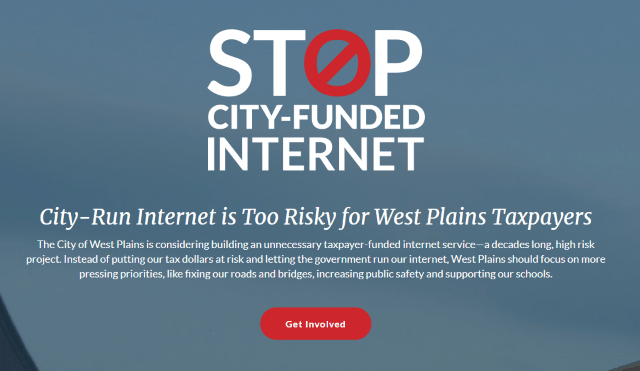
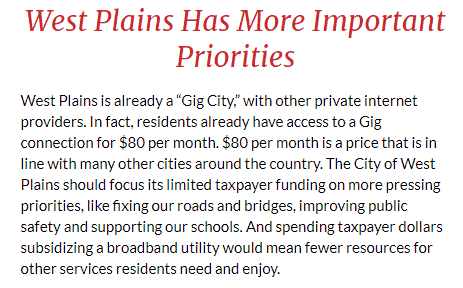
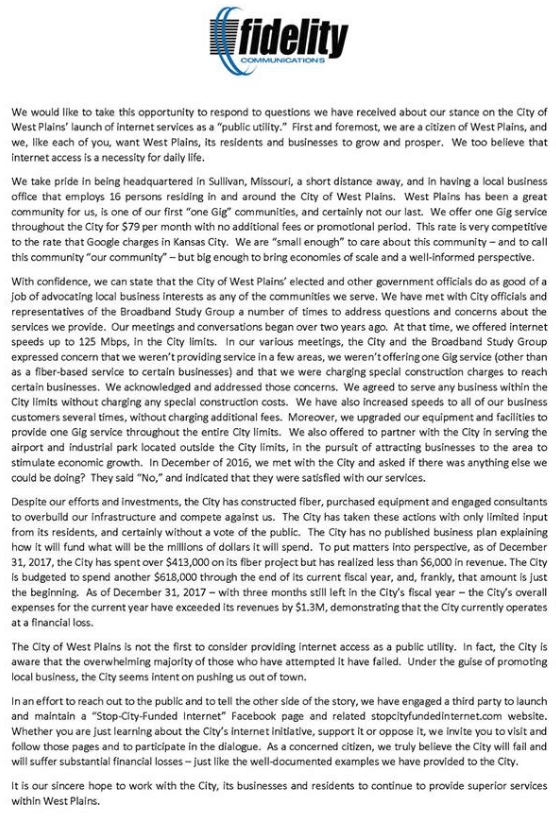
You know you’re not dealing with a neighborhood group lobbying to reduce road speeds in the neighborhood or sign a petition for improved trash collection when you read Leap’s financial disclosure reports:

  • $120,913.64 to mass communications firm SE2 of Denver for a variety of services, including mail pieces, consulting, two television buys and ad production and design.
  • $70,500 to Rocky Mountain Voter Outreach of Denver for “canvass, management rent and miscellaneous associates.”
  • $37,500 to OnSight Public Affairs for consulting.
  • $22,000 to Drake Research and Strategy of Boulder for polling.
  • $15,776.84 to Zata3 for phone work.
  • $12,260 to Holland and Hart of Denver for legal expenses.
  • $8,000 to EIS of Grand Junction for consulting.
  • $4,334.65 to Campaign Products of the Rockies, of Denver, for a voter file, mailing lists, stickers and yard signs.
  • $2,500 to Mark Stevens of Denver for research.
  • $743.75 to Tim Thomas of Boulder for general campaign work.

The whole dog and pony show of Big Telecom money has bemused Longmont mayor Bryan Baum, who supports the 2A measure and believes the distortion campaign has gone way over the top.

“It doesn’t really matter at this stage of the game,” Baum told the newspaper. “It’s going to the electorate. The electorate will vote. And we will know on Tuesday how they voted – if they believe a $300,000 ad campaign, or if they believe the people they’ve entrusted their votes to.”

Some of that $300,000 has also gone into vilifying a real grass-roots effort in support of the Longmont fiber initiative — Longmont’s Future.  Comcast’s front group tried to raise questions about where that pro-fiber group got their backing and money.  The newspaper discovered Longmont’s Future isn’t backed by any French conglomerate or nefarious outside interest.  It’s the work of Jonathan Rice, who operates the website all by himself, spending a grand total of $353 to fight Comcast’s $300,000.

“Every single candidate for office and every incumbent, in every race, supports this measure,” says Rice. “But Comcast and its friends are more interested in profit than progress, and continue to run a smear campaign to spread misinformation and outright lies – they recently posted Mayor Baum’s name as an opponent of 2A when he is actually a vociferous supporter.”

Community Broadband Networks has compiled a series of articles detailing the project and helping to expose the so-called “grassroots” opponents.  We encourage readers to become better acquainted with the underhanded tactics community broadband opponents will use to stop anything that resembles competition.

Share

Cell Phone Companies Hoarding Cash/Credit for Spending Blitz on Canadian Spectrum

Upcoming wireless spectrum auctions are critically important for some of Canada’s newest players in the cell phone marketplace.  Most are working hard to make sure they have plenty to spend to secure new frequencies for advanced wireless services that will help them remain competitive with larger players.

Globalive Holdings, the parent company of Wind Mobile, has convinced backers to provide hundreds of millions of dollars in financing, so long as all of the money is spent on acquiring wireless spectrum.

Wind’s nearly 400,000 customers will appreciate the additional room for growth, and new customers may keep Wind in mind for advanced 4G networks most Canadian providers intend to build and expand into the new spectrum they acquire at an auction next year.

Much of the funding, estimated to approach nearly a half-billion dollars, is coming from Wind’s parent entities, Egypt-based Orascom Telecom and the European conglomerate VimpelCom that acquired Orascom earlier this year.  Because the Canadian government is expected to set-aside some of the valued 700MHz spectrum exclusively for bidding among new entrants in the market, Wind could walk away a big winner, particularly if other similar-sized competitors Mobilicity and Vidéotron Ltee./Quebecor have trouble raising enough money to remain competitive in the bidding.

As far as Canada’s largest cell companies are concerned, set-asides are unnecessary and they prefer a winner-take-all auction.  Rogers, in particular, has been lobbying hard to convince Canadian officials it needs access to the 700MHz spectrum up for auction to roll out service in rural communities and upgrade networks in larger cities.

Those who feel Canada’s cell phone marketplace is already too concentrated have little sympathy for Rogers’ point of view, and expect an auction free-for-all will mean the largest incumbent players will walk away with everything they can bid on.

Among smaller players, assuming the set-asides are in place, analysts expect Wind will probably secure the most spectrum, but Vidéotron is expected to stay competitive and walk away with at least some frequencies for use in its home province of Quebec.  Big losses among the smaller players could fuel calls for additional mergers and acquisitions among those carriers deemed to have been left behind.

The Canadian government is expected to be the biggest winner of all, netting a potential $3-4 billion from the spectrum sale.

Share

Search This Site:

Contributions:

Recent Comments:

  • David: Daniel, That is what I set up via my bionic droid smartphone. A WAP2 that acts as the hotspot for my computer. Currently running 8 mb/s on download...
  • Matt: If they don't like the broadband options that are available, they can start their own WISP. That is how most WISPs started out anyway!...
  • Scott: and who do consumers turn to to get away from metered low cap and high priced WISP's?...
  • David: Confirmed working on 2/8/2012....
  • Jared: I agree with Fred. After all these years everyone should have broadband at 1 gigabit upload and download. South Caralina will never progress at this...
  • Matt: Fixed wireless providers (WISPs) all over the country have a simple message for AT&T: "Don't worry bro, we got this" Visit the map at www.wisp...
  • Scott: Even with the FCC standard, if 3G cellular service is in the area they could argue it's 3mbit/512kb service constituted broadband coverage, as they li...
  • Scott: Thank you AT&T.. for once a honest quote we can reference in the future against your lobbyist paid for campaigns to stop community owned broadband...
  • Craig Settles: To get an abstract and full copy of the IEDC-sponsored survey report I wrote, go here - http://bit.ly/pyjSDc...
  • Jay: The Feds should override that with the FCC's 768k minimum standard....
  • Duffin: See, I really don't get that. Why isn't everything pretty much backward compatible? It used to be. It used to be that you could use Cupcake-level apps...
  • Tony: Not yet updated for Android 4.0.... driving me insane as well........

Your Account: