Home » Cricket » Recent Articles:

Pushed Into a Corner: Sprint Left Behind As Wireless Consolidation Frenzy Resumes

An industry orphan?

Sprint CEO Dan Hesse probably rues the day his Board of Directors pulled the plug on a merger deal that would have combined MetroPCS and Sprint back in February. The merger was abandoned after board members openly worried the transaction would distract Sprint from its network improvement project — dubbed Network Vision — then just getting underway.

The deal with T-Mobile and MetroPCS may have limited Sprint’s takeover options, although analysts say a hostile counteroffer for MetroPCS could still take the small carrier away from T-Mobile.

Hesse himself is a proponent of additional wireless industry consolidation. He believes the current market has too many wireless carriers and the two dominant providers — AT&T and Verizon — enjoy economy of scale Sprint cannot hope to achieve in its current position.

Hesse

Wall Street was more pessimistic about Sprint after the T-Mobile/MetroPCS merger was announced, suggesting they may be an industry orphan, pushed into a corner and running out of options.

Shares of Leap Wireless, the owner of Cricket, rose as much as 17 percent after the T-Mobile deal was announced, signaling Cricket is likely an endangered species. Leap’s cellular network is similar in scope to MetroPCS, although the two companies largely serve different markets. Wall Street’s favorite dance card has Sprint and Leap Wireless as future partners, and Sprint may be forced to acquire the smaller carrier to save face. Leap operates its own modest network of cell towers and has plans to roll out LTE 4G service to its customers. That spectrum could become important to Sprint, especially in the larger urban areas Cricket targets.

An endangered species.

Some Wall Street analysts say deals with MetroPCS, Leap, and other small regional carriers are small potatoes. Many advocate for a much larger merger between Sprint and T-Mobile to more realistically confront the de-facto duopoly of AT&T and Verizon Wireless.

Regulators under the Obama Administration may take a dim view of a merger that combines the third and fourth largest nationwide carriers, but nobody expects much regulatory resistance approving mergers that wipe out MetroPCS and Cricket.

“The problems that Sprint and T-Mobile have are they are not as big as AT&T and Verizon,” Piper Jaffray’s Chris Larsen told Bloomberg News in a phone interview. “They don’t have the scale so therefore it is harder to compete. Increasing your size 25 percent, it helps. But when you are less than half as big as your rival, getting 25 percent bigger narrows the gap, but it does not close the gap.”

http://www.phillipdampier.com/video/CNBC MetroPCS Down on Merger Reports 10-3-12.flv

CNBC reports the T-Mobile/MetroPCS deal reignites wireless consolidation and leaves Sprint in a potentially difficult position.  (5 minutes)

http://www.phillipdampier.com/video/Bloomberg Sprint Left Behind as MetroPCS Joins T-Mobile 10-3-12.flv

Bloomberg News reports T-Mobile needs more subscribers, but some Wall Street analysts think the company is making a mistake focusing on the prepaid market.  (1 minute)

Share

Largely Pointless ‘Radio Shack Mobile’ Simply Resells Cricket Service, Where Available

Another face in the crowd.

For customers uncomfortable being seen anywhere near a Cricket store, Radio Shack’s No-Contract Wireless may be just what you were waiting for.

The electronics chain today unveils two Cricket-powered mobile phones as part of their new “no-contract” prepaid wireless offering.

  • The Huawei Mercury Ice is exclusive to RadioShack for the next 30 days and appears to be a slight makeover of the original Huawei Mercury… in white. For $149.99, the Android 2.3 phone is powered by a 1.4 GHz processor, a scratch-resistant 4-inch FWVGA screen and 8MP camera. With Muve Music® included in the $50 a month unlimited data plan, the phone delivers unlimited song downloads, ringtones and ringback tones.
  • The $39.99 Huawei Pillar feature phone works with plans that start at $25 a month, includes a QWERTY keyboard, camera, and rudimentary mobile Web access.

Cricket’s own cell coverage is more limited than most carriers, and an extensive roaming agreement with Sprint covers the rest of the country where Sprint provides service. If Sprint does not cut it in your area, Cricket will not either. Cricket emphasizes its home coverage in urban and near-suburban areas and across major highways. Their rural coverage is extremely lacking.

Once you reach the specific data limit, Cricket throttles your connection speed to something comparable to dial-up.

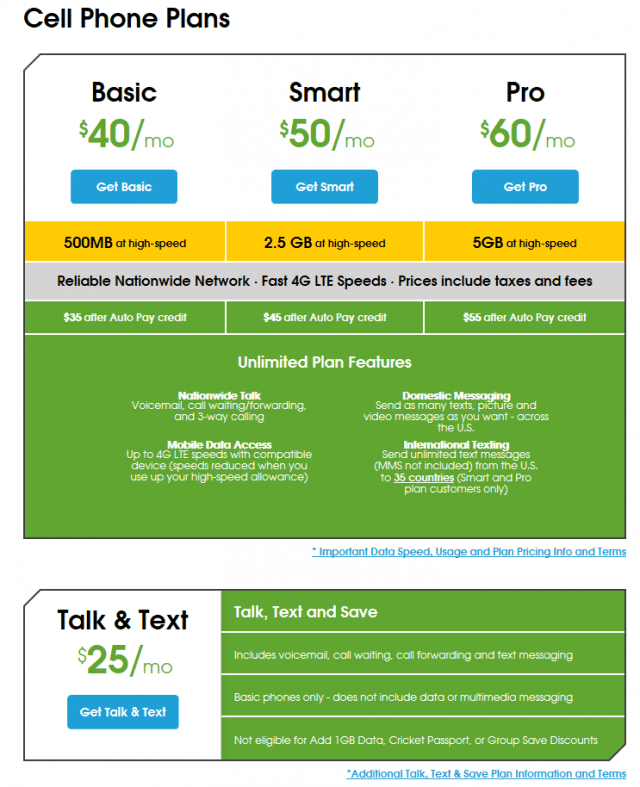
Plan Details1 $25/mo. Feature $35/mo.Feature $50/mo.Smartphone $60/mo.Smartphone
Voice Minutes/Mo. 300 1,000 Unlimited Unlimited
Unlimited Text * * * *
Additional Calling Features2 * * * *
Unlimited Multimedia Text * * * *
Unlimited Music with Muve Music * *
Unlimited Web/Data * * * (1GB) * (2.5GB)
Tethering  N/A  N/A  N/A *
1 All monthly service plans include Voicemail and Caller ID. (*-feature included)
2 Additional Calling Features include: Call Waiting and 3-way calling.

Unfortunately, Radio Shack does not bring anything new to the deal except additional retail stores where customers can buy phones and activate the service. Cricket customers can choose these plans and a wider array of phones directly from Cricket, its website or one of its authorized dealers or resellers. But if your nearest Cricket store is in a sketchy neighborhood or you don’t want your friends to catch you walking out of one, Radio Shack offers a potentially safer alternative (although nobody under 40 probably shops at Radio Shack either).

That being said, Cricket offers respectable service when you live and travel in areas where it provides service. In suburban Rochester, N.Y., your author’s personal experience is that voice coverage is comparable to that offered by Sprint. Their 3G network performs better than Sprint, but falls far behind AT&T, T-Mobile, and Verizon Wireless. Data roaming over Sprint’s 3G network is painfully slow in this area.

Cricket is planning on upgrading to 4G LTE service in additional cities next year. Currently, its coverage map only shows LTE service in Tucson, Ariz.

Share

PC Magazine Hands Out Fastest Wireless Data Awards, But Does It Matter?

Won first place nationally for the best 4G LTE network with the fastest overall speeds and best performance.

PC Magazine went to a lot of effort to test the data speeds of America’s wireless providers, traveling to 30 U.S. cities sampling both 3G and 4G wireless networks to see which carrier delivers the most consistent and fastest results.

After 240,000 lines of test data, the magazine declared the results a bit “muddy.”

They have a point.

Depending on which carrier’s flavor of “4G” is being utilized, where reception was strongest, how much spectrum was available in each tested city, and how many people were sharing the cell tower at the time of each test, PC Magazine was able to deliver the definitive results. And it was effectively a draw.

Verizon Wireless achieved victory in 19 cities, AT&T won in ten others, and T-Mobile came in pretty close behind, and that carrier does not even operate an LTE 4G network. But taking all factors into account, including upload and download speeds, whether or not test downloads actually completed, and whether streamed media was tolerable, Verizon Wireless won first prize nationwide.

But by how much?

Not enough to matter, if you are using Verizon, AT&T, or T-Mobile.

But the results do offer some things to think about.

  1. MetroPCS is a mess. Despite the fact this smaller carrier is building its own 4G LTE network, results were simply terrible. Either its backhaul network from cell towers offers lower capacity or its backbone network is screaming for an upgrade.
  2. Cricket was not willing to participate in the test. Their network, still 3G, delivers dependably “meh” results in the places where they actually provide coverage. The company has been reducing data allowances on their mobile broadband plans and raising prices on others. In one conference call with investors, company executives admitted they have been losing mobile broadband customers and expect that to continue at the prices they are charging.
  3. Sprint needs their forthcoming 4G LTE network more than ever. Their 3G data service turned in mediocre results and their 4G WiMAX network was yesterday’s news a year ago. Sprint’s 3G network is also notorious for dead-end downloads, a situation I have witnessed on friends’ phones for several months.
  4. Verizon Wireless remains far ahead of AT&T in covering more cities with their 4G LTE network. But more customers are also starting to use Verizon’s newer network, and the more customers piling on, the slower the speeds get for everyone. AT&T turned in some superior speed results in several cities, but those networks are often used less than the competition, for now.
  5. No network is good if you cannot afford to use it. As America’s wireless carriers keep raising prices and reducing usage allowances to keep data usage under control, there will be a breaking point where customers decide the money they spend for wireless data just is not worth it, especially if they live in a place where Wi-Fi is free and easy to find.
  6. What you test today will probably be different tomorrow. Wireless networks are constantly evolving and changing, with a wide range of factors contributing to their overall performance. Perhaps a more useful test would have been measuring how wireless carriers respond when their networks need upgrading and how long it takes them to respond to changing usage patterns. Verizon seems particularly aggressive, AT&T less so based on these results. The real surprise seems to be how well T-Mobile’s older technology is performing, and how quickly Sprint is now falling behind. On Cricket and MetroPCS, “you get what you pay for” seems to apply.
Share

Wireless Telecom Roundup: The Big Get Bigger; Smaller Providers Feeling the Heat

A summary of recent quarterly earnings reports from America’s wireless companies:

Verizon Wireless: Verizon has been uncompetitive in the prepaid market for the last several years, as it focused on its postpaid/contract customers.  No more.  Recent price cutting and the introduction of new contract-free plans that offer unlimited calling or packages of features comparable to contract plans are starting to win Verizon a bigger share of the prepaid market.  But Verizon also successfully picked up 1.2 million new contract customers as well, many switching from AT&T or smaller providers.  That’s the second best result the company has had in the last two years.  Verizon has a whopping 87.4 million people on two-year contracts and 21.3 million prepaid customers — 108.7 million total.  Verizon’s iPhone remains popular with 4.3 million activations last quarter.

AT&T: Growth at AT&T achieved its best results in the last quarter of the year, but the company continues to trail Verizon Wireless.  AT&T added 717,000 contract customers last quarter, and has been behind Verizon adding new customers for more than a year.  The company’s reputation for lousy service and policies that antagonize their customers have driven people to look elsewhere — mostly to Verizon.  But iPhone devotees are remaining loyal to AT&T, with one of every five new iPhone activations happening on AT&T’s network.  The company picked up 7.6 million new iPhone activations last quarter.

Sprint: The iPhone is killing Sprint’s balance sheet, but is bringing the company new contract customers.  Historically, Sprint’s most predictable growth has come from its resale agreements with third party providers and its various prepaid service divisions (Boost/Virgin Mobile).  But with the introduction of the Sprint iPhone (1.8 million new activations last quarter), customers looking for unlimited data or a cheaper plan are finding both at Sprint.  Unfortunately for the company, the wholesale cost of the iPhone is eating heavily into the company’s cash on hand.

Leap Wireless/Cricket and MetroPCS: Both companies are facing increasing challenges sustaining their prepaid service business models because of growing competition from larger providers.  Just about everyone who wants a two year contract-cell phone plan already has one, limiting new growth opportunities.  That is forcing AT&T, Verizon, Sprint and T-Mobile to turn their attention to the still-growing prepaid market, which is attractive for the credit-challenged, occasional users, travelers, and those with lower incomes.  Both Cricket and MetroPCS have traditionally targeted urban markets, where their networks are focused, to sell customers inexpensive service plans with convenient payment options.  But their networks don’t extend outside of suburban and urban areas, so roaming expenses can be higher for customers on the go.  Customers of both companies are increasingly looking to larger providers with more robust network coverage and increasingly aggressive pricing.

That has left Cricket with anemic, but acceptable growth, picking up 179,000 new customers in the fourth quarter.  MetroPCS, however, failed to meet expectations with just 197,410 new customers in the fourth quarter.  Existing MetroPCS subscribers are also leaving at a higher rate.

Verizon Buying Portion of Plateau Wireless’ New Mexico Operations

Plateau Wireless serves eastern New Mexico and portions of western Texas.

The consolidation of America’s wireless market continues with this week’s announcement Verizon Wireless intends to acquire a portion of Plateau Wireless’ network operations in southwest New Mexico.

Verizon will take over Plateau’s 259,000 mostly rural customers in portions of Roswell, Carlsbad, Artesia, Hobbs, and Ruidoso, N.M.

The acquisition covers a service territory of 26,100 square miles.

Plateau says the decision came down to money.  The wireless company needs the infusion of cash a Verizon purchase would bring to help finance high speed wireless upgrades.

The FCC will have to review the transaction before it can be approved.

Plateau will continue to service customers in Clovis, Portales, Tucumcari and parts of western Texas.
Share

Moody’s Declares AT&T and Verizon the Winners — Sprint and T-Mobile Can “Never Catch Up”

Game over. In the championship of cell phone competition, Verizon Wireless and AT&T have won, and it is now too late for Sprint-Nextel or T-Mobile USA to catch up.

That is the conclusion of Moody’s Investors Service, who has determined competition in waning in the U.S. wireless marketplace.

“AT&T Mobility and Verizon Wireless have better network coverage, wider capabilities and wider profit margins which gives them a competitive advantage that smaller rivals just can’t match,” said Mark Stodden, a Moody’s analyst and author of the report. “It is too late for competitors to invest and catch up; Sprint has the willingness but not the ability, while T-Mobile’s parent Deutsche Telekom, is the opposite.”

Sprint’s ambitious plans for a new 4G LTE network have been suppressed by a lack of enthusiasm by Wall Street investors and bankers, who seem to prefer the much-larger AT&T and Verizon who can sustain increased pricing and are better credit risks.  T-Mobile USA has practically been abandoned by its parent owner Deutsche Telekom, which wants to focus its investments in larger markets in Europe.

Moody’s estimates AT&T and Verizon will account for 81 percent of industry earnings in 2011.  Wall Street has pressured Sprint and T-Mobile to seek consolidation to better withstand their larger competitors.  Before AT&T bid for T-Mobile, rumors of an acquisition of the German-owned company by Sprint-Nextel were common, although the two companies operate with different network technology.  Moody’s predicts troubled waters for Sprint if it should actually seek to acquire T-Mobile, because the FCC seems comfortable with a minimum of four national carriers.

Instead, Moody’s predicts Sprint will seek to acquire smaller regional carriers and prepaid providers like Leap Wireless’ Cricket and MetroPCS.  Neither acquisition would significantly improve Sprint’s service footprint, however, as both prepaid providers operate only in larger markets where they already co-exist with Sprint.

Share

AT&T Scores Last (Again) in Consumer Reports’ Ratings; Oddly AT&T Reseller Scores Highest

AT&T has once again scored dead last in a nationwide survey (subscription required) of wireless providers commissioned by consumer magazine Consumer Reports.

Among national coverage carriers, Verizon Wireless again scored the highest, but not highest overall when including smaller independent and regional carriers.  Top honors were won by Consumer Cellular, a relatively small company in Portland, Ore. that ironically depends on bottom-rated AT&T’s network to deliver service.  What sets Consumer Cellular apart from other carriers is its near-exclusive focus on selling phone service to America’s senior population.  Working with groups like the AARP to market simple cell phones to older, less technologically-comfortable customers, over 85% of Consumer Cellular customers are over the age of 50.  The vast majority are occasional cell phone users, primarily using cell phones to make and receive calls.

Regional carrier U.S. Cellular, which used to top Consumer Reports‘ surveys, scored second.  Most U.S. Cellular customers are in the Pacific Northwest, Midwest, and parts of the East including New England.  CREDO, better known under its former name Working Assets Wireless, scored third.  It provides service over the Sprint network.

Among major-sized providers, only Sprint managed to escape the poor ratings for value received by AT&T, Verizon, and T-Mobile.  Also ironic, T-Mobile continued to score better than AT&T, which is still working feverishly to acquire the German-owned carrier.

AT&T also did poorly in delivering reliable voice and data services, according to respondents.  Customer service was also deemed lacking.

Consumer Reports

“Our survey indicates that subscribers to prepaid and smaller standard-service providers are happiest overall with their cell-phone service,” said Paul Reynolds, electronics editor for Consumer Reports. “However, these carriers aren’t for everyone. Some are only regional, and prepaid carriers tend to offer few or no smart phones.”

Consumer Cellular being a prime example. 

Consumer Reports surveyed 66,000 Americans for its 2011 Wireless Satisfaction Survey and found little had changed from last year.  The consumer magazine recommends consumers who don’t make or receive a lot of calls or are not addicted to wireless data services consider a prepaid plan instead of a two-year contract.  Competition in the prepaid arena continues to force prices down, and most providers offer month-to-month service plans that can be automatically renewed through a checking account or credit card, eliminating any hassle purchasing “top up” cards.

Most of the prepaid providers resell service provided by AT&T, Sprint, or Verizon Wireless.  Two that don’t: MetroPCS and Leap Wireless’ Cricket, received little regard from those surveyed.  MetroPCS scored second from the bottom and Cricket didn’t make the ratings at all.  Two prepaid plans to consider first: TracFone, excellent for occasional calling, and Straight Talk, sold by Wal-Mart — better for those who like to talk a lot on their phones.  If you don’t need the sexiest handset around, Stop the Cap! also recommends Page Plus, which relies on the Verizon Wireless network, especially if you don’t need a lot of data services.

Share

Cricket’s Labor Day Sign Failure

Phillip Dampier September 5, 2011 Cricket, Editorial & Site News 1 Comment

CricKet-style: This mess of a sign was caught on the door of the Cricket retail store in Henrietta, N.Y. yesterday. -- Word to the wise: "Operation" has never had two "p's" in it and we have no idea how they managed to come up with "varie." Bonus fails: 1) Despite the revised hours, the store was closed anyway and, 2) The sign (which was taped to the only door), appeared to have been photocopied, leaving us pondering how many other doors in the area are graced with this image-branding nightmare.

Share

Cricket Drives Away Mobile Broadband Customers With Internet Overcharging Scheme

Phillip Dampier August 4, 2011 Audio, Broadband Speed, Competition, Cricket, Internet Overcharging, Wireless Broadband Comments Off

Leap Wireless is trying to save face on less-than-impressive second quarter financial results showing the company is losing its mobile broadband customers who are increasingly weary of Cricket’s price increases and speed throttles.

The company lost at least 132,000 broadband customers since the first quarter, mostly due to price increases, reduced usage allowances and “network management” practices, which reduce speeds to near dial-up for customers who are deemed to be “using too much.”

“On broadband, we tightened our focus to more profitable customers while shedding less profitable ones,” said Leap Wireless CEO Douglas Hutcheson.

Internet Overcharging Facts of Life: What 'Network Management' tools are really used for. (Courtesy: Cricket's Second Quarter Results Investor Presentation)

Cricket recently announced increased pricing on their usage limited plans: $45/month for 2.5GB, $55/month for 5GB, or $65/month for 7.5GB.

With a less-than-robust regional 3G network and higher pricing, broadband customers have decided to take their business elsewhere, despite the company’s recently announced expanded data roaming agreement with Sprint.

Cricket acknowledges their “increased network management initiatives” are partly to blame for the loss, but the company also says increased prices for mobile broadband devices, which used to be available for free after rebate, are also responsible.  Cricket’s least expensive mobile broadband modem now runs just under $90.

Company officials told investors the losses “were expected,” and that the company has been trying to make up the difference with higher value smartphone data plans.  Mobile broadband customers tend to consume more data than smartphone users, so the company’s emphasis on smartphone data users, who use less, will deliver increased revenue at a reduced cost.

Cricket’s CEO explains the company’s renewed focus on keeping highly-profitable mobile broadband customers while effectively getting rid of “heavy users” who have been targeted with aggressive speed throttling over the past year, and now face higher prices for lower usage allowances. Also explored: Cricket’s future 4G LTE network buildout.  August 3, 2011.  (4 minutes)
You must remain on this page to hear the clip, or you can download the clip and listen later.

Cricket's declining mobile broadband business

In fact, the company’s presentation to investors credits network management tools for driving away “higher usage customers,” allowing Cricket to reap the benefit of “improved revenue yield per gigabyte.”  In short, that means Cricket profits handsomely from data plans they hope customers will only occasionally use.

One of Cricket’s biggest product priorities this year is pitching its Muve Music service, bundled into an all-inclusive $55 wireless prepaid phone plan.  It gives Muve phone customers unlimited access to an enormous downloadable music library accessed on the phone.  Since the service does not allow customers to transfer the music to other devices, record companies are happy to participate.

The biggest downside for some is that the Muve phone becomes your music player — a phone many customers consider a work in progress.  Some critics have labeled the service a “total fail” because of sound quality and DRM restrictions. But since the service is already bundled into the wireless plan at no additional cost, more than 100,000 customers are using it, downloading at least 130 million songs since it was first introduced in January.

Muve Music is another way Cricket is trying to differentiate itself from other wireless providers, and the company may try to expand the Muve Music service to much-more-profitable smartphones in the near future. Cricket hopes to begin selling no-contract smartphones at prices below $100 by Christmas.

Cricket executives answer questions from Wall Street about how the company intends to deal with a decline in mobile broadband customers, and explains their use of network speed throttles. Cricket plans to “follow industry trends” and experiment with “session-based” throttles sometime next year. These allow customers to pay an extra charge to temporarily remove the speed throttle when they need additional bandwidth. It’s just one more source of lucrative revenue from conjured up network management schemes.  August 3, 2011.  (4 minutes)
You must remain on this page to hear the clip, or you can download the clip and listen later.

Cricket is also planning further expansion of its ‘welfare wireless’ plan — a Universal Service Fund-backed home phone replacement for customers receiving public assistance.  The Lifeline USF subsidy is designed to provide affordable home telephone service to the most income-challenged among us.  Many landline providers charge around $1 a month for the service (before fees), and then charge for every call made.

Cricket’s implementation of this subsidy could draw some controversy because it delivers a $13.50 monthly discount off -any- of their rate plans.  That means qualified customers could pay just over $40 a month for a high end smartphone service plan, subsidized by every telephone ratepayer in the country.

Cricket also plans to launch LTE 4G service starting in early 2012.

Cricket plans to introduce 4G LTE service in 2012.

Share

Cricket Raising Wireless Broadband Prices Again; Announces Data Roaming On Sprint’s 3G Network

Leap Wireless’ Cricket is raising prices $5 a month on its prepaid 3G mobile broadband service for the second time in nearly a year, with the announcement the company will offer limited data roaming on Sprint’s 3G network.

In return for being able to access Cricket mobile broadband outside of the company’s highly limited network of cell towers, the price has to increase, according to statements made on Cricket’s website.  Cricket will now sell three different broadband plans, all without a contract:

$45/month for 2.5GB, $55/month for 5GB, or $65/month for 7.5GB

But there are a number of catches.

First, your service will be terminated if you do not live in a zip code where Cricket provides its own cellular service.  The company is only interested in selling service to customers who will primarily use it inside of its own coverage areas.  Second, if you are caught data roaming on Sprint’s network for more than 50 percent of your monthly usage, the company can throttle your speed to dial-up for at least one month or terminate your account.

These pricing changes could also impact certain grandfathered Cricket mobile broadband customers, some of whom are still paying Cricket’s rate of $40 a month for up to 5GB of usage that was being sold until last summer.  Who will pay the added $5 bite depends on when and where you activated your account:

Customers activated prior to August 2, 2010: You are likely grandfathered on Cricket’s $40 a month plan, good for up to 5GB of usage per month.  Most of these customers never activated last year’s newly introduced limited 3G mobile data roaming, so they will not be able to use their service outside of a Cricket service area.  They will not see a rate increase unless they opt-in to “roaming” service from a menu on their wireless device’s configuration panel.  If you opt in, you cannot opt back out.

Customers who purchased their device at Best Buy, Wal-Mart, or Radio Shack at any time: You are not eligible for 3G data roaming service at this time.  You will not see a rate change unless and until that changes.

Customers activated after August 3, 2010: Your device was activated with 3G roaming capability and you will be impacted by the price change.  Existing customers on an impacted account will receive Nationwide 3G coverage beginning July 12.  The first bill with increased pricing will be for customers with a bill due on August 11.  Your bill will see an increase on or after this date.  Technically that equals one month of free roaming coverage.

Cricket's new data coverage map, with Sprint roaming included.

For some customers, this is quite a price increase from two years ago when the company claimed to provide “unlimited” 3G wireless broadband service for $40 a month.  Customers soon learned Cricket’s definition of “unlimited” meant around 5GB of usage before the company throttled broadband speeds to near dial-up for the remainder of the billing month.  By last summer, “unlimited” was gone, replaced with usage allowances enforced by the aforementioned “fair access policy” speed throttles.

Although the company touts the service will run at speeds up to 1.4Mbps, in reality, most will see speeds much lower than that.  From Stop the Cap! headquarters in Rochester, N.Y., we routinely see speeds on Cricket’s 3G network operating at between 300-600kbps.

Cricket still delivers a cheaper plan over Sprint-owned Virgin Mobile, which charges $50 for 2.5GB.  For those who want more, Clearwire is still pitching 5GB of usage on Sprint’s 3G network and “unlimited” use on its 4G network, although “unlimited” really isn’t when the provider deems you a heavy user and throttles your speeds.  T-Mobile offers a data pass for some of their customers allowing 1GB of data for $30, 3GB of data for $50 — all prepaid.

Share

Phoenix’s Fox Morning News Team Perplexed by Cell Phone Survey Results

http://www.phillipdampier.com/video/KSAZ Phoenix ATT Customer Satisfaction 5-17-11.mp4

The morning news team at Fox affiliate KSAZ-TV in Phoenix were slightly in over-their-heads trying to cover the results of a satisfaction survey about cell phone companies.  Poor Kristin Anderson was coping with a personal AT&T crisis all her own — she lost her cell phone.  Her luck didn’t get much better when she tried to explore the survey’s results from the University of Michigan.  Instead of a slide ranking the winners and losers, viewers got a pop quiz question asking which country in the news is run by President Bashar al-Assad.  While you might have wanted to answer the Republic of AT&T, the correct answer is Syria.  AT&T scored rock-bottom in the survey with T-Mobile not far behind.  Among the major carriers, Verizon and Sprint tied for first place.  When asked which carrier scored the highest overall, the morning anchor team guessed Cricket.  Yes, Cricket.  (The correct answer turned out to be Tracphone, which is a prepaid reseller using other carriers’ networks.)  (4 minutes)

Share

Search This Site:

Contributions:

Recent Comments:

  • Danny Lampley: "As we’ve reported before, Tom Wheeler has said almost nothing on his blog about consumer interests . . . ." Expecting a bit much aren't we? After ...
  • Phillip Dampier: I received information from our friends in North Carolina: AT&T has already won the right to redline customers in states like N.C. where they have a s...
  • elfonblog: And I certainly have a problem with that. AT&T is suggesting that they *deserve* the same deal. And they don't. Always playing the victim. Poor, p...
  • txpatriot: The NY PSC partially approved the VZ Tariff filing; you can find the Order and press release on this page: http://documents.dps.ny.gov/public/Matte...
  • txpatriot: AT&T is saying that if google is allowed to redline, then AT&T s/b allowed to redline....
  • Damaeus: Joshua Taylor says: >>> [SNIP]--- Get rid of your internet, save your money and READ. Who cares about AT&T and the Internet? ---[SNIP]...
  • Scott: Get 1GB of metered data transfer free with every $100.00 spent!!...
  • Tim: The fact that Erie, PA was chosen as an example is quite intriguing because Erie unlike Buffalo or Pittsburgh is a totally Fios-less market. Of course...
  • Ralph: The tv ads featuring "Frank " have been running quite a bit lately. I think Frontier chose an animal as their spokesman because no human being wanted...
  • elfonblog: Right right. AT&T wants us to think that it's diligently elbowing into municipalities that Google has bullied into relaxing their regulations. ...
  • Scott: Our internet and the majority of those lines were built with hundreds of millions of taxpayer dollars, the majority of it being ripped off via creativ...
  • Jim Donahue: In the long term fiber is less expensive than the old copper network. The problem is that it doesn't provide enough of a margin versus wireless wh...

Your Account: