Broadband Shortage Myth

You are currently browsing the archive for the Broadband Shortage Myth category.

Comcast Implements 250GB Usage Cap Effective October 1, 2008.

Comcast Implements 250GB Usage Cap Effective October 1, 2008.

Comcast CEO Brian Roberts likes his new high-tech toys, even if using them on his own cable system is now pointless.  At the January Consumer Electronics Show, Roberts demonstrated the next generation of broadband Comcast is poised to begin rolling out to consumers in the next several months.

Dubbed “wideband,” Roberts downloaded a High Definition copy of Batman Begins in less than four minutes.  Comcast’s DOCSIS 3.0 upgrade, which bonds multiple channels together to deliver broadband speeds up to 160 Megabits per second, will be able to bring Comcast customers the latest high bandwidth applications, particularly including very high quality video, in just a matter of minutes.

Designed to compete with Verizon’s FIOS fiber to the home network, Comcast’s “wideband” service will create a new paradigm for high quality video services entering the home.

Except for one thing.

A 250GB monthly usage cap.

Using Comcast’s wideband service, customers downloading movies could easily exceed the 250GB cap in less than five hours.

Even the cable industry’s trade publications like Multichannel News are now posing questions about how exactly Comcast can promote customers upgrading to wideband service when a cap of 250GB stops the fun in a matter of hours.  What MN didn’t add to the equation is the fact Verizon FIOS does not have a usage cap and has no current plans to implement one.

So exactly why would any consumer choose Comcast wideband, with a usage cap over Verizon FIOS, which leaves you alone and doesn’t threaten to terminate your service if you use more than the cable company deems appropriate?

Another issue MN touched on, but didn’t bother extending to the real issue - stifling competition:

Imagine if all your TV were delivered via the Internet. High-quality 1080i HD video at (conservatively) an average of 5 Mbps would chew up plenty of bandwidth: roughly 286 Gigabytes in a 30-day period, given that Americans watch an average of 127 hours and 15 minutes of TV per month, according to Nielsen. Cap busted!

Imagine indeed.  Imagine virtual “cable companies” delivering cable networks and broadcast TV over the Internet.  Pay your monthly bill for data from the cable company, but watch your video programming from another provider.  A 250GB cap puts an end to that business plan quite nicely, thank you.

YouTube Preview Image
Comcast CEO Demonstrates Wideband At Cable Show In May

By the way, a quick note to Frontier, which still thinks 5GB a month is just plenty. Pay attention to the file sizes in this video and then get back to us about why you think your customers will never come close to using 5GB a month in the coming year or two.

BREAKING NEWS: Frontier Communications has modified their position on the 5GB usage cap yet again.  Your pushback on this unjustified 5GB monthly usage cap has continued to make a real difference in getting company officials to listen to reason.

Frontier’s website has been changed again, now deleting the portions of their DSL sales pitch which used to reference “5GB” of included access per month.  Additional changes have been made to their terms and conditions pages.  Still present in Frontier’s Residential Acceptable Use Policy is the language which defines their usage cap at 5GB per month, although they don’t formally call it that.  Instead, they consider 5GB to be a “reasonable” amount of usage, and reserve the right to terminate accounts that exceed it.  However, some other language has been introduced as Frontier backs off from implementing their cap formally:

The Company has made no decision about potential charges for monthly usage in excess of 5GB.

Company officials have repeatedly said they will not penalize customers who exceed the 5GB “reasonable” level they define in their Acceptable Use Policy, which is to be commended.  But as Frontier Communications has been continually modifying their position on the cap issue in general, both in comments to reporters and on their website, customers have no guarantees what they insist today won’t be much different tomorrow.

StopTheCap! calls on Frontier to do the right thing and remove this entire “5GB” section of their Residential Acceptable Use Policy altogether.  It is this language upon which the entire 5GB usage cap debacle was built, and Frontier can show its good faith by eliminating it from their website if they truly want to put customers at ease.

We have also learned that Frontier has taken another piece of our advice: to launch a campaign to better educate and inform their customers about how bandwidth is utilized, and ways they can reduce their usage voluntarily.

StopTheCap! strongly believes that consumers are willing to review what they are doing with their Internet connections and will reduce usage voluntarily if they understood how certain applications can consume bandwidth even if they don’t seem to be running.  And it’s a win-win for customers who wonder why their Internet connection seems so slow without realizing someone in the house is running a torrent server 24/7, or has a computer infected with a virus that is churning out millions of spam e-mails without the owner even realizing it.

Treating your customers right means allowing them to take advantage of the myriad of new applications and features a broadband experience can provide, without a draconian limit on that usage.  And customers have a responsibility to better understand what they are running on their computers.

There are several additional developments about Frontier’s 5GB usage cap, and we’ll be publishing a roundup of the latest news, including your comments and what company representatives have been telling you, shortly.

This remains a developing story.

Comcast’s announcement that it would implement a usage cap of 250GB per month comes on the heels of the company’s entanglements with the Federal Communications Commission, who spanked the nation’s largest cable operator for purposely interfering with Internet traffic Comcast felt constituted a problem on its network - namely torrent traffic.

Cable operators face the evolution of cable modem service from something primarily valued by a minority of Internet enthusiasts into a “must-have” product for more and more Americans.  And with the spectacular growth of the Internet, new applications are being introduced daily that are specifically designed to take advantage of the speeds that broadband promises to provide.

Today's Lesson In Unparalleled Greed: Invent a bandwidth "crisis," throw a usage cap on your customers without proving you need to, threaten to cancel service for anyone who exceeds it, kill your competition, and laugh all the way to the bank!

Unparalleled greed means not being able to fit all of the cash we're going to make off you into just one briefcase!

Just 24 months ago, the “problem” was peer-to-peer traffic, such as file sharing networks and torrent applications.  Customers fired up their trading software and often let it run for hours on end as they attempted to grab the latest software, TV show, or movie.  File sharing software can consume an enormous amount of bandwidth, as users share files with one another, uploading and downloading pieces of a favorite TV show or movie until a complete file is assembled.  Good etiquette dictates leaving the software running even longer to help make sure everyone else in the queue can complete their download as well.

The result was a lot of traffic going in both directions.  Most networks in the United States are designed to handle people receiving more files than sending them, and file sharing software began to challenge that paradigm.

Soon enough, broadband providers began complaining that this kind of traffic was tying up their networks, designed for what company officials thought average customers would do with their Internet connection.  People consuming a lot of bandwidth downloading music or movies required operators to spend more money to expand and enhance their networks.

Ironically, the same companies complaining about file sharing created their own “problem” by marketing cable modem service as the fastest way to… download movies and music!  DSL, they said, kept you waiting for your favorite show while cable modem service guarantees your show will be ready the moment the popcorn is popped.

The earliest theories of the artificial “bandwidth crisis” offered by companies annoyed with having to keep up with the demands of their customers, suggested that file sharing traffic would be the death of the Internet as we know it, as torrent traffic completely clogged the network, consuming any and all available bandwidth.  Godzilla’s destructive powers had nothing on file sharing, which could literally create a global Internet crisis.

Comcast decided it could address the torrent traffic problem by inspecting the bits and bytes of traffic running across its network and, at certain peak times, substantially slow down the delivery of that traffic.  Their theory suggested that this would protect other customers from the neighbors eating up more than their fair share of bandwidth.  In practice, it essentially crippled the usefulness of running any torrent application.

Comcast paid people off the street to "hold seats" at one FCC hearing, keeping the interested public out. (Courtesy: Free Press)

Comcast paid people off the street to fill one FCC hearing room, keeping conscious members of the public out. (Courtesy: Free Press)

The FCC would have none of it, telling Comcast it cannot discriminate against the traffic being carried over its network.  The answer to the traffic problem was to build better roads to manage the traffic.

Instead of simply agreeing to keep up with demand, Comcast has now approached this “bandwidth crisis” from a different angle.  It has simply put a limit on the amount of traffic each subscriber can utilize on its network during a 30 day period, regardless of what that traffic represents.

Comcast’s suggested limits on bandwidth gave a number of broadband providers the idea that they, too, could slap caps on their customers.  And since the usage cap question was first raised nationally earlier this year, the suggested caps have gotten lower and lower from each subsequent company testing or implementing them.

Cox has “informal” caps of up to 75GB per month in some areas.  Time-Warner began testing caps of up to 40GB per month in Beaumont, Texas.  Frontier announced a forthcoming 5GB usage cap, which is among the lowest in the United States.  In Canada, companies have gone even lower with caps like Rogers’ 400MB monthly cap for their $60 wireless Internet plan for iPhone owners.  Canadians were so outraged by that cap, Rogers eventually had to relent and create a 6GB monthly service package for $30.

Usage capping cable and DSL providers are in a race to the bottom as they try to learn how low they can go without creating mass defections among their customers.

Some Comcast customers have told Stop the Cap! they are relieved that at least they are on the top of the usage cap pile with Comcast’s 250GB cap, which at first glance appears generous.  In fact, only a small minority of their customers will currently exceed that kind of usage cap.

But regardless of how generous a usage cap appears, it still raises a lot of questions.

1. If informal efforts to control “bandwidth hogs” have been so successful, why bother with a cap at all?

For several years, Comcast has informally enforced its own internal interpretation of a usage cap with customers who consumed incredible amounts of bandwidth, usually as a result of running a home-based torrent/peer-to-peer file server, web server, or other application that runs contrary to the residential acceptable use policy.  Company officials send warnings to customers who consume hundreds of gigabytes of bandwidth every month.  Comcast’s own public statements indicate such warnings are usually successful.

“We know from experience the vast majority of customers we ask to curb usage do so voluntarily,” Comcast notes on their website.

So why bother the 99% of the rest of your customers with a formal usage cap if they don’t come anywhere close to exceeding it?  It’s awfully hard to convince people of a broadband bandwidth crisis if you also claim the overwhelming majority of your customers consume less than 5% of your proposed cap!

2. While most people won’t come close to 250GB of usage, unless they are backing up their files through an online backup service or are downloading a very large number of files, the usage cap that seems generous today is draconian tomorrow.

This little piggy says you've had enough Internet for this month.

This little piggy says you've used enough Internet for this month!

The biggest problem usage caps bring to the table is the artificial drag they create on innovation.  In the global race to be leaders in the emerging Internet economy, the United States was in a strong position to lead the world in high bandwidth next generation applications like streamed high definition video programming, store-and-forward video on demand and Tivo-like recording, storing TV shows online and delivering them to you on demand, online file backup services, high quality video teleconferencing, new “cable-TV”-like services over broadband which compete with cable and satellite providers, and more applications yet to be dreamed up.

Just ten years ago, when most cable modem service began to really get off the ground, the Internet of the late 1990s was very different from the Internet of today.  A usage cap based on what customers did then would likely be under one gigabyte a month, as users satisfied themselves with low bitrate RealAudio streams, slideshow-like online video, and a World Wide Web considered primitive by today’s standards.

As broadband Internet became established in a growing number of consumers’ homes, the applications to take advantage of the increased bandwidth followed.  Voice Over IP telephone services, high quality streamed audio and video, and online file storage would never have been developed based on the Internet of the late 90s, and would never have gotten off the ground in a world with usage caps.

High definition streaming video consumes many gigabytes per hour.  It’s among the very first exciting applications being made available to consumers with broadband connections, but will die an early death if usage caps are the order of the day.

3. Usage caps are anti-competitive and convenient, particularly as those who mandate them have a direct interest in limiting the potential of competitors that exist today or cannot get start-up funding tomorrow.

Usage caps actually do nothing to solve the “bandwidth crisis” the cable and DSL companies suggest are on the verge of killing the Internet.  They merely restrict the natural growth of traffic, allowing companies to pocket higher profits and spend less on expanding and enhancing their networks.

Sky Angel, a multichannel "cable"-like service for Christian viewers, depends on broadband to send its channels to customers.  Can they survive with usage caps?

Sky Angel, a "cable"-like system for Christian households, delivers more than 65 channels over broadband. How can they survive usage caps?

More importantly, cable companies conveniently put a stop to plans to bring competing multichannel video packages to consumers over the Internet.  The “cable company online” model exists today with providers like SkyAngel, which delivers Christian and secular “pro-family” programming to its customers over a set top box connected to the Internet.  More than 65 channels ranging from TBN to Animal Planet and The Weather Channel reach their customers over broadband for a monthly subscription fee.  SkyAngel’s service is in peril in a world with usage caps that will limit viewing to as little as a few hours per month before exceeding usage caps.

Netflix and some satellite dish companies offer video on demand programming utilizing the Internet to deliver the programming to subscribers.  In a world with usage caps, you will be stuck watching those programs only from your cable company or local video rental store.

Future businesses that seek start-up funding to build the high bandwidth applications of the future will get a guaranteed rejection once potential investors learn that consumers will be unable to take advantage of those applications because they will exceed their usage caps and have their service shut off.

Of course, the convenient exception to the usage cap world comes from companies that partner with that cable or DSL company.

Frontier has already announced it will exempt its partners from their 5GB usage cap.  ESPN360 and their online backup service preferred partner will enjoy the benefits of an uneven playing field in the marketplace because they aren’t subject to a usage cap.  Everyone else is.

What about Time-Warner and Comcast?  Will their partner services also enjoy exemptions from usage caps while everyone else is forced out of business when customers discover that using them puts them over their monthly limit?

What about Voice Over IP?  Cable companies are giving telephone companies a real headache by offering telephone service over cable lines at highly competitive pricing.  But independent companies like Vonage and MagicJack don’t enjoy the benefit of being exempted from usage caps limiting the number of calls you can make or receive.  If you are owned or are partnered with a cable or DSL company, your service gets a free pass from the usage cap.  Everyone else is potentially buried by it.

4. The punitive measures suggested for those that violate usage caps scare customers into using their connections even less, to the great benefit of the bottom line of the broadband provider.

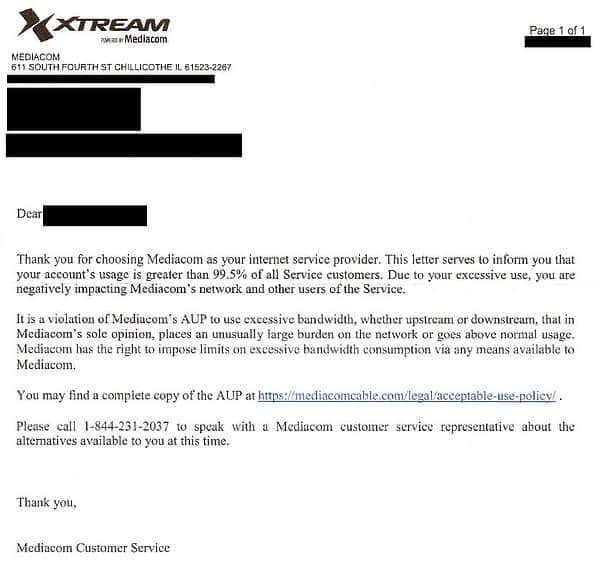
What’s the best way to make sure your customers use their connections as little as possible?  Impose outrageous penalties for exceeding usage caps.  Comcast proposes to send a warning letter first, but then potentially turn off a customer’s service for six months to an entire year if they dare to use their broadband service more than the company wants.

Other providers have discovered the tangible benefits of the “penalty rate.”  It guarantees striking fear into the hearts of your most hearty customers, when to exceed the cap means paying 50 cents per MEGABYTE for traffic above and beyond your capped limit, as Rogers charges Canadians right now.

Download that one hour episode of CSI: Miami, and pay up to $175 in penalties on your next bill.  Ouch!  Imagine the conversation at that family’s dinner table after your son or daughter downloaded a TV show before you had a chance to tell them you were at your monthly limit.  Horatio Caine can then come and solve the homicide at your house.

It all comes down to paying the same or more money for less service.  And if you are potentially going to have your service cut off or outrageous overage fees billed for exceeding that cap, you will make darn sure you don’t even come close to it out of fear of exceeding it.

Being in the “bandwidth shortage business” means more profits for you, less service for your customers.

The best part about imposing usage caps is that you get to invent word of a “bandwidth crisis” to justify penalizing your customers, provide absolutely no independent evidence to prove such a crisis exists, reduce your investment in keeping your network up with the times, and help protect your product lines from pesky competition. 

After all, your cable modem or DSL service was among your most profitable products before usage caps were even proposed, but now you can make even more money.  And if a competitor ever does arrive without usage caps, you can just drop them and go back to making a decent profit instead of one that rivals the oil industry.

Comcast, the nation’s largest cable broadband provider, has announced it will begin limiting customers to 250GB of usage per month on their cable modem service.  Company officials claim less than 1% of their customers consume “excessive bandwidth,” and a 250GB cap explicitly defines what constitutes excessive use.

Comcast Implements 250GB Usage Cap Effective October 1, 2008.

Comcast Implements 250GB Usage Cap Effective October 1, 2008.

250 GB/month is an extremely large amount of data, much more than a typical residential customer uses on a monthly basis. Currently, the median monthly data usage by our residential customers is approximately 2 - 3 GB. To put 250 GB of monthly usage in perspective, a customer would have to do any one of the following:

* Send 50 million emails (at 0.05 KB/email)
* Download 62,500 songs (at 4 MB/song)
* Download 125 standard-definition movies (at 2 GB/movie)
* Upload 25,000 hi-resolution digital photos (at 10 MB/photo)

Users who exceed the cap will first receive a warning, followed by account suspension for six months to a year if they rate among the heaviest users of their Internet service.  At this time, no extra bandwidth will be sold by Comcast.  The company has traditionally asked very heavy users to upgrade to a business account, available at a substantially higher cost.

The company has suggested the implementation of usage caps will provide better and more consistent speeds to their customers, blaming a small minority of customers for consuming a huge amount of bandwidth.

AP

By PETER SVENSSON, AP Technology Writer
Fri Aug 22, 10:36 AM ET

NEW YORK - Three months ago, Guy Distaffen switched Internet providers, lured from his cable company to his phone company by a year of free service on a two-year contract. But soon the company quietly updated its policies to say it would limit his Internet activity each month.

“We felt that were suckered,” said Distaffen, who lives in the small village of Silver Springs in upstate New York.

The phone company, Frontier Communications Corp., is one of several Internet service providers that are moving to curb the growth of traffic on their networks, or at least make the subscribers who download the most pay more.

This could have consequences not just for consumers — who would have to learn to watch how much data their Internet use entails — but also for companies that hope to make the Internet a conduit for movies and other content that comes in huge files.

Cable companies have been at the forefront of imposing and talking about usage caps, because their lines are shared between households. Frontier’s announcement is noteworthy because it is a phone company — and it is matching a seemingly low ceiling set by a main cable rival: just 5 gigabytes per month, the equivalent of about 3 DVD-quality movies.

“We go through that in a week,” Distaffen said. “If they start enforcing the caps we’re going to have to change service.” Other subscribers on Broadbandreports.com, where the cap was first reported, echoed his feelings.

But since the other option for wired broadband in the village is Time Warner Cable Inc., switching providers isn’t necessarily going to get Distaffen away from a bandwidth cap. The cable company is trying out a 5-gigabyte traffic cap for new users in Beaumont, Texas. Every gigabyte above that costs $1. More expensive plans have higher caps — at $54.90 per month, the allowance is 40 gigabytes. Depending on the results of the trial, Time Warner Cable may apply the same pricing structure elsewhere.

Frontier’s biggest market is in Rochester, N.Y., where it competes with Time Warner Cable.

“This isn’t really an issue that’s just going to be about Frontier,” said Philip Dampier, a Rochester-based technology writer who is campaigning to get Frontier to back off its plans. “Virtually every broadband provider has been suddenly discovering that there’s this so-called `bandwidth crisis’ going on in the United States.”

In a sense, caps on Internet use are no stranger than the limited number of minutes a cell phone subscriber gets each month. Internet use varies hugely from person to person, and service providers argue that the people who use it the most should pay the most. But the industry hasn’t worked out where to set the limits, or how much to charge users who exceed them. Fearing a customer backlash, most providers are setting the limits at levels where very few would bump into them. Comcast Corp. has floated the idea of a 250-gigabyte monthly cap.

Frontier says it plans to start enforcing its 5-gigabyte cap next year. First, it will let customers know how much data they use each month, a figure that most people don’t know how to track on their own (the tech-savvy Distaffen gets it from his Internet router). Then it will offer premium plans with higher caps to those who use more data.

Frontier says most of its 559,300 broadband subscribers consume less than 1.5 gigabytes per month. But in an e-mail to Frontier employees, Chief Executive Maggie Wilderotter said traffic is doubling every year, which means that by the time the caps would be put in place, a lot more users will exceed them. In two years, the average user could be consuming 6 gigabytes of traffic per month if the current growth rate holds up.

The growth of traffic means the company has to invest millions in its network and infrastructure, threatening its profitability, according to the e-mail.

Dampier disagrees, saying the costs of network equipment and connecting to the wider Internet are falling.

“If they continue to make the necessary investments … there’s no reason they can’t keep up” with increasing customer traffic, he said.

Read more…

[Editor's Note: As promised, Stop the Cap! now moves on to expanding coverage of the issue of broadband usage caps by North America's other broadband providers.  In the coming weeks, we'll be reviewing the plans, proposals, and implementation of caps by companies large and small.  We will also continue to report on how this potentially impacts on our national competitiveness, considerations of Net Neutrality issues, and addressing the digital divide by information-have's and have-nots.] 

Beaumont, Texas

Beaumont, Texas

Beaumont, on the eastern border of Texas with Louisiana, is one of America’s mid-sized cities of just over 100,000 people, best known for the Texas Wildcatters, a smattering of oil and gas companies, and the first advance by Time Warner, America’s second largest cable television company, into this year’s issue of bandwidth usage caps.

Company officials first announced the market test in January, impacting only new customers in Road Runner’s Golden Triangle Division with usage caps ranging from 5GB for the Lite Tier plan to 40GB for the Turbo Tier.  The charge for exceeding your plan’s cap is $1 per gigabyte.

Like other companies talking about usage caps, everyone likes to use their own internal definitions of what 1GB of usage represents.  Time Warner’s is:

1GB gets you about 70,000 e-mails, 34 hours of gaming or 1,344 hours of Web browsing; or, it’s the approximate equivalent of downloading 569 photos, 277 music files, 7 hours of low-resolution video (YouTube), 3 hours of standard definition streaming video or 45 minutes of high-definition streaming video.

Again, my own calculations bring some different numbers to the table, and, honestly, does anyone really worry about going over a usage cap from reading e-mail and web browsing alone?

Randomly grabbing 277 MP3 music files consumed 1.56GB of usage.  Downloading 569 photos assumes your collection consists of pictures averaging 1.75MB apiece.  I grabbed some digital photos I took to Walgreens for printing and looked at the files I uploaded to their server.  My pictures, at high resolution (but not extremely high) come closer to 8MB apiece.  One episode of Law & Order (around 42 minutes without the commercials and dropping the stream before the end credits rolled) consumed 360MB at standard definition rates.  As noted earlier, a movie delivered by Akamai can consume 6-9GB for just one 720p high definition film, nearly double that if you choose the 1080 version.

Taking each of these activities into consideration individually, usage caps of 20GB a month (or 40GB) don’t immediately sound alarming.  But people do not use their Internet connections for a single activity, and the more people you bring to the table, such as in a four person household, the easier it is to see just how quickly a family, especially with teenagers, will quickly exceed even these kinds of caps.

Beaumont residents are the first to participate in a Road Runner trial with usage capped.

Beaumont residents are the first to participate in a Road Runner trial with usage capped.

There are users out there who use their connections for little more than basic e-mail and occasional web browsing, and Time Warner offering a plan at a discount for those users is not a problem, assuming they actually promote such plans to potential customers.  The greater issue comes from a service provider charges the same price (or more) for a plan that is now seriously limited by a cap.  And to date, there has been no proposal for retaining an “unlimited” tier in addition to offering a range of capped tiers for those who figure they will use considerably less.

Wireless telephone companies, which historically sold usage in plans with buckets of minutes, are now moving towards offering flat rate options - pay one price, talk all you like, while the broadband industry, which marketed “unlimited, always on” connections for a variety of content they include in their advertising are now headed in the other direction, limiting consumer choice and access.

Time Warner has been complaining about broadband growth as both a content distributor and as a bandwidth provider, which adds an interesting twist to the rationale companies have to implement caps.

Saul Hansell, a reporter and blogger for The NY Times, noted company officials are growing tired of basic cable networks making them pay license fees for content, and then seeing that content being given away on the web.

Speculation that bandwidth caps may also have to do with limiting the amount of streaming video that consumers watch have also been offered as a reason for providers adding caps to their Internet service.

Time Warner’s rationale for bandwidth capping was, according to the company itself, to control what they felt was excessive use of their network.

“This is not targeted at people who download movies from Apple,” Time Warner spokesman Alex Dudley told the NY Times. “This is aimed at people who use peer-to-peer networks and download terabytes.”

And again that brings up the question of how a 20-40GB cap is the most effective way to control a minority of users running a torrent client or server 24/7 and consuming terabytes over an entire month.  That is the equivalent of dropping a nuclear weapon on a pesty moth.  The weapon does get the moth, but it also impacts on a far larger circle of customers that don’t come close to consuming that level of data.  Every ISP has language in their contracts with customers that allow them to cut off the 24/7 torrent addict today.  Some, including Comcast, have enforced these kinds of provisions before without a usage cap.

To date, consumer reaction in Beaumont has been mixed.  Many are convinced the caps are unjustified, too low, or simply too expensive for what you get.  Others object to the excessive rate of $1 per gigabyte for overage fees.  Some don’t like the idea of having to measure everything they do online in fear of exceeding a usage cap.  There are also some that like the idea of paying for what they use, and are willing to consider different plans based on what they actually consume if it also means they get the speeds they were promised in advertising.

Dudley argues that the usage cap issue is not a foregone conclusion at Time Warner.  Dudley told GigaOm that TWC’s experiment in Texas was just that – a test. If consumers don’t want it, the company is going to back away from it. “I think this is a trial and we are going to learn from this trial,” he said.

Stop the Cap! wants the company to learn as well.  If you ask customers if they’d prefer paying the same amount they do today for unlimited access or capped access, there will be little surprise as to the outcome.

Yesterday, Stop the Cap! raised the issue of how exactly Frontier Communications can offer access to the various “extras” the company offers to broadband customers all while limiting them to 5GB of consumption.

A number of readers have shared exactly the same concerns, not only with us, but the company as well.

It is interesting watching our concerns here get answered with shifting policies and vague promises over there, both on the Frontier website and in replies to customer inquiries.  Unfortunately, they keep digging the hole they’ve gotten themselves into deeper and deeper with every passing day.

Intentionally or not, Frontier has now stepped on the landmine of the Net Neutrality debate.

Stop the Cap! reader William received a reply from Frontier that was remarkable for its less-than-certain tone, and the latest company line:

I can certainly understand your frustration and confusion on who’s
statement’s to follow.

Unfortunately at the present all we know is what we have been told about the situation and that is that we (Frontier) are reserving the right to charge or terminate service for those that exceed the cap.

Currently feedback such as yours is being recorded and passed on to those that are in charge of this proposed change.

The email your received is correct, we are not currently enforcing this policy and we have been informed that, at the present, the plan is to start the enforcement part of the policy in December or January. Again that is the current time table we have been made aware of.

I do know that we have been made aware that certain activities such as carbonite backup and other services we offer can be excluded from the bandwidth usage. I wish I could offer more information with regards to the plan, unfortunately what was/is published is what there is to know at the present. We are passing all feedback to higher levels and it is possible the plan may change before it goes live so to speak.

I know the above does not answer all your questions, unfortunately since the plan is not finalized I can only offer what information I know to be accurate at the present.

There are several points raised in this reply.

First, it’s clear that those contacting Frontier’s support team should recognize the support personnel are absolutely not responsible for the corporate policy decisions being made by management in Connecticut.  It is patently obvious to a lot of readers who have heard back from Frontier that there is no great enthusiasm for a usage cap among a lot of folks working for the company.  We have always tried to draw a strong line between those responsible for these usage caps - upper management, and the employees who are stuck having to implement them.  We have nothing but good things to say about the support people who are in a tough position on this issue.

Second, our own sources have confirmed the timetable outlined in this reply from Frontier’s support personnel.  And again, that is entirely a management decision.

Frontier Steps on Net Neutrality Landmine As It Digs the PR Hole Deeper and Deeper Over a 5GB Usage Cap. (Slowpoke used by permission, copyright 2006, Jen Sorensen - Visit http://www.slowpokecomics.com.)

Frontier Steps on Net Neutrality Landmine As It Digs the PR Hole Deeper and Deeper Over a 5GB Usage Cap. (Slowpoke used by permission, copyright 2006, Jen Sorensen - Visit http://www.slowpokecomics.com.)

Third, Frontier’s newest acknowledgement that they are considering excluding their preferred partners from the usage cap now opens the can of worms over the Net Neutrality issue.

Certain telecommunications companies have been attempting to change the Internet as we know it today.  Currently, every online service has an equal shot on the network.  But some companies want to change the playing field, by offering selected partners “enhanced” access to customers, faster data networks, and more prominent placement, either by paying a higher fee or entering into a partnership with an Internet Service Provider (ISP).

A “preferred partner” quickly becomes the cream rising to the top, not based on their merits, but rather by their deep pockets and willingness to pay their way to number one.  Better yet, such partnerships allow both companies to reap the rewards gained from driving more subscribers to the content they wish to promote, and enjoying the enhanced advertising revenue which often accompanies such services.

More alarming are efforts to manipulate customers by penalizing them for accessing non-preferred content, and a usage cap or bandwidth limitation on those services that lack a preferred partner agreement is a great way to accomplish that.

This doesn’t just manipulate the playing field, it destroys it, giving enormous advantages to a select few.

Such agreements will devastate a lot of start-up companies that have brought the most creative and revolutionary new services to the Net.  Virtually all of these companies would not exist without reaching out to investors for initial financing.  In a world without Net Neutrality, inevitably one of the questions that will be asked is whether or not that start-up has any “preferred relationship” with a bandwidth provider.  If that company does not, questions will be raised about the viability of that venture, especially if usage caps and bandwidth limits are widespread.  And once an agreement is made, how does someone new break through?  Under these conditions, expect a number of investors to simply take a walk.

Stop the Cap! has previously raised questions about ISP’s making an end run around Net Neutrality by imposing caps but exempting content or services accessed from that provider’s web portal.  That has always been our prediction, but until today, there has not been a real world example of that practice in action or imminent.

Now, Frontier Communications is poised to prove us right once again by potentially giving cap-free, preferential treatment to their partners, but sticking it to every other video content provider or online backup service where the 5GB cap will apply.

Ask yourself: Would you use an online service that consumed significant bandwidth that was subject to a usage cap or one that was exempted from it?  Is this what you are paying for every month - to be told what services and sites to visit and effectively penalizing you for choosing to make up your own mind?

It’s just one more reason why usage caps are an incredibly bad idea, and one that actually invites government scrutiny, if not direct oversight.  It’s an issue we intend to raise with our elected officials.  I’m certain Frontier Communications had no intention of being a poster child for the issue of Net Neutrality, but as we’ve seen time and time again in the short time Stop the Cap! has been online, there is a fundamental disconnect by upper management in understanding the implications and consequences of what they thought would simply be a great way to enhance profits and reduce “excessive usage.”

Free Press, a media reform group, issued a damning report (Adobe Reader required) Friday about efforts by the broadband industry to introduce metered or capped Internet access plans, accusing the industry of engaging in scare tactics and making an end run around the Net Neutrality debate.

“Consumers should not have to choose between secret and arbitrary blocking and the very unreasonable practice of metering,” said S. Derek Turner, research director of Free Press and author of the policy brief. “That is a false choice, one most providers don’t even consider necessary or practical. These scare tactics shouldn’t deter anyone from pursuing the policies we need to preserve a free and open Internet.”

Among the conclusions of the brief:

  • It is a false choice to suggest that since Internet service providers cannot arbitrarily block online content, they will be forced to meter. There are a whole host of other non-discriminatory options available to providers that are more effective at managing congestion.
  • Talk of metering is not new and has nothing to do with the FCC’s laudable decision to prohibit providers from blocking applications. Cox has had bandwidth caps in place since 2003 but was still caught blocking applications. Time Warner floated plans to meter as early as 2002.
  • Metering is the wrong solution for Internet users. History shows that consumers strongly prefer simple, flat-rate pricing to metering. They do not want to look over their shoulder and face surprise higher monthly bills. This is likely to encourage all subscribers – not just high-bandwidth users — to curb their Internet use.
  • Metering is bad business for Internet service providers. Not only does it decrease Internet use, it discourages the development of and demand for new and innovative applications that give the Internet its value. ISPs that meter are likely to see a subscription drop that hurts their bottom line.
  • Congestion should be treated as a short-term problem, while continued investments are made to keep pace with demand. Offering simplicity and abundance is the best outcome for users, providers and the future of the Internet.

Stop the Cap! applauds Free Press for joining an increasing number of industry watchdog groups and consumers vehemently opposed to price-gouging usage caps and highly arbitrary caps on Internet access.  In the United States, broadband providers attempting to drum up attention for a so-called “bandwidth crisis” have proposed usage limitations ranging from 5GB per month to 250GB per month, with each proposal considered “effective” at controlling usage.

One of the nation’s top authorities on global Internet traffic growth says his latest data show no reason to fear network capacity shortages, as traffic growth may even be slightly decelerating.

An article published Tuesday in Telephony Online carries new evidence that the so-called “bandwidth crisis” may be based more on fear than reality.

Professor Andrew Odlyzko, director of the University of Minnesota’s Interdisciplinary Digital Technology Center, released a report last week charting the growth in Internet traffic.  Odlyzko concluded that growth continues at predicted levels between 50-60% per year, which is unchanged for at least the past three years.

Odlyzko introduced his research remarking that the “threatened deluge that was supposed to clog the Internet” still has not made any appearance.  In fact, he said, bandwidth rates may in fact be trending downwards.

Proponents of the Network Bandwidth Congestion Crisis theory usually argue that the apocalyptic end of the Internet as we know it will occur either from capacity shortages on the Internet backbone, or because of congestion at the local “last mile” level, between the broadband provider and your home.

But the raw data suggests neither is an impending threat, particularly assuming that broadband providers do not attempt to shortchange stable investment in their networks to meet the demands of their growing customer base.

Broadband providers could engineer a self-fulfilling prophecy of a bandwidth crisis if they reduce their investment in their networks, preferring to take additional profits from the broadband business while cutting costs in order to prop up shareholder return or profitability.  But such moves, which are often uncovered by carefully reviewing required public filings made for shareholder review, would quickly expose the fallacy of the position taken by several bandwidth providers that usage caps are necessary to reduce demand, which could have been met by responsible company practices to maintain and expand their networks to the same historic degree they have done for the last several years.

Vint Cerf, “Chief Internet Evangelist” for Google’s Public Policy Blog, raised objections and concerns about the broadband industry’s efforts to impose “consumption-based billing” on customers.

Cerf noted plans by several cable operators to test usage caps in an effort to manage their Internet traffic.

“At least one proposal has surfaced that would charge users by the byte after a certain amount of data has been transmitted during a given period, [...] a kind of volume cap, which I do not find to be a very useful practice, ” said Cerf.

“Given an arbitrary amount of time, one can transfer arbitrarily large amounts of information,” he said.

Excerpt: “Network management also should be narrowly tailored, with bandwidth constraints aimed essentially at times of actual congestion. In the middle of the night, available capacity may be entirely sufficient, and thus moderating users’ traffic may be unnecessary. Some have suggested metered pricing — charging by the megabyte rather than flat fee plans — as a solution to congestion, and prices could be adjusted at non-peak periods. These kinds of pricing plans, depending on how they are devised or implemented, could end up creating the wrong incentives for consumers to scale back their use of Internet applications over broadband networks.”

To date, the two largest cable broadband providers, Comcast & Time-Warner are already considering moving to a consumption-based billing system, but with no decrease in existing rates.  Instead, customers exceeding those usage caps will find overage charges on their monthly bills.

Several DSL providers, most notably Frontier Communications, have already imposed even more draconian usage caps on their customers; Frontier now limits DSL customers to just 5GB of traffic per month.

« Older entries