Home » Astroturf » Recent Articles:

Former FCC Chairman Turned Top Cable Lobbyist: What Broadband Problem?

Powell

Powell

You and I may think America can do better providing fast and inexpensive broadband service. But a former chairman of the FCC now representing industry interests waved shiny keys of distraction to explain away why cable companies are still delivering Internet speeds slower than those found in Romania, Latvia, South Korea and Japan.

Michael Powell, the poster child of D.C.’s “revolving door” problem gave a well-compensated, rousing (yet fact-lacking) defense of an industry he was supposed to oversee in the public interest as the Bush Administration’s FCC chairman from 2001-2005.

“America is home to the world’s very best Internet companies,” said Michael Powell, chief executive of the National Cable and Telecommunications Assn. at the annual Cable Show in Washington, D.C. “We have worked hard to reach everyone, and now offer service to 93% of American homes. Despite our success, many people like to denigrate U.S. broadband by painting false comparisons to other countries. There are some nations doing very well, but it is foolish to compare countries like Latvia and France to the United States of America.”

Powell’s response is hardly a fact-filled defense for cable company broadband that still delivers slow speeds at high prices. Instead of attempting to call the statistics inaccurate, he tried to explain away the discrepancy by complaining people are ignoring the size of the country and its population.

In denial and not listening.

In denial

Powell’s arguments might have some merit if the cable industry did not make a point of bypassing vast rural areas that do not meet Return on Investment tests. It is difficult to claim cable companies cannot deliver comparatively fast service in rural Iowa when they don’t offer any service at all.

The People’s Republic of China’s population is far larger than our own and is now a vital market for fiber optics manufacturers and suppliers. While some of America’s cable industry CEOs repeatedly argue America does not need fiber broadband or gigabit broadband speeds, the Chinese government has insisted that every new housing development be pre-wired with fiber that will easily and inexpensively supply those speeds in the near future.

Powell is correct to say speeds are improving in the United States, but there is growing evidence they are improving even faster overseas, especially in countries that are basing their primary telecommunication infrastructure on fiber optics, which can support enormously fast Internet speeds. As those fiber networks are lit, America will fall even faster in broadband rankings as long as cable operators continue to insist there is no demand or interest in the next generation of high-speed service. At the prices they charge, they may just prove their own “no demand”-argument, at least in this country.

Powell himself helped lay the foundation for America’s broadband duopoly by deregulating the industry with one hand while ignoring the need for competitive checks and balances with the other. At the end of Powell’s tenure, his greatest achievement was constructing an industry-friendly personal resumé to win lucrative employment as a telecommunications lobbyist.

Who better to speak with “authority” on telecommunications matters than a well-connected former FCC chairman that does the industry’s bidding? The NCTA hired him to deliver just the kind of defense cable operators hope Americans will believe.

Those that are aware of what broadband is like abroad don’t.

Share

AT&T Using ALEC to Win Deregulation in Connecticut Despite Poor Service & Repair Record

alec exposedAT&T is seeking freedom from regulation, oversight and the right to abandon its landline network with the assistance of Connecticut legislators who modeled a state deregulation measure on recommendations from the corporate-funded, AT&T-backed, American Legislative Exchange Council (ALEC).

The legislature’s Energy and Technology Committee voted 20-4 to approve the bill, which would eliminate service and oversight requirements and allow the phone company to raise rates. AT&T has lost most of its landline customers since assuming control of service in Connecticut. Today, only 28 percent of homes in the state choose AT&T for their home phone service. The Office of Consumer Counsel suggests AT&T’s poor performance in the state may have had a lot to do with that, citing the company’s slow job of restoring phone service after a series of storms affected the state.

AT&T wants the power to drop telephone service altogether in areas considered unprofitable to repair or continue to serve. A trio of company-backed bills in the state legislature would hand them that right.

House Bills 6401, 6402 and Senate Bill 888 are all measures that would deregulate the phone company and open public lands for placing cell towers, limit regulator oversight and cut reporting requirements that let regulators track telephone rates.

None of the measures have been introduced on a whim, contend critics. The Connecticut Citizen Action Group released a report showing links between corporate-written model bills produced by ALEC and the current legislation before the Connecticut General Assembly.

att-logo-221x300HB 6401: House Bill 6401 strips the Public Utilities Review Authority (PURA) of their ability to regulate Voice Over Internet Protocol (VoIP) telephone services. An emerging market, this bill creates deregulation for the sake of deregulation.

HB 6402: House Bill 6402 eliminates the right of regulators to oversee AT&T to make sure it has some form of accountability to the public. The section on annual audits has been gutted, making it impossible to protect the public from rate-fixing. More importantly, it includes a provision to allow AT&T to end service to any customer it wants upon 30 days’ written notice.

SB 888: Senate Bill 888 has an ALEC-drafted provision that allows cell phone towers to be built on public lands on a presumption that the will of telecommunications companies is in the interest of the public good.

“If AT&T is allowed to drop service in unprofitable areas at their sole discretion, if they’re allowed to let service outages drag on for weeks with no consequences, if they’re allowed to jack up rates — of course they will,” Daniel Ravizza of Connecticut Citizen Action Group said in a statement. “‘Trust me’ is not a good enough guarantee for Connecticut consumers.”

ALEC and AT&T’s Legislative Chorus

  • Rep. Debra Lee Hovey of Monroe and Newtown and Sen. Kevin Witkos of Simsbury, Avon, and Torrington serve as ALEC’s chair people for the state;
  • Rep. John Piscopo is currently serving as ALEC’s National Chair;
  • Rep. Lonnie Reed (D-Branford), chairwoman of the state legislature’s Energy and Technology Committee defended the measures saying they would give certainty to the telecom industry which would attract more investment in broadband and phone services. But she admitted once consumers learned of the proposed bills, things got heated quickly. “Some of this stuff is radioactive,” she told The Hartford Courant. “It’s hard even if you change the language to convince people otherwise;”
  • “The arguments by opponents of HB 6402 have been shown to be without merit so now they’re resorting to desperate measures and innuendo,” said AT&T spokesman Chuck Coursey. “The fact is modernizing our telecom rules this year will help encourage private investment, job growth and consumer choice at a time when Connecticut needs it most;”
  • John Emra is AT&T’s chief lobbyist in Connecticut. Emra was behind last year’s attempts to advance similar deregulation. Emra serves as the Executive Director of External Affairs for AT&T and as the chair of ALEC Connecticut.

“This is part of a national strategy by ALEC to advance a pro-corporate agenda at the expense of consumers,” James Browning, regional director of state operations for Common Cause, said in a statement. “We’ve seen the destructive impact these measures have had in other states. AT&T should not be allowed to get away with it here in Connecticut.”

The New Haven Register notes Browning said the three bills — SB888, HB6401 and HB6402 — closely resemble model legislation ALEC’s legislative template used in 20 other states where telecommunications regulatory overhaul has occurred. In 17 of those 20 states, telecommunications rates have increase, and in some cases, the cost of service has doubled.

Connecticut consumers can share their feelings about the bills through e-mail with their elected officials.

Share

“Future FCC Chairman” Tom Wheeler’s Fruit Doesn’t Fall Far from Big Telecom’s Tree

Wheeler

Wheeler

Tom Wheeler has a blog.

The presumptive leading candidate for America’s next chairman of the Federal Communications Commission also has a major conflict of interest problem, with at least 30 years of working directly for the business interests of the cable and telephone companies he may soon be asked to oversee in the public interest. Wheeler is the former president of the National Cable & Telecommunications Association (NCTA) — the nation’s largest cable industry lobbying group and past CEO of the Cellular Telecommunications & Internet Association (CTIA) — the AT&T and Verizon-dominated wireless trade association. Today Wheeler serves as a managing director at Core Capital Partners, a Washington, D.C.-based venture capital firm that invests in these and other industries.

In more than 60 articles in the last six years, Wheeler has written of his trials and tribulations with federal regulators who simply refuse to see telecom industry wisdom on spectrum management, the legacy telephone network, obstinate broadcasters, outdated regulations, mergers and acquisitions, and the amazing story of private Wall Street investment and its wisdom to naturally shape America’s telecommunications landscape by “letting the marketplace work” unfettered by oversight and consumer protection laws.

Almost entirely absent in Wheeler’s writings is any interest in the plight of ordinary consumers that do business, often unhappily, with the companies Wheeler used to represent. America’s love of many-things Apple and Google, two runaway success stories heavily invested in the digital economy and well-regarded by more than a few consumers, are scorned by Wheeler as part of the “Silicon Valley mafia.”

Wheeler is the consummate Washington beltway insider, a lifelong lobbyist well-positioned to walk through the perpetually revolving door between the public and private sector. Even worse, he has maintained warm regards for not one, but two telecom industry lobbying giants — the cable and wireless industry trade associations that have daily business before the FCC. Whether Wheeler can stand up to his former best friends is open for debate. Wheeler wrote in one blog entry he remains in awe of AT&T’s chief lobbyist, Jim Ciccioni, who he called “one of the smartest and shrewdest policy mavens in the capital.

Wheeler’s blog makes it clear he would have supported the 2011 attempted merger between AT&T and T-Mobile, with a few temporary token pre-conditions. He heaped scorn on antitrust regulators for missing an opportunity the merger approval could have had on reshaping the American wireless marketplace. Less is more in Wheeler World.

D.C.'s perpetually revolving door keeps on spinning.

D.C.’s perpetually revolving door keeps on spinning.

Like outgoing FCC chairman Julius Genachowski, Wheeler is a longtime Obama loyalist and was involved in Obama’s 2008 election campaign.

Wheeler relays to C-SPAN’s Brian Lamb in a 2009 interview that who you know in Washington can mean a lot. After Obama entered the 2008 race, Wheeler connected to Obama through a friend — Peter Rouse, who had recently accepted the position of Obama’s chief of staff.

“I picked up the phone one day and there was a message from Barack Obama that he wanted to talk about some issues related to technology,” Wheeler described. “Things began to develop. We got really interested in the potential of this person and the opportunity that he represented for a transformational moment in American history, and we decided that Iowa was the place.”

Wheeler and his wife Carol (employed by the National Association of Broadcasters, itself a lobbying group) had the financial resources in place to put their D.C. jobs on hold and spend six weeks in the Region 2 Obama election office in Ames, Iowa.

After Obama won the election, Lamb predicted Wheeler might find himself at the FCC. Instead, Obama’s college friend and money-bundler Julius Genachowski won the position.

Wheeler’s chances of succeeding Genachowski improved dramatically in mid-April after receiving the written support of several public policy advocates. One of them was Susan Crawford, whose recent book, Captive Audience: The Telecom Industry and Monopoly in the New Guilded Age, railed against many of the policies supported by the largest telecommunications companies Wheeler professionally represented in his roles at the NCTA and CTIA. Some consumer groups wrote President Obama directly, strongly recommended a change from the ‘business as usual’ revolving door:

During his election campaign, President Obama pledged “to tell the corporate lobbyists that their days of setting the agenda in Washington are over.” Yet the president is reportedly considering a candidate for the next FCC chair who was the head of not one but two major industry lobbying groups. After decades of industry-backed chairmen, we need a strong consumer advocate and public interest representative at the helm. It’s time to end regulatory capture at the FCC and restore balance to government oversight.

Those consumer groups have plenty to worry about if Tom Wheeler becomes the next head of the FCC. Stop the Cap! has found several quotes from his blog which paint a picture of a potential FCC chairman devoted to industry interests:

Close Wireless Retail Stores to Save Money and Kill Jobs: “Sprint announced plans to close eight percent of its over 1,500 company-owned retail outlets. Why stop there? Why does it make sense for wireless carriers to operate more stores than Sears and Macy’s combined?”

Wireless network redundancy is a waste of money — an interesting sentiment in light of major wireless network failures during Hurricane Sandy and insufficient capacity during the terrorist attack on the Boston Marathon last week: “The history of the U.S. wireless industry is a network-centric history that wasted untold billions of dollars building duplicative networks and advertising ‘mine is better than yours.’”

The failed merger of AT&T and T-Mobile represented a missed opportunity in Wheeler's view.

The failed merger of AT&T and T-Mobile represented a missed opportunity in Wheeler’s view.

WiMAX is King of the World?: “Back in the mid-1990s new digital technology called Personal Communications Service (PCS) was forecast to be the death knell of the cellular industry. It seemed all anyone could talk about was the “smaller, cheaper, lighter” handsets that would perform feats beyond the capabilities of analog cellular. Now in the mid-2000s the differentiator is speed and throughput and WiMAX is the new hot technology.”

Who needs free over the air television when only 10-15 percent of the country watches?:What is the purpose of continuing the local TV broadcasting model when between 85 and 90 percent of American homes are connected to cable or satellite services?”

AT&T and Verizon will save us from the Great Recession, except for the fact they laid off “redundant” workers: “In the midst of the first shrinking of global economic growth in almost 70 years, the wireless industry represents what must be the largest non-governmental stimulus program in the world. Wireless is an economic recovery triple play.”

Those mooching broadcasters got their spectrum for free when Verizon and AT&T had to pay real money: “The setting for these theatrics is the digital conversion for which broadcasters lobbied so hard for. Yes, they won new spectrum – which they got for free while all other were paying billions – but getting what they asked for also brought something no one ever imagined. Broadcasting ceased to be broadcasting. Going digital meant that what used to be about moving atoms is now about moving bits.”

We need to verify broadcasters use their spectrum the way we define it or we might take it away: “But threatening a shootout at the OK Corral in order to ‘hang on to every last hertz of spectrum’ is an invitation to irrelevance and proof that the spectrum needs to be assigned to parties that think digitally and see themselves as a part of the solution to the spectrum crisis. Opportunity is knocking for the broadcasters; we’ll see if anyone is at home.”

Cicconi

Cicconi

Reduced quality of service is worth it, even if it means shutting down wired telephone service or increasing interference for wireless users: “It is time to abandon the concept of perfection in spectrum allocation. The rules for 21st century spectrum allocation need to evolve from the avoidance of interference to interference tolerance. We’ve seen this evolution in the wired network; it’s now time to bring the chaotic efficiency of Internet Protocol to wireless spectrum policy. What the FCC’s TAC is proposing is that we officially wean ourselves from the old wireline switched circuit world to embrace the reality of IP and its benefits. It’s time to start down the same road with spectrum allocation.

Did you know your mobile bill is lower than ever and sending data wirelessly costs next to nothing? How much is your limited data plan costing you again?: “As wireless rates have plunged for both voice and data such regulation has less impact than it did in the wireline era anyway. When each connection required an analog circuit, the cost of such a connection, and the return on that investment was a more logical nexus than today’s digital networks where the incremental cost of a packet of information approaches zero.”

AT&T’s propaganda supporting its attempted merger with T-Mobile was brilliant. Those pesky consumer groups and their meddling, truth-telling agenda ruined everything. When Americans think of rural wireless broadband, the first company that comes to mind is T-Mobile, right?: “The most important times in any merger approval process are the first two weeks when the acquiring company gets to define the discussion and the last four weeks when the concerns raised by others and the analysis by the government congeals to define the issues to be negotiated in the final outcome. AT&T shot out of the blocks brilliantly, framing their action in terms of the spectrum shortage and President Obama’s desire to provide wireless broadband to rural areas. Over the coming months those who were caught by surprise, as well as those who would use the review process to gain their own advantages, will have organized to present their messages.”

Wheeler sends a Hallmark card to AT&T’s most powerful lobbyist: “AT&T’s recent negotiations with the FCC on the Net Neutrality/Open Internet issue provide an insight into how the company deals with such a complex issue. Jim Cicconi, AT&T’s Senior Executive Vice President, is one of the smartest and shrewdest policy mavens in the capital.”

What do they know about it?

What do they know about it?

AT&T’s Jim Cicconi is the go-to-guy for determining future wireless policy, not the FCC: “Randall Stephenson may be channeling Theodore Vail, but Jim Cicconi sits astride a process that could determine the future of wireless policy, first for AT&T and then by extension for everyone else. Quite possibly the result of this merger decision will be far wider than the merger itself. At the end of the day we may be talking about a new era of wireless policy based on the Cicconi Commitment.”

The Justice Department just proved it does not understand regulatory concepts governing relentless corporate telecom mergers because it decided Americans should have at least four wireless companies to choose from, not three: “Thus, the long-term impact of the Justice Department’s decision would appear to be the growing irrelevance of traditional telecommunications regulatory concepts on mobile broadband providers.”

Wheeler lacks the realization wireless providers are moving to usage pricing for fun and profit, not because of spectrum shortages: “Having walked away from taking the easy money, will the Congress remain as committed as they were to selling spectrum? What will be the light at the end of the tunnel for wireless carriers who see their spectrum capacity being consumed by huge increases in demand? Will the resulting shortage mean that usage based mobile pricing becomes a demand dampening and profit increasing tool?

We don’t need free over the air television. Just tell free viewers to subscribe to cable like everyone else: “I’ve been mystified why broadcasters have declared jihad against the voluntary spectrum auction. Getting big dollars for an asset for which you paid nothing while still being able to run your traditional business over cable (the vast majority of its reach anyway) and maintain a broadcast signal at another point on the dial seems a pretty good business proposition – unless you really are serious about providing new and innovative services and need all that spectrum.”

You don’t deserve free Internet access either, because it hurts the corporate business plans of other providers:Competition among networks for customers has put the consumer in the enviable position of being told they won’t have to pay for access to Internet services. “Free It,” the advertisements of British network operator “3″ proclaim to promote their unlimited data plan, for instance. The policies that created wireless network competition have trapped operators between holding market share and giving away capacity for ever-increasing data demands. So long as there is one carrier willing to offer its capacity at a low price (or for free), the other carriers must play along thus bringing those who run networks to loggerheads with those who use the networks.”

(Image courtesy: FCC.com)

(Image courtesy: FCC.com)

Google and Apple are privacy invaders that collect your personal data as part of a great Silicon Valley mafia: “If wireless carriers are truly going to become “operators” participating in the broader ecosystem their focus needs to shift from running networks to managing the information created by the 21st Century’s digital networks. The Silicon Valley mafia hijacked that information, but they could quite possibly be in the process of blowing their escape with the goods by exposing what they were really up to.”

We need a “voluntary” auction of the public airwaves with a subjective standard for what represents their “best use” (ie. the way the wireless industry defines it): “For almost four decades I have listened to businesspeople tell government policy makers to “let the marketplace work.” There is no more effective marketplace than a voluntary auction where everyone is free to decide whether to sell, how much to sell, and at what price to sell. The marketplace for wireless spectrum has spoken through its explosion; now it’s time for the marketplace to be able to decide the best use of spectrum. There is no doubt that some broadcasters will opt to use their spectrum in innovative ways [my firm, Core Capital Partners, has invested in such a belief]. Bully for the broadcast entrepreneurs! The FCC should be encouraging and rewarding of entrepreneurial initiative. Just as clearly, however, some broadcasters will choose other options. It is essential that we get on with offering that option quickly so we can nip the spectrum crunch in the bud, spur innovation, stimulate investment, create jobs, and continue American leadership in wireless services.”

Coming Clean: Wheeler ran astroturf operations that pretended to represent the interests of consumers but actually were little more than corporate sock-puppetry: “In the early days of cable television a cabal of Hollywood and broadcast interests combined to convince the Federal government to deny cable its competitive advantage of more channel choices for consumers. Corporate lobbyists told Congressmen and Senators how cable would mean the end of “free TV” unless it was stopped or controlled. Then these same groups recruited real people – the so-called “grassroots” – to back up their claims. Such lobbyist-organized grassroots efforts were the Standard Operating Procedure (SOP) of political organizing – I know because I used to do it.”

The alliance between Verizon and a cabal of cable companies selling each others’ products is pro-competition: “A TV subscription service like the one Apple is proposing is the heart of what cable is all about. And whatever Google is doing, they aren’t in every TV just for the heck of it. The Mongols of Silicon Valley have been behaving just like their 13th and 14th century predecessors. Using new technology to their advantage, the Mongols of the Middle Ages sent invasions in every direction. Soon they had the largest contiguous empire the world has ever seen.  Sound familiar? It may be a case of “my enemy’s enemy is my friend,” but a cable-wireless alliance is an exceedingly logical response to the impending attack. Cable operators have program distribution rights (or leveraged access to them) and Verizon has the high-speed wireless network to deliver to the growing number of mobile devices. Both these players can help each other confront the coming onslaught.”

Share

Wall Street Journal’s Distorted Views on Broadband Only See the Industry’s Point of View

Phillip Dampier

Phillip Dampier

The Wall Street Journal’s not-living-in-the-real-world editorial page strikes again.

The commentary pages have always been the weakest part of the Journal, primarily because they screech pro-corporate talking points in contrast to the more balanced reporting in the rest of the newspaper.

Mr. Holman W. Jenkins, Jr. decided to distort broadband reality (again) in yesterday’s edition with a glowing commentary on how wonderful broadband providers are in his piece, “Springtime for Broadband.” The only thing missing was a border in fine print labeled, “Sponsored by Verizon, AT&T, and your cable company.”

While your Internet bill is being hiked at the same time your provider is slapping usage limits on your connection, Jenkins dismisses consumer-fueled complaints about broadband price gouging, assaulting Net Neutrality, and overall poor customer service as part of Washington’s “broadband policy circus.”

Charges fly hourly that Google or some other company is guilty of gross insult to net neutrality (that sacred principle nobody can define). Oregon Sen. Ron Wyden has introduced legislation to regulate data caps and Internet pricing. Law professor Susan Crawford, until recently a White House technology adviser, clearly craves to be America’s next go-to talking head on broadband. Lately she’s been everywhere calling for a crackdown on the competing “monopolists” who supply Internet access.

How dare they complain, decries Jenkins in a robust defense of the 21st century version of the railway robber barons.

Comfortably playing patty cake with provider-fed talking points from the industry echo chamber, Jenkins is ready for battle, facts or not.

But wireless providers have invested big money to deploy high-speed mobile networks, and fixed and mobile are inevitably beginning to compete. The latest evidence: Australia recently predicted that up to 30% of households will go the all-wireless route and won’t be customers for its vaunted national broadband project.

Jenkins

Jenkins

Not exactly. The basis for this 30% figure is the National Broadband Network’s own business plan, which warns -if- the company raised prices to a maximum theoretical level, up to 30 percent of its customers would rely on wireless instead… by the year 2039. That is 26 years from now. You have nothing better to do in the meantime, right?

In fact, conservative critics of the fiber network, some defending the big wireless cell phone industry in Australia, have suggested fiber optics is a big waste of money because “wireless is the future.”

That old chestnut again.

“Now you can present a bulletin without touching a typewriter … it’s just there on the computer system, you don’t need a reel to reel tape recorder. I’ve got a touchscreen in front of me. Back then I had a big cartridge deck,” said Ray Hadley on 2GB radio. “Can you imagine the advances in technology in the next 26 years? I can’t. I can’t comprehend it. By the time they finish the NBN, it could be superseded by something we don’t even know about.”

NBN Myths, a website set up to tackle the disinformation campaign from political and industry opponents has one simple fact to convey: “Despite what you may have read from certain clueless commentators, there is not a single country or telecommunications company anywhere in the world that is attempting to replace fixed networks with wireless in urban areas, or even planning to do so in the future.”

Which would you rather have?

Which would you rather have?

Even Telstra, the biggest telecom company in Australia scoffs at such a notion, noting a growing number of its customers have both wired and wireless service, and they do not depend on one over the other.

Research firm Telsyte found that 85 per cent of Australians want speeds of 50Mbps or higher, speeds impossible for wireless to offer. In fact, when the NBN fiber network became available to Australians, almost half the current users as of October last year had chosen an even-faster 100Mbps plan option. But Australians also want mobile broadband, and they are signing up for that as well.

The Australian Bureau of Statistics notes the number of mobile broadband Internet connections also grew by around 40% in Australia between 2009 and 2010. But here is the Achilles heel of wireless: it cannot deliver the same speeds or capacity, and providers charge high prices and deliver low usage caps. As a result, the wireless industry has pulled off a coup: they earn enormous revenues from networks they have successfully rationed. The total amount of data downloaded over Australia’s wireless networks actually fell on a per user basis, despite the growth in customers.

Much of Jenkins’ commentary is spoon-fed by the industry-funded Information Technology and Innovation Foundation, which produces industry-sponsored studies designed to tell America all is well in our broadband duopoly.

In the latest federal survey, the average broadband speed in America is up to 15.6 megabits per second, from 14.3 a year earlier. Nearly half of customers who six months ago made do with one megabit or less have now moved up to higher speeds. Since 2009, the U.S. has gone from 22nd fastest Internet to the eighth fastest.

The 15.6Mbps figure comes from the Federal Communications Commission. The statistics about our global speed ranking come from Akamai’s voluntary speed test program. Other studies rate America much lower. More importantly, while providers in the U.S. try to squeeze out more performance from their copper networks, other countries are laying speedier fiber networks that are destined to once again leapfrog over the United States. Most charge less for their broadband connections as well.

Jenkins also quotes the ITIF which touts 20 million miles of fiber were laid in America last year. But the ITIF, when pressed, will admit the majority of that fiber was “middle mile” connections, institutional or business network fiber you cannot access, or fiber to cell towers. Fiber to the home expansion has stalled, primarily because Verizon has suspended expansion of its FiOS network to new areas after Wall Street loudly complained about the cost.

Jenkins argues that if we leave providers alone and stop criticizing their growing prices, declining competition, and fat profits, the marketplace will suddenly decide to invest in network upgrades yet again.

“The day may come when even Verizon, which visibly soured on its $23 billion FiOS bet, rediscovers an urge to invest in fixed broadband infrastructure to meet growing consumer lust for hi-def services,” writes Jenkins.

Would Wall Street rather see providers invest in network upgrades or return profits to shareholders? Investment expansion in the broadband industry comes when a company senses if they do not spend the money, their business will be swept away by others that will. Cable broadband threatens telephone company DSL, so AT&T cherry-picked communities for investment in its half-measure U-verse fiber to the neighborhood network. Google Fiber, should it choose to expand, will be an even bigger threat to both cable and phone companies. Municipal fiber to the home networks upset the incumbent players so much, they spend millions of ratepayer dollars in efforts to legislate them out of existence.

Jenkins’ view that giving the industry carte blanche to do and charge as it pleases to stimulate a better broadband future is as fanciful as NBN critics in Australia suggesting fiber upgrades should be canceled in favor of waiting 20+ years for improved wireless to come along.

He even approves of Internet Overcharging schemes like usage caps and consumption billing, calling it proper price discrimination in a “fiercely competitive” environment to defray a network’s fixed costs.

Do you think there is fierce competition for your broadband dollar?

Broadband’s fixed costs are so low and predictable, it literally calls out consumption pricing as just the latest overreach for enhanced profits. As Suddenlink’s CEO himself admitted, the era of big expensive cable upgrades are over. Incremental upgrades are cheap, the costs to offer broadband are declining, so it is time to reap the profits.

Jenkins closes with one recommendation we can agree with: “A low-tech way to stir up broadband competition would be to relax the regulatory obstacles to the actual physical provision of broadband.”

We can start by scrapping all the state laws the industry lobbied to enact that prohibit community-owned broadband competition. If big cable and phone companies won’t provide communities with the quality of broadband service they need to compete for 21st century jobs, let those communities do it themselves.

Share

Mowing the Astroturf: Tennesee’s Pole Attachment Fee Derided By Corporate Front Groups

phone pole courtesy jonathan wCable operators and publicly owned utilities in Tennessee are battling for control over the prices companies pay to use utility poles, with facts among the early casualties.

The subject of “pole attachment fees” has been of interest to cable companies for decades. In return for permission to hang cable wires on existing electric or telephone poles owned by utility companies, cable operators are asked to contribute towards their upkeep and eventual replacement. Cable operators want the fees to be as low as possible, while utility companies have sought leeway to defray rising utility pole costs and deal with ongoing wear and tear.

Little progress has been made in efforts to compromise, so this year two competing bills have been introduced by Republicans in the state legislature to define “fairness.” One is promoted by a group of municipal utilities and the other by the cable industry and several corporate-backed, conservative front groups claiming to represent the interests of state taxpayers and consumers.

Some background: Tennessee is unique in the pole attachment fee fight, because privately owned power companies bypassed a lot of the state (and much of the rest of the Tennessee Valley and Appalachian region) during the electrification movement of the early 20th century. Much of Tennessee is served by publicly owned power companies, which also own and maintain a large percentage of utility poles in the state.

Some of Tennessee’s largest telecom companies believe they can guarantee themselves low rates by pitching a case of private companies vs. big government utilities, with local municipalities accused of profiteering from artificially high pole attachment rates. Hoping to capitalize on anti-government sentiment, “small government” conservatives and telecom companies want to tie the hands of the pole owners indefinitely by taking away their right to set pole attachment rates.

The battle includes fact-warped editorials that distort the issues, misleading video ads, and an effort to conflate a utility fee with a tax. With millions at stake from pole attachment fees on tens of thousands of power poles throughout the state, the companies involved have launched a full-scale astroturf assault.

Grover Norquist’s Incendiary “Pole Tax”

Conservative Grover Norquist, president of Americans for Tax Reform wrote that the pole attachment fee legislation promoted by public utilities would represent a $20 million dollar “tax increase” from higher cable and phone bills. Even worse, Norquist says, the new tax will delay telecom companies from rushing new investments on rural broadband.

Norquist

Norquist

In reality, Americans for Tax Reform should be rebranded Special Interests for Tax Reform, because the group is funded by a variety of large tobacco corporations, former clients of disgraced lobbyist Jack Abramoff, and several wealthy conservative activists with their own foundations.

Norquist’s pole “tax increase” does not exist.

The Federal Communications Commission (FCC) provides guidelines and a formula for determining pole attachment rates for privately owned utilities, but permits states to adopt their own regulations. Municipal utilities are exempted for an important reason — their rates and operations are often already well-regulated.

Stop the Cap! found that pole attachment revenue ends up in the hands of the utility companies that own and keep up the poles, not the government. Municipal utilities stand on their own — revenue earned by a utility stays with the utility. Should a municipal utility attempt to gouge other companies that hang wires on those poles, mechanisms kick in that guarantee it cannot profit from doing so.

A 2007 study by the state government in Tennessee effectively undercut the cable industry’s argument that publicly owned utilities are overcharging cable and phone companies that share space on their poles. The report found that “pole attachment revenues do not increase pole owners’ revenue in the long run.”¹

The Tennessee Valley Authority, which supplies electricity across Tennessee, regularly audits the revenues and costs of its municipal utility distributors and sets end-user rates accordingly. The goal is to guarantee that municipal distributors “break even.” Any new revenue sources, like pole attachment fees, are considered when setting wholesale electric rates. If a municipal utility overcharged for access to its poles, it will ultimately gain nothing because the TVA will set prices that take that revenue into account.

Freedom to Distort: The Cable Lobby’s Astroturf Efforts

Freedom to distort

Freedom to distort

Another “citizens group” jumping into the battle is called “Freedom to Connect,” actually run by the Tennessee Cable Telecommunications Association (TCTA). Most consumers won’t recognize TCTA as the state cable lobby. Almost all will have forgotten TCTA was the same group that filed a lawsuit to shut down EPB’s Fiber division, which today delivers 1,000Mbps broadband service across the city and competes against cable operators like Comcast and Charter Cable.

One TCTA advertisement claims that some utilities are planning “to double the fees broadband providers pay to the state’s government utilities.”

In reality, cable companies have gone incognito, hiding their identity by rebranding themselves as “broadband providers.” No utility has announced it plans to “double” pole attachment fees either.

TCTA members came under fire at a recent hearing attended by state lawmakers when Rep. Charles Curtiss (D-Sparta) spoke up about irritating robocalls directed at his constituents making similar claims.

“What was said was false,” Curtiss told the cable representatives at the hearing. “You’ve lost your integrity with me. Whoever made up your mind to do that, you’re in the wrong line of work.”

http://www.phillipdampier.com/video/TCTA Pole Attachment Fees Ad 3-13.flv

TCTA — Tennessee’s cable industry lobbying group, released this distorted advertisement opposing pole attachment fee increases.  (1 minute)

The Chattanooga Free-Press’ Drew Johnson: Independent Opinion Page Editor or Well-connected Activist with a Conflict of Interest?

Johnson

Johnson (Times Free Press)

In its ad campaign, the TCTA gave prominent mention to an article in Chattanooga’s Times-Free Press from Feb. 27: “Bill Harms Consumers, Kills Competition.”

What the advertisement did not say is it originated in an editorial published by Drew Johnson, who serves as the paper’s conservative opinion editor. Johnson has had a bone to pick with Chattanooga’s public utility EPB since it got into the cable television and broadband business.

That may not be surprising, since Johnson is still listed as a “senior fellow” at the “Taxpayers Protection Alliance,” yet another corporate and conservative-backed astroturf group founded by former Texas congressman Dick Armey of FreedomWorks fame.

Johnson’s journalism credentials? He wrote a weekly column for the conservative online screed NewsMax, founded and funded by super-wealthy Richard Mellon Scaife and Christopher Ruddy, both frequent donors to conservative, pro-business causes.

TPA has plenty to hide — particularly the sources of their funding. When asked if private industry backs TPA’s efforts, president David Williams refused to come clean.

“It comes from private sources, and I don’t reveal who my donors are,” he told Environmental Building News in January.

Ironically, Johnson is best known for aggressively using Tennessee’s open records “Sunshine” law to get state employee e-mails and other records looking for conflicts of interest or scandal.

Newspaper readers may want to ask whether Johnson represents the newspaper, an industry-funded sock puppet group, or both.  They also deserve full disclosure if the TPA receives any funding from companies that directly compete with EPB.

The Institute from ALEC: The Institute for Policy Innovation’s Innovative Way to Funnel AT&T and Comcast Money Into the Fight

Provider-backed ALEC advocates for the corporate interests that fund its operations.

Provider-backed ALEC advocates for the corporate interests that fund its operations.

Another group fighting on the side of the cable and phone companies against municipal utilities is the Institute for Policy Innovation. Policy counsel Bartlett D. Cleland claimed the government is out to get private companies that want space on utility poles.

“The proposed new system in HB1111 and SB1222 is fervently supported by the electric cooperatives and the government-owned utilities for good reason – they are merely seeking a way to use the force of government against their private sector competitors,” Cleland said. “The proposal would allow them to radically raise their rates for pole attachments to multiples of the national average.”

The facts don’t match Cleland’s rhetoric.

In reality, the state of Tennessee found in their report on the matter in 2007 that Tennessee’s pole attachment fees are “not necessarily out of line with those in other states.”²

In fact, some of the state’s telecom companies seemed to agree:

  • EMBARQ (now CenturyLink) provided data on fees received from other service providers in Tennessee, Virginia, South and North Carolina. In these data, Tennessee’s rates ($36.02 – $47.41) are similar to those in North Carolina ($23.12-$52.85) and Virginia ($28.94 – $35.77). Rates were lower in South Carolina.
  • Cable operators, who have less infrastructure on poles than telephone and electric utilities, paid even less. Time Warner Cable provided mean rates per state showing Tennessee ($7.70) in the middle of the pack compared to Florida ($9.83) and North Carolina ($4.86 – $13.64).

In addition to his role as policy counsel, Cleland also happens to be co-chair of the Telecommunications and Information Technology Task Force of the American Legislative Exchange Council (ALEC). Members of that committee include Comcast and AT&T — Tennessee’s largest telecom companies, both competing with municipal telecommunications providers like EPB.

¹ Analysis of Pole Attachment Rate Issues in Tennessee, State of Tennessee. 2007. p.23

² Analysis of Pole Attachment Rate Issues in Tennessee, State of Tennessee. 2007. p.12

Share

The Friends of AT&T: The Self-Serving/Confused Non-Profits That Sell Out Rural America

Pulling the wool over your eyes.

Pulling the wool over your eyes.

As the Federal Communications Commission continues to consider AT&T’s proposal to abandon its wired infrastructure in rural service areas, hundreds of comments are arriving at the federal agency both for and against the idea. Between the submissions from large telecom companies and state regulators, a curious mix of professionally prepared comments favoring AT&T’s proposal have also arrived, many from organizations that simply do not have a direct interest in the outcome.

These Friends of AT&T include a range of non-profit, minority, and civil rights groups that have little interest in rural telecommunications policy but every interest in pleasing a company that lends executives to serve on advisory boards or writes big checks.

Even worse, some of the constituencies these groups purport to represent are among the most vulnerable. The rural poor, elderly, and economically disadvantaged are precisely those that cannot afford to lose budget-friendly phone and broadband service in favor of the expensive wireless solutions AT&T proposes as replacements.

Not all groups favoring AT&T are simply trolling for corporate contributions. Some seem to have been hoodwinked by the AT&T’s lobbyists, believing that abandoning rural wired infrastructure is an evolutionary step towards better service. They do not understand AT&T will offer exceptionally expensive broadband and voice calling over a wireless network notorious for dropped calls, poor rural reception, and stingy data caps in its place.

Stop the Cap! is here to help. Over the coming weeks, we will be running a special series calling out a range of groups that either take AT&T money and advocate for their cause or seem misinformed about the future rural reality AT&T has in store for rural America. We encourage readers to contact these groups and let them know they are hurting themselves — and you — spending precious resources advocating for a multibillion dollar telecommunications company that honestly does not need their help and does not have their interests at heart.

Ask these groups to carefully consider the comments from organizations that live and breathe rural broadband, consumer protection, and oversight:

A million-five can buy a lot of advocacy.

A million-five can buy a lot of advocacy.

RURAL BROADBAND POLICY GROUP: “[We are] alarmed at the request AT&T has presented before the Commission, and believes that approving this petition will inflict negative consequences on rural communities and consumers including loss of affordable and reliable basic telephone service, which is the only form of communication many remote communities can access; eliminate consumer protections that have made it possible for rural people to access telecommunications services; reverse our commitment to Universal Service; endanger our national public safety; and fuel a divest-from-Rural-trend that will disadvantage our national economy and global competency. We simply cannot allow that to happen.”

FREE PRESS: “For the typical consumer, the grant of AT&T’s wishes would mean no protections from price gouging, no accountability for service outages, no consumer protections from cramming and slamming, and no reliable access to emergency services. For millions of consumers and businesses, it would mean no access at all, as AT&T would be free to stop providing service. And because there would no longer be any obligation for interconnection, Americans should expect to see rolling localized Internet blackouts as intercarrier disputes pop up, which will be “resolved” by higher prices paid to dominant carriers like AT&T.”

MICHIGAN PUBLIC SERVICE COMMISSION: “The MPSC recognizes that the transition to an IP-based network is already underway. The MPSC supports the transition from TDM to IP-based or other next generation networks and services, and the deployment of affordable, open, and high-capacity broadband by all broadband providers. However, it is imperative to recognize that great care must be taken to ensure the continuation of the competitive marketplace, universal service, and consumer protections. AT&T’s Petition proposes sweeping deregulation of the incumbent providers, which would allow them to withdraw service unilaterally. There cannot be a reduction in competition, thus leaving customers subject to prices and/or rates that are not just, reasonable, and affordable, with little or no competitive recourse.”

Coming Up: The National Farmers Union: Hoodwinked by AT&T’s Lobbyists

Share

Telecom Sock Puppets Attack Industry Critics: ‘Facts Don’t Matter, Only How You Interpret Them’

Supporting innovation from the right kind of companies.

The mouthpiece of Big Telecom.

The Information Technology and Innovation Foundation has looked and looked, and just does not see America’s broadband problems aptly described by industry critics including Susan Crawford, David Cay Johnston and Tim Wu. As far as the ITIF is concerned Americans have little to complain about with respect to broadband availability, speeds or pricing.

That finding is part of a new research paper, “The Whole Picture: Where America’s Broadband Networks Really Stand,” authored by Richard Bennett, Luke Stewart, and Robert Atkinson.

The report sniffs at critics complaining about uncompetitive, high-priced service, dismissing them as misguided “holders of a particular ideology or economic doctrine, which is Neo-Keynesian, populist economic thinking in this instance.”

Bennett, Stewart, and Atkinson, who have all penned pro-industry reports for years, prove another economic doctrine: the free market for industry bought-and-paid-for-”research” is alive and well.

The summary finding of the report:

Taking the whole picture into account, this report finds that the United States has made rapid progress in broadband deployment, performance, and price, as well as adoption when measured as computer-owning households who subscribe to broadband. Considering the high cost of operating and upgrading broadband networks in a largely suburban nation, the prices Americans pay for broadband services are reasonable and the performance of our networks is better than in all but a handful of nations that have densely populated urban areas and have used government subsidies to leap-frog several generations of technology ahead of where the market would go on its own in response to changing consumer demands.

Although the report is extensively footnoted to bestow credibility, once a reader begins to check out those footnotes, trouble looms:

  1. Some footnotes lead the reader to business or Wall Street media reports, which can favor an industry point of view or extensively quote from executives and insiders;
  2. Several certain critical assertions include footnotes that link only to the home page of the source, making it impossible to find the exact source material used;
  3. Many footnotes come from earlier articles, position papers, and statements from the authors or others affiliated with the ITIF — hardly independent sources of information.
Bought and paid for research.

Bought and paid for research.

ITIF’s report is riddled with customized benchmarks the ITIF appears to have invented itself. Ars Technica caught one in the executive summary and questioned the relevance of measuring broadband adoption among “computer-owning households” at a time when an increasing number of Americans use broadband for video streaming on televisions, use smartphones, or rely on tablets for access.

We also noted the authors making several assertions without facts in evidence to support them. Among them is the unsupported notion that “the high cost of operating and upgrading broadband networks in a largely suburban nation” makes today’s broadband pricing understandable and fair.

In fact, the most significant costs borne by cable operators came during the early years of their initial construction — one, even two decades before broadband over cable was envisioned. When cable Internet service was introduced, it was praised for its relatively inexpensive start-up costs and its ability to deliver ancillary, unregulated revenue for cable operators. Those cable networks over which broadband is delivered have been paid off for years.

The authors avoid the actual financial reports of the largest phone and cable companies in their study, because as public shareholder-owned companies, they are obligated to disclose reality. Those financial reports show a consistent drop in capital expenses and infrastructure investment and a major increase in revenue and profits from broadband service. Cable industry executives have repeatedly asserted the reason they raise broadband prices is not because the costs to run their networks are very high, but rather because “they can.”

From there, Bennett, Stewart, and Atkinson play endless rounds of Statistics Scrabble.

Claim: America enjoys robust competition for broadband.

ISP #1

Phone Company

Fact: The cable industry has declared itself the victor for delivering high-speed broadband in the United States. DSL has long since given up competing on speed, and even AT&T’s hybrid fiber-copper U-verse platform is rapidly losing ground in the broadband speed race. Wireless and satellite plans are almost all slower and routinely cap usage, often to levels of just a few gigabytes per month.

The cable industry also won the right to keep its network to itself, not allowing third-party wholesalers on-demand access to resell broadband over those networks. Phone companies have been able to charge discriminatory wholesale pricing to access their networks, and only for certain types of connections.

Abroad, most networks are open to third parties on non-discriminatory terms. In places like the United Kingdom, customers have their choice of ISPs available over a traditional BT DSL line. In Asia, public subsidies and incentives helped push providers to construct fiber to the premises networks, but those networks are open access, helping spur competition and lower prices.

Domestically Time Warner Cable permits competitors like Earthlink on its network on a voluntary basis, but unsurprisingly Earthlink charges the same or higher prices for service that Time Warner charges once a six month promotion ends. That represents “competition” in name-only.

Claim: Most speed-test-based research rankings on broadband speeds around the world are wrong.

ISP #2

Cable Company

Fact: ITIF at one point makes the unfounded assertion that since many people only test their broadband speed when something seems wrong with their connection, most speed-test-sourced “actual speed” data is not very useful because there often is something wrong with a broadband connection when testing it, resulting in flawed data. This ‘picked out of the sky’ claim is one of the primary arguments ITIF makes about why broadband rankings (produced by those other than themselves) are irrelevant.

ITIF’s press release about its report makes the completely unsubstantiated assertion that “the average network rate of all broadband connections in the United States was 29.6Mbps in the third quarter of 2012; in the same period, we ranked seventh in the world and sixth in the OECD in the percentage of users with performance faster than 10Mbps.”

DSL customers may find a statistic rating America’s broadband speeds as better than one might expect to be less than useful when it only counts broadband connections faster than the average DSL user can buy themselves.

This cherry-picking may help the ITIF’s arguments look more credible, but it does nothing to improve your broadband speeds at home or at work.

Claim: Broadband provider profits average less than 2% annually.

Fact: Another clever statistic (poorly sourced as ‘from the home page of Bloomberg.com’ — check back with us when you find the original article yourself) that fails to tell the whole story.

We aren't THAT profitable, really.

We aren’t THAT profitable, really.

First, ITIF defines net profits specifically as “simply the difference between revenue and expenses.” But that definition may not account for a range of corporate accounting activities which can diminish net profits but still let the company walk away with high fives from Wall Street. Share buybacks or dividend payouts, acquisitions, costs and expenses from other divisions not related to broadband, etc., can all affect the bottom line and mask the enormous earnings and profit potential of American broadband.

Take Time Warner Cable, which has a 95 percent gross margin selling broadband. Broadband service is just one of three primary services sold by the cable operator. Broadband does not suffer from landline losses in the phone business or from escalating TV programming expenses. Broadband is clearly the most profitable service in Time Warner’s product arsenal because it occupies only a small part of the company’s wired infrastructure. Supplying broadband service also costs Time Warner relatively little money as a percentage of their earnings and has helped offset revenue loss from the television side of the business. Bandwidth costs have also declined year after year. Infrastructure upgrades are more than covered by pricing that has begun to creep up over the last few years. In effect, broadband earnings are covering for other products that are not selling as well.

ITIF’s claim that supplying broadband is costly and that current rates are justified just isn’t true.

Claim: Europe is behind the United States in broadband.

Fact: The one legacy network that both Europeans and Americans share in common is the copper wire basic telephone service. From there, telecommunications service diverged.

North Americans embraced cable television while much of western Europe (especially the UK) preferred direct-to-home satellite service. That difference set the stage for some significant broadband disparity. Cable broadband technology has proved more robust and reliable than DSL service. Phone companies that rely on basic DSL are falling behind in broadband speeds. Investment to bring fiber online is the only way these phone companies can stay competitive with cable broadband. Some countries with particularly decrepit telephone networks, especially those left over from the Communist era in eastern Europe, are being scrapped in favor of fiber to the home service. Many western European countries are incrementally introducing fiber to the cabinet or neighborhood service, which leaves the last mile copper phone wire connection in place.

This is why speeds in many eastern European countries and the Baltic states with full fiber networks are so high. Advanced forms of DSL are more common further west, using technologies like VDSL2+. But DOCSIS 3 cable upgrades (and those to follow) continue to leapfrog over telephone company DSL advancements. Speed disparity is often the result of fewer cable systems in Europe as well as the amount of fiber optics replacing basic telephone service infrastructure.

Despite that, many Europeans pay less, particularly for faster service, than we do. Plus, fiber optic upgrades are within the foreseeable future in many European countries. In the United States, fiber deployments are now crawling or stalled in areas served by AT&T and Verizon. Neither company shows much interest in spending money on further wired upgrades and no competitive pressure is forcing them to, especially as both phone companies increasingly turn attention to their wireless divisions for most of their earnings.

The kind of research produced by the ITIF is tainted as long as they don’t reveal who is paying for these research reports. As Stop the Cap! readers have learned well, following corporate money usually helps expose the real agenda of these so-called “think tanks,” which are created to distort reality and quietly echo the agenda of their paymasters with a veneer of independence and credibility.

Share

ALEC Front Group Responds to Truth-telling About N.C. Broadband With Talking Points

The Man from A.L.E.C. pockets Time Warner Cable and AT&T's money.

The Man from A.L.E.C. represents premiere members Time Warner Cable and AT&T.

The News & Observer has printed a rebuttal to a guest editorial from Christopher Mitchell and Todd O’Boyle accusing the two of misleading readers about the true state of North Carolina’s broadband.

The author, John Stephenson, is director of the Communications and Technology Task Force at the American Legislative Exchange Council (ALEC). Considering North Carolina’s largest broadband providers — AT&T and Time Warner Cable — are both card-carrying members of ALEC, his response mouths their words.

Nearly 300 million Americans have access to at least one and, in most cases, two or three broadband providers. Moreover, wireless and satellite providers continue to invest in 4G wireless technology and new satellites that can now offer speeds rivaling wired broadband.

By contrast, government-owned broadband has demonstrated mixed results at best and abject failure at worst. Cities’ attempts to build and operate their own broadband networks have been marked by poor results, huge debts and accounting gimmicks that threaten taxpayers.

In North Carolina, broadband “consultants” persuaded cities like Salisbury and Mooresville to ignore basic economics and to compete against private providers. But the broadband networks recorded deficits and were forced to tap other sources of financing. Despite these losses, as many as three dozen North Carolina cities appeared ready to go down the same dangerous path.

Stephenson’s rebuttal regurgitates the usual Time Warner Cable and AT&T talking points — the same ones used to convince North Carolina legislators to ban community broadband (with contributions to their campaign coffers stapled to the back).

Fact: North Carolinians typically have at most two choices for broadband, the telephone and cable company. Only a few cities were lucky enough to construct community-owned alternatives before the hammer fell in the General Assembly. Stephenson’s alternatives include satellite broadband, which delivers slow speeds and a paltry usage allowance or wireless 4G broadband that will set you back a fortune. North Carolina’s largest providers AT&T and Verizon Wireless sell service with a starting monthly cap of 1GB. Anything more costs more. These are hardly comparable choices to wired broadband.

Fact: Community broadband in cities like Wilson and Salisbury dramatically outperform Time Warner Cable and AT&T and deliver a fair deal instead of temporary promotions and endless rate hikes from the cable/telco bully boys. Stephenson uses the case of Mooresville to trash community broadband, which is a weak example. That city bought a decrepit cable system from bankrupt Adelphia Cable and had to spend a fortune to rebuild it. It’s now on track to deliver for local residents. Those communities would have been better off with a fiber to the home system, but the rebuilt cable system still delivers more competition than Time Warner and AT&T ever gave one-another.

Stephenson also ignores the debts the cable and phone companies piled up when they first built their networks. It is the cost of getting into the telecommunications business. Cable companies needed 10, 20, or even 30 years to pay off construction costs. Community providers got into telecommunications with the knowledge it would take time to pay back the initial debt, but they hope to do it without gouging customers.

ALEC routinely pits community providers against private ones as “government funded unfair broadband competition.” But the group ignores the fact cities like Charlotte have doled out tax incentives and other goodies to Time Warner Cable for building its new headquarters there. AT&T is not doing too bad either, securing statewide video franchising and effective permission to drop its ugly U-verse cabinets on public easements all over the state.

The fact is, the only disruptive force in North Carolina’s broadband market comes from community-owned providers trying to break up the comfortable telco-cable duopoly that charges nearly the same prices for the same yesteryear service. That’s a story The Man from A.L.E.C. cannot afford to tell you.

Share

Dark Money: Inside the Internet Innovation Alliance’s Guide to Total Deregulation, Abandoning Rural America

iiaThe Internet Innovation Alliance this week unveiled its 2013 Broadband Guide to the 113th Congress, outlining recommendations for a better broadband future that just so happen to fall in step with AT&T’s lobbying action agenda, guaranteeing near-total telecom deregulation and abandoning rural America’s wired telecommunications networks.

That should come as no surprise, because the IIA’s principal backer is AT&T, along with a host of public interest and non-profit groups that have received significant contributions and backing from the phone giant.

The IIA’s chief recommendation: allow phone companies to abandon wired landline networks in favor of all-IP-based technologies that escape most regulatory requirements and are not subject to much oversight by local, state, or federal officials.

The IIA guide unintentionally discloses that its largest service area in the central and southern U.S. has some of the worst broadband service in the country.

The IIA guide unintentionally illustrates that AT&T’s largest service area in the central and southern U.S. has some of the lowest broadband rankings in the country.

In order for consumers to enjoy the speed and bandwidth capacity of IP networks and to take advantage of the programs and services (including education, gaming, entertainment, social media) that require fast and robust data transmission, the United States should encourage the upgrade to a digital, all-Internet Protocol (IP) broadband infrastructure. Current legacy wired networks fail to meet the FCC’s definition of broadband, yet outdated laws essentially assume that incumbent telephone companies continue to maintain and operate these slow, antiquated networks, even as incumbents invest and deploy separate IP infrastructure and fewer and fewer consumers rely on the outdated voice-only networks.

Requiring incumbent telephone providers to maintain costly antiquated networks siphons investment away from deployment of advanced, high-speed next-generation IP-based networks that consumers prefer. Reforming antiquated 1930s regulations designed for monopoly providers in a copper-wire, analog era will encourage the private sector investment needed to upgrade non-IP-based facilities with newer and faster broadband infrastructure, creating jobs and growing our economy.

In addition, today’s 4G LTE wireless networks are IP-based, but the spectrum required to fuel consumers’ advanced wireless devices on these networks is becoming severely congested. Releasing more spectrum, the radio waves that carry everything from television to texts to mobile video, is necessary to maintain and improve service quality on wireless networks. The government controls the allocation of spectrum and should reallocate more of it for consumer use in order to sustain the increasing public demand for data and continue the benefits offered by the mobile revolution.

Nowhere in IIA’s guide does the “Alliance” disclose its largest backer is AT&T, one of the “telephone providers” IIA talks about as if it was a third party that had no direct connection to the group.

IIA’s guide takes care not to come down too hard on its benefactor for not upgrading rural telecommunications networks to support next generation broadband. In fact, AT&T has dragged its feet providing even ordinary DSL service in many of its rural service areas. The IIA is also careful not to disclose AT&T’s real plan: not to upgrade existing networks to fiber but rather abandon them altogether in favor of its high-profit, high revenue wireless service. That assures everyone deemed unworthy of wired broadband investment will be relegated to the company’s high-cost wireless platform with paltry usage caps and speed throttles.

At the start of 2013, we are witnessing exciting changes enabled by mobile broadband: an app economy that didn’t even exist five years ago now employs more than 500,000 Americans, according to Economist Michael Mandel; the inexorable shift to the cloud and its more efficient information storage; proliferating creative tools that are transforming consumers’ business and personal lives; rapacious appetite for faster speeds, greater bandwidth opportunity and more capacious storage; overwhelming competition with 90 percent of consumers able to choose from at least five different providers, as reported by the FCC; and accelerating innovation cycles where tomorrow’s technology is invented today. The future of broadband is bright and the benefits to consumers and our nation could be boundless. To realize these benefits we need only to let our innovators innovate, our entrepreneurs compete, and ensure our consumers have the knowledge and freedom to make the most of the technology available to them.

…and let AT&T do whatever and charge whatever it wants, while depriving rural America of a wired broadband future.

The IIA hopes its message gets through to members of Congress. Helping make that happen are two former Washington, D.C. insiders that have bipartisan support for AT&T’s agenda.

“We love technology here and believe in its power to change the country, the world, and that it’s a non-partisan issue,” gushes Bruce Mehlman, IIA’s founding co-chairman and former assistant secretary of commerce for technology policy in the George W. Bush Administration.

Mehlman was recognized by Washingtonian Magazine as one of the city’s top lobbyists and is a founding partner of his own lobbying firm. Mehlman is considered an expert in running issue campaigns and “developing advanced lobbying strategies that achieve impactful policy outcomes.” At least AT&T hopes so.

Mehlman's D.C. lobbying firm promises to "get things done in Washington." At least AT&T hopes they can.

Mehlman’s D.C. lobbying firm promises “we get things done in Washington.”

“It’s critical that policymakers be well-informed as they make decisions affecting the Internet in order to promote and encourage the expansion of Internet investment, access and adoption,” echoed IIA honorary chairman Rick Boucher, a former Democratic member of Congress from the state of Virginia.

Boucher has never strayed too far from AT&T money either. AT&T was his third largest contributor overall from 1989 until he lost re-election in 2010. Today, Boucher is a partner in the law firm of Sidley Austin, which has represented AT&T’s interests for over 100 years.

Share

Telecom Lobbyists Flood Media With Hit Pieces Against New Book Criticizing Telecom Monopolies

targetSusan Crawford’s new book, “Captive Audience: The Telecom Industry and Monopoly Power in the New Gilded Age,” is on the receiving end of a lot of heat from industry lobbyists and those working for shadowy think tanks and “consumer groups.”

Most of the critics have not disclosed their industry connections. Stop the Cap! will.

Crawford’s premise that Americans are suffering the impact of an anti-competitive marketplace for broadband just doesn’t “add up,” according to Zack Christenson and Steve Pociask, both with the American Consumer Institute Center for Citizen Research.

Christenson and Pociask’s rebuttal of Crawford’s conclusions about broadband penetration, price, and its monopoly/duopoly status relies on industry-supplied statistics and outdated government research. For instance, the source material on wireless pricing predates the introduction of bundled “Share Everything” plans from AT&T and Verizon Wireless that raised prices for many customers.

Their proposed solutions for the problems of broadband access, pricing, and competition come straight from AT&T’s lobbying priority checklist:

  • Free up more wireless spectrum, which is likely to be acquired by existing providers, not new ones that enter the market to compete;
  • Allow AT&T and other phone companies to abandon current copper-based networks, which would also allow them to escape legacy regulations that require them to provide service to consumers in rural areas.

One pertinent detail missing from the piece published in the Daily Caller is the disclosure Pociask is a a telecom consultant and former chief economist for Bell Atlantic (today Verizon). The “American Consumer Institute” itself is suspected of being backed by corporate interests from the telecommunications industry. ACI has closely mirrored the legislative agendas of AT&T and Verizon, opposing Net Neutrality, supporting cable franchise reform that allowed U-verse and FiOS to receive statewide video franchises in several states, and generally opposes government regulation of telecommunications.

Critics for hire.

Critics for hire.

The so-called consumer group’s website links primarily to corporate-backed astroturf and political interest groups that routinely defend corporate interests at the expense of consumers. Groups like the CATO Institute, the Competitive Enterprise Institute, the Koch Brother-backed Heartland Institute, and the highly free-market, deregulation-oriented James Madison Institute are all offered to readers.

The Wall Street Journal trotted out Nick Schulz to handle its book review. Schulz is a fellow at the American Enterprise Institute, which is funded by corporate contributions to advocate a pro-business agenda.

Schulz attempts to school Crawford on the definition of “monopoly,” eventually suggesting “oligopoly” might be a more precise way to state it.

“Washington’s fights over telecommunications—and just about every other industrial sector—could use a lot less militancy and self-righteousness and a lot more sound economics,” concludes Schulz, while ignoring the fact interpretation of what constitutes “sound economics” is in the eye of the beholder. All too often those making that determination are backed by self-interested corporate entities with a stake in the outcome.

Hance Haney from the Discovery Institute claims Crawford’s conclusions are “misplaced nostalgia for utility regulation.” Haney cites AT&T’s breakup as the spark for competition in the telecommunications sector and proof that monopolies cannot stand when voice, video, and data service from traditional providers can be bypassed. That assumes you can obtain those services without the broadband service sold by the phone or cable company (that also likely owns your wireless service provider and controls access to cable television programming).

Haney also ignores the divorce of Ma Bell has been amicably resolved. AT&T and Verizon have managed to pick up most of their former constituent pieces (the Baby Bells) and today only “compete” with one another in the wireless sector, where each charges identically-high prices for service.

Crawford

Crawford’s critics often share a connection with the industry she criticizes in her new book.

Haney places the blame for these problems on the government. He argues exclusive cable franchise agreements instigated the lack of cable competition and allowed “hidden cross-subsidies” to flourish, causing the marketplace to stagnate. Haney’s argument ignores history. In the 1970s, before the days of USA, TNT and ESPN, the two largest cable operators TelePrompTer and TCI nearly went bankrupt due to excessive debt leverage. With a very low initial return on investment, exclusive cable franchise agreements were adopted by cities to attract cable providers to wire their communities. Wall Street argues to this day that there is no room for a high level of competition for cable because of infrastructure costs and the unprofitable chase for subscribers that will be asked to cover those expenses. Government was also not responsible for the industry drumbeat for consolidation, not competition, to protect turfs and profits.

The cable industry repeated that argument with cable broadband service, claiming oversight and regulations would stifle innovation and investment. The industry even won the right to exclude competitors from guaranteed access to those networks, claiming it would make broadband less attractive for future investment and expansion.

Haney never discloses the Discovery Institute was founded, in part, to support the elimination of government regulation of telecommunications networks. Broadband Reports also notes the Discovery Institute is subsidized by telecom carriers to make the case for deregulation at all costs.

The Discovery Institute is essentially a PR firm that will present farmed science and manipulated statistics for any donating constituents looking to make a political point.

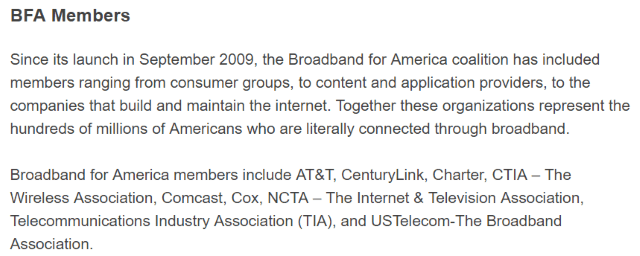
Broadband for America, perhaps the largest industry-backed astroturf telecom group in the country and itself cited as a source by the American Consumer Institute, seized on the criticism of Crawford’s book for its own attack piece. But every book critic mentioned has a connection to the telecom industry or has ties to groups that receive substantial telecom industry contributions.

NetCompetition chairman Scott Cleland, who accused Crawford of cherry picking information, does not bother to mention NetCompetition is directly funded by the same telecom industry Crawford’s book criticizes. Cleland in fact works to represent the interests of his clients: large phone and cable operators.

Randolph May’s criticism of Crawford’s book is unsurprising when one considers he is president of the Free State Foundation, a special interest group friendly to large telecom companies. FSF also supports the work of the American Legislative Exchange Council (ALEC), a group with strong ties to AT&T.

Richard Bennett, who once denied to Stop the Cap! he worked for a K Street lobbyist (he does), attacked the book on behalf of his benefactors at the Information Technology and Innovation Foundation, a group Reuters notes  receives financial support from telecommunications companies. He also received a $20,000 stipend from Time Warner Cable.

In fact, Broadband for America could not cite a single source criticizing Crawford’s book that does not have ties to the industry Crawford criticizes.

Share

Search This Site:

Contributions:

Recent Comments:

  • Ken R: Stopping people from shopping around seems a little communist! cable is no different than paying for anything else car's.TV's Computers, Cellphones, w...
  • Twizted: Oh its wanted 3.1 Docsis speeds for sure; the problem is big content providers and their pricing schemes are the number one major obstacle along with ...
  • James R Bivins: Your right other countries are leaven the usa behind.When usa please companies and leaves the customers behind.And charter is getting faster,but leavi...
  • James: He was amazing as FCC chair and you are right, he was building his resume, each group he talked to would think they were his key focus....cable won th...
  • James R Bivins: Everytime I see ad saying,they want new customers.They don't know how to get them.They talk expandion,that means update services,that should be update...
  • Andrew Madigan: I wonder what that does to the "private" wifi network. If they're sharing an antenna I bet the private network gets to fight the public network for wi...
  • Phillip Dampier: I have been looking and running into "proprietary battery" blockades. I don't believe the battery was created specifically for this device, but I do s...
  • Phillip Dampier: I can't imagine a firmware update could not correct this, but you are right you need a replacement for now because who knows exactly when that update ...
  • Phillip Dampier: The SIM card change may help restore some connectivity, but it does not resolve the degraded 4G performance. Run some speed tests. If you are in the 1...
  • Bill K: Sorry, here is the image link: http://postimg.org/image/fwpd7ttgz/...
  • Bill K: Here is a screen grab of the battery from the FCC ID submission. I am also interested in an alternate source, $35 is a bit expensive. Thank you for an...
  • John Case: I just spoke to an employee at a local Verizon authorized partner, and he indicated that the only way to really fix the phone is to replace it. He cla...

Your Account: