

 Subscribe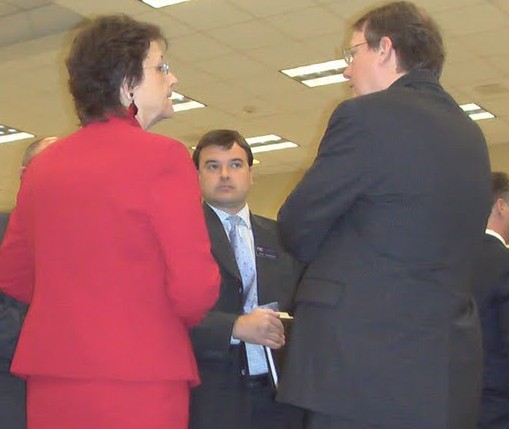
Rep. Avila with Marc Trathen, Time Warner Cable's top lobbyist (right) Photo by: Bob Sepe of Action Audits
Over the course of an hour this afternoon, North Carolina’s Senate Finance Committee discussed the implications of H.129, legislation proposed, written, and lobbied by Time Warner Cable and some of their phone friends across the state.
On hand was Rep. Marilyn Avila (R-Time Warner Cable), who tried to turn her competition-busting bill into an emotional epiphany about jobs and the benefits private providers bring to a state now ranked dead last in broadband.
Pass me a tissue.
Nobody doubts Ms. Avila is looking out for the interests of the state’s big cable and phone companies. Unfortunately for her district, she isn’t looking out for the broadband interests of her constituents, forced to pay some of America’s highest prices for low end service.
As Avila pals around with lobbyists from Time Warner Cable and the state’s cable trade group (more lobbyists), consumers in places like Orange County in north-central North Carolina see themselves on broadband maps but find they cannot actually get service from any providers.
As the hearing progressed into two-minute statements from parties interested in the outcome, the disconnect between well-paid lobbyists and corporate front groups like Americans for Prosperity with elected officials and consumers on the ground surveying a bleak broadband landscape said a lot.
Cable companies and their lobbyist friends sought to portray community broadband projects as fiscal failures — one suggested that was a global reality, despite the fact many countries have embarked on nationwide broadband plans that directly involve government to help build infrastructure. The global leader in broadband, South Korea, is a perfect example. With collaboration between the government and the private sector, Korea will have 1 gigabit broadband service across much of the country within a few years. That’s because South Korea does not believe broadband is simply a convenience, they see it as a social and economic necessity.
The other side sees it as a private moneymaker that can charge rapacious prices because it’s not an essential service.
 Shining a bright light on this reality was Americans for Prosperity, who delivered their own speaker at today’s hearing. As the group complained about government ‘overreach’ providing incentives in the 1930s for rural power and phone service, it quickly became apparent there are some in this debate willing to let rural Americans sit in darkness, without a phone line (much less broadband), to make a free market point: if private companies can’t or won’t deliver the service, you don’t deserve it and shouldn’t have it.
One wonders where this thinking will ultimately take us. Will community gardens be opposed for taking vegetable profits away from private corporate farms? Flea markets on public fairgrounds should be banned because they unfairly compete with eBay, Dollar Tree or a supermarket? The irony is these “small government conservatives” are all for big government legislation to keep potential competitors at bay. For them, broadband cannot be a locally-determined community project — just something you buy from a company that may or may not have an interest in serving you.
Just ask the gentleman from Orange County, who appeared as the final speaker. He spent his two minutes complaining about faulty cable and phone company-provided broadband coverage maps that claim service where none exists. After spending money on equipment, he learned CenturyLink had no interest in actually providing him with DSL. In fact, when he asked both the phone and cable company when that might change, the impression he was left with was “never.”
Whether members of the state legislature understand the irony of CenturyLink spending a fortune making sure Orange County never delivers the broadband service the company won’t provide itself is something voters across the state will need to impress on them.
They should be told, in no uncertain terms, to oppose H.129 and leave community broadband alone in North Carolina.

This is why America is failing. Our politicians are for sale to the highest bidder. In this case Verizon, AT&T, and others.
It is so nice to hear that countries in Southeast Asia have surpassed the USA in broadband access and speed.
It is just a matter of time before we become a third world country. Thanks to the idiots and corrupt in Washington and the foolish American population that sits back and does nothing.