


Home » washington utilities » Recent Articles:

CenturyLink’s Broadband Issues Color Company’s Deregulation Request in Washington

Phillip Dampier October 15, 2013 Broadband Speed, CenturyLink, Community Networks, Competition, Consumer News, Public Policy & Gov't Comments Off on CenturyLink’s Broadband Issues Color Company’s Deregulation Request in Washington

centurylinkCenturyLink is seeking “greater flexibility” to set its own prices, terms and conditions of service without a review by Washington State regulators, even as its broadband customers complain about bait and switch Internet speeds and poor service.

Three years after the Monroe, La., based independent phone company purchased Qwest — a former Baby Bell serving the Pacific Northwest — CenturyLink continues to lose customers to cell phone providers and cable phone and broadband service. Since 2001, CenturyLink and its predecessor have said goodbye to 60 percent of their customers, reducing the number of lines in service from around 2.7 million to just over 1 million.

CenturyLink is apparently ready to lose still more after upsetting customers with a notice it intended to seek deregulation that could lead to rising phone bills.

Docket UT-130477, filed with the Washington Utilities and Transportation Commission (WUTC) proposes to replace currently regulated service with what CenturyLink calls “an Alternate Form Of Regulation.” (AFOR)
broadband wa

If approved, CenturyLink will “normalize” telephone rates in Washington State, language some suspect is “code” for a rate increase. For CenturyLink customers in cities like Seattle, Spokane, and Tacoma, the maximum rate permitted for basic phone service for the next three years will be $15.50 (unless a customer already pays more), before calling features, taxes, and surcharges are applied. Most observers, including the state regulator, suspect CenturyLink will limit rate hikes to $1-2 if approved. A higher increase might provoke more customers to leave.
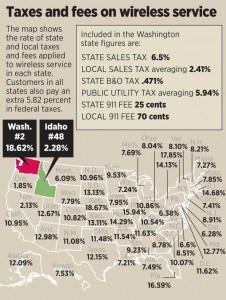
Washington residents already pay the nation's second highest taxes on wireless service. Now landline customers also pay more.

Washington residents already pay the nation’s second highest taxes on wireless service. Now landline customers also pay more. (Graphic: The Spokesman)

“We don’t think they can do much because, in our view, all (a big rate increase) is going to do is accelerate people dropping the landline into their homes,” Brian Thomas, a spokesman for the Washington Utilities and Transportation Commission told The Spokesman-Review. “A lot of people are cutting the cord.”

Frontier Communications, which previously won its own case for deregulation within its service areas including Everett, Wenatchee, and Tri-Cities, raised rates about $1 beginning this month.

A spokesman for the company confessed Frontier’s phone service is becoming obsolete.

“It’s safe to say plain old telephone service is in the process of becoming archaic for some people,” Frontier’s Carl Gipson said. “Five years from now, it will be almost – but not quite – extinct.”

Every rate change seems to provoke a review of whether landline service is still necessary.

Earlier this year, CenturyLink jumped on board legislation that purposely increased phone rates by several dollars a month by removing the sales tax exemption on residential telephone service. Wireless companies did not enjoy the same exemption and sued for parity.

A confidential settlement with state regulators made Washington phone customers, instead of telecom companies, liable for the sales tax starting in August. As a result, some residential phone bills went up at much as $5 based on retroactively charged sales tax.

Customers sticking with CenturyLink often say it is the only broadband provider in rural towns across the state. Although better than satellite broadband, the lack of regulatory oversight and technology investments have allowed CenturyLink to sell Internet speeds it cannot provide to customers.

At a hearing held this week by the San Juan County Council, members criticized CenturyLink officials on hand for selling fast service but delivering slow speeds to the group of islands between the mainland of Washington State and Vancouver Island, B.C.

Hughes

Hughes

“Last night I did a speed test at my house and I am paying for 10Mbps but only getting 4.74Mbps,” complained Councilman Rick Hughes (District 4 – Orcas West). “I am paying for 10 and I am only getting 5Mbps, so how is that fair? There has been a ton of frustration over the last two years we have worked on this broadband issue. Everywhere I go and every meeting I talk to all I hear is complaints about CenturyLink. No matter what they are paying for, it’s a poor broadband connection to the end customer.”

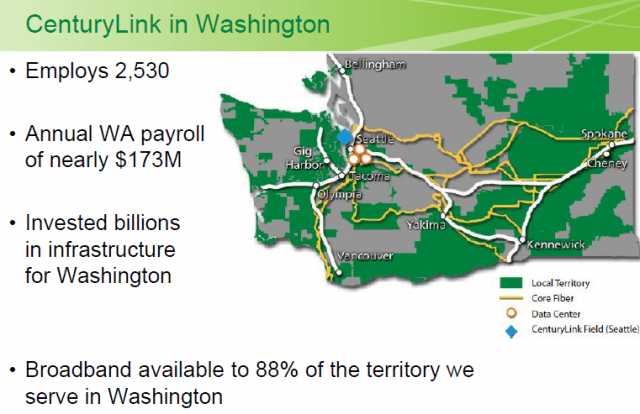
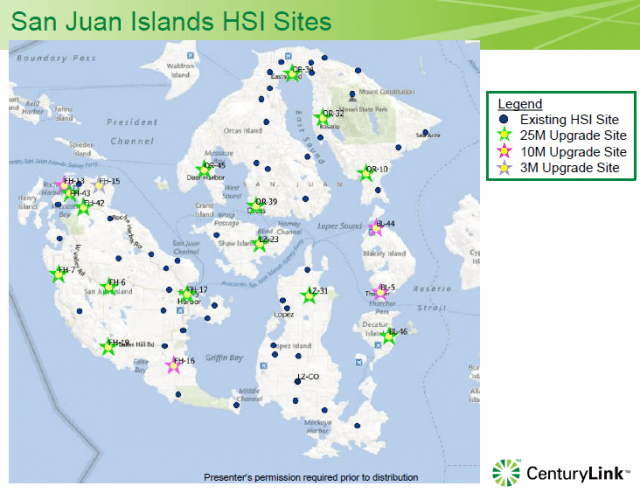
CenturyLink provides broadband to 88% of the territory the company serves in Washington. Like most telephone companies, CenturyLink relies on DSL in much of its footprint and has upgraded central offices, remote equipment, and the telephone lines that connect them. On the San Juan Islands, most customers used to receive 1-3Mbps, but CenturyLink claimed at this week’s hearing it spent billion on infrastructure improvements that can now deliver faster Internet service across the state. In San Juan County, CenturyLink claims:

  • 58% of all qualified addresses were upgraded to 10-25Mbps;
  • 66% now qualify for more than 10Mbps (but less than 25Mbps) versus 46% prior to upgrades;
  • 29% of customers now qualify to sign up for 25Mbps service.

CenturyLink warned the council its speed claims were not to be taken literally, noting DSL “speed is dependent on distance from equipment; speeds drop quickly as distance increases.”
san juan hsi

Hughes told CenturyLink officials residents appreciated the investment, but customers were still disappointed after being promised higher speeds than actually received.

“When people call customer service, there is always an excuse about why there is a problem,” said Hughes. “If people are paying for something, they want to receive it.”

opalco“For our long-term financial interests in this county, we need to have reliable 10-25Mbps service to customers on any part of the islands,” Hughes added. “My goal has always been 90+ percent should be able to get 25Mbps or better connectivity in the county.”

The problem for CenturyLink is the amount of upgrade investment versus the amount of return that investment will generate. San Juan County is disconnected from the mainland and collectively house only 15,769 residents. But it is also the smallest of Washington’s 39 counties in land area, which can make infrastructure projects less costly.

CenturyLink committed to continue investment in its network “where economically feasible.”

San Juan County’s Orcas Power & Light Cooperative (OPALCO), a member-owned, non-profit cooperative electric utility may have a partial solution to the problem of meeting Return on Investment requirements.
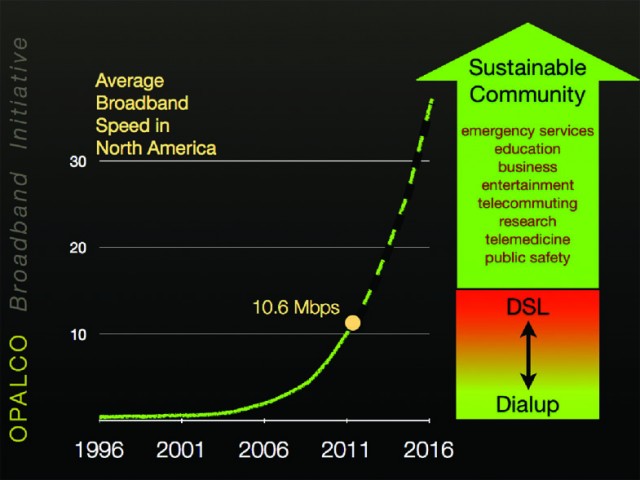
BB-growth-chartOPALCO originally proposed a hybrid fiber-wireless system designed to reach 90% of the county with a $34 million investment, to be built over two years. When completed, all county residents would pay a $15 monthly co-op infrastructure fee and a $75 monthly fee for broadband and telephone service. To gauge interest, OPALCO asked residents for a $90 pre-commitment deposit. By the annual meeting in May, the co-op admitted only 900 residents signed up and it needed 5,800 customers to make the project a success.

Some residents balked at the high cost, others did not want wireless broadband technology, and some local environmental activists wanted OPALCO to focus on clean, affordable energy and avoid the competitive broadband business.

The lack of commitment forced the co-op to modify its broadband plans, offering a “New Direction” to residents in June 2013.

OPALCO elected to stay out of the ISP business and instead announced a public-private initiative, providing fiber infrastructure to existing service providers. In effect, the co-op will cover the cost of building fiber extensions where CenturyLink is not willing to invest. For a $3-5 million investment from the co-op, ISPs like CenturyLink will be able to commission OPALCO to build fiber in the right places to make DSL service better. CenturyLink would have non-exclusive rights to the fiber network and would have to pay the co-op a service lease fee.

Unlike ISPs in other communities that have shunned publicly funded fiber infrastructure, CenturyLink says it will contemplate a trial — buying bandwidth from OPALCO instead of enhancing its own fiber middle mile network — to test what level of improved service CenturyLink can offer customers.

Regardless of CenturyLink’s plans, OPALCO is moving forward installing limited fiber connections as part of an effort to develop a more modern electric grid.

logo_broadband“Our data communications network brings exponential benefit to our membership,” OPALCO notes. “It includes tools that allow the co-op to: control peak usage and keep power costs down, remotely manage and control the electrical distribution system, manage and resolve power outages more efficiently, integrate and manage community solar projects and improve public safety throughout the county.”

There are some drawbacks, reports Wally Gudgell from The Gudgell Group.

“It will take longer to implement, and will impact fewer businesses and households,” Gudgell writes. “While about two-thirds of the islands will eventually be covered, more remote areas will have to work with a local ISP and potentially pay more for service.  DSL coverage for homes that are further than 15,000 feet from CenturyLink fiber-served distribution hubs will be challenging. Some homeowners may need to pay for fiber to be run to their homes by Islands Network (fiber direct is costly, estimated at $20/foot).”

Frontier Fined for Excessive Returned Check Fees in Washington

Phillip Dampier August 22, 2013 Consumer News, Frontier, Public Policy & Gov't Comments Off on Frontier Fined for Excessive Returned Check Fees in Washington

logo_wutcState regulators have fined Frontier Communications $41,400 for 414 violations of Washington’s law governing the largest amount a company can charge for a returned check.


The Washington Utilities and Transportation Commission gave Frontier 15 days to pay the fine, contest it by requesting a hearing, or seek a reduced penalty settlement.

The state found Frontier guilty of charging customers $20-25 for returned checks from Aug. 1, 2010 – March 31, 2012, despite the fact the maximum penalty Frontier is authorized to levy for a returned check in the state is $15.

Customers who overpaid Frontier for returned check charges should contact Frontier at 1-800-921-8101 to negotiate a partial refund or service credit. The state’s fine will not be used to repay customers.


Action Alert For Washington State Residents: Tell The Utility Commission Frontier Must Dump 5GB Acceptable Use Limit

Several staff members working for the Washington Utilities and Transportation Commission (WUTC), the regulatory agency reviewing the proposed Frontier purchase of Verizon territories in Washington state, have reversed their opposition to the Frontier-Verizon deal because of concessions they believe will better serve consumers impacted by the deal.  But the provisions don’t come close to protecting consumer rights and do not sufficiently protect local telephone and broadband service.

The WUTC must be told that broadband expansion from a service provider that insists on a 5 gigabyte usage limit in its Acceptable Use Policy makes such expansion barely worth the effort.  The WUTC must insist on a permanent exemption from any usage limits for Washington state consumers, especially because many may find Frontier DSL to be their only broadband option for years to come.  To allow a company with such a paltry limit to be the monopoly provider of broadband puts Washington residents and small businesses at a serious economic disadvantage in the digital economy.

Would you choose to reside or locate your business in a community with one broadband provider offering a limit so low, your broadband usage will be limited to web page browsing and e-mail?

High Speed Internet Access Service

Customers may not resell High Speed Internet Access Service (“Service”) without a legal and written agency agreement with Frontier. Customers may not retransmit the Service or make the Service available to anyone outside the premises (i.e., wi-fi or other methods of networking). Customers may not use the Service to host any type of commercial server. Customers must comply with all Frontier network, bandwidth, data storage and usage limitations. Frontier may suspend, terminate or apply additional charges to the Service if such usage exceeds a reasonable amount of usage. A reasonable amount of usage is defined as 5GB combined upload and download consumption during the course of a 30-day billing period. The Company has made no decision about potential charges for monthly usage in excess of 5GB.

Frontier will be a part of the lives of almost 500,000 state residents, including those in Wenatchee and other parts of North Central Washington.  That covers a lot of rural residents with no hope of cable competition or other broadband options.  Verizon is the second-largest local telephone service provider in Washington, serving cities such as Redmond, Kirkland, Everett, Bothell, Woodinville, Kennewick, Pullman, Chelan, Richland, Naches, Westport, Lynden, Anacortes, Mount Vernon, Newport, Oakesdale, Republic and Camas-Washougal.  Currently, Verizon has approximately 1,300 employees in Washington, who would be transferred to Frontier once the deal is complete.

Frontier’s concessions don’t come close to assuring residents they can get the kind of broadband service they need in the 21st century, especially from a company that could easily find itself swamped in debt.  Let’s look at what Frontier has offered:

  • Invest $40 million to expand high-speed Internet access in Washington.
  • Submit quarterly financial reports to identify merger savings.
  • Branding and transition costs to be paid by stockholders, not ratepayers.
  • Increase financial incentives to prevent a decline in service quality.
  • Adopt Verizon’s existing rates and contracts for at least three years.

Frontier would also be required to pay residential customers $35 for missed service repairs or installation appointments. That’s $10 more than Verizon now pays. Current Verizon customers would also have 90 days after the transition to choose another provider without incurring a $5 switching fee. Low-income customers who qualify through the Washington Telephone Assistance Program will also receive a one-time $75 credit if the company fails to offer appropriate discounts or deposit waivers.

Our take:

  • Investing $40 million in low speed DSL service with a 5GB usage allowance saddles residents with yesterday’s technology with a usage allowance that rations the Internet.
  • Customers don’t care about merger cost reductions because they’ll never enjoy those savings, but they’ll feel their impact if they include layoffs and reduction in investment.
  • Consumers will be more concerned about what happens to their phone and broadband service when the “transition” results in service and billing problems.  Will stockholders pay inconvenienced customers?
  • Vague promises of increased financial incentives for a company to do… its job, without declines in service quality, exposes just how unnecessary this deal is.  Why not offer incentives for Verizon to stay?
  • Freezing rates for three years doesn’t prevent massive increases to make up the difference in year four and beyond.

The WUTC staff had it right the first time when it opposed the deal.  A healthy, financially secure Verizon is still a better deal than a smaller independent company saddled with debt.  Frontier seals the fate of Washington state residents from the benefits of fiber optics wired to the home, delivering high speed broadband for the future because Frontier doesn’t do fiber to the home on its own.  With a tiny usage allowance, just waiting for the company to decide to enforce it means you won’t be using your broadband account too much anyway.

The WUTC is accepting comments and you need to start calling and writing.  Make sure to tell the Commission it must secure a permanent exemption for Washington from any Internet Overcharging schemes like consumption/usage-based Internet billing and any usage limits Frontier defines in its Acceptable Use Policy.  Better yet, tell them Frontier’s concessions don’t come close to making you feel good about Verizon turning over your phone service to a company that is traveling the same road three other companies took all the way to bankruptcy.

Customers who would like to comment on the provisions can call toll-free: (888) 333-9882 or send e-mail to [email protected]. The deadline for comments is January 10th.

Washington State Utilities and Telecom Staff Recommend Rejection of Verizon Sale to Frontier

Phillip Dampier November 6, 2009 Frontier, Public Policy & Gov't, Verizon, Video 3 Comments

Washington State

Washington State

Saying the sale would harm customers, Washington state utilities’ commission staff is recommending rejecting a proposed sale of Verizon’s landline residential and commercial telephone business in Washington to Frontier Communications.

In raising objections to the proposed Frontier-Verizon transaction, Washington Utilities and Transportation Commission (UTC) staff members concluded the business deal is not in the public interest. The proposed purchase does not include Verizon Wireless customers.

The three-member UTC, which will make the final decision early next year, will consider whether state ratepayers would be harmed by the proposed transaction, which is part of an $8.6 billion bid by Frontier to acquire 4.8 million Verizon phone lines in 14 states.

“There may not be any way for Frontier to provide benefits to Washington customers that offset the financial harm and operational risks,” said commission staff in their written testimony. “The failure of the companies to offer adequate consumer benefits or protections puts customers at risk of being served by a company without enough financial strength to make necessary improvements to local telephone facilities and widen deployment of broadband access.”

The Commission staff believes Frontier’s proposal to improve service is loaded with risk:

  • The company’s credit rating is lower than Verizon, making capital difficult to obtain in a credit-challenged economy.  Without such capital, Frontier cannot make improvements to the telephone network.
  • Frontier’s ranking as a relatively small independent phone company means it will face “higher per unit” costs because of the unavailability of volume discounts super-sized companies like Verizon enjoy.
  • Frontier could easily face the same fate as three other Verizon spinoffs – a fast trip to bankruptcy court, but only after providing lousy service and broken promises to customers along the way.

logo_wutcFrontier said it would file a formal rebuttal to the comments later this month.  The company disputes the conclusions reached by the utility commission staff, saying the company will reduce its dividend to free up financial resources and will aggressively expand broadband availability in their service areas.

But the findings from Washington state are familiar to readers of Stop the Cap! They are largely the same echoed by the campaign to stop the sale of West Virginia’s landlines to Frontier.  The Communications Workers of America issued a press release reminding West Virginians Frontier enjoys abysmal approval ratings for its broadband service, based on an independent survey done by PC Magazine we covered a few months back.  Verizon ranks number one in customer satisfaction, in part thanks to its FiOS fiber to the home service.

Union spokeswoman Elaine Harris said, “The economic growth and development of West Virginia depends on having modern, high-speed Internet access. It’s not in the public’s best interest for West Virginia to replace the leader in broadband service with a smaller company whose customer satisfaction is appallingly low.”

Frontier’s defense to union objections is that Verizon hasn’t yet wired any customers in West Virginia for FiOS, and many parts of the state don’t have any broadband, so customer satisfaction numbers don’t matter if you don’t have any service.  Frontier claims it has good customer reviews in West Virginia, but offered no evidence to back up their claim.

So far, the Washington state commission has received 93 public comments with five in favor, 40 undecided and 48 opposed to the proposed sale. Washington customers who would like to comment on the case are encouraged to send correspondence to:

Washington Utilities and Transportation Commission
P.O. Box 47250
Olympia, WA 98504

e-mail comments: [email protected] or call toll-free 1-888-333-9882.

The commission’s deadline for accepting public comments is Jan. 11, 2010.

[flv width=”640″ height=”480″]http://www.phillipdampier.com/video/Bloomberg News Frontier Maggie Wilderotter 11-4-09.flv[/flv]

Frontier CEO Maggie Wilderotter appeared on Bloomberg TV on November 4th to discuss the company’s challenges from declining wireline telephone service. Wilderotter’s spin is that disconnected dial-up residential lines and business data circuits represent some of that loss.  Wilderotter agrees with the anchor’s contention that delivering broadband in rural areas where there is not a lot of competition is good for Frontier. But is it good for consumers?(3 minutes)

Frontier Communications reported its third quarter results earlier today with an 11% increase in net profits “attributable to shareholders,” but a 6% decline in revenue, mostly due to losing an additional 34,000 consumer and business line accounts in the third quarter.  Thanks to selling add-ons like calling features and broadband, the company managed an average 1% increase in revenue per line.  Wilderotter said improved customer metrics and disciplined cost control was responsible for the increase in profits.

Search This Site:

Contributions:

Recent Comments:

Your Account:

Stop the Cap!