
Home » usage meter » Recent Articles:

Comcast Tries to Prove Its Usage Meter is Accurate Before Slapping the Caps Back On

Phillip Dampier June 5, 2014 Comcast/Xfinity, Consumer News, Data Caps, Editorial & Site News, History, Public Policy & Gov't Comments Off on Comcast Tries to Prove Its Usage Meter is Accurate Before Slapping the Caps Back On
Keeping an eye on the scale

Keep an independent eye on the scale

Without independent verification by an unbiased third-party, providers’ usage meters can measure any amount of usage — correct or not — with no recourse for those facing overlimit fees or service suspension.

That is why companies like Comcast depend on the patina of credibility a third-party company can offer when certifying Internet traffic measurement tools as accurate, even if that company has a vested interest handing Comcast the results it wants to see.

NetForecast just completed its third paid study of Comcast’s Internet meter declaring it amazingly accurate with an error rate of just -0.75 to 0.36%.

NetForecast claims it performed independent traffic measurements using real user traffic in subscribers’ homes as well as its own in-house PC and server.

“Based on our measurement results, Comcast subscribers should be able to rely on Comcast’s meter accuracy,” NetForecast says.

Comcast subscribers should also be able to rely on the fact that any cable company that involved with its usage measurement meter has a clear agenda to use it as part of a nationwide return to usage caps or usage-based billing.

NetForecast is no substitute for utilizing a financially uninvolved third-party to oversee any measurement tool that could expose customers to additional charges.

The country has been through this before.

Offices of Weights and Measures represent one of the country’s oldest efforts at consumer protection and trace their origins to the Code of Hammurabi, the Magna Carta and the United States Constitution. Most states created their own bureau to verify all sorts of measurement tools from scales to gas pumps in the early 1900s after an epidemic of widespread fraud shortchanged citizens.
Measure with confidence.

Measure with confidence.

By 1910, the California Legislature was engaged in a battle with the railroads over the accuracy of scales used to weigh railway cars. Railroad tariffs for hauling goods were based on the weight or measurement of the commodity carried. The railroad industry occasionally hired so-called “independent” third parties to certify the accuracy of railway scales to fend off government regulation and oversight after reports of widespread fraud reached the legislature. It didn’t solve the problem.

In 1920, 52.4% of railroad scales, including those “certified” accurate were found to be well out of tolerance. When the industry knew the state of California’s Office of State Superintendent of Weights and Measures would oversee testing a year later, every scale tested in 1921 was suddenly accurate within tolerance.

The problem of accurate measurement was not limited to the railroads. Californian cattle and livestock ranchers faced dishonest hay balers that ginned up the cost of hay by sneaking in heavy debris like rocks and using inaccurate scales to charge higher prices. The 1919 Hay Baling Act was passed to ensure accuracy in the sale of hay and to stop the fraud and abuse the hay balers denied ever existed.

In Maryland, the fraud came from scales used by grocers and gas pumps — both rigged by their respective owners to deliver bigger profits at the consumer’s expense.

In the 1971 Report of the 56th National Conference on Weights and Measures, E.E. Wolski, manager of quality control at the Colgate-Palmolive Company considered it unthinkable that anyone other than a truly independent, financially uninvolved third-party should monitor the accuracy of measurement tools.

This Maryland gas pump is being verified for accuracy by the Weights & Measures program run by the state government.

This Maryland gas pump is being verified for accuracy by the Weights & Measures program run by the state government.

“I do not think anyone will be so naïve as to even suggest that an elimination or reduction of inspection or enforcement would result in anything other than a return to the situation which made the need for them so apparent,” said Wolski. “It is a well-known fact that where enforcement drops off, so does compliance.”

In one state where private companies were permitted to self-certify, inaccuracy turned out to be rampant.

“I was informed that the average gallon was about a half pint short and that an average pound had been a little less than an ounce short,” Wolski said. “The shortages had been statewide and were almost universal.”

The state-employed director that finally established independent oversight of weights and measurements in light of the widespread fraud Wolski talked about was firm in his conclusion that “everybody, literally everybody (and that includes you and me), needs to know that someone is there watching what he does.”

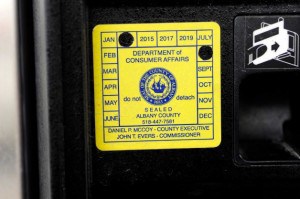
Any financial interest in the outcome of a weight or measurement involving money is a temptation to cheat consumers, one that has effectively only been tempered all the way back to the days of King Solomon by truly independent oversight, typically by a state or local authority. That authority is on display today in the form of a compliance sticker found on commercial scales, gas pumps, and other measurement tools, attesting to their accuracy.

While it is nice Comcast at least bothers to investigate the accuracy of its usage meter, consumers should not be asked to trust the findings of a third-party paid to produce results. Consumers should insist that a truly independent regulator of weights and measurements regularly test and verify usage meters wherever they could be used to suspend a customer’s account or result in extra fees.

AT&T Mailing More Warning Letters to Customers Exceeding Their Usage Allowance

Phillip Dampier February 17, 2014 AT&T, Data Caps, Editorial & Site News 3 Comments

att-logo-221x300AT&T wants customers to pay attention to their broadband account’s monthly usage limits: 150GB for DSL or 250GB for U-verse. Customers who exceed their allowance are more likely than ever to get a warning letter from AT&T threatening overlimit fees if they continue to ‘use too much’ Internet.
AT&T customers in Texas, Ohio, Oklahoma, and Florida have shared identical warnings with Stop the Cap! received during the last 10 days — in each case it was the first warning notice received about exceeding AT&T’s arbitrary allowance:

Dear AT&T High Speed Internet Service Customer,

We want to remind you that your AT&T High Speed Internet service includes 150 gigabytes (GB) of data for each billing period.

You have exceeded 150 GB this billing period.

We’ll waive the charges for additional data this month and notify you as your usage approaches 150 GB in future months.

The next time you exceed 150 GB you’ll be notified, but not billed. However if you go over your data plan in any subsequent billing period, we’ll provide you with an additional 50 GB of data for $10. You’ll be charged $10 for every incremental 50 GB of usage beyond your plan.

AT&T imposed usage caps a few years ago but has generally not enforced them, even when usage meters show an excess of 500GB in Internet traffic. Some AT&T customers still have no access to a working usage meter, making compliance even more difficult. Stop the Cap! has yet to receive a verified copy of a billing statement actually showing overages billed to customers, but the increasing number of warning letters may indicate overlimit fees are forthcoming for persistent ‘violators.’

We recommend that customers receiving these warning letters send a warning of their own by calling AT&T and threatening to cancel service over the issue of unacceptable usage caps. Let AT&T know that you consider usage-based billing a deal-breaker and you will begin exploring your options with other providers. Remind AT&T that they already earn a lot of money from you and that any overlimit fees that appear on your bill will mean the immediate termination of your account.

NorthwesTel’s Usage Meter Runs Amuck; Company Says “Turn Off Your Computer At Night”

1638.OpenMedia-Internet-meterMore than two dozen NorthwesTel customers in Canada’s north are contemplating a class-action lawsuit against their Internet provider after being charged hundreds, if not thousands of dollars in overlimit charges for phantom traffic nobody can seem to identify.

Kyle Jennex of Whitehorse has always checked his usage, particularly because NorthwesTel charges very high prices for access and has a low usage cap. Running over a plan limit can prove costly at $5 per gigabyte. In November, Jennex discovered NorthwesTel’s usage meter was registering between 5-7GB of mysterious upload traffic every night even after the computer was physically disconnected from his Internet connection.

Despite complaining to NorthwesTel, the company billed him for nearly $1000 in overlimit fees, claiming he exceeded his allowance by nearly 200GB.

“I depend on the Internet for our lifestyle,” Jennex told Yukon News. “We like our music and our movies and our TV, so I download a lot of stuff. I also believe that if I’m paying for 150 gigabytes, I’m going to use that up. So because of that I monitor our usage carefully so I can spread it out throughout the month and to make sure we don’t go over.”

NorthwesTel has never suspected their meter of being responsible for the phantom usage measurements. To Curtis Shaw, NorthwesTel’s vice president of marketing, excess usage is entirely the customer’s responsibility. The company told Jennex his high usage was likely caused by torrent/peer-to-peer network traffic or a neighbor who had hacked into his password-protected Wi-Fi network. But neither explanation can account for usage that continued to rack up with nothing connected to his Internet modem.

Shaw recommends NorthwesTel customers shut down their computers when not in use, particularly overnight, to avoid excess charges. He also advises customers to change their passwords, regularly check usage, and install and update anti-virus software on their computers.

badbill

Bill Shock

Shaw also says users can sign up for e-mail that notifies customers when they approach their limit, “really to protect people from receiving a surprise bill.” He adds the company does monitor customer usage and has called customers in the past when their accounts show an unusual amount of activity.

But NorthwesTel didn’t bother to call a customer in Whitehorse who reports he was billed an extra $990 for the extra 198GB of usage he claims he never used. Nor did the company call the woman in the Northwest Territories bill shocked with $3,000 in overlimit fees in a single month.

The company says there have been repeated cases of neighbors “sharing” Wi-Fi connections which can quickly run up usage. But Jennex, who says he well understands the danger of unprotected Wi-Fi, believes he has taken the necessary precautions and has been overbilled anyway.

“The way they’re talking, it’s like every second neighbor is hacking into your wireless,” Jennex said. “I have passwords that are completely random that would take some pretty sophisticated equipment to hack into. We even tried disconnecting all our devices from the router and it still kept happening. The only way I could get them to stop was to physically unplug my modem.”

The company cannot or will not trace Jennex’s mysterious web traffic to identify the source, confident their meter is accurate. Besides, the company says, customers often underestimate the amount of traffic they consume using file sharing programs or watching video online. The company claims it worked hard on its usage meter and it received industry approval for its high degree of accuracy. But providers need not submit their meters for independent verification or subject them to periodic audits to verify meter accuracy.

NorthwesTel does not have a good record on meter accuracy. In 2010 the company was forced to admit it had overbilled hundreds of customers over a “meter glitch” when usage monitors were not reset. As a result, customers found enormous overlimit fees attached to their bills. In one example, a customer was charged a $2,500 overlimit fee on top of his usual bill of $88.

cctsA glitch may indeed be part of the problem as one Yukon customer successfully confronted NorthwesTel for erroneous overlimit fees for consumption of data that was impossible to accrue at the speed of his Internet connection.

Angry customers complain that with so little competition, NorthwesTel has every incentive to play fast and loose with its meter, either because customers will cut their usage, upgrade to a higher cost tier with a bigger allowance, or pay the overlimit fees.

Customers who believe they were unjustly billed overlimit fees should take their case first to the Office of the President. Failing that, they should appeal to the Commissioner for Complaints for Telecommunications Services, an independent agency that has a good track record of winning relief.

Some customers fear the expensive overlimit fees so much, they are following NorthwesTel’s advice and keeping their computers switched off when not being used, but that isn’t a good enough answer for Jennex, who plans to continue the fight.

“There’s no need to rip us off because we live so far North,” he told CBC North.

Comcast Expands 300GB Usage Cap in Alabama, South Carolina; Minimum Overlimit Fee: $10

Comcast-LogoComcast has expanded its 300GB usage cap to Internet customers in Huntsville and Mobile, Ala. and Charleston, S.C.

In these cities the XFINITY Internet allowance includes a $10 penalty for each 50GB segment customers exceed the arbitrary allowance. Alabama and South Carolina join customers in parts of Georgia, Kentucky, Mississippi and Tennessee now subject to a usage allowance.

Comcast is also offering a new Flexible Data Option for Economy Plus customers that use less than 5 GB per month.

Customers who do not want the new usage caps can register their displeasure by calling Comcast Customer Security Assurance at 1-877-807-6581, contacting the local news media, or writing to your federal elected officials.

xfinitylogo

Dear XFINITY Internet Customer:

At Comcast, we recognize that our customers use the Internet for different reasons and have unique data needs. As a reminder, starting November 1, 2013, Comcast will trial a new monthly data plan in this area, which will increase the amount of data included in your XFINITY Internet Service to 300 Gigabytes (GB) and provide more choice and flexibility.

What this means for You

The vast majority of XFINITY customers use far less than 300GB of data in a month. Based upon your recent usage history, it appears this new data plan will have no impact upon you, and you won’t need to do anything, or change your Internet usage. If you are not sure about your monthly data usage, please refer to the Track and Manage Your Usage section below.

We want our customers to use the Internet for everything they want and your service will not be limited to 300 GB . While we believe that 300 GB is more than enough to meet the Internet usage needs of most customers, Comcast will automatically add blocks of 50 GB to your account for an additional $10, should you exceed the 300 GB included in your plan in a month.

In order for our customers to get accustomed to this new data plan, we are implementing a three-month courtesy program. That means you will not be billed for the first three times you exceed 300 GB included in the data plan during a 12 month period. Should your usage exceed 300 GB a fourth time during any 12-month period, an additional 50 GB will automatically be allocated to your account and you will be billed $10 for that data and each additional 50 GB of data in excess of 300 GB during that month and any subsequent months your usage exceeds 300 GB.

Please note that this is a consumer trial. Comcast may modify or discontinue this trial at any time. However, we will notify you in advance of any such change.

For more information on all our data usage plans, please visit www.xfinity.com/datausageplan/expansion

Track and Manage Your Usage

Comcast provides you with several tools to easily track and manage your data plan:

Usage meter – Use the usage meter to see how much data you have used – available at www.xfinity.com/usagemeter

Data Usage Calculator – Estimate your data usage with this tool available at www.xfinity.com/datacalculator. Simply enter information on how often and how much you typically use the Internet, and the calculator will estimate your monthly data usage.

In-Browser Notices and Emails – We will send you a courtesy “in-browser” notice and an email letting you know how much of the data included in your monthly plan you are using. If you have any additional questions about the new data usage plan, please visit www.xfinity.com/datausageplan/expansion

Thank you for being an XFINITY Internet Customer.

Sincerely,

Comcast

Entertainment Producers Call Out Stifling Data Caps That Upset the Online Video Revolution

Phillip Dampier February 27, 2013 AT&T, Comcast/Xfinity, Competition, Data Caps, Online Video, Public Policy & Gov't, Verizon Comments Off on Entertainment Producers Call Out Stifling Data Caps That Upset the Online Video Revolution

Public-KnowledgeData caps protect incumbent big studio and network content creators at the expense of independent producers and others challenging conventional entertainment business models.


That was the conclusion of several writers and producers at a communications policy forum hosted by Public Knowledge, a consumer group fighting for an open Internet.

A representative from the Writers Guild of America West noted that cord-cutting paid cable TV service has become real and measurable because consumers have a robust online viewing alternative for the first time. John Vezina, the Guild’s political director, noted how Americans watch television is transitioning towards on-demand viewing.

New types of short-form programming and commissioned series for online content providers like Netflix are also changing the video entertainment model.

Welch: It is about the money.

Welch: It is about the money.

But a digital roadblock erected by some of the nation’s largest broadband providers is interfering with that viewing shift: the data cap.

Data caps place artificial limits on how much a customer can use their Internet connection without either being shut off or finding overlimit fees attached to their monthly bill. Critics contend usage caps and consumption billing discourage online viewing — one of the most bandwidth intensive applications on the Internet. With broadband providers like Time Warner Cable, AT&T, Verizon, and Comcast also in the business of selling television packages, cord-cutting can directly impact providers’ bottom lines.

Providers have traditionally claimed that usage limits are about preserving network resources and fairness to other customers. But Time Warner Cable admits they exist as a money-making scheme.

Rachel Welch, vice president of federal legislative affairs at Time Warner Cable, says the cable company is not worried about limiting data consumption. It considers monetizing that consumption more important.

“We want our customers to buy as much of the product as possible,” Welch told PC World. “The goal of companies is to make money.”

Time Warner now offers customers a choice of unlimited service or a $5 discount if customers keep their monthly usage under 5GB, but some worry that is only a prelude to introducing expanded usage limits on a larger number of customers in the future.

For many consumers already hard-pressed by high broadband bills, worrying about exceeding a data allowance and paying even more may keep viewers from watching too much content online.

For that reason, Vezina called data caps “anti-innovation.”

“It hurts consumers [and] it hurts creators who want to get as much out to the public in as many ways” as possible, he said.

Public Knowledge has become increasingly critical of data caps in the last two years. The organization has questioned how ISP’s decide what constitutes a ‘fair’ usage limit and criticized inaccurate usage meters that could potentially trigger penalties and overlimit fees.

Search This Site:

Contributions:

Recent Comments:

Your Account:

Stop the Cap!