Home » usage limit » Recent Articles:

FCC Chairman Julius Genachowki on Rate of Innovation in American Broadband: America Dead Last

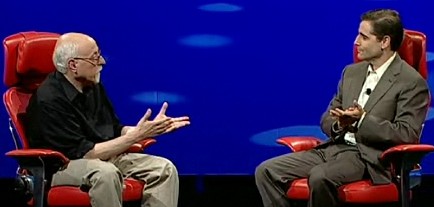
Walt Mossberg (left) discusses the current state of American broadband with FCC Chairman Julius Genachowski (right)

FCC Chairman Julius Genachowki told attendees at the D: All Things Digital conference America scores dead last in a study measuring the rate of change in broadband innovation.  American broadband is stuck in neutral while every other ranked nation is moving forward faster in understanding the importance of deploying fast, reliable, and universal broadband.  Genachowski directly ties broadband to improving local economies, propelling growth in jobs, and improving education and health care.

Unfortunately the American duopoly most Americans cope with maintains a stranglehold on efforts to bring America literally up to speed with competing nations.  Worse, there is no end in sight as long as America relies entirely on incumbent providers to get the job done.

Americans pay some of the highest prices in the world for mediocre broadband, and it’s only getting worse with the introduction of usage limiting schemes like data caps and so-called consumption billing.

Genachowski is attempting to facilitate improved broadband across the United States, but is hampered by private industry undermining the FCC’s authority to help push improvements forward.  Recent industry-driven court challenges to the FCC’s authority have led to the agency seeking a different path to regain its regulatory footing.

The FCC chairman sees the biggest challenges coming in wireless broadband, where a spectrum shortage is limiting potential capacity and available bandwidth.  Genachowski seeks an accommodation with the nation’s television stations to relinquish UHF spectrum where possible to bolster wireless networks.

Conference host Walt Mossberg challenged Genachowski on why more isn’t getting done and why accepting the current state of the marketplace is acceptable.  He also criticized providers for charging high prices for slow service and attacked Comcast for its set top box, claiming if there was an open market for these things, no one would buy it, that it would be the worst thing on the shelf.

[flv width=”512″ height=”308″]http://www.phillipdampier.com/video/All Things Digital Genachowski 6-2-10.flv[/flv]

Excerpts from FCC Chairman Julius Genachowski’s visit with Walt Mossberg at the June 2nd D: All Things Digital conference.  (6 minutes)

Fairy Tale: O2’s Nobbling Broadband Niggles & Narks Forgets to Mention Internet Overcharging Sharks

Phillip Dampier May 26, 2010 Data Caps, O2 (UK), Rural Broadband, Video 2 Comments

Pot?  Meet Kettle!

In one of the biggest ironies thus far this year, a British broadband provider trying to one-up the competition has started running ads with Dr. Seuss-like characters that represent marketing exaggerations, traps, and bad customer service, all while forgetting to disclose it engages in some tricks of its own.

O2’s Niggles & Narks campaign features animated creatures that represent where broadband has gone all-wrong:

[flv width=”640″ height=”380″]http://www.phillipdampier.com/video/O2 Niggles and Narks Ad 5-2010.flv[/flv]

Once upon a time, when broadband was made, we browsed and surfed and chatted — everybody played.

But for some, the magic faded.  Some things started to go wrong.

Without any warning, the niggles and nobs came along.

With the No Support-a-Saurus — spouting twaddle was his game.  His impossible instructions would slowly knot your brain.

The Crafty-Cost Nark took pleasure in his work, delivering line rental bills that drove us all berserk.

And with the Mystery-Speed Mook, you never really know. You thought you’d get mega-fast but got stuck with dead slow.

But this is where we draw the line and try to right what’s wrong.  Wouldn’t broadband be a better place, with narks and niggles gone?

But accusing the others of broadband narks and niggles -you- see, without confessing your own is little more than hypocrisy.

In a land of broadband O2 promises is not a dream, it brings to the table its own Internet Overcharging scheme.

No nobble or niggle could ever believe, selling unlimited broadband -that wasn’t- was something they could achieve.

But O2 managed — somehow, we don’t know, to define “unlimited” as 10GB per month — exceeding it brings woe.
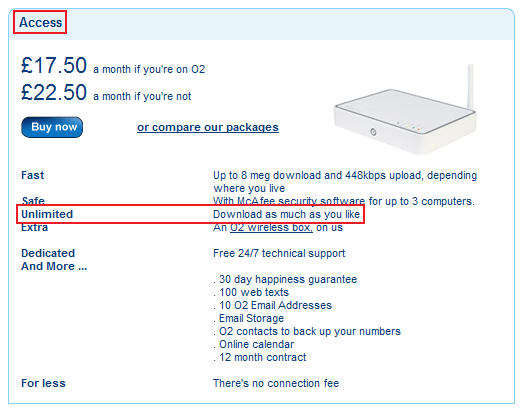
Maybe it's a typo that should have read, "download as much as WE like."

O2 sells its broadband packages across the United Kingdom, either bundled under a BTWholesale-based package or unbundled direct from O2 or BeBroadband.  Only the BTWholesale accounts, common in rural areas where O2 doesn’t have its own equipment installed in the exchange offices, are impacted by the limit on unlimited.  BT apparently charges them some form of consumption billing, and they aren’t willing to eat the costs.

Starting in March, many customers started receiving letters stating they were using the service too much, and if they didn’t back off, they’d be disconnected.  One customer received a disconnect warning after using 40.1GB, primarily from watching BBC’s iPlayer, which delivers on demand television programming.

What represented “too much” for an “unlimited service?”

“Most O2 customers use less than 10GB a month. Aim for that and you’ll be okay,” says one of O2’s support pages on the topic.

Outraged consumers arguing that “unlimited” should mean “unlimited” and didn’t comply were promptly disconnected.

With the introduction of O2’s new high-priced Niggles & Narks advertising campaign, the hilarity ensued as customers began calling out O2’s hypocrisy, leading to clarifications from O2 that were anything but:

As some of you have been discussing, we’ve started to disconnect some of the very highest usage customers whose download patterns have detrimentally affected other customers’ experience, even after we have requested them to reduce their usage and explained the effect it’s having. We will continue this in order to improve the experience for the majority of the customers on the service.

We are also making the service run more efficiently by updating the hardware and software that runs the Access service. This will improve the prioritization of the real-time activity, such as streaming, over less time-sensitive activities such as P2P. — O2 Statement from March 26th 2010

O2's "Unlimited Broadband" Price Chart

Then there is this fine print on the question of “unlimited service” that only a credit card company or bank could love (the underlining is ours):

How much should I cut my broadband use?

Most O2 customers use less than 10GB a month. Aim for that and you’ll be okay.

Your product is unlimited, so why are you telling me to use less?

There aren’t any usage limits on any of our O2 Home Broadband packages. That means you can download and upload as much as you like each month, within reason.

Our network’s been designed to cope with people downloading large files (like music or films) and watching video online. But if you’re using the service excessively – like continually downloading large files at peak times – then we do reserve the right to warn you to lower your usage. In exceptional circumstances, we can even terminate your account.

This is because excessive use by a few people can reduce the speed that other customers in the same area can get. We just want to provide everyone with an excellent level of service.

Then company officials unofficially increased the limit to 40GB per month, as this note on an official company forum disclosed:

We’re contacting less than 10% of our heaviest users at the moment and you fell into this top tier. The majority use less than 10GB and at present if you use less than 40GB, you wouldn’t hear from us.”

This isn’t the first time O2 has confused its customers.  ThinkBroadband reminds us of 2007’s mess over the same issue:

O2 have never been good at defining the term ‘unlimited’ as can be seen in 2007 when they had three different definitions for the word. Back then they did recognize that customers were confused by the term and the marketing director Sally Cowdry was quoted as saying “customer feedback has been that if we say unlimited, it should be unlimited.” We wonder why two and half years on, O2 still have not ‘nobbled this broadband niggle.’

Unfortunately for O2 customers, the company has not righted any broadband wrongs.  They’ve added to them.  O2 has an chronic problem with their own Niggles and Narks.  Perhaps British regulators can do a better job exterminating them.

Provider Admits Caps & Overlimit Fees Are About Deterrence, Forcing Upgrades, Or Going Elsewhere for Service

Customers of Vistabeam in Nebraska and Wyoming who subscribe to the company’s rural Wireless Internet Service are about to discover their online activities are about to be capped… for real this time.

Matthew Larsen, who runs the Wireless Cowboys blog, includes some illustrative examples of Internet Overcharging schemes in action and what they’re all about.  He writes about his experiences at Vistabeam, which serves rural Nebraska and Wyoming with wireless broadband service.  The company started operations with an admittedly-unenforced 3GB usage limit, backed up with a stinging $25/GB penalty overlimit fee to underscore the point.  Today that cap is described by Larsen as “a joke” — too low to be taken seriously.  [Note to Frontier: Are you reading this?]

But the company was determined to monitor and measure its customers’ online activities and developed an in-house tool that is providing daily insights into customer usage, and gives Vistabeam the ability to begin penalizing customers who exceed the limits established by the provider.

Wireless providers, known as WISPs, often provide the only Internet access in rural areas that are too sparsely populated to deliver DSL service and where cable television is a financial impracticality.  For Nebraska and Wyoming residents bypassed by cable and underserved by DSL (if at all), it’s often a choice between dial-up, satellite fraudband service barely capable of 1Mbps service with a punitive “fair access policy,” or an independent WISP.  A number of customers have chosen the latter.

Vistabeam offers service plans for its 2000 customers ranging from 384kbps for $29.95 a month to 4Mbps service for $99.95 a month, with a discount for paying in six month increments.  That’s not cheap by any means.  But rural Americans routinely face higher broadband bills because of the inability of providers to achieve economy of scale.  Fewer customers have to share the expenses to construct, operate and maintain the service.

But those bills could soon grow even higher if customers exceed the new harder-line Vistabeam will take on usage cap offenses.

Larsen’s measurements identified what their customers were doing with their broadband connections and identified Vistabeam’s biggest users:

Out of 2000+ customers, 80 used more than 10 gigs for the month.

One customer – a 1 meg subscriber at the far eastern edge of our network, behind seven wireless hops and on an 802.11b AP – downloaded 140gig.

Another one, on the far western side of our network, downloaded 110gig.   We called them and found out that they were watching a ton of online video.

We discovered a county government connection that was around 100gig – mostly because someone in the sheriff’s department was pounding for BitTorrent files from 1am to 7am in the morning, and sometimes crashing their firewall machine because of the traffic.

One wonders what the sheriff’s department was grabbing off BitTorrent, but the question itself opens the door as to whether or not your provider (and by extension, you and I) should know what they are doing with their broadband connection in the first place.

Larsen says the other subscribers on his list were watching lots of online video, had a virus, or had “mistakenly” left their file sharing programs running.

Larsen’s solution is usage caps and overlimit penalties for his subscribers.

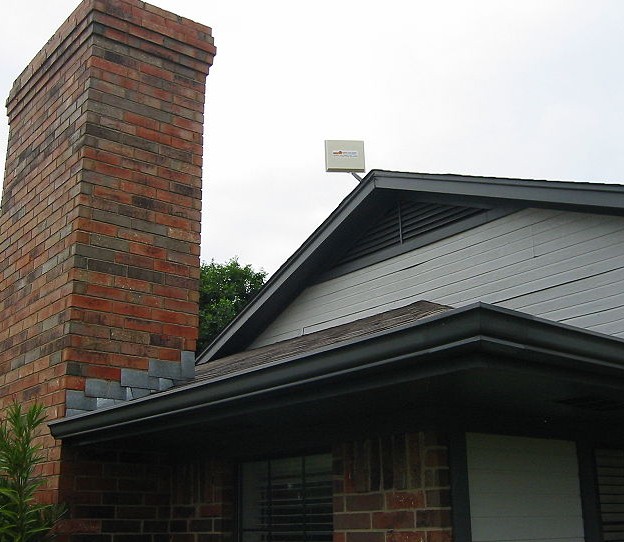
A home equipped with a WISP antenna on the roof

Package                                                               Monthly Download Cap

384k                                                                       10 gigabytes

640k                                                                       10 gigabytes

1 meg                                                                    20 gigabytes

2 meg                                                                    40 gigabytes

3 meg                                                                    50 gigabytes

4 meg                                                                    60 gigabytes

8 meg                                                                    80 gigabytes

Additional capacity over cap                        $1 per gigabyte over the cap

Although Larsen claims the cap and the overlimit fee isn’t “a profit center,” it would be disingenuous to suggest it isn’t about the money (underline emphasis ours):

I feel that these caps are more than generous, and should have a minimal effect on the majority of our customers.   With our backbone consumption per customer increasing, implementing caps of some kind became a necessity.    I am not looking at the caps as a new “profit center” – they are a deterrent as much as anything.    It will provide an incentive for customers to upgrade to a faster plan with a higher cap, or take their download habits to a competitor and chew up someone else’s bandwidth.

Customers upgrading to a faster plan have to pay a correspondingly higher price for that service and taking their “download habits to a competitor” reduces the cost for the provider no longer encumbered with serving the higher-usage-than-average customer now heading for the door.  Among his 2,000 customers, the end effect will be what Larsen himself hopes is a deterrent for customers using increasingly common higher bandwidth applications like online video, file backup, and uploading and downloading files.  Larsen himself admits that one of his customers was a little bit upset to be told he was using too much.

Rural providers do face higher costs to provide service than their urban counterparts.  But before they enjoy any benefits from Universal Service Fund reform or other government-provided stimulus, customer-unfriendly Internet Overcharging schemes should not be part of the deal.

Vodafone UK Dumps Unlimited Mobile Broadband, Overcharges ‘Pay Monthly’ Customers Who Already Pay Plenty

Coming this June, Vodafone will introduce an Internet Overcharging scheme for its “pay monthly” mobile customers, dropping “unlimited” smartphone broadband service in the United Kingdom.

From a post on the company’s support forum:

We are planning to introduce Out Of Bundle charging for Pay Monthly customers from 1st June 2010. The reason we’re introducing these charges is to make it fairer for everyone, and to protect our network from data abuse. We’re introducing a real-time notifications service to be completely transparent about these charges and keep customers in control of their spend. No Out Of Bundle charges will happen this month but they will take effect from 1st June. The messages you’ve received this month were sent in error and no more will be sent out from today.

The charging will be as follows:

Monthly bundle customers will pay £5/$7.43 for every 500MB after the first 500MB
Customers without a monthly bundle will pay 50p/$0.74 for every 10MB after the first 25MB

Whilst you’ve all previously been used to there not being any Out Of Bundle charging, the current information available online is clear in explaining that we could introduce such charging at any time. The Vodafone Mobile Internet costs page does state:

We’ll keep an eye on things and let you know your options if it looks like you’ll go over your 500MB Flexi or Value Pack limit.

Our Pay Monthly Terms and Conditions already state that we reserve the right to charge for any usage beyond the Fair Usage limit.

At the same time Vodafone wants to punish customers for using their phones too much, the company continues to heavily market the very phones capable of  “data abuse.”

In addition to the iPhone, Vodafone now also sells a handful of Android phones — both of which are designed for their data service capabilities.

For consumers who believed Vodafone’s marketing and bought an iPhone or Android phone with an unlimited data plan, the rug is about to be pulled out.  Come June, those exceeding Vodafone’s arbitrary data allowances will begin receiving SMS text messages warning them their bills are about to rocket sky-high from excessive usage charges.

Rochester TV Station Gives Away Five-Minute ‘Infomercial’ to Frontier Without Disclosing the 5GB Usage Cap

While several residents of Mound, Minnesota try to negotiate to keep their broadband service from Frontier Communications after the company sent them letters threatening to cut off their service, a Rochester, N.Y. television station handed over five minutes of airtime during its morning newscast that was little more than a promotion piece for Frontier’s broadband packages, right down to quoting inaccurate pricing, but no time to mention to viewers the company maintains a 5GB “appropriate usage limit” in its Acceptable Use Policy.

WHAM-TV ran a virtual infomercial (thanks to PreventCAPS for the tip) that was supposed to be about changing service providers, but devolved into a promotional puff piece for Frontier.  Among the services promoted were high bandwidth applications you can ostensibly use with Frontier DSL, despite the company’s continued insistence on defining an acceptable amount of usage at a level so low, you can’t possibly use those applications much and stay within the limits.

Michael Johns, from Frontier’s Network Operations Center misquoted Frontier’s own rates for DSL service, claiming the company sells service for between $18-26 a month, which seemed quite low.  We called Frontier Communications this morning to ask for those prices, telling the representative we saw them on WHAM’s sister CW Network station “CW16.”  The customer service representative in DeLand, Florida didn’t know what we were talking about.

In fact, we were quoted a far higher price for Frontier High-Speed Internet Lite – 768kbps service, with no term commitments starting at $39.99 a month. The representative claimed they could reduce the price, but only with a multi-year term commitment and a service bundle that included phone service. Even with those discounts, the price was still more than $20 a month. Considering Frontier’s term commitments carry a steep early disconnect penalty, there isn’t much value to be found here.

For standard 10Mbps DSL service, $26 a month isn’t going to get you far. In fact, Frontier wants around $45 a month for the service, not including a modem rental fee/equipment charge of $4 per month. Again, there were some discounts available for bundling, but they always carried those pesky term commitments and never brought the price down to what Johns claimed was available.

Michael Johns (left) from Frontier speaks with WHAM reporter Evan Dawson (right)

Also along for the ride was a hard sell for add on products like “anti-spam technology,” hard drive backup, technical support for your computer and Internet service — each carrying an additional monthly price.

Getting Frontier pinned down on prices is next to impossible as the representative kept coming back with new offers when I didn’t agree to “begin the sign up process today.” Apparently there is plenty of room for negotiation when signing up for Frontier service in a market where Time Warner Cable eats their DSL service for breakfast.

But the most fun came last when I asked about Frontier 5GB monthly usage allowance. The representative promised me “we don’t do that in your area so you can ignore that,” and “we’re never going to hold you to that. It’s there so we can control the pirate downloaders.” When I asked why Mound, Minnesota was apparently a hotbed of pirates (who knew?) the representative didn’t understand what I was talking about. When I explained, she put me on hold and came back apparently now acquainted with Frontier’s experimental hard capping in Mound, and asked me how I found out about that.

How did I, indeed.

If such experiments are deemed successful by the company, all of Frontier’s customers will find out about them soon enough.

[flv]http://www.phillipdampier.com/video/WHAM Rochester Changing Your Internet Provider 5-3-10.flv[/flv]

On Monday, WHAM-TV’s sister station “CW16” handed over five minutes of the morning news for an extended-length commercial for Frontier Communications.  Judge for yourself whether this story was about how to change providers or how to change to Frontier DSL.  (5 minutes)

Search This Site:

Contributions:

Recent Comments:

Your Account:

Stop the Cap!